Розробка міждисциплінарної рамки постконфліктного економічного відновлення країн у парадигмі міжнародних економічних відносин
DOI:
https://doi.org/10.15587/2706-5448.2025.334888Ключові слова:
ПІІ, постконфліктне економічне відновлення, фінанси, фінансові інструменти, міжнародні економічні відносиниАнотація
Об’єктом дослідження є постконфліктне економічне відновлення як складова міжнародних економічних відносин, що охоплює взаємодію між донорами, реципієнтами, міжнародними організаціями та іноземними інвесторами. Одним з найбільш проблемних місць є надмірне спрощення цього явища у межах технократичних або вузькодисциплінарних підходів, унаслідок чого ігноруються політичні, соціальні, інституційні та культурні фактори, а також глибинні суперечності, що лежать в основі конфлікту. Існуючі концепції не здатні повною мірою відобразити складність процесу відновлення та ризики повторної ескалації, особливо в умовах політичної невизначеності та обмеженого державного потенціалу.
У ході дослідження використовувалися методи міждисциплінарного аналізу, контент-аналізу наукових джерел і нормативно-інституційних документів, критичний огляд обмежень чинних підходів, а також індуктивне узагальнення для формулювання нової концептуальної рамки. Це дозволило здійснити системне зіставлення трьох провідних наукових підходів – конфліктології, інституційної економіки та теорії транзиту – щодо тлумачення ключових категорій: «постконфліктність», «економіка» та «відновлення».
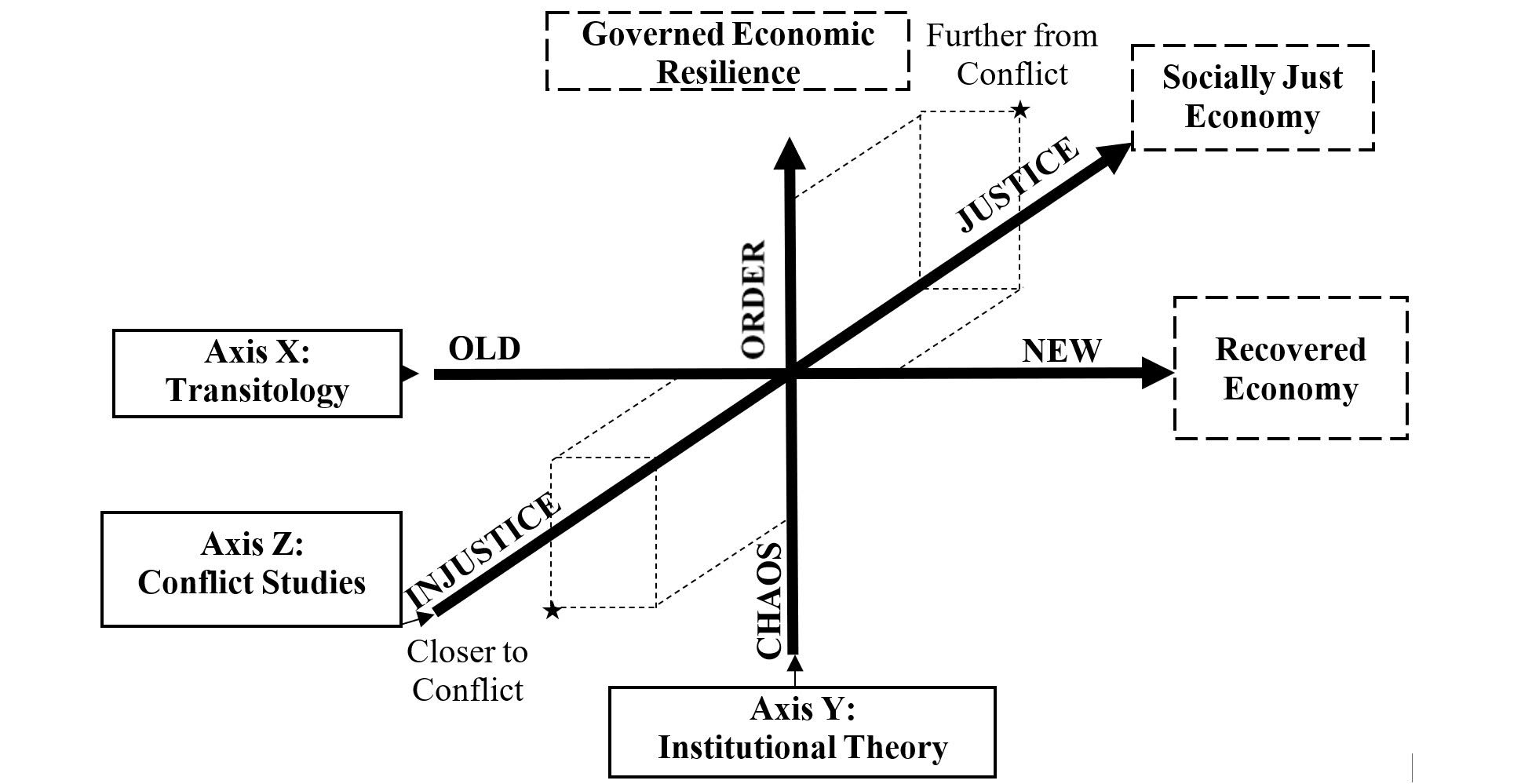
Отримано оновлену міждисциплінарну аналітичну рамку, в межах якої постконфліктне відновлення розглядається як багатовимірний процес трансформації, що розгортається у просторі фундаментальних суперечностей: порядок / хаос, старе / нове, справедливість / несправедливість. Це пов’язано з тим, що запропонована модель дозволяє інтегрувати економічні, інституційні та соціальні виміри, відмовившись від лінійної логіки реконструкції на користь гнучкого та контекстно чутливого підходу.
Завдяки цьому забезпечується можливість побудови стратегій відновлення, що відповідають локальним умовам, підвищують довіру, легітимність та включення, а також знижують ризики рецидиву конфлікту. У порівнянні з аналогічними відомими концепціями, це забезпечує такі переваги, як вища адаптивність, багатовимірність і практична релевантність у міжнародній економічній політиці в умовах постконфліктних трансформацій та складної соціальної спадщини воєн.
Посилання
- Holtzman, S., Elwan, A., Scott, C. (1998). Post Conflict Reconstruction. Washington: World Bank. https://doi.org/10.1596/0-8213-4215-0
- The IMF Strategy for Fragile and Conflict-Affected States (2022). Policy Papers. International Monetary Fund, 2022 (004), 59. https://doi.org/10.5089/9798400201820.007
- David, A., Bastos, F. R., Mills, M. (2011). Post-Conflict Recovery: Institutions, Aid, or Luck? IMF Working Papers, 11 (149), 1. https://doi.org/10.5089/9781455269471.001
- IATE: Interactive Terminology for Europe. European Union. Available at: https://iate.europa.eu/entry/slideshow/1737555771630/3506614/en-en- Last accessed: 22. 01. 2025
- Helping Prevent Violent Conflict (2001). The DAC guidelines. OECD Publishing. https://doi.org/10.1787/9789264194786-en
- DAC guidelines on conflict, peace and development cooperation (1997). OECD Publishing. Available at: https://reliefweb.int/attachments/dda26d61-8d7f-3475-b127-34ccb9e275db/7C9EF6DDE0533021C1256C2F00392CF3-oecd-guide-1997.pdf
- Post Conflict Economic Recovery: Enabling Local Ingenuity (2008). New York: Bureau for Crisis Prevention and Recovery, 238.
- Fischer, M.; Austin, A., Fischer, M., Ropers, N. (Eds.) (2004). Recovering from Violent Conflict: Regeneration and (Re-)Integration as Elements of Peacebuilding. Transforming Ethnopolitical Conflict, 373–402. https://doi.org/10.1007/978-3-663-05642-3_18
- Forman, S., Patrick, S., Salomons, D. (2000). Recovering from conflict: Strategy for an international response. Center on International Cooperation, New York University. Available at: https://web.archive.org/web/20031208014928/http://www.nyu.edu/pages/cic/pdf/Recovering%20From%20Conflict.pdf
- Tzifakis, N. (2010). Post-conflict economic reconstruction. Princeton Encyclopedia of Self-Determination Project. Princeton University. Available at: https://pesd.princeton.edu/node/586
- Hamre, J. J., Sullivan, G. R. (2002). Toward postconflict reconstruction. The Washington Quarterly, 25 (4), 83–96. https://doi.org/10.1162/016366002760252554
- Macrae, J. (1999). Aiding peace ... and war: UNHCR, returnee reintegration, and the relief–development debate. Working Paper No. 14. UNHCR, 37. Available at: https://www.unhcr.org/media/aiding-peace-and-war-unhcr-returnee-reintegration-and-relief-development-debate-joanna-macrae
- Coyne, C. J. (2005). The Institutional Prerequisites for Post-Conflict Reconstruction. The Review of Austrian Economics, 18 (3-4), 325–342. https://doi.org/10.1007/s11138-005-4016-9
- Coyne, C. (2007). Reconstruction and reconciliation: What's economics got to do with it? The Whitehead Journal of Diplomacy and International Relations, 8 (1), 69–84. Available at: https://ciaotest.cc.columbia.edu/olj/shjdir/v8n1/v8n1_06.pdf
- Addison, T. (2005). Post-conflict recovery: Does the global economy work for peace? WIDER Discussion Paper, No. 2005/05. Helsinki: The United Nations University World Institute for Development Economics Research. Available at: https://www.econstor.eu/bitstream/10419/53045/1/486961621.pdf
- Addison, T. (2003). Africa's Recovery from Conflict: Making Peace Work for the Poor. UNU-WIDER policy brief 03/2003, 6. Available at: https://ssrn.com/abstract=2524298
- del Castillo, G. (2008). Rebuilding War-Torn States: The Challenge of Post-Conflict Economic Reconstruction. Oxford University Press. https://doi.org/10.1093/acprof:oso/9780199237739.001.0001
- del Castillo, G. (2013). Rebuilding war-torn states: Is the UN system up to the challenges? FUNDS Briefing No. 8. Friedrich-Ebert-Stiftung & Center on International Cooperation. Available at: https://www.futureun.org/en/Publications-Surveys/Article?newsid=14
- Bhatia, M. (2005). Postconflict Profit: The Political Economy of Intervention. Global Governance: A Review of Multilateralism and International Organizations, 11 (2), 205–224. https://doi.org/10.1163/19426720-01102006
- Pugh, M. (2005). The Political Economy of Peace-Building: A Critical Theory Perspective. International Journal of Peace Studies, 10 (2), 23–42. Available at: https://www3.gmu.edu/programs/icar/ijps/vol10_2/wPugh10n2IJPS.pdf
- Biletskyi, O., Kolesnyk, T., Shymanovska-Dianych, L., Spitsyna, A., Shkoda, M., Krasnoshtan, O. (2024). Innovative management of integrated business structures in the financial mechanism of post-war recovery. Financial and Credit Activity: Problems of Theory and Practice, 6 (59), 293–310. https://doi.org/10.55643/fcaptp.6.59.2024.4663
- Hedegaard, M., Hrytsenko, L., Derkach, L. (2025). Foreign Direct Investment in Ukraine: A Pathway to Sustainability. Financial and Credit Activity Problems of Theory and Practice, 1 (60), 337–356. https://doi.org/10.55643/fcaptp.1.60.2025.4638
- Andriushchenko, K., Liezina, A., Vasylchak, S., Manylich, M., Shterma, T., Petrynyak, U. (2022). Management of the Development of the Innovative Potential of the Region. TEM Journal, 11 (1), 339–347. https://doi.org/10.18421/tem111-43
- Andriushchenko, K., Kovtun, V., Shergina, L., Rozhko, O., Yefimenko, L. (2020). Agro-based Clusters: A Tool for Effective Management of Regional Development in the ERA of Globalisation. TEM Journal, 9 (1), 198–204. https://doi.org/10.18421/tem91-28
- Buriachenko, A., Koczar, J., Biliavska, O., Levchenko, K., Kolomiiets, H. (2024). The impact of urbanization on socio-economic development: the experience of Poland, Spain and Ukraine. Naukovyi Visnyk Natsionalnoho Hirnychoho Universytetu, 6, 158–168. https://doi.org/10.33271/nvngu/2024-6/158
- Gilpin, R. (2001). Global Political Economy. Princeton: Princeton University Press. https://doi.org/10.1515/9781400831272
- Galtung, J., Jacobsen, C. G. (2000). Searching for peace: The road to transcend. London: Pluto Press.
- Galtung, J. (1998). After violence: 3R, reconstruction, reconciliation, resolution: Coping with visible and invisible effects of war and violence. Princeton: Transcend.
- Lederach, J. P. (1997). Building peace: Sustainable reconciliation in divided societies. Washington: United States Institute of Peace Press.
- Autesserre, S. (2014). Peaceland. Cambridge University Press. https://doi.org/10.1017/cbo9781107280366
- North, D. C. (1990). Institutions, Institutional Change and Economic Performance. Cambridge University Press. https://doi.org/10.1017/cbo9780511808678
- Collier, P., Elliott, V. L., Hegre, H., Hoeffler, A., Reynal-Querol, M., Sambanis, N. (2003). Breaking the conflict trap: Civil war and development policy. Washington: World Bank, Oxford University Press. https://doi.org/10.1596/0-8213-5481-7
- Collier, P. (2009). Wars, guns and votes: Democracy in dangerous places. Harper Perennial, 272.
- Ostrom, E. (1990). Governing the Commons. Cambridge University Press. https://doi.org/10.1017/cbo9780511807763
- Carothers, T. (1999). Aiding democracy abroad: The learning curve. Washington: Carnegie Endowment for International Peace.
- Carothers, T. (2002). The End of the Transition Paradigm. Journal of Democracy, 13 (1), 5–21. https://doi.org/10.1353/jod.2002.0003
- O'Donnell, G., Schmitter, P. C. (1986). Transitions from Authoritarian Rule: Tentative Conclusions about Uncertain Democracies. Baltimore: Johns Hopkins University Press.
- Whitehead, L. (2002). Democratization: Theory and Experience. Oxford University Press. https://doi.org/10.1093/0199253285.001.0001
- Lederach, J. P. (2005). The Moral Imagination: The Art and Soul of Building Peace. Oxford University Press. https://doi.org/10.1093/0195174542.001.0001
- Autesserre, S., Gbowee, L. (2021). The Frontlines of Peace. Oxford University Press. https://doi.org/10.1093/oso/9780197530351.001.0001
- North, D. C. (2005). Understanding the Process of Economic Change. Princeton: Princeton University Press. https://doi.org/10.1515/9781400829484
- Ostrom, E. (2005). Understanding Institutional Diversity. Princeton University Press. https://doi.org/10.1515/9781400831739
- O’Donnell, G. A. (1996). Illusions About Consolidation. Journal of Democracy, 7 (2), 34–51. https://doi.org/10.1353/jod.1996.0034
##submission.downloads##
Опубліковано
Як цитувати
Номер
Розділ
Ліцензія
Авторське право (c) 2025 Vitalii Gramotnev, Andrii Buriachenko, Tetiana Obolenska, Pavlo Logvinov

Ця робота ліцензується відповідно до Creative Commons Attribution 4.0 International License.
Закріплення та умови передачі авторських прав (ідентифікація авторства) здійснюється у Ліцензійному договорі. Зокрема, автори залишають за собою право на авторство свого рукопису та передають журналу право першої публікації цієї роботи на умовах ліцензії Creative Commons CC BY. При цьому вони мають право укладати самостійно додаткові угоди, що стосуються неексклюзивного поширення роботи у тому вигляді, в якому вона була опублікована цим журналом, але за умови збереження посилання на першу публікацію статті в цьому журналі.