Physical and chemical properties of iron(II) sulfate heptahydrate as factors for selecting the drying process mode in a fluidized bed apparatus
DOI:
https://doi.org/10.15587/2706-5448.2025.335323Keywords:
iron(II) sulfate heptahydrate, particle size distribution, free and crystallization moisture, impuritiesAbstract
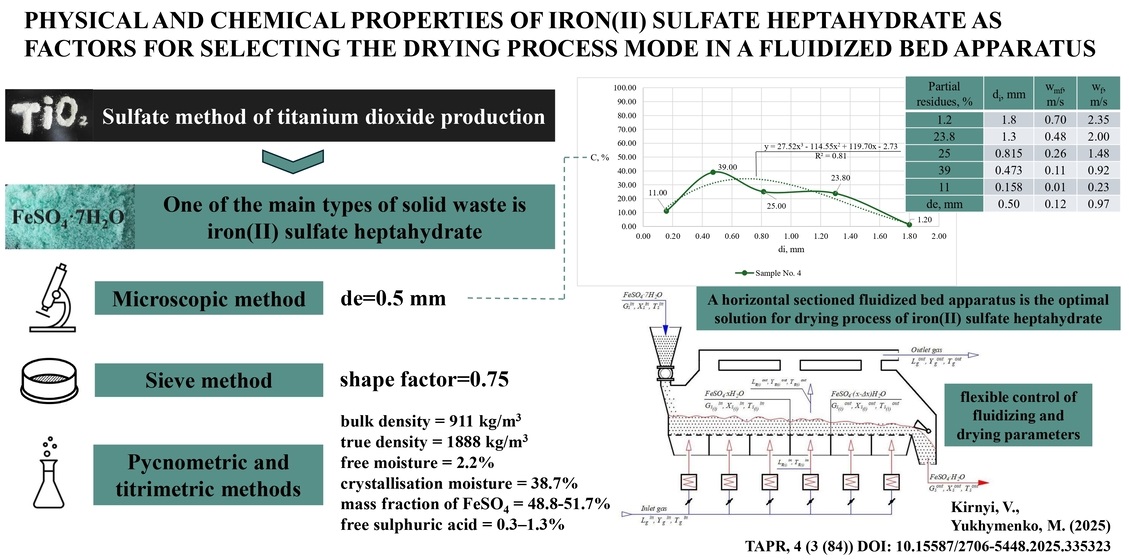
The object of the study is iron(II) sulfate heptahydrate – the main solid waste product of titanium dioxide sulfate production, the accumulation of which poses a significant environmental threat. The problematic stage of its processing is the technological stage of dehydration in a fluidized bed to a monohydrate form, for which it is important to select an acceptable hydrodynamic regime and drying regime.
Experimental studies included microscopic, sieve, pycnometric and titrimetric methods of analysis. The average equivalent particle diameter was found to be 0.50 mm, with a shape factor of 0.75. The bulk density of the material is 911 kg/m3, and the true density is 1888 kg/m3. The free moisture content was found to be 2.2%, and the crystallisation moisture content was 38.7%, which corresponds to the heptahydrate form of FeSO4 · 7H2O. Chemical analysis showed that the mass fraction of FeSO4 in the samples ranges from 48.8% to 51.7%, and the Fe2+ content is 18%. Free sulphuric acid is present in an amount of 0.3–1.3%.
Granulometric analysis revealed significant polydispersity of the material, in particular the presence of agglomerates and fine fractions in samples No. 1–3 of the closed storage composition of iron(II) sulfate heptahydrate. For sample No. 4, which was characterised by the most uniform particle distribution, the minimum fluidization velocity of the largest particle fraction (0.7 m/s) and the fluidization velocity (0.97 m/s) for the equivalent particle diameter of the material were calculated. It was found that particles with a diameter of less than 0.207 mm will be carried out of the boiling layer, which requires additional measures to reduce material losses. The heat transfer coefficient for particles of intermediate fractions (0.315–1.6 mm) is 77.79–349.17 W/(m2 · K), which ensures efficient heat exchange during the drying process.
Based on the data obtained, the choice of a horizontal sectioned fluidized bed apparatus is justified. The proposed design provides for the division of the process into independent zones with individual control and regulation of the drying agent parameters (temperature and flow rate). This makes it possible to obtain a stable hydrodynamic regime for polydisperse materials and reduce the influence of mixing on the driving force of the process.
The results obtained allow predicting the behaviour of the material in the fluidized bed apparatus and calculating the fluidization and drying regimes.
References
- Titanium dioxide market size – industry report on share, growth trends & forecasts analysis (2025–2030). Mordor Intelligence. Available at: https://www.mordorintelligence.com/industry-reports/titanium-dioxide-market
- Titanium Dioxide Market size to increase by USD 6899.93 million between 2022 to 2027, market Segmentation by Application and Geography – Technavio (2024). PR Newswire. Available at: https://www.prnewswire.com/news-releases/titanium-dioxide-market-size-to-increase-by-usd-6899-93-million-between-2022-to-2027--market-segmentation-by-application-and-geography--technavio-302089174.html
- Das, R., Ambardekar, V., Pratim Bandyopadhyay, P.; Ali, H. M. (Ed.) (2022). Titanium Dioxide and Its Applications in Mechanical, Electrical, Optical, and Biomedical Fields. Titanium Dioxide – Advances and Applications. IntechOpen. https://doi.org/10.5772/intechopen.98805
- Khaustov, V. (2023). Prospects for the development of titanium dioxide production in Ukraine. Scientific Bulletin of International Association of Scientists. Series: Economy, Management, Security, Technologies, 2 (4). https://doi.org/10.56197/2786-5827/2023-2-4-2
- Barsukova, H. V., Savchenko-Pererva, M. Y. (2021). Development of technology for obtaining a mixed coagulant from the main waste of titanium production. Journal of Chemistry and Technologies, 28 (3), 289–297. https://doi.org/10.15421/082031
- Gao, Y., Yue, T., Sun, W., He, D., Lu, C., Fu, X. (2021). Acid recovering and iron recycling from pickling waste acid by extraction and spray pyrolysis techniques. Journal of Cleaner Production, 312, 127747. https://doi.org/10.1016/j.jclepro.2021.127747
- Gázquez, M. J., Contreras, M., Pérez-Moreno, S. M., Guerrero, J. L., Casas-Ruiz, M., Bolívar, J. P. (2021). A Review of the Commercial Uses of Sulphate Minerals from the Titanium Dioxide Pigment Industry: The Case of Huelva (Spain). Minerals, 11 (6), 575. https://doi.org/10.3390/min11060575
- Mončeková, M., Novotný, R., Koplík, J., Kalina, L., Bílek, V., Šoukal, F. (2016). Hexavalent Chromium Reduction by Ferrous Sulphate Heptahydrate Addition into the Portland Clinker. Procedia Engineering, 151, 73–79. https://doi.org/10.1016/j.proeng.2016.07.382
- Green, D. W., Southard, M. Z. (Eds.) (2019). Perry’s chemical engineers’ handbook. McGraw-Hill Education. Available at: https://www.accessengineeringlibrary.com/content/book/9780071834087
- Shaikh, L., Pandit, A., Ranade, V. (2013). Crystallisation of ferrous sulphate heptahydrate: Experiments and modelling. The Canadian Journal of Chemical Engineering, 91 (1), 47–53. https://doi.org/10.1002/cjce.20695
- Gázquez, M. J., Bolívar, J. P., García-Tenorio, R., Vaca, F. (2009). Physicochemical characterization of raw materials and co-products from the titanium dioxide industry. Journal of Hazardous Materials, 166 (2-3), 1429–1440. https://doi.org/10.1016/j.jhazmat.2008.12.067
- Wang, T., Debelak, K. A., Roth, J. A. (2007). Dehydration of iron (II) sulfate heptahydrate. Thermochimica Acta, 462 (1-2), 89–93. https://doi.org/10.1016/j.tca.2007.07.001
- ISO 13322-1:2014 Particle size analysis – Image analysis methods – Part 1: Static image analysis methods (2014). International Organization for Standardization. Available at: https://cdn.standards.iteh.ai/samples/51257/e5956ce29c644e71ad37738bd690a3cf/ISO-13322-1-2014.pdf.
- ISO 9276-1:1998 Representation of results of particle size analysis – Part 1: Graphical representation (1998). International Organization for Standardization. Available at: https://cdn.standards.iteh.ai/samples/25860/7bdb509b70814f5ba4526488f14b7ba5/ISO-9276-1-1998.pdf
- Ulusoy, U. (2023). A Review of Particle Shape Effects on Material Properties for Various Engineering Applications: From Macro to Nanoscale. Minerals, 13 (1), 91. https://doi.org/10.3390/min13010091
- Atamaniuk, V. M., Humnytskyi, Ya. M. (2013). Naukovi osnovy filtratsiinoho sushinnia dyspersnykh materialiv. Lviv: Vydavnytstvo Lvivskoi politekhniky, 276.
- ISO 3923-1:2018 Metallic powders – Determination of apparent density – Part 1: Funnel method (2018). International Organization for Standardization. Available at: https://cdn.standards.iteh.ai/samples/69219/73e768c2dd64481eb5d96ff1c0e0a6a2/ISO-3923-1-2018.pdf
- ISO 567:2021 Coke – Determination of bulk density in a small container (2021). International Organization for Standardization. Available at: https://cdn.standards.iteh.ai/samples/78697/97576b6a78994ee0b1deca87b9a59dea/ISO-567-2021.pdf
- DSTU 2463-94 Kuporos zaliznyi tekhnichnyi. Tekhnichni umovy (HOST 6981-94) (1994). Derzhavnyi Standart Ukrainy. Available at: https://online.budstandart.com/ua/catalog/doc-page.html?id_doc=52579
- Srinivasan, T. G., Vasudeva Rao, P. R. (2014). Free acidity measurement – A review. Talanta, 118, 162–171. https://doi.org/10.1016/j.talanta.2013.10.017
- Davidson, J. F., Clift, R., Harrison, D. (Eds.) (1985). Fluidization. Academic Press, 733.
- Tsiura, N., Kindzera, D., Huzova, I., Atamanyuk, V. (2021). Study of the kinetics of drying iron (II) sulfate heptahydrate by filtration method. ScienceRise, 1, 11–21. https://doi.org/10.21303/2313-8416.2021.001583
- Yukhymenko, M., Artyukhov, A., Ostroha, R., Artyukhova, N., Krmela, J., Bocko, J. (2021). Multistage Shelf Devices with Fluidized Bed for Heat-Mass Transfer Processes: Experimental Studies and Practical Implementation. Applied Sciences, 11 (3), 1159. https://doi.org/10.3390/app11031159
- Bachmann, P., Bück, A., Tsotsas, E. (2017). Experimental investigation and correlation of the Bodenstein number in horizontal fluidized beds with internal baffles. Powder Technology, 308, 378–387. https://doi.org/10.1016/j.powtec.2016.11.025
- Yukhymenko, M., Ostroha, R., Lytvynenko, A., Mikhajlovskiy, Y., Bocko, J. (2020). Cooling Process Intensification for Granular Mineral Fertilizers in a Multistage Fluidized Bed Device. In: Ivanov, V., Pavlenko, I., Liaposhchenko, O., Machado, J., Edl, M. (eds) Advances in Design, Simulation and Manufacturing III. DSMIE 2020. Lecture Notes in Mechanical Engineering. Springer, Cham. https://doi.org/10.1007/978-3-030-50491-5_24
Downloads
Published
How to Cite
Issue
Section
License
Copyright (c) 2025 Viacheslav Kirnyi, Mykola Yukhymenko

This work is licensed under a Creative Commons Attribution 4.0 International License.
The consolidation and conditions for the transfer of copyright (identification of authorship) is carried out in the License Agreement. In particular, the authors reserve the right to the authorship of their manuscript and transfer the first publication of this work to the journal under the terms of the Creative Commons CC BY license. At the same time, they have the right to conclude on their own additional agreements concerning the non-exclusive distribution of the work in the form in which it was published by this journal, but provided that the link to the first publication of the article in this journal is preserved.





