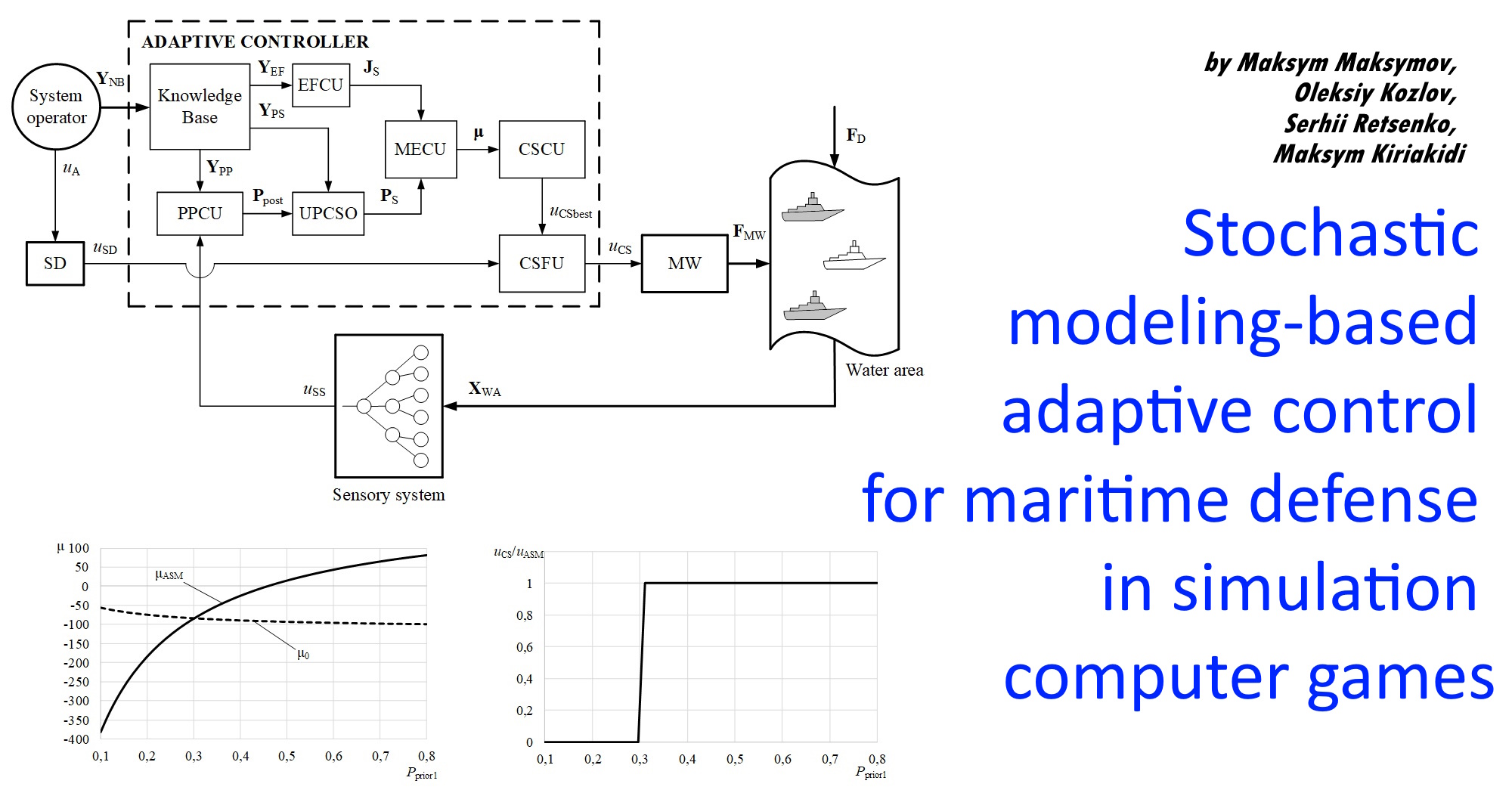
Stochastic modeling-based adaptive control for maritime defense in simulation computer games
DOI:
https://doi.org/10.15587/2706-5448.2025.335923Keywords:
simulation games, maritime defense, mine weapons, automatic control, stochastic modeling, mathematical expectationAbstract
The object of the study is the modeling process of virtual adversary behavior and automated control systems for mine weapons in game-based naval combat scenarios, taking into account uncertainty and incomplete information, particularly in conditions of partial or erroneous functioning of the sensor system. One of the most problematic aspects is ensuring effective decision-making in situations where the sensor system exhibits Type I and Type II errors or its feedback is completely absent due to malfunctions or damage.
The study employs stochastic modeling methods, mathematical expectation estimation for all possible combat scenarios, and adaptive control algorithms that consider the accuracy of the sensor system and the a priori probability of enemy presence.
An adaptive control method for anti-ship defense and a corresponding implementation system have been developed, which includes an adaptive controller capable of performing the core computations in real time to determine optimal control actions for mine weapon deployment.
The results of numerical experiments were obtained for various scenarios: with fixed parameters, variable minefield density, sensor system accuracy changes, and different a priori probabilities of ship appearances. These experiments enabled a comprehensive evaluation of the method's effectiveness. The conducted experiments confirm that the proposed method enables effective control of mine weapons in the presence of Type I and Type II errors with probabilities ranging from 0 to 0.9 during the detection of enemy and neutral ships.
As a result, the proposed solution provides the capability for adaptive control of combat operations even under high uncertainty, enhances the realism of virtual adversary behavior in simulation games, and lays the groundwork for the development of intelligent automatic control systems in naval combat scenarios.
References
- Cazenave, T., Saffidine, A., Sturtevant, N. (Eds.) (2019). Computer games. Communications in computer and information science. Springer International Publishing. https://doi.org/10.1007/978-3-030-24337-1
- Bach, M. P., Meško, M., Stjepić, A. M., Khawaja, S., Quershi, F. H. (2025). Understanding Determinants of Management Simulation Games Adoption in Higher Educational Institutions Using an Integrated Technology Acceptance Model/Technology-Organisation-Environment Model: Educator Perspective. Information, 16 (1), 45. https://doi.org/10.3390/info16010045
- Uludağlı, M. Ç., Oğuz, K. (2023). Non-player character decision-making in computer games. Artificial Intelligence Review, 56 (12), 14159–14191. https://doi.org/10.1007/s10462-023-10491-7
- van Haaften, M. A., Lefter, I., van Kooten, O., Brazier, F. M. T. (2024). The validity of simplifying gaming simulations. Computers in Human Behavior Reports, 14, 100384. https://doi.org/10.1016/j.chbr.2024.100384
- Schmuck, E., Flemming, R., Schrater, P., Cardoso-Leite, P. (2019). Principles underlying the design of a cognitive training game as a research framework. 2019 11th International Conference on Virtual Worlds and Games for Serious Applications (VS-Games). Vienna, 1–2. https://doi.org/10.1109/vs-games.2019.8864551
- Hohl, W. (2019). Game-Based Learning – Developing a Business Game for Interactive Architectural Visualization. 2019 11th International Conference on Virtual Worlds and Games for Serious Applications (VS-Games). Vienna, 1–4. https://doi.org/10.1109/vs-games.2019.8864595
- Rhee, H. K., Song, D. H., Kim, J. H. (2019). Comparative analysis of first person shooter games on game modes and weapons – military-themed, overwatch, and player unknowns’ battleground. Indonesian Journal of Electrical Engineering and Computer Science, 13 (1), 116–122. https://doi.org/10.11591/ijeecs.v13.i1.pp116-122
- Chen, H., Wang, L., Wang, X. (2023). A combat game model with inter-network confrontation and intra-network cooperation. Chaos: An Interdisciplinary Journal of Nonlinear Science, 33 (3). https://doi.org/10.1063/5.0137338
- Samčović, A. (2018). Serious games in military applications. Vojnotehnicki Glasnik, 66 (3), 597–613. https://doi.org/10.5937/vojtehg66-16367
- Mantello, P. (2017). Military Shooter Video Games and the Ontopolitics of Derivative Wars and Arms Culture. The American Journal of Economics and Sociology, 76 (2), 483–521. https://doi.org/10.1111/ajes.12184
- Bradbeer, N., Manley, D. (2024). Naval Wargaming as a Requirements Elucidation Tool for Warship Design Teams. International Marine Design Conference. https://doi.org/10.59490/imdc.2024.878
- Maksymov, M. V., Boltenkov, V. O., Gultsov, P. S., Maksymov, O. M. (2023). Verification of artillery fire under the influence of random disturbances for the computer game ARMA 3. Applied Aspects of Information Technology, 6 (4), 362–375. https://doi.org/10.15276/aait.06.2023.24
- Ampatzoglou, A., Stamelos, I. (2010). Software engineering research for computer games: A systematic review. Information and Software Technology, 52 (9), 888–901. https://doi.org/10.1016/j.infsof.2010.05.004
- Wang, W. (2023). The Structure of Game Design. International Series on Computer, Entertainment and Media Technology. Springer International Publishing. https://doi.org/10.1007/978-3-031-32202-0
- Lukosch, H. K., Bekebrede, G., Kurapati, S., Lukosch, S. G. (2018). A Scientific Foundation of Simulation Games for the Analysis and Design of Complex Systems. Simulation & Gaming, 49 (3), 279–314. https://doi.org/10.1177/1046878118768858
- Maksymova, O. B., Boltenkov, V. O., Maksymov, M. V., Gultsov, P. S., Maksymov, O. M. (2023). Development and optimization of simulation models and methods for controlling virtual artillery units in game scenarios. Herald of Advanced Information Technology, 6 (4), 320–337. https://doi.org/10.15276/hait.06.2023.21
- Grishyn, M., Maksymova, O., Kirkopulo, K., Klymchuk, O. (2025). Development of methods of artillery control for suppression of an enemy amphibious operation in video game simulations. Technology Audit and Production Reserves, 1 (2 (81)), 26–33. https://doi.org/10.15587/2706-5448.2025.321797
- Toshev, O., Kirkopulo, K., Klymchuk, O., Maksymov, M. (2025). Optimization of ammunition preparation strategies for modern artillery operations in computer simulation. Technology Audit and Production Reserves, 2 (2 (82)), 50–57. LOCKSS. https://doi.org/10.15587/2706-5448.2025.326225
- Sakai, K., Hohzaki, R., Fukuda, E., Sakuma, Y. (2018). Risk evaluation and games in mine warfare considering shipcounter effects. European Journal of Operational Research, 268 (1), 300–313. https://doi.org/10.1016/j.ejor.2018.01.030
- Jung, S.-K., Roh, M.-I., Kim, K.-S. (2018). Arrangement method of a naval surface ship considering stability, operability, and survivability. Ocean Engineering, 152, 316–333. https://doi.org/10.1016/j.oceaneng.2018.01.058
- Chang, W., Choung, J. (2024). Sensitivity analysis of damage extent in naval ship compartments due to internal airborne explosions. International Journal of Naval Architecture and Ocean Engineering, 16, 100622. https://doi.org/10.1016/j.ijnaoe.2024.100622
- Maksimov, M., Kozlov, O., Retsenko, S., Kryvda, V. (2025). Design of Fault-tolerant Structures for Underwater Sensor Networks based on Markov Chains. Journal of Automation, Mobile Robotics and Intelligent Systems, 19 (1), 49–64. https://doi.org/10.14313/jamris-2025-006
- Li, J., Chu, X., He, W., Ma, F., Malekian, R., Li, Z. (2019). A Generalised Bayesian Inference Method for Maritime Surveillance Using Historical Data. Symmetry, 11 (2), 188. https://doi.org/10.3390/sym11020188
- Gaglione, D., Soldi, G., Meyer, F., Hlawatsch, F., Braca, P., Farina, A., Win, M. Z. (2020). Bayesian information fusion and multitarget tracking for maritime situational awareness. IET Radar, Sonar & Navigation, 14 (12), 1845–1857. https://doi.org/10.1049/iet-rsn.2019.0508
- Korendovych, V., Kiriakidi, M., Vdovitskyi, Y. (2021). Practical aspects of evaluation of efficiency of anti-ship cruise missiles against surface targets. Scientific Works of Kharkiv National Air Force University, 3 (69), 64–75. https://doi.org/10.30748/zhups.2021.69.08.
- Boström, P., Heikkilä, M., Huova, M., Waldén, M., Linjama, M.; Campos, J., Haverkort, B. (Eds.) (2015). Bayesian Statistical Analysis for Performance Evaluation in Real-Time Control Systems. Quantitative Evaluation of Systems. Cham: Springer, 312–328. https://doi.org/10.1007/978-3-319-22264-6_20
- Leitner, S., Wall, F. (2015). Simulation-based research in management accounting and control: an illustrative overview. Journal of Management Control, 26 (2-3), 105–129. https://doi.org/10.1007/s00187-015-0209-y
- Millington, I., Funge, J. (2018). Artificial Intelligence for Games. CRC Press. https://doi.org/10.1201/9781315375229
- Kondratenko, Y., Shevchenko, A., Zhukov, Y., Kondratenko, G., Striuk, O. (2023). Tendencies and Challenges of Artificial Intelligence Development and Implementation. 2023 IEEE 12th International Conference on Intelligent Data Acquisition and Advanced Computing Systems: Technology and Applications (IDAACS), 221–226. https://doi.org/10.1109/idaacs58523.2023.10348800
- Kutyło, M., Pluciński, M., Laskowska, M. (2015). Application of the reinforcement learning for selecting fuzzy rules representing the behavior policy of units in RTS-type games. Przegląd Elektrotechniczny, 1 (2), 144–148. https://doi.org/10.15199/48.2015.02.33
- Volna, E. (2017). Fuzzy-based decision strategy in real-time strategic games. Proceedings of the International Conference of Computational Methods in Sciences and Engineering 2017 (ICCMSE-2017), AIP Conference Proceedings, 1906, 080002. https://doi.org/10.1063/1.5012346
- Congxiang, L., Kozlov, O., Kondratenko, G., Aleksieieva, A.; Kondratenko, Y. P., Shevchenko, A. I. (Eds.) (2024). Decision Support System for Maintenance Planning of Vortex Electrostatic Precipitators Based on IoT and AI Techniques. Research Tendencies and Prospect Domains for AI Development and Implementation. New York: River Publishers, 87–105. https://doi.org/10.1201/9788770046947-5
- Werners, B., Kondratenko, Y. (2017). Alternative Fuzzy Approaches for Efficiently Solving the Capacitated Vehicle Routing Problem in Conditions of Uncertain Demands. Complex Systems: Solutions and Challenges in Economics, Management and Engineering. Cham: Springer, 521–543. https://doi.org/10.1007/978-3-319-69989-9_31
- Kozlov, O., Kondratenko, G., Aleksieieva, A., Maksymov, M., Tarakhtij, O. et al. (2024). Swarm optimization of the drone’s intelligent control system: comparative analysis of hybrid techniques. CEUR Workshop Proceedings, 3790, 1–12. Available at: https://ceur-ws.org/Vol-3790/paper01.pdf
- Kondratenko, Y. P., Kozlov, O. V., Zheng, Y., Wang, J., Kuzmenko, V., Aleksieieva, A. (2024). Bio-inspired optimization of fuzzy control system for inspection robotic platform: comparative analysis of hybrid swarm methods. CEUR Workshop Proceedings, 3711, 109–123. Available at: https://ceur-ws.org/Vol-3711/paper7.pdf
- Maksymov, M., Kozlov, O., Shynder, A., Maksymova, O., Aleksieieva, A. (2025). Development of mathematical models for temperature control objects in thermal destruction systems based on transient process identification. EUREKA: Physics and Engineering, 3, 207–220. https://doi.org/10.21303/2461-4262.2025.003802
Downloads
Published
How to Cite
Issue
Section
License
Copyright (c) 2025 Maksym Maksymov, Oleksiy Kozlov, Serhii Retsenko, Maksym Kiriakidi

This work is licensed under a Creative Commons Attribution 4.0 International License.
The consolidation and conditions for the transfer of copyright (identification of authorship) is carried out in the License Agreement. In particular, the authors reserve the right to the authorship of their manuscript and transfer the first publication of this work to the journal under the terms of the Creative Commons CC BY license. At the same time, they have the right to conclude on their own additional agreements concerning the non-exclusive distribution of the work in the form in which it was published by this journal, but provided that the link to the first publication of the article in this journal is preserved.