Increasing the role of military logistics in the context of growing geopolitical instability based on strategic management
DOI:
https://doi.org/10.15587/2706-5448.2025.336198Keywords:
military logistics, efficiency, National combat capability, geopolitical instability, strategic management, innovation, digitalizationAbstract
The object of research is the process of strategic management of military logistics to ensure national combat capability in the face of growing geopolitical instability.
The study presents provisions on the global role of military logistics – it is the basis of any defense operation, because it includes planning and organizing the movement and maintenance of military forces.
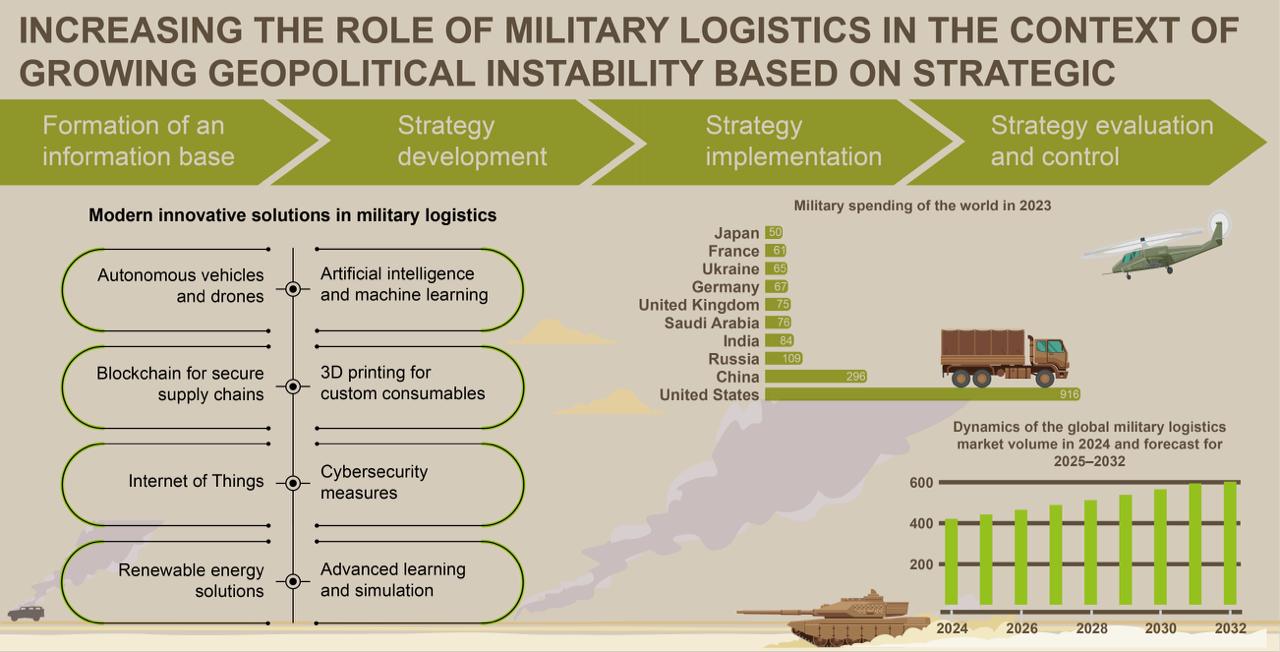
The key driving forces of military logistics are revealed: growing geopolitical instability, technological progress in the defense sector, which contributes to new profitable opportunities, opportunities for using the Logistics 4.0 concept. The volume of the global military logistics market in 2024 is analyzed, which is estimated at 419.46 billion USD and the forecast for 2025–2032, according to which it will reach 600.91 billion USD.
It is revealed that the development of military logistics is hindered by budget constraints and poorly developed infrastructure, which are key challenges.
The content of the concept of “strategic management of military logistics” as a process of planning and coordinating resources, personnel and materials necessary for conducting military operations at all levels, aimed at achieving long-term goals, is substantiated.
A methodological approach has been developed regarding the model of strategic management of military logistics as a complex structure adapted to the specific needs of military operations, integrating logistics processes with the overall strategy and tactics of military operations. It includes four main components (information base formation, strategy development, implementation and evaluation and control) and defines key strategic directions for the development of military logistics.
It is revealed that the development of military logistics is hindered by budget constraints and poorly developed infrastructure, which are key challenges. Modern innovative solutions in military logistics are identified: autonomous vehicles and drones, artificial intelligence (AI) and machine learning, blockchain for secure supply chains, 3D, Internet of Things (IoT), renewable energy solutions, advanced training and simulation. The results of the study are to justify the need to use the achievements of military logistics to ensure and maintain the combat capability of the country with the lowest possible total costs in the context of the growing threat of military conflicts.
References
- Military Logistics Market Size By Type (Logistics & Distribution, Facility Management, Services), By Mode of Transportation (Roadways, Railways, Waterways, Airways), By Geographic Scope And Forecast (2025). Verified Market Research, 202. Available at: https://www.verifiedmarketresearch.com/product/military-logistics-market/
- Alexa, A., Schorn, C. (2021). Zur Theorie der Militärlogistik. Österreichische Militärische Zeitschrift, 59 (1), 42–49. Available at: https://ideas.repec.org/a/zbw/espost/231381.html
- Alexa, A. (2023). 6 bestimmende Faktoren der Militärlogistik. Truppen Dienst. Available at: https://www.truppendienst.com/themen/beitraege/artikel/6-bestimmende-faktoren-der-militaerlogistik
- van Fenema, P. C., van Kampen, T.; Sookermany, A. M. (Eds.) (2021). Foundational Concepts of Military Logistics. Handbook of Military Sciences. Cham: Springer, 1–25. https://doi.org/10.1007/978-3-030-02866-4_71-1
- Alexa, A. (2021). Militärlogistik 4.0. Schriftenreihe der Landesverteidigungsakadmie 6/2021. Wien: Eigenverlag Bundesministerium für Landesverteidigung. Available at: https://www.bundesheer.at/wissen-forschung/publikationen/publikation.php?id=1079
- Nikonenko, U., Shtets, T., Kalinin, A., Dorosh, I., Sokolik, L. (2022). Assessing the Policy of Attracting Investments in the Main Sectors of the Economy in the Context of Introducing Aspects of Industry 4.0. International Journal of Sustainable Development and Planning, 17 (2), 497–505. https://doi.org/10.18280/ijsdp.170214
- NATO’s role in logistics (2025). NATO. Available at: https://www.nato.int/cps/en/natohq/topics_61741.htm
- Prebilič, V. (2006). Theoretical aspects of military logistics. Defense & Security Analysis, 22 (2), 159–177. https://doi.org/10.1080/14751790600764037
- Hellmuth-Sander, T. A. (2024). Securing the future: strategic approaches to military logistics and supply chain resilience. LinkedIn. Available at: https://www.linkedin.com/pulse/securing-future-strategic-approaches-military-supply-hellmuth-sander-w37pf/
- Antai, I., Hellberg, R., Skoglund, P. (2023). Logistics growth in the armed forces: development of a theoretical framework and research propositions. Defence Studies, 24 (1), 84–106. https://doi.org/10.1080/14702436.2023.2249441
- Alkema, V., Melenchuk, V. (2022). Logistics ensuring the performance of security and defense tasks in conditions of hybrid warfare. Economics, Finance and Management Review, 3, 71–81. https://doi.org/10.36690/2674-5208-2022-3-71
- Alekseieva, K. (2023). State Business Support Programs in Wartime Conditions. Economic Affairs, 68 (1s). https://doi.org/10.46852/0424-2513.1s.2023.26
- Paparone, C. R., Topic, G. L. (2016). Three fundamental ideas that are the essence of military logistics. U.S. Army. Available at: https://www.army.mil/article/166061/three_fundamental_ideas_that_are_the_essence_of_military_logistics
- Bereitschaft revolutionieren – Neueste Innovationen in der Militärlogistik (2024). Logistik und Transport. Market Research intellect. Available at: https://www.marketresearchintellect.com/de/blog/revolutionizing-readiness-latest-innovations-in-military-logistics/
- Ti, R., Kinsey, C. (2023). Lessons from the Russo-Ukrainian conflict: the primacy of logistics over strategy. Defence Studies, 23 (3), 381–398. https://doi.org/10.1080/14702436.2023.2238613
- Dalsjö, R., Jonsson, M., Norberg, J. (2022). A Brutal Examination: Russian Military Capability in Light of the Ukraine War. Survival, 64 (3), 7–28. https://doi.org/10.1080/00396338.2022.2078044
- Military Logistics Market Research Report Information By Type (Logistics & Distribution, Facility Management, and Services), By Mode of Transportation (Roadways, Railways, Waterways, and Airways), and By Region (North America, Europe, Asia-Pacific, And Rest Of The World) – Market Forecast Till 2030. Market Research Future, 168. Available at: https://www.marketresearchfuture.com/reports/military-logistics-market-8514
- Countries with the highest military spending worldwide in 2023 (in billion U.S. dollars). Statista. Available at: https://www.statista.com/statistics/262742/countries-with-the-highest-military-spending/
- Logistik 4.0: Definition, Ziele, Herausforderungen. IPH. Available at: https://www.iph-hannover.de/de/dienstleistungen/digitalisierung/logistik-4.0/
- Hong Tan, W. (2024). Strategic Management Model. LinkedIn. Available at: https://www.linkedin.com/pulse/strategic-management-model-wei-hong-tan-bu8oc/
Downloads
Published
How to Cite
Issue
Section
License
Copyright (c) 2025 Lіubov Karbovska, Iryna Kalina, Serhii Voroshnov, Yuliia Mazur, Kateryna Zhelezniak, Alla Kozlova

This work is licensed under a Creative Commons Attribution 4.0 International License.
The consolidation and conditions for the transfer of copyright (identification of authorship) is carried out in the License Agreement. In particular, the authors reserve the right to the authorship of their manuscript and transfer the first publication of this work to the journal under the terms of the Creative Commons CC BY license. At the same time, they have the right to conclude on their own additional agreements concerning the non-exclusive distribution of the work in the form in which it was published by this journal, but provided that the link to the first publication of the article in this journal is preserved.





