Development of an approach to forming a model of balanced development of food security under conditions of technological load
DOI:
https://doi.org/10.15587/2706-5448.2025.336241Keywords:
agricultural land, Environmental Technogenic Oppression (ETO) index, TEDR, sustainability levelAbstract
The object of this study is a model of balanced agricultural development to ensure food security in conditions of technogenic stress. This issue is relevant for many countries, which is increasing its food exports to the world market while actively developing industrial production. Technogenic pressure on agricultural land not only negatively affects production volumes, but also product quality, environmental purity and consumer safety.
The proposed approach to forming a model of balanced food security development in conditions of technogenic load allows facilitates the use of strategic components of industrial and agricultural production, thereby enabling the achievement of an optimal balance of development. In this work, the optimal balance is defined as a balance in which the level of influence of new technologies is simultaneously increasing. This approach will also allow for the adjustment of the growth of technological influence on food security. Consequently, the proposed approach will enhance the impact of anthropogenic load on agricultural land and reduce anthropogenic pollution of agricultural land.
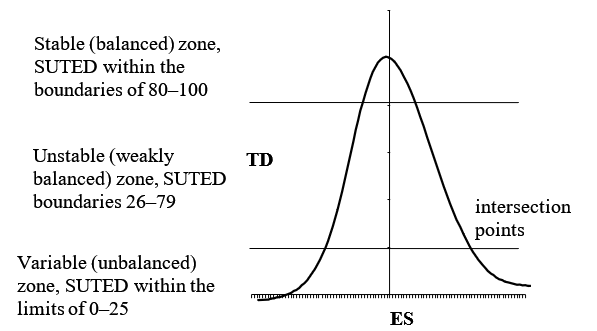
As a result of the work, a model of balanced food security development was created for three regions of Kazakhstan – Akmola, Kostanay and North Kazakhstan. To this end, aggregated large-scale coefficients for wheat grain and livestock meat were introduced into the Technological Development model. These products are essential for ensuring food security within the boundaries of the regions under study and for Kazakhstan as a whole. According to the criteria studied, the indicators for the Kostanay and North Kazakhstan regions are approximately the same, at 78.1 and 78.3, respectively. This allows for the large-scale cultivation of agricultural products that are safe for human consumption. For the Akmola region, the indicator is 24.7. This indicator is not critical, but it highlights the need to change production technologies both in agriculture in this region and in industrial production.
The proposed approach can be used to analyse the balanced development of regions with the aim of intensifying food production.
References
- Mondal, P., DeFries, R., Clark, J., Flowerhill, N., Arif, Md., Harou, A. et al. (2021). Multiple cropping alone does not improve year-round food security among smallholders in rural India. Environmental Research Letters, 16 (6), 065017. https://doi.org/10.1088/1748-9326/ac05ee
- Kent, K., Brooks, C., Attuquayefio, T., Ewald, A., Morrison, N., Alhassani, G. et al. (2025). Participation in a community-based food cooperative impacts self-reported food security status and dietary intake in Australian adults. Appetite, 212, 108030. https://doi.org/10.1016/j.appet.2025.108030
- Sultan, Md. T., Mahmud, U., Khan, Md. Z. (2023). Addressing soil salinity for sustainable agriculture and food security: Innovations and challenges in coastal regions of Bangladesh. Future Foods, 8, 100260. https://doi.org/10.1016/j.fufo.2023.100260
- Westerveld, J. J. L., van den Homberg, M. J. C., Nobre, G. G., van den Berg, D. L. J., Teklesadik, A. D., Stuit, S. M. (2021). Forecasting transitions in the state of food security with machine learning using transferable features. Science of The Total Environment, 786, 147366. https://doi.org/10.1016/j.scitotenv.2021.147366
- Aigarinova, G. T., Akshatayeva, Z., Alimzhanova, M. G. (2014). Ensuring Food Security of the Republic of Kazakhstan as a Fundamental of Modern Agricultural Policy. Procedia – Social and Behavioral Sciences, 143, 884–891. https://doi.org/10.1016/j.sbspro.2014.07.511
- Lazzat, Y., Aigerim, O., Daniya, N. (2014). The Ecological and Legal Aspects of Ensuring the Food Security of the Republic of Kazakhstan Under the Transition to a “Green” Economy. Procedia – Social and Behavioral Sciences, 143, 971–975. https://doi.org/10.1016/j.sbspro.2014.07.536
- Malyarenko, O., Kushebina, G. (2022). Sustainable development of the agro-industrial complex of Kazakhstan as the basis of the country’s food security. Agrarian Bulletin of The, 216 (1), 86–91. https://doi.org/10.32417/1997-4868-2022-216-01-86-91
- Yessymkhanova, Z., Niyazbekova, S., Tochieva, L., Goigova, M., Varsin, V., Varaksa, N. et al. (2021). Livestock products of households in ensuring food security in Kazakhstan. E3S Web of Conferences, 284, 02020. https://doi.org/10.1051/e3sconf/202128402020
- Varieties and Technologies. University of Agricultural Sciences Bangalore. Available at: https://www.uasbangalore.edu.in/en/varieties-and-technologies/
- Duisenbekuly, A., Kulbay, B., Bigeldiyeva, Z., Zhakipbekova, D., Daurbayeva, M. (2024). Food security in Kazakhstan and Azerbaijan: Challenges and strategies for economic and sustainable development. International Journal on Food System Dynamics, 15 (3), 267–277. https://doi.org/10.18461/ijfsd.v15i3.k5
- Eicher-Miller, H. A., Wright, B. N., Tooze, J. A., Craig, B. A., Liu, Y., Bailey, R. L. et al. (2022). Evaluating a Food Pantry-Based Intervention to Improve Food Security, Dietary Intake, and Quality in Midwestern Food Pantries. Journal of the Academy of Nutrition and Dietetics, 122 (11), 2060–2071. https://doi.org/10.1016/j.jand.2022.02.016
- Burke, M., Cabili, C., Berman, D., Forrestal, S., Gleason, P. (2021). A Randomized Controlled Trial of Three School Meals and Weekend Food Backpacks on Food Security in Virginia. Journal of the Academy of Nutrition and Dietetics, 121 (1), 34–45. https://doi.org/10.1016/j.jand.2020.10.026
- Toiba, H., Rahman, M. S., Nugroho, T. W., Priyanto, M. W., Noor, A. Y. M., Shaleh, M. I. (2024). Understanding the link between climate change adaptation and household food security among shrimp farmers in Indonesia. Marine Policy, 165, 106206. https://doi.org/10.1016/j.marpol.2024.106206
- Ofoedu, C. E., Bozkurt, H., Mortimer, J. C. (2025). Towards sustainable food security: Exploring the potential of duckweed (Lemnaceae) in diversifying food systems. Trends in Food Science & Technology, 161, 105073. https://doi.org/10.1016/j.tifs.2025.105073
- Nchanji, E. B., Chagomoka, T., Bellwood-Howard, I., Drescher, A., Schareika, N., Schlesinger, J. (2023). Land tenure, food security, gender and urbanization in Northern Ghana. Land Use Policy, 132, 106834. https://doi.org/10.1016/j.landusepol.2023.106834
- Alhelou, H. H., Amani, A. M., Sajjadi, S. S., Jalili, M. (2022). Electric Transportation Systems in Smart Power Grids. CRC Press. https://doi.org/10.1201/9781003293989
- Bureau of National statistics. Agency for Strategic planning and reforms of the Republic of Kazakhstan. Available at: https://stat.gov.kz/
- Hull, R. N., Barbu, C.-H., Goncharova, N. (Eds.) (2007). Strategies to enhance environmental security in transition countries. NATO Science for Peace and Security Series C: Environmental Security. Netherlands: Springer, 429. https://doi.org/10.1007/978-1-4020-5996-4
- The Sustainable Development Goals Report 2023: Special Edition (2023). The Sustainable Development Goals Report, 80. https://doi.org/10.18356/9789210024914
Downloads
Published
How to Cite
Issue
Section
License
Copyright (c) 2025 Zhanar Amangeldiyeva, Raissa Baizholova, Danagul Tleuzhanova, Gulzhan Mukasheva, Dauren Sarzhanov, Talgat Zhakupov

This work is licensed under a Creative Commons Attribution 4.0 International License.
The consolidation and conditions for the transfer of copyright (identification of authorship) is carried out in the License Agreement. In particular, the authors reserve the right to the authorship of their manuscript and transfer the first publication of this work to the journal under the terms of the Creative Commons CC BY license. At the same time, they have the right to conclude on their own additional agreements concerning the non-exclusive distribution of the work in the form in which it was published by this journal, but provided that the link to the first publication of the article in this journal is preserved.





