Evaluation of physico-chemical properties and bioactivity of derivatives of black chokeberry products obtained during osmotic dehydration
DOI:
https://doi.org/10.15587/2706-5448.2025.337008Keywords:
black chokeberry, osmotic dehydration, syrup, powder, derivatives, biologically active substances, antioxidant propertiesAbstract
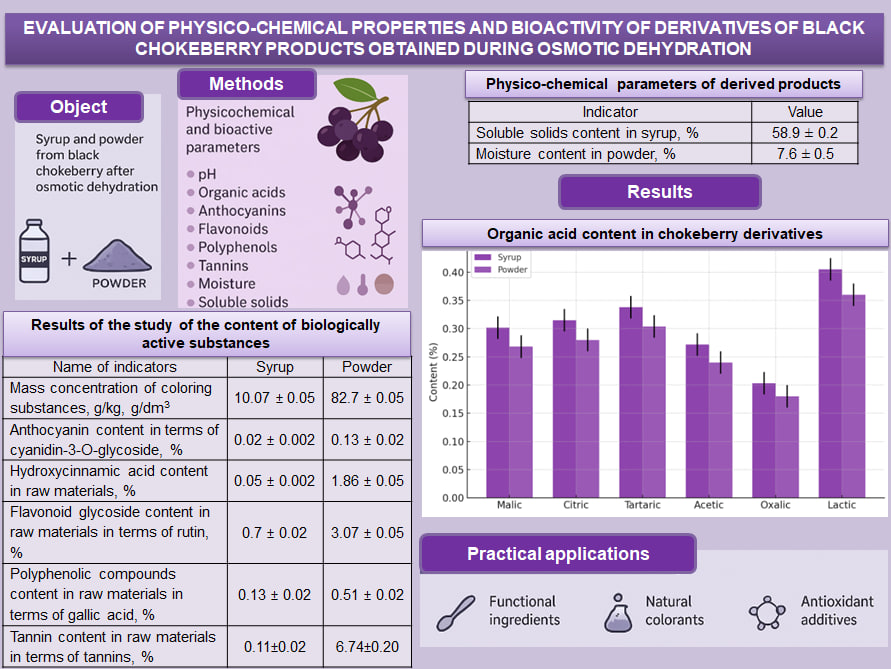
The object of the study was black chokeberry derivatives, namely syrup and powder obtained by osmotic dehydration. The problem solved in the study is the lack of a comprehensive definition of the physicochemical properties and bioactivity of Aronia melanocarpa derivatives obtained by osmotic dehydration. The described problem limits the effective use of black chokeberry syrup and powder in the production of food products with increased biological value. During the study, an assessment of the complex of physicochemical characteristics (acidity, moisture, dry matter content) of black chokeberry derivatives obtained by osmotic dehydration was carried out. The content of bioactive compounds, such as anthocyanins, flavonoids, polyphenolic and hydroxycinnamic acids, was studied. As a result of the studies, it was found that they contain a high level of anthocyanins, flavonoids, polyphenolic compounds and tannins. The moisture content of the raw material was 7.6 ± 0.5%, and soluble solids – 58.9 ± 0.2%. In addition, a significant concentration of coloring substances (10.07 ± 0.05 g/dm3 in syrup and 82.7 ± 0.05 g/kg in powder) and bioactive components was found, which determines the high antioxidant activity of the product. The results obtained are explained by the high natural bioactivity of black chokeberry in combination with the use of the osmotic dehydration process for its processing. The results obtained during the study allowed us to assess the potential of using osmotic dehydration for black chokeberry processing. In practice, the results of the study can be used to develop new technologies for processing and storing black chokeberry-based products, in particular for the production of natural dyes and additives to functional foods or beverages. Such additives can be used in the food industry to create products with increased antioxidant properties, as well as to improve taste and preserve the beneficial properties of the product during storage.
Supporting Agency
- The research was conducted within the framework of scientific and technical work 0124U002836 “Development of technologies for the production of food products with added value based on the principles of sustainable development” at the expense of the executors.
References
- Bataraga, A., Valkovska, V. (2020). Phytochemical Profile of Chokeberry (Aronia melanocarpa). Key Engineering Materials, 850, 184–189. https://doi.org/10.4028/www.scientific.net/kem.850.184
- Sidor, A., Gramza-Michałowska, A. (2019). Black Chokeberry Aronia Melanocarpa L. – A Qualitative Composition, Phenolic Profile and Antioxidant Potential. Molecules, 24 (20), 3710. https://doi.org/10.3390/molecules24203710
- Denev, P., Kratchanova, M., Petrova, I., Klisurova, D., Georgiev, Y., Ognyanov, M., Yanakieva, I. (2018). Black Chokeberry (Aronia melanocarpa(Michx.) Elliot) Fruits and Functional Drinks Differ Significantly in Their Chemical Composition and Antioxidant Activity. Journal of Chemistry, 2018, 1–11. https://doi.org/10.1155/2018/9574587
- Yilmaz, A. (2021). Miracle Plant: Black Chokeberry (Aronia melanocarpa). MAS Journal of Applied Sciences, 6 (6). https://doi.org/10.52520/masjaps.20
- Platonova, E. Y., Shaposhnikov, M. V., Lee, H.-Y., Lee, J.-H., Min, K.-J., Moskalev, A. (2021). Black chokeberry (Aronia melanocarpa) extracts in terms of geroprotector criteria. Trends in Food Science & Technology, 114, 570–584. https://doi.org/10.1016/j.tifs.2021.06.020
- Cvetanović, A., Zengin, G., Zeković, Z., Švarc-Gajić, J., Ražić, S., Damjanović, A. et al. (2018). Comparative in vitro studies of the biological potential and chemical composition of stems, leaves and berries Aronia melanocarpa’s extracts obtained by subcritical water extraction. Food and Chemical Toxicology, 121, 458–466. https://doi.org/10.1016/j.fct.2018.09.045
- King, E. S., Bolling, B. W. (2020). Composition, polyphenol bioavailability, and health benefits of aronia berry: a review. Journal of Food Bioactives, 11, 13–30. https://doi.org/10.31665/jfb.2020.11235
- Huang, R., Xu, C. (2023). Sensory Property and Phenolic Profile of Aronia Juice. Natural Products in Beverages. Springer International Publishing, 1–37. https://doi.org/10.1007/978-3-031-04195-2_73-1
- Lidikova, J., Čeryová, N., Musilová, J., Vollmannová, A., Tóth, T., Grygorieva, O., Brindza, J. (2025). Antioxidant Activity, Polyphenol, And Anthocyanin Content Of Black Chokeberry (Aronia Melanocarpa L.). Journal of microbiology, biotechnology and food sciences, e11620. https://doi.org/10.55251/jmbfs.11620
- Bontsidis, C., Mantzourani, I., Terpou, A., Mallouchos, A., Alexopoulos, A., Plessas, S. (2024). Functional beverage production through lactic acid fermentation of black chokeberry (Aronia melanocarpa) juice. Biocatalysis and Agricultural Biotechnology, 58, 103168. https://doi.org/10.1016/j.bcab.2024.103168
- Nour, V. (2022). Quality Characteristics, Anthocyanin Stability and Antioxidant Activity of Apple (Malus domestica) and Black Chokeberry (Aronia melanocarpa) Juice Blends. Plants, 11 (15), 2027. https://doi.org/10.3390/plants11152027
- Nemetz, N. J., Schieber, A., Weber, F. (2021). Application of Crude Pomace Powder of Chokeberry, Bilberry, and Elderberry as a Coloring Foodstuff. Molecules, 26 (9), 2689. https://doi.org/10.3390/molecules26092689
- Zbikowska, A., Lukasiak, P., Kowalska, M., Lukasiak, A., Kozłowska, M., Marciniak-Lukasiak, K. (2024). Incorporation of Chokeberry Pomace into Baked Products: Influence on the Quality of the Dough and the Muffins. Applied Sciences, 14 (21), 9675. https://doi.org/10.3390/app14219675
- Jurendić, T., Ščetar, M. (2021). Aronia melanocarpa Products and By-Products for Health and Nutrition: A Review. Antioxidants, 10 (7), 1052. https://doi.org/10.3390/antiox10071052
- Denev, P., Číž, M., Kratchanova, M., Blazheva, D. (2019). Black chokeberry (Aronia melanocarpa) polyphenols reveal different antioxidant, antimicrobial and neutrophil-modulating activities. Food Chemistry, 284, 108–117. https://doi.org/10.1016/j.foodchem.2019.01.108
- Ghendov-Mosanu, A., Ungureanu-Iuga, M., Mironeasa, S., Sturza, R. (2022). Aronia Extracts in the Production of Confectionery Masses. Applied Sciences, 12 (15), 7664. https://doi.org/10.3390/app12157664
- Mesárošová, A., Bobko, M., Jurčaga, L., Bobková, A., Poláková, K., Demianová, A. et al. (2024). Chokeberry (Aronia melanocarpa) as natural antioxidant for the meat industry. Czech Journal of Food Sciences, 42 (3), 184–191. https://doi.org/10.17221/38/2024-cjfs
- Park, M.-J., Kim, H.-K., Choi, K.-K., Koo, B.-Y., Lee, S.-K. (2016). Fermentation Characteristics of Makgeolli Containing Aronia (Aronia melanocarpa, Black chokeberry). Korean Journal of Food Science and Technology, 48 (1), 27–35. https://doi.org/10.9721/kjfst.2016.48.1.27
- Pădureţ, S., Ghinea, C., Prisacaru, A. E., Leahu, A. (2024). Physicochemical, Textural, and Antioxidant Attributes of Yogurts Supplemented with Black Chokeberry: Fruit, Juice, and Pomace. Foods, 13 (20), 3231. https://doi.org/10.3390/foods13203231
- Plessas, S., Mantzourani, I., Terpou, A., Bekatorou, A. (2023). Assessment of the Physicochemical, Antioxidant, Microbial, and Sensory Attributes of Yogurt-Style Products Enriched with Probiotic-Fermented Aronia melanocarpa Berry Juice. Foods, 13 (1), 111. https://doi.org/10.3390/foods13010111
- Köpsel, M., Ozkan, G., Esatbeyoglu, T. (2025). Metabolic fate of chokeberry (Aronia melanocarpa) phenolics in different food matrices. Current Research in Food Science, 10, 100967. https://doi.org/10.1016/j.crfs.2024.100967
- Gandova, V., Petrova, I. (2024). Black chokeberry (Aronia melanocarpa) copigmentation reaction: Thermodynamic and kinetic investigations. BIO Web of Conferences, 122, 01001. https://doi.org/10.1051/bioconf/202412201001
- Błaszak, M., Lachowicz-Wiśniewska, S., Kapusta, I., Szewczuk, M., Ochmian, I. (2025). Enhanced Extraction of Polyphenols, Physicochemical Properties, and Microbial Control in Vitis vinifera L. Juice Using Ultrasound-Assisted Maceration. Molecules, 30 (3), 587. https://doi.org/10.3390/molecules30030587
- Witczak, T., Stępień, A., Gumul, D., Witczak, M., Fiutak, G., Zięba, T. (2021). The influence of the extrusion process on the nutritional composition, physical properties and storage stability of black chokeberry pomaces. Food Chemistry, 334, 127548. https://doi.org/10.1016/j.foodchem.2020.127548
- Jia, G., Jiang, M., Sun, A., Gan, Z. (2022). Quality Changes in Black Chokeberry Juice Treated by Thermal-Assisted High Hydrostatic Pressure during Cold Storage. Molecules, 27 (18), 5892. https://doi.org/10.3390/molecules27185892
- Schmid, V., Steck, J., Mayer-Miebach, E., Behsnilian, D., Briviba, K., Bunzel, M. et al. (2020). Impact of defined thermomechanical treatment on the structure and content of dietary fiber and the stability and bioaccessibility of polyphenols of chokeberry (Aronia melanocarpa) pomace. Food Research International, 134, 109232. https://doi.org/10.1016/j.foodres.2020.109232
- Samilyk, M., Helikh, A., Bolgova, N., Potapov, V., Sabadash, S. (2020). The application of osmotic dehydration in the technology of producing candied root vegetables. Eastern-European Journal of Enterprise Technologies, 3 (11 (105)), 13–20. https://doi.org/10.15587/1729-4061.2020.204664
- Samilyk, M., Illiashenko, Y. (2024). Research of quality indicators of jelly from rowan powder. EUREKA: Life Sciences, 4, 50–56. https://doi.org/10.21303/2504-5695.2024.003586
- Samilyk, M., Bal’-Prylipko, L., Korniienko, D., Paska, M., Ryzhkova, T., Yatsenko, I. et al. (2023). Determination of quality indicators of sugar fortified with a by-product of elderberry processing. Eastern-European Journal of Enterprise Technologies, 4 (11 (124)), 65–72. https://doi.org/10.15587/1729-4061.2023.284885
- Sylla, B., Osman, L., Sharma, P., Green, B. V., Abdelmotalab, M., Ristvey, A. G., Volkis, V. V. (2024). The Influence of Temperature on the Antioxidants of Aronia mitschurinii Fruit Juice and Drinks. ACS Omega, 9 (46), 46074–46090. https://doi.org/10.1021/acsomega.4c06369
- Borowska, S., Tomczyk, M., Strawa, J. W., Brzóska, M. M. (2020). Estimation of the Chelating Ability of an Extract from Aronia melanocarpa L. Berries and Its Main Polyphenolic Ingredients Towards Ions of Zinc and Copper. Molecules, 25 (7), 1507. https://doi.org/10.3390/molecules25071507
- Yang, H., Kim, Y.-J., Shin, Y. (2019). Influence of Ripening Stage and Cultivar on Physicochemical Properties and Antioxidant Compositions of Aronia Grown in South Korea. Foods, 8 (12), 598. https://doi.org/10.3390/foods8120598
- Tasinov, O., Dincheva, I., Badjakov, I., Grupcheva, C., Galunska, B. (2022). Comparative Phytochemical Analysis of Aronia melanocarpa L. Fruit Juices on Bulgarian Market. Plants, 11 (13), 1655. https://doi.org/10.3390/plants11131655
- Bae, S., Choi, J.-Y., Lee, H.-J., Kim, J., Moon, K.-D. (2020). The effect of osmotic dehydration pretreatment with sweetenerson the quality of dried aronia berries. Korean Journal of Food Preservation, 27 (4), 468–475. https://doi.org/10.11002/kjfp.2020.27.4.468
- Wójtowicz, A., Combrzyński, M., Biernacka, B., Różyło, R., Bąkowski, M., Wojtunik-Kulesza, K. et al. (2023). Fresh Chokeberry (Aronia melanocarpa) Fruits as Valuable Additive in Extruded Snack Pellets: Selected Nutritional and Physiochemical Properties. Plants, 12 (18), 3276. https://doi.org/10.3390/plants12183276
- Trenka, M., Nawirska-Olszańska, A., Oziembłowski, M. (2020). Analysis of Selected Properties of Fruits of Black Chokeberry (Aronia melanocarpa L.) from Organic and Conventional Cultivation. Applied Sciences, 10 (24), 9096. https://doi.org/10.3390/app10249096
- Mari, A., Parisouli, D. N., Krokida, M. (2024). Exploring Osmotic Dehydration for Food Preservation: Methods, Modelling, and Modern Applications. Foods, 13 (17), 2783. https://doi.org/10.3390/foods13172783
- Hassan, N. A. A., Mousa, E. A. M., Elbassiony, K. R. A., Ali, M. I. K. (2024). Effect of osmotic dehydration and gamma irradiation on quality characteristics of dried vegetable slices. Journal of Food Measurement and Characterization, 18 (11), 9181–9194. https://doi.org/10.1007/s11694-024-02869-0
Downloads
Published
How to Cite
Issue
Section
License
Copyright (c) 2025 Maryna Samilyk, Yana Illіashenko, Svetlana Tkachuk, Tetiana Prylipko, Tetiana Koval

This work is licensed under a Creative Commons Attribution 4.0 International License.
The consolidation and conditions for the transfer of copyright (identification of authorship) is carried out in the License Agreement. In particular, the authors reserve the right to the authorship of their manuscript and transfer the first publication of this work to the journal under the terms of the Creative Commons CC BY license. At the same time, they have the right to conclude on their own additional agreements concerning the non-exclusive distribution of the work in the form in which it was published by this journal, but provided that the link to the first publication of the article in this journal is preserved.





