Numerical modeling and comparative analysis of strategies for enhancing oil recovery and geological storage of CO₂ in a depleted oil reservoir
DOI:
https://doi.org/10.15587/2706-5448.2025.337280Keywords:
enhanced oil recovery, geological storage of CO₂, CCUS, numerical modeling, WAG, optimization, geological heterogeneityAbstract
The object of the study is the processes of enhancing oil recovery and geological storage of CO₂ in a depleted, highly waterflooded oil reservoir, modeled using a three-dimensional compositional reservoir simulation model.
The key problem addressed in CCUS projects is the internal contradiction between maximizing oil production and optimizing the volume and safety of long-term CO₂ storage. The study examined the choice of an operational strategy that would balance these objectives under conditions of high geological heterogeneity and the risk of early gas breakthrough.
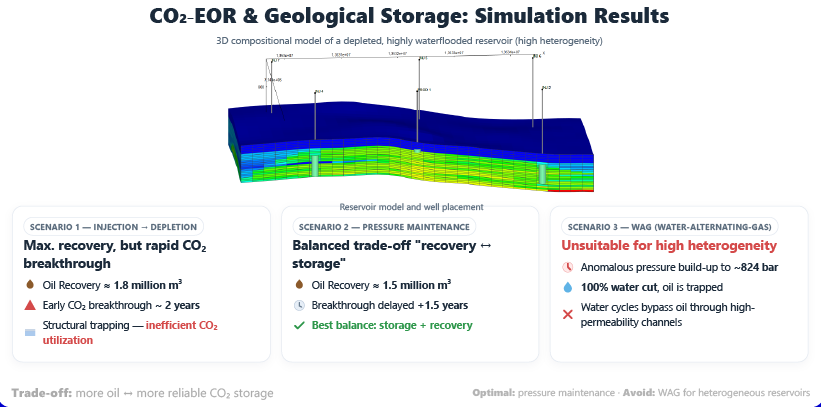
It was established that the “injection – depletion” strategy provides the highest cumulative oil production (about 1.8 million m³) but is inefficient due to early gas breakthrough (after ~ 2 years). The pressure-maintenance strategy proved to be the most balanced: gas breakthrough was delayed by 1.5 years, ensuring high CO₂ storage efficiency, but cumulative oil production was lower (about 1.5 million m³). The water-alternating-gas (WAG) technology, for the geological conditions of this reservoir, proved detrimental, causing abnormal pressure build-up (up to 824 bar) and blockage of oil reserves.
The obtained results are explained by the physics of the process. The early gas breakthrough in the first scenario is due to CO₂ gravitational segregation and the formation of a gravity override (“gravity tongue”). The efficiency of the second scenario is associated with the creation of a more stable displacement front through pressure maintenance. The complete inefficiency of WAG is explained by the presence of high-permeability channels in the geologically heterogeneous formation, through which water moved, bypassing the oil.
The results can be practically applied by operators of mature fields to justify the choice of a CCUS strategy. They provide a quantitative basis for assessing the trade-off between short-term economic benefits (production) and long-term environmental objectives (storage). The study confirms the critical importance of conducting detailed geological modeling before applying WAG, in order to avoid substantial financial losses.
References
- CCUS in clean energy transitions (2020). International Energy Agency. Available at: https://www.iea.org/reports/ccus-in-clean-energy-transitions
- Roefs, P., Moretti, M., Welkenhuysen, K., Piessens, K., Compernolle, T. (2019). CO2-enhanced oil recovery and CO2 capture and storage: An environmental economic trade-off analysis. Journal of Environmental Management, 239, 167–177. https://doi.org/10.1016/j.jenvman.2019.03.007
- Bachu, S. (2008). CO2 storage in geological media: Role, means, status and barriers to deployment. Progress in Energy and Combustion Science, 34 (2), 254–273. https://doi.org/10.1016/j.pecs.2007.10.001
- Juanes, R., Spiteri, E. J., Orr, F. M., Blunt, M. J. (2006). Impact of relative permeability hysteresis on geological CO2 storage. Water Resources Research, 42 (12). https://doi.org/10.1029/2005wr004806
- Kovscek, A. R., Cakici, M. D. (2005). Geologic storage of carbon dioxide and enhanced oil recovery. II. Cooptimization of storage and recovery. Energy Conversion and Management, 46 (11-12), 1941–1956. https://doi.org/10.1016/j.enconman.2004.09.009
- Cao, C., Hou, Z., Li, Z., Pu, X., Liao, J., Wang, G. (2022). Numerical modeling for CO2 storage with impurities associated with enhanced gas recovery in depleted gas reservoirs. Journal of Natural Gas Science and Engineering, 102, 104554. https://doi.org/10.1016/j.jngse.2022.104554
- Rutqvist, J. (2012). The Geomechanics of CO2 Storage in Deep Sedimentary Formations. Geotechnical and Geological Engineering, 30 (3), 525–551. https://doi.org/10.1007/s10706-011-9491-0
- Rutqvist, J., Vasco, D. W., Myer, L. (2009). Coupled reservoir-geomechanical analysis of CO2 injection at In Salah, Algeria. Energy Procedia, 1 (1), 1847–1854. https://doi.org/10.1016/j.egypro.2009.01.241
- Vilarrasa, V., Makhnenko, R., Gheibi, S. (2016). Geomechanical analysis of the influence of CO2 injection location on fault stability. Journal of Rock Mechanics and Geotechnical Engineering, 8 (6), 805–818. https://doi.org/10.1016/j.jrmge.2016.06.006
- Zuloaga, P., Yu, W., Miao, J., Sepehrnoori, K. (2017). Performance evaluation of CO2 Huff-n-Puff and continuous CO2 injection in tight oil reservoirs. Energy, 134, 181–192. https://doi.org/10.1016/j.energy.2017.06.028
- Alam, M. M. M., Hassan, A., Mahmoud, M., Sibaweihi, N., Patil, S. (2022). Dual Benefits of Enhanced Oil Recovery and CO2 Sequestration: The Impact of CO2 Injection Approach on Oil Recovery. Frontiers in Energy Research, 10. https://doi.org/10.3389/fenrg.2022.877212
- Carbon dioxide enhanced oil recovery (2010). National Energy Technology Laboratory. Available at: https://netl.doe.gov/sites/default/files/netl-file/NETL_CO2-EOR-Primer.pdf
Downloads
Published
How to Cite
Issue
Section
License
Copyright (c) 2025 Taras Petrenko, Victoriia Rubel

This work is licensed under a Creative Commons Attribution 4.0 International License.
The consolidation and conditions for the transfer of copyright (identification of authorship) is carried out in the License Agreement. In particular, the authors reserve the right to the authorship of their manuscript and transfer the first publication of this work to the journal under the terms of the Creative Commons CC BY license. At the same time, they have the right to conclude on their own additional agreements concerning the non-exclusive distribution of the work in the form in which it was published by this journal, but provided that the link to the first publication of the article in this journal is preserved.





