Development of a method for rapid ignition detection based on current selective dispersion of hazardous parameters of the gas environment
DOI:
https://doi.org/10.15587/2706-5448.2025.339602Keywords:
ignition detection, sample dispersion, hazardous parameter, gas medium, material ignitionAbstract
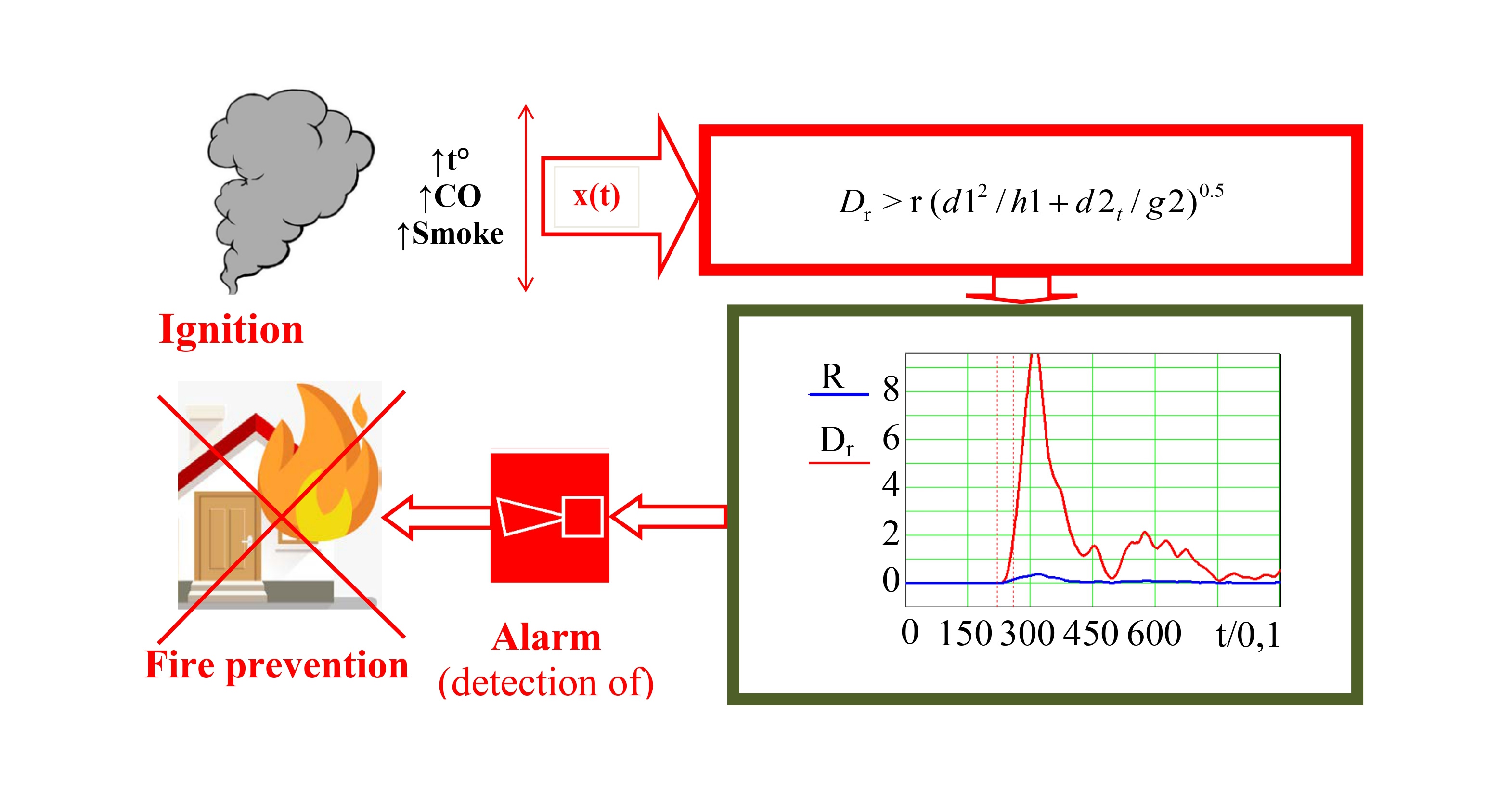
The object of the study is the current sample dispersion of arbitrary hazardous parameters of the gas environment during the ignition of materials. A theoretical justification of the method of operational detection of ignitions based on significant deviations of the current difference of sample dispersions of the measured arbitrary hazardous parameter of the gas environment has been carried out. In this case, the significance of the current difference of sample dispersions will allow detecting the ignition occurrence in real-time observation of an arbitrary hazardous parameter of the gas environment. The method allows setting the level of significance for the current deviation and ensuring the maximum power of fire detection. Laboratory experiments were conducted to verify the proposed method. At the same time, the differences of sample dispersions of hazardous parameters of the gas environment correspond to the general sets of reliable absence and occurrence of ignition. The results of the verification showed that at a given level of significance, the method allows detecting current ignitions of materials based on significant deviations of sample dispersions of the considered parameters of the gas environment. It was found that the most sensitive in terms of ignition detection are the CO concentration and the temperature of the gas medium. The maximum rate of increase in the CO concentration during the ignition of alcohol, paper, wood and textiles are 0.7 ppmm2/s, 0.3 ppmm2/s, 6.4 ppmm2/s, 0.0025 ppmm2/s, respectively. During the ignition of alcohol and paper, the rate of temperature increase is about 1°C/s, and during the ignition of wood and textiles – 0.25°C/s, respectively. The practical importance of the research lies in the use of significant deviations of the sample dispersions of parameters of the gas medium for the detection of material ignition.
References
- World Fire Statistics (2022). Center for Fire Statistics of CTIF, 27, 65.
- Çetin, A. E., Merci, B., Günay, O., Töreyin, B. U., Verstockt, S. (2016). Camera-Based Techniques. Methods and Techniques for Fire Detection. Academic Press, 3–46. https://doi.org/10.1016/b978-0-12-802399-0.00002-8
- Sadkovyi, V., Andronov, V., Semkiv, O., Kovalov, A., Rybka, E., Otrosh, Y. et al. (2021). Fire resistance of reinforced concrete and steel structures. Kharkiv: РС ТЕСHNOLOGY СЕNTЕR, 180. https://doi.org/10.15587/978-617-7319-43-5
- Bogue, R. (2013). Sensors for fire detection. Sensor Review, 33 (2), 99–103. https://doi.org/10.1108/02602281311299635
- Khan, F., Xu, Z., Sun, J., Khan, F. M., Ahmed, A., Zhao, Y. (2022). Recent Advances in Sensors for Fire Detection. Sensors, 22 (9), 3310. https://doi.org/10.3390/s22093310
- Truong, C. T., Nguyen, T. H., Vu, V. Q., Do, V. H., Nguyen, D. T. (2023). Enhancing Fire Detection Technology: A UV-Based System Utilizing Fourier Spectrum Analysis for Reliable and Accurate Fire Detection. Applied Sciences, 13 (13), 7845. https://doi.org/10.3390/app13137845
- El-afifi, M. I., Team, S., M. Elkelany, M. (2024). Development of Fire Detection Technologies. Nile Journal of Communication and Computer Science, 7 (1), 58–66. https://doi.org/10.21608/njccs.2024.263103.1027
- Li, X., Hua, Y., Xia, N. (2013). Fire Detecting Technology based on Dynamic Textures. Procedia Engineering, 52, 186–195. https://doi.org/10.1016/j.proeng.2013.02.125
- Vasconcelos, R. N., Franca Rocha, W. J. S., Costa, D. P., Duverger, S. G., Santana, M. M. M. de, Cambui, E. C. B. et al. (2024). Fire Detection with Deep Learning: A Comprehensive Review. Land, 13 (10), 1696. https://doi.org/10.3390/land13101696
- Jee, S.-W., Lee, C.-H., Kim, S.-K., Lee, J.-J., Kim, P.-Y. (2012). Development of a Traceable Fire Alarm System Based on the Conventional Fire Alarm System. Fire Technology, 50 (3), 805–822. https://doi.org/10.1007/s10694-012-0299-0
- Nolan, D. P. (2014). Handbook of fire and explosion protection engineering principles: for oil, gas, chemical and related facilities. William Andrew. https://doi.org/10.1016/c2009-0-64221-5
- Pospelov, B., Rybka, E., Savchenko, A., Dashkovska, O., Harbuz, S., Naden, E. et al. (2022). Peculiarities of amplitude spectra of the third order for the early detection of indoor fires. Eastern-European Journal of Enterprise Technologies, 5 (10 (119)), 49–56. https://doi.org/10.15587/1729-4061.2022.265781
- Li, J., Yan, B., Zhang, M., Zhang, J., Jin, B., Wang, Y., Wang, D. (2019). Long-Range Raman Distributed Fiber Temperature Sensor With Early Warning Model for Fire Detection and Prevention. IEEE Sensors Journal, 19 (10), 3711–3717. https://doi.org/10.1109/jsen.2019.2895735
- Çetin, A. E., Dimitropoulos, K., Gouverneur, B., Grammalidis, N., Günay, O., Habiboǧlu, Y. H. et al. (2013). Video fire detection – Review. Digital Signal Processing, 23 (6), 1827–1843. https://doi.org/10.1016/j.dsp.2013.07.003
- Pospelov, B., Andronov, V., Rybka, E., Chubko, L., Bezuhla, Y., Gordiichuk, S. et al. (2023). Revealing the peculiarities of average bicoherence of frequencies in the spectra of dangerous parameters of the gas environment during fire. Eastern-European Journal of Enterprise Technologies, 1 (10 (121)), 46–54. https://doi.org/10.15587/1729-4061.2023.272949
- Dubinin, D., Cherkashyn, O., Maksymov, A., Beliuchenko, D., Hovalenkov, S., Shevchenko, S., Avetisyan, V. (2020). Investigation of the effect of carbon monoxide on people in case of fire in a building. Sigurnost, 62 (4), 347–357. https://doi.org/10.31306/s.62.4.2
- Fisher, A. (2013). Characterization of MQ-Series Gas Sensor Behavior. Honors Capstones. 279.
- Pospelov, B., Andronov, V., Rybka, E., Bezuhla, Y., Liashevska, O., Butenko, T. et al. (2022). Empirical cumulative distribution function of the characteristic sign of the gas environment during fire. Eastern-European Journal of Enterprise Technologies, 4 (10 (118)), 60–66. https://doi.org/10.15587/1729-4061.2022.263194
- Sadkovyi, V., Pospelov, B., Rybka, E., Kreminskyi, B., Yashchenko, O., Bezuhla, Y. et al. (2022). Development of a method for assessing the reliability of fire detection in premises. Eastern-European Journal of Enterprise Technologies, 3 (10 (117)), 56–62. https://doi.org/10.15587/1729-4061.2022.259493
- Gupta, S. C., Kapoor, V. K. (2020). Fundamentals of mathematical statistics. Sultan Chand & Sons.
- Devore, J. L., Berk, K. N., Carlton, M. A. (2012). Modern mathematical statistics with applications. New York: Springer, 975. https://doi.org/10.1007/978-3-030-55156-8
- Otrosh, Y., Rybka, Y., Danilin, O., Zhuravskyi, M. (2019). Assessment of the technical state and the possibility of its control for the further safe operation of building structures of mining facilities. E3S Web of Conferences, 123, 01012. https://doi.org/10.1051/e3sconf/201912301012
- Zabulonov, Y. L., Popov, O. O., Skurativskyi, S. I., Stokolos, M. O., Puhach, O. V., Molitor, N. (2023). Mathematical tools of solving the problem of restoring the surface distribution of radiation pollution based on remote measurement data. IOP Conference Series: Earth and Environmental Science, 1254 (1), 012099. https://doi.org/10.1088/1755-1315/1254/1/012099
- Hogg, R. V., McKean, J. W., Craig, A. T. (2013). Introduction to mathematical statistics. Pearson Education India. Available at: https://minerva.it.manchester.ac.uk/~saralees/statbook2.pdf
- Stanley, D. J., Spence, J. R. (2024). The Comedy of Measurement Errors: Standard Error of Measurement and Standard Error of Estimation. Advances in Methods and Practices in Psychological Science, 7 (4). https://doi.org/10.1177/25152459241285885
- Pospelov, B., Rybka, E., Samoilov, M., Morozov, I., Bezuhla, Y., Butenko, T. et al. (2022). Defining the features of amplitude and phase spectra of dangerous factors of gas medium during the ignition of materials in the premises. Eastern-European Journal of Enterprise Technologies, 2 (10 (116)), 57–65. https://doi.org/10.15587/1729-4061.2022.254500
Downloads
Published
How to Cite
Issue
Section
License
Copyright (c) 2025 Igor Tolok, Boris Pospelov, Evgenіy Rybka, Andrii Iatsyshyn, Ihor Morozov, Olekcii Krainiukov, Yuliia Bezuhla, Larysa Prokhorova, Tatiana Lutsenko, Dmytrо Morkvin

This work is licensed under a Creative Commons Attribution 4.0 International License.
The consolidation and conditions for the transfer of copyright (identification of authorship) is carried out in the License Agreement. In particular, the authors reserve the right to the authorship of their manuscript and transfer the first publication of this work to the journal under the terms of the Creative Commons CC BY license. At the same time, they have the right to conclude on their own additional agreements concerning the non-exclusive distribution of the work in the form in which it was published by this journal, but provided that the link to the first publication of the article in this journal is preserved.





