Development of an approach for predicting the cost of damaged infrastructure recovery with microservice implementation
DOI:
https://doi.org/10.15587/2706-5448.2025.339773Keywords:
information-analytical system, Web, ML, cost prediction, Linear Regression, Random Forest, XGBoostAbstract
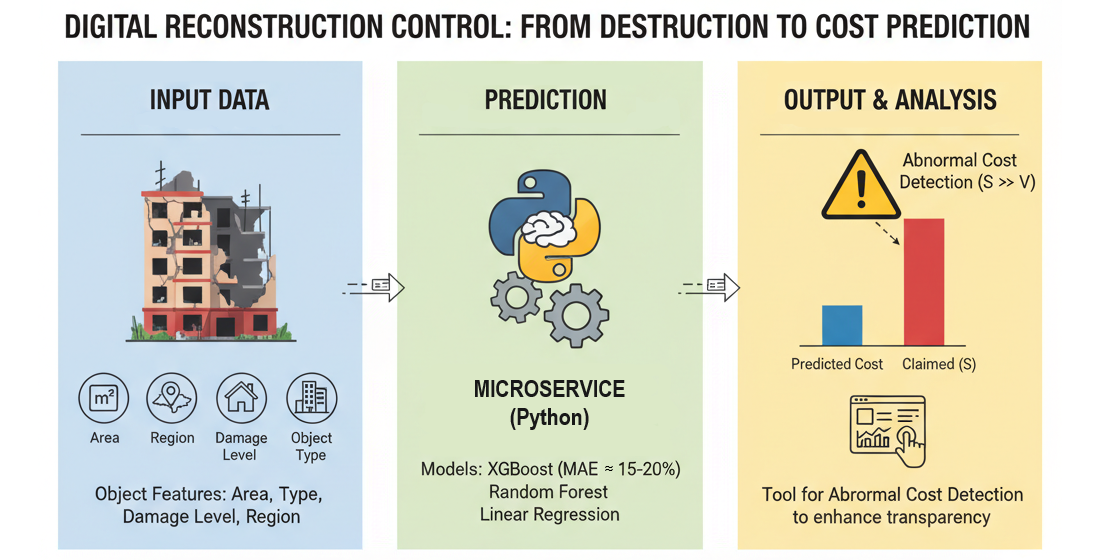
The object of the research is the process of preliminary cost assessment for restoring infrastructure objects damaged as a result of the war in Ukraine. The subject of the research is an information-analytical system that enables partial automation of this process.
Problem addressed is the lack of tools for forecasting reconstruction costs, since existing solutions are limited to recording destruction, visualization, and reporting.
In the course of the study, an approach was developed for predicting the cost of restoring damaged infrastructure objects based on machine learning models (Linear Regression, Random Forest, XGBoost). The proposed approach enables the automatic estimation of the expected restoration cost based on object characteristics. These estimates can serve as a basis for further analyses, including the detection of abnormal expenses and potential misuse. Experimental calculations on open data demonstrated that the use of modern ML models for processing structured data on objects makes it possible to estimate the restoration cost with an error margin of 15–20%. For practical use, the approach has been implemented as a standalone Python microservice, which ensures flexibility and scalability, and has been integrated into the existing information-analytical system (Laravel, Vue.js).
The developed solution can be used by national and municipal authorities to monitor infrastructure recovery. However, it is important to note that the models were pre-trained on open datasets of damaged objects valued from 20 million to over 90 million UAH, which include information such as object type, area, region, and other attributes. Therefore, successful application requires similarly structured and reliable data. Under these conditions, the microservice can enhance transparency in planning and improve the efficiency of reconstruction management.
References
- Novozhylova, M. V., Chub, O. I. (2024). Matematychne zabezpechennia proiektiv vidnovlennia istorychnykh pamiatok. Informatsiini systemy v upravlinni proiektamy ta prohramamy. Koblevo, Kharkiv: KhNURE, 171–175. Available at: https://mmp-conf.org/documents/archive/proceedings2024.pdf Last accessed: 05.01.2025
- Puri, A., Elkharboutly, M., Ali, N. A. (2024). Identifying major challenges in managing post-disaster reconstruction projects: A critical analysis. International Journal of Disaster Risk Reduction, 107, 104491. https://doi.org/10.1016/j.ijdrr.2024.104491
- Singh, R. (2024). The role of geographic information systems (GIS) in disaster management and planning. International Journal of Geography, Geology and Environment, 6 (2), 195–205. https://doi.org/10.22271/27067483.2024.v6.i2c.305
- Russia Will Pay. The project of collecting, evaluating, analyzing, and documenting information on direct losses to civilian infrastructure in connection with Russian aggression. KSE. Available at: https://kse.ua/russia-will-pay/ Last accessed: 05.01.2025
- Lozano, J.-M., Tien, I. (2023). Data collection tools for post-disaster damage assessment of building and lifeline infrastructure systems. International Journal of Disaster Risk Reduction, 94, 103819. https://doi.org/10.1016/j.ijdrr.2023.103819
- Zelene vidnovlennia Ukrainy: kerivni pryntsypy ta instrumenty dlia tykh, khto ukhvaliuie rishennia (2023). UNDP, KSE. Kyiv: PROON, 64. Available at: https://www.undp.org/uk/ukraine/publications/zelene-vidnovlennya-ukrayiny-kerivni-pryntsypy-ta-instrumenty-dlya-tykh-khto-ukhvalyuye-rishennya Last accessed: 05.01.2025
- Ukraine Humanitarian Needs and Response Plan 2025: Annex 4.3 – Analysis Methodology, Data Sources & Findings (2025). Geneva: UN OCHA, 58. Available at: https://humanitarianaction.info/plan/1271/document/ukraine-humanitarian-needs-and-response-plan-2025/article/43-analysis-methodology Last accessed: 05.01.2025
- Centre for Economic Strategy. Biudzhet-2025: analitychnyi ohliad (2024). Kyiv: TsES, 34. Available at: https://ces.org.ua/reports/budget-2025/ Last accessed: 05.01.2025
- Bosenko, I. (2025). Models and methods of artificial intelligence in the process of performing building-technical expertise. Management of Development of Complex Systems, 61, 180–186. https://doi.org/10.32347/2412-9933.2025.61.180-186
- Prohrama kompleksnoho vidnovlennia terytorii Mykhailo-Kotsiubynskoi terytorialnoi hromady. Chernihivskoi oblasti (2024). Mykhailo-Kotsiubynske, 133. Available at: https://mkocubynska-gromada.gov.ua/news/1740637546/ Last accessed: 05.01.2025
- Bakurova, A., Bilyi, V., Didenko, A., Tereschenko, E. (2023). Analytics Module for the System for Recording Destruction Due to Russian Aggression. 17th International Conference Monitoring of Geological Processes and Ecological Condition of the Environment. Kyiv, 1–5. https://doi.org/10.3997/2214-4609.2023520232
- Prysiazhniuk, A. (2019). Yak pratsiuie machine learning ta yoho zastosuvannia na praktytsi. Na chasi. Available at: https://nachasi.com/tech/2019/01/31/yak-pratsyuye-machine-learning/ Last accessed: 05.01.2025
- Pizhuk, O. I. (2019). Artificial intelligence as one of the key drivers of the economy digital transformation. Economics, Management and Administration, 3 (89), 41–46. https://doi.org/10.26642/ema-2019-3(89)-41-46
- Pedregosa, F., Varoquaux, G., Gramfort, A., Michel, V., Thirion, B., Grisel, O. (2012). Scikit-learn: Machine Learning in Python. Journal of Machine Learning Research, 12 (85), 2825–2830. https://doi.org/10.48550/arXiv.1201.0490
- Anisimov, V., Kunanets, N. (2024). Transition from Monolithic to Microservice Architecture: Methodology and Implementation Experience. Computer-Integrated Technologies: Education, Science, Production, 55, 30–41. https://doi.org/10.36910/6775-2524-0560-2024-55-03
- Di Francesco, P., Lago, P., Malavolta, I. (2019). Architecting with microservices: A systematic mapping study. Journal of Systems and Software, 150, 77–97. https://doi.org/10.1016/j.jss.2019.01.001
- Gooljar, S., Manohar, K., Hosein, P. (2023). Performance Evaluation and Comparison of a New Regression Algorithm. Proceedings of the 12th International Conference on Data Science, Technology and Applications. https://doi.org/10.5220/0012135400003541
- Sharma, H., Harsora, H., Ogunleye, B. (2024). An Optimal House Price Prediction Algorithm: XGBoost. Analytics, 3 (1), 30–45. https://doi.org/10.3390/analytics3010003
- Hyndman, R. J., Koehler, A. B. (2006). Another look at measures of forecast accuracy. International Journal of Forecasting, 22 (4), 679–688. https://doi.org/10.1016/j.ijforecast.2006.03.001
- Restoration data. Available at: https://drive.google.com/file/d/1oIVs52C9artD6jBgDzJd5mNUwDJSi8YW/view Last accessed: 05.06.2025
Downloads
Published
How to Cite
Issue
Section
License
Copyright (c) 2025 Anna Bakurova, Vitalii Bilyi

This work is licensed under a Creative Commons Attribution 4.0 International License.
The consolidation and conditions for the transfer of copyright (identification of authorship) is carried out in the License Agreement. In particular, the authors reserve the right to the authorship of their manuscript and transfer the first publication of this work to the journal under the terms of the Creative Commons CC BY license. At the same time, they have the right to conclude on their own additional agreements concerning the non-exclusive distribution of the work in the form in which it was published by this journal, but provided that the link to the first publication of the article in this journal is preserved.





