Development of a personalized learning trajectory using a brain-computer interface
DOI:
https://doi.org/10.15587/2706-5448.2025.339867Keywords:
electroencephalography (EEG), brain-computer interface (BCI), cognitive profiling, learning modalities, personalized education, artificial intelligence (AI), decision tree algorithm, memory retention, neuroadaptive learning, educational technologyAbstract
The object of research is electroencephalogram (EEG) signals obtained as a result of a non-invasive test that records the electrical activity of the brain by placing small sensors (electrodes) on the scalp. The article analyzes brain wave patterns to monitor a learner's memory ability.
One of the persistent issues in contemporary education is the misalignment between the competencies of graduates and the evolving demands of the labor market. A key contributing factor to this gap lies in the individual differences in how students perceive and process information. Empirical studies suggest that, excluding individuals with clinically diagnosed cognitive impairments, the population exhibits varied abilities in information retention depending on the modality of content delivery.
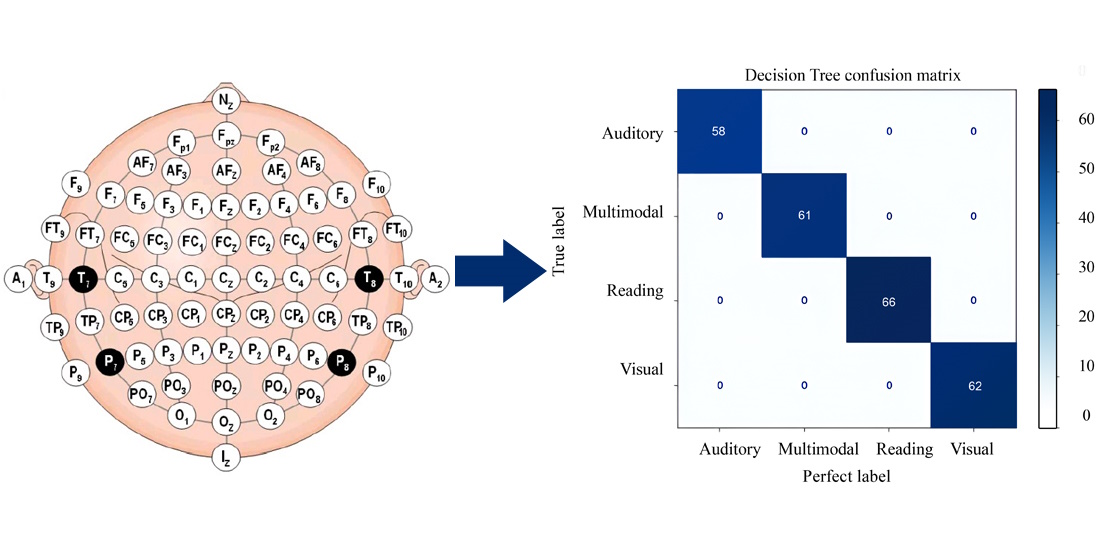
To address this issue, the study explores brain-computer interface technologies, particularly electroencephalography (EEG), as a means of assessing individual learning profiles. An artificial intelligence (AI)-based model employing a decision tree algorithm was developed to analyze EEG signals acquired from a 256-electrode system. A publicly available dataset from Kaggle was utilized to train and refine the model, enabling the classification of preferred memorization modalities – namely, reading, multimodal, auditory, and visual.
The applied phase of the study involved 32 students who had previously received failing (“F”) grades. Based on their EEG-derived cognitive profiles, these students were subsequently taught using tailored content delivery methods aligned with their dominant memorization styles. Remarkably, this personalized approach resulted in significant academic improvement, with students achieving “C”, “B”, and even “A” grades in subsequent assessments.
The proposed model offers a scalable and time-efficient method for identifying optimal learning modalities at the individual level. It holds promise for enhancing educational outcomes by enabling more personalized and neuroadaptive instructional strategies.
References
- Gu, X., Cao, Z., Jolfaei, A., Xu, P., Wu, D., Jung, T.-P., Lin, C.-T. (2021). EEG-Based Brain-Computer Interfaces (BCIs): A Survey of Recent Studies on Signal Sensing Technologies and Computational Intelligence Approaches and Their Applications. IEEE/ACM Transactions on Computational Biology and Bioinformatics, 18 (5), 1645–1666. https://doi.org/10.1109/tcbb.2021.3052811
- Gasimov, H. (2020). Modelling support systems for selecting professions for applicants in the content of personalization of education. EUREKA: Physics and Engineering, 2, 83–97. https://doi.org/10.21303/2461-4262.2020.001181
- Mammadova, M., Mammadzadeh, F. (2012). Formation of supply and demand for IT specialists on the base of competency model. 2012 IV International Conference “Problems of Cybernetics and Informatics” (PCI), 199–201. https://doi.org/10.1109/icpci.2012.6486486
- A. Duque-Vaca, M., Carmona, J. A. R.-, Yungán, J. I. G., Builes, J. A. J. (2025). Implementation of Instructional Design Modelswithout Considering Inclusive Education. International Journal of Modern Education and Computer Science, 17 (1), 17–27. https://doi.org/10.5815/ijmecs.2025.01.02
- Abbasov, A. M., Mamedova, M. H., Orujov, G. H., Aliev, H. B. (2001). Synthesis of the methods of subjective knowledge representations in problems of fuzzy pattern recognition. Mechatronics, 11 (4), 439–449. https://doi.org/10.1016/s0957-4158(00)00027-1
- Hu, P.-C., Chen, P.-H., Kuo, P.-C. (2018). Educational Model Based on Hands-on Brain-Computer Interface: Implementation of Music Composition Using EEG. 2018 IEEE International Conference on Systems, Man, and Cybernetics (SMC), 982–985. https://doi.org/10.1109/smc.2018.00174
- Lyu, L., Sokolova, A. (2022). The effect of using digital technology in the music education of elementary school students. Education and Information Technologies, 28 (4), 4003–4016. https://doi.org/10.1007/s10639-022-11334-8
- Alibeyli, T. (2025). Brain-computer interfaces: neural signal processing and algorithmic approaches. ScienceRise, 1, 89–95. https://doi.org/10.21303/2313-8416.2025.003767
- Xu, W., Chen, L., Sui, X., Tian, Y., Liu, Z. (2022). Brain-computer interface – Brain information reading and activity control. Chinese Science Bulletin, 68 (8), 927–943. https://doi.org/10.1360/tb-2022-0338
- Flesher, S. N., Downey, J. E., Weiss, J. M., Hughes, C. L., Herrera, A. J., Tyler-Kabara, E. C. et al. (2021). A brain-computer interface that evokes tactile sensations improves robotic arm control. Science, 372 (6544), 831–836. https://doi.org/10.1126/science.abd0380
- Pitt, K. M., McKelvey, M., Weissling, K., Thiessen, A. (2024). Brain-computer interface for augmentative and alternative communication access: The initial training needs and learning preferences of speech-language pathologists. International Journal of Speech-Language Pathology, 2 7 (1), 14–22. https://doi.org/10.1080/17549507.2024.2363939
- Gupta, E., Sivakumar, R. (2025). Response coupling with an auxiliary neural signal for enhancing brain signal detection. Scientific Reports, 15 (1). https://doi.org/10.1038/s41598-025-87414-9
- Salehzadeh, R., Mynderse, J. (2024). Board 143: Work in Progress: Mind and Computer: Integration of Brain-Computer Interfaces in Engineering Curricula. 2024 ASEE Annual Conference & Exposition Proceedings. https://doi.org/10.18260/1-2--46702
- Badcock, N. A., Mousikou, P., Mahajan, Y., de Lissa, P., Thie, J., McArthur, G. (2013). Validation of the Emotiv EPOC®EEG gaming system for measuring research quality auditory ERPs. PeerJ, 1, e38. https://doi.org/10.7717/peerj.38
- Cuesta, D. L., Rivera, A. F. G., Borrero, J. S. M. (2020). Interfaz BCIE (Brain Computer Interface Educational) en Rasberry Pi utilizando sensor neurosky. 2020 15th Iberian Conference on Information Systems and Technologies (CISTI), 1–6. https://doi.org/10.23919/cisti49556.2020.9141128
- Akhtar, M. T., Mitsuhashi, W., James, C. J. (2012). Employing spatially constrained ICA and wavelet denoising, for automatic removal of artifacts from multichannel EEG data. Signal Processing, 92 (2), 401–416. https://doi.org/10.1016/j.sigpro.2011.08.005
Downloads
Published
How to Cite
Issue
Section
License
Copyright (c) 2025 Huseyn Gasimov, Turkan Alibeyli, Hesen Hesenli, Asiman Ismayilov

This work is licensed under a Creative Commons Attribution 4.0 International License.
The consolidation and conditions for the transfer of copyright (identification of authorship) is carried out in the License Agreement. In particular, the authors reserve the right to the authorship of their manuscript and transfer the first publication of this work to the journal under the terms of the Creative Commons CC BY license. At the same time, they have the right to conclude on their own additional agreements concerning the non-exclusive distribution of the work in the form in which it was published by this journal, but provided that the link to the first publication of the article in this journal is preserved.





