Поєднання контактної мережі та автономних тролейбусів для удосконалення транспортної системи міста
DOI:
https://doi.org/10.15587/2706-5448.2025.340517Ключові слова:
автономні тролейбуси, станція, пантограф, зарядка, батарея, контактна мережа, потужністьАнотація
Об’єктом дослідження є технічні характеристики автономних тролейбусів та системи, що забезпечують їх безперебійне електропостачання.
Одним із найбільш проблемних місць є залежність традиційних тролейбусів від контактної мережі, що обмежує їх маршрути, ускладнює експлуатацію в історичних центрах міст, на мостових переходах та у районах із недостатньою інфраструктурою.
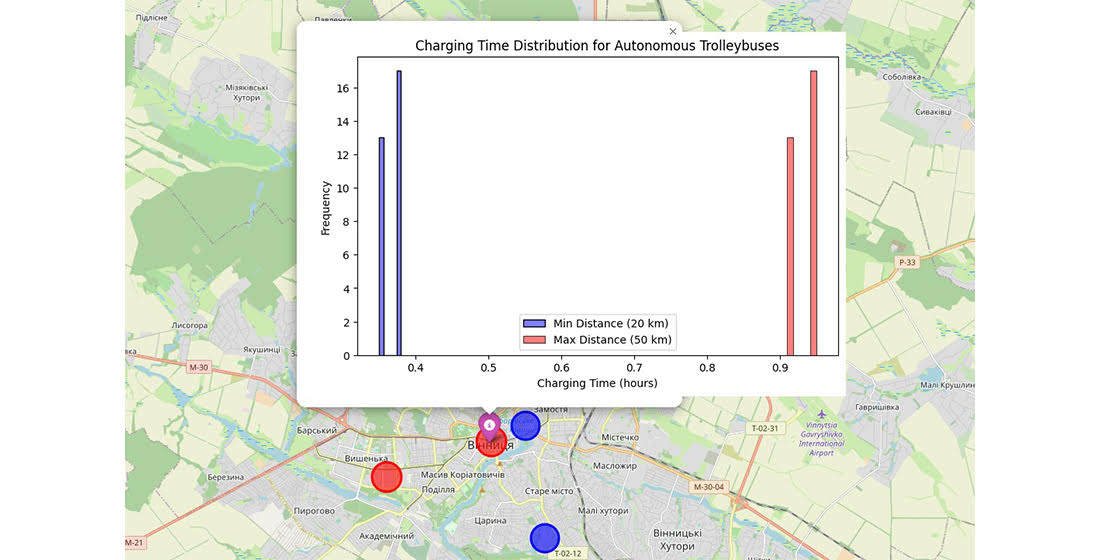
У роботі розглядаються ключові технологічні аспекти автономних тролейбусів, зокрема типи зарядних станцій (контактні, індукційні, з пантографами), ефективність зарядки, енергоспоживання та автономний пробіг. Наведено приклади впровадження цієї технології в Україні, аналіз витрат на зарядку та енергетичних характеристик для пробігу 20–50 км. Підкреслюються перспективи використання автономних тролейбусів для оптимізації міської транспортної мережі, зменшення викидів CO₂ та покращення якості обслуговування пасажирів. Проведено розрахунки енергії, необхідної для руху тролейбуса на відстань 20–50 км, з урахуванням середнього енергоспоживання (1,2–2,0 кВт · год/км), потужності зарядних станцій (до 100 кВт) та ефективності зарядки (0,9). Розрахунки показали, що для автономного пробігу тролейбуса на 30 км необхідно 45 кВт · год енергії. Сучасні літій-іонні батареї та зарядні станції потужністю до 100 кВт забезпечують повну зарядку за 30 хвилин. Додаткова проміжна зарядка на кінцевих або коротких зупинках дозволяє мінімізувати контактну інфраструктуру, зберігаючи гнучкість транспортної системи. Автономні тролейбуси зменшують залежність від контактної мережі, що є особливо актуальним для мостових переходів, де будівництво чи обслуговування контактних ліній ускладнене, а також для історичних центрів, де збереження архітектури та естетики вимагає уникнення надмірної інфраструктури. Вони також сприяють значному зменшенню викидів CO₂, сприяючи екологічній сталості, та покращують якість повітря в міських районах.
Посилання
- Wołek, M., Wolański, M., Bartłomiejczyk, M., Wyszomirski, O., Grzelec, K., Hebel, K. (2021). Ensuring sustainable development of urban public transport: A case study of the trolleybus system in Gdynia and Sopot (Poland). Journal of Cleaner Production, 279, 123807. https://doi.org/10.1016/j.jclepro.2020.123807
- Kivekas, K., Lajunen, A., Baldi, F., Vepsalainen, J., Tammi, K. (2019). Reducing the Energy Consumption of Electric Buses With Design Choices and Predictive Driving. IEEE Transactions on Vehicular Technology, 68 (12), 11409–11419. https://doi.org/10.1109/tvt.2019.2936772
- Abdelaty, H., Mohamed, M. (2021). A Prediction Model for Battery Electric Bus Energy Consumption in Transit. Energies, 14 (10), 2824. https://doi.org/10.3390/en14102824
- Xu, H., Tu, R., Li, T., Chen, H. (2023). Interpretable bus energy consumption model with minimal input variables considering powertrain types. Transportation Research Part D: Transport and Environment, 119, 103742. https://doi.org/10.1016/j.trd.2023.103742
- Andrusenko, S., Dembitskyi, V., Budnychenko, I., Dykyi, V. (2024). Research on the feasibility of using electric buses on bus and trolleybus routes in cities. Advances in mechanical engineering and transport, 1 (22), 76–88. https://doi.org/10.36910/automash.v1i22.1348
- Yankivskyi, D., Bryzhalov, V., Liahushkin, A. (2019). Power supply sources for autonomous electric vehicles and the effectiveness of their application. Bulletin of Lviv National Agrarian University. Agroengineering Research, 23, 106–116. https://doi.org/10.31734/agroengineering2019.23.106
- Polievoda, Y., Kupchuk, I., Hontaruk, Y., Furman, I., Mytko, M. (2022). Method for determining homogeneity of fine dispersed mixtures based on the software analysis of photo cross-cut of the sample. Przegląd Elektrotechniczny, 1 (11), 111–115. https://doi.org/10.15199/48.2022.11.20
- Borysiuk, D., Spirin, A., Kupchuk, I., Tverdohlib, I., Zelinskyi, V., Smyrnov, Y. et al. (2021). The methodology of determining the place of installation of accelerometers during vibrodiagnostic of controlled axes of wheeled tractors. Przegląd Elektrotechniczny, 1 (10), 46–50. https://doi.org/10.15199/48.2021.10.09
- Kupchuk, I., Burlaka, S., Galushchak, A., Yemchyk, T., Galushchak, D., Prysiazhniuk, Y. (2022). Research of autonomous generator indicators with the dynamically changing component of a two-fuel mixture. Polityka Energetyczna – Energy Policy Journal, 25 (2), 147–162. https://doi.org/10.33223/epj/150746
- Tokarchuk, O., Tokarchuk, D., Mytko, M., Bahrii, V. (2024). Modern innovative technologies and materials for enhancing the efficiency of solar panels. Engineering, Energy, Transport AIC, 1 (124), 140–148. https://doi.org/10.37128/2520-6168-2024-1-16
- New trolleybus line (and thirteen 24-metre double-articulated by Hess) in Bern (2024). Sustainable-bus.com. Available at: https://www.sustainable-bus.com/trolleybus-tramway/new-trolleybus-line-and-thirteen-24-metre-double-articulated-by-hess-in-bern
- Novye investitcii v obshchestvennyi transport: Poznan zakazyvaet 37 elektroavtobusov Solaris (2020). Hevcars.com.ua. Available at: https://hevcars.com.ua/polsha-solaris-poluchaet-zakaz-na-eshhe-37-elektricheskih-avtobusov
- Yutong: the Chinese leader on worldwide expansion (as electric buses gain ground) (2025). Sustainable-bus.com. Available at: https://www.sustainable-bus.com/news/yutong-bus-zhengzhou-electric-bus
- U Vinnytsi planuiut zibraty shche 10 enerhooshchadnykh nyzkopidlohovykh troleibusiv “VinLine” (2023). Vezha.ua. Available at: https://vezha.ua/u-vinnytsi-planuyut-zibraty-shhe-10-energooshhadnyh-nyzkopidlogovyh-trolejbusiv-vinline
- Ponad 70 milioniv hryven vytratiat na novi troleibusy VinLine (2023). Vn.20minut.ua. Available at: https://vn.20minut.ua/Podii/ponad-70-milyoniv-griven-vitratyat-na-novi-troleybusi-vinline-11859875.html
##submission.downloads##
Опубліковано
Як цитувати
Номер
Розділ
Ліцензія
Авторське право (c) 2025 Mykola Mytko, Serhii Burlaka, Oleksandr Halushchak, Dmytro Halushchak, Viacheslav Zelinskyi

Ця робота ліцензується відповідно до Creative Commons Attribution 4.0 International License.
Закріплення та умови передачі авторських прав (ідентифікація авторства) здійснюється у Ліцензійному договорі. Зокрема, автори залишають за собою право на авторство свого рукопису та передають журналу право першої публікації цієї роботи на умовах ліцензії Creative Commons CC BY. При цьому вони мають право укладати самостійно додаткові угоди, що стосуються неексклюзивного поширення роботи у тому вигляді, в якому вона була опублікована цим журналом, але за умови збереження посилання на першу публікацію статті в цьому журналі.