Determinants of high-tech exports in the EU and Ukraine in the context of innovation, industrial and entrepreneurship policy
DOI:
https://doi.org/10.15587/2706-5448.2025.340796Keywords:
innovation policy, industrial policy, entrepreneurship policy, European Union – Ukraine, policy effectivenessAbstract
The object of research is the innovation, industrial and entrepreneurial policy of the EU and Ukraine in 2016–2024, assessed by key performance indicators.
The problem lies in the lack of mechanisms for integrating European practices adapted to Ukrainian conditions, which limits investment potential, the development of innovation ecosystems, acceleration of structural modernization and growth of competitiveness in the context of post-war recovery.
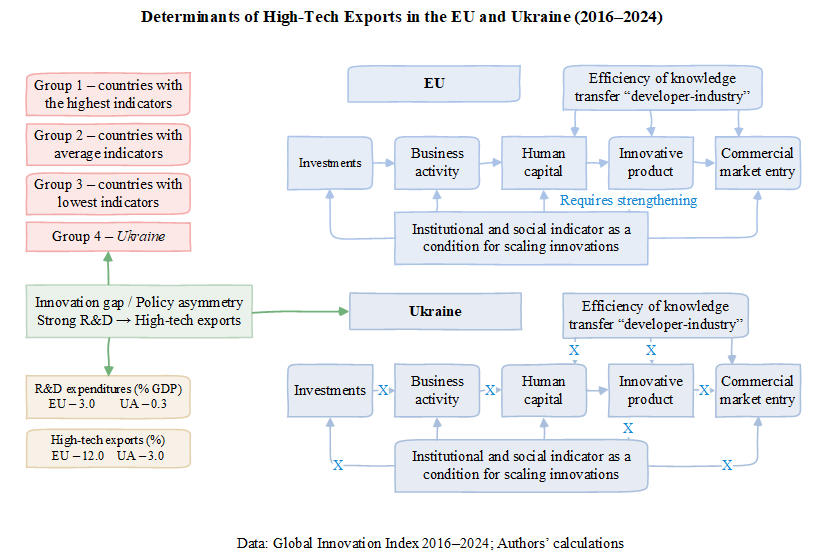
The essence of the results obtained is to identify significant differences between the EU and Ukraine in seven indicators of innovation policy, as well as to establish the factors that most affect high-tech exports. For the EU, a close relationship between R&D funding, business participation, human capital development and commercialization of innovations has been confirmed. In Ukraine, science-industry cooperation and the human resource potential of business research have become decisive, while the impact of R&D funding is weak and unstable. Regression modeling showed that in the EU the key drivers are corporate R&D, human capital and scientific-industrial cooperation, while in Ukraine – institutional and personnel factors.
These results are explained by differences in institutional maturity, quality of innovation management, efficiency of commercialization of developments and integration of science into production. The EU has comprehensive and targeted support instruments that ensure a direct link between innovation spending and economic results. In Ukraine, however, there is fragmentation of measures, declarative nature of reforms and low conversion of costs into high-tech exports.
The results obtained can be used to adjust national innovation development strategies, form post-war recovery programs, increase the role of private R&D, human capital development and intensify cooperation between science and business at all levels.
References
- Veugelers, R. (2024). An Innovation-Based Industrial Policy for the EU. Intereconomics, 59 (5), 254–261. https://doi.org/10.2478/ie-2024-0052
- Dugo, A., Erixon, F., Guinea, O. (2025). Models of industrial policy: Driving innovation and economic growth. European Centre for International Political Economy. Available at: https://ecipe.org/wp–content/uploads/2025/04/ECI_OccasionalPaper_05–2025_LY02.pdf
- Landesmann, M. A. (2025). EU industrial policy in the evolving geo–political and geo-economic environment. The Vienna Institute for International Economic Studies, 44. Available at: https://wiiw.ac.at/eu-industrial-policy-in-the-evolving-geo-political-and-geo-economic-environment-dlp-7342.pdf
- Batbaatar, M., Larsson, J. P., Sandström, C., Wennberg, K.; Henrekson, M., Sandström, C., Stenkula, M. (Eds.) (2024). The State of the Entrepreneurial State: Empirical Evidence of Mission-Led Innovation Projects around the Globe. Moonshots and the New Industrial Policy. Cham: Springer, 125–143. https://doi.org/10.1007/978-3-031-49196-2_8
- Wigger, A. (2023). The New EU Industrial Policy and Deepening Structural Asymmetries: Smart Specialisation Not So Smart. JCMS: Journal of Common Market Studies, 61 (1), 20–37. https://doi.org/10.1111/jcms.13366
- Garcia Calvo, A., Hancké, B. (2025). When does industrial policy fail and when can it succeed? Case studies from Europe. Socio-Economic Review. https://doi.org/10.1093/ser/mwaf045
- The impact of R&I policy instruments: Quarterly R&I literature review 2022/Q4 (2023). European Commission. Available at: https://research–and–innovation.ec.europa.eu/system/files/2023–03/ec_rtd_quarterly–ri–review_042022.pdf
- Veugelers, R. (2021). Research and innovation policies and productivity growth. Bruegel. Available at: https://www.bruegel.org/system/files/wp_attachments/WP–2021–08–100521.pdf
- Makrevska Disoska, E., Tonovska, J., Toshevska-Trpchevska, K., Tevdovski, D., Stojkoski, V. (2024). Empirical Determinants of Innovation in European Countries: Firm-level Analysis Based on CIS 2018. European Review, 32 (3), 269–290. https://doi.org/10.1017/s106279872400019x
- Belanová, K., Ochotnický, P., Sivák, R. (2025). Innovation performance of EU countries in context of R&D: R&D trap risk in Slovakia? Journal of Innovation and Entrepreneurship, 14 (1). https://doi.org/10.1186/s13731-025-00533-5
- Haddad, C. R., Bergek, A. (2023). Towards an integrated framework for evaluating transformative innovation policy. Research Policy, 52 (2), 104676. https://doi.org/10.1016/j.respol.2022.104676
- Borrás, S., Laatsit, M. (2019). Towards system oriented innovation policy evaluation? Evidence from EU28 member states. Research Policy, 48 (1), 312–321. https://doi.org/10.1016/j.respol.2018.08.020
- Edler, J., Berger, M., Dinges, M., Gok, A. (2012). The practice of evaluation in innovation policy in Europe. Research Evaluation, 21 (3), 167–182. https://doi.org/10.1093/reseval/rvs014
- Cunningham, J. A., Link, A. N. (2016). Exploring the effectiveness of research and innovation policies among European Union countries. International Entrepreneurship and Management Journal, 12 (2), 415–425. https://doi.org/10.1007/s11365-016-0394-7
- Fuest, C., Gros, D., Mengel, P.-L., Presidente, G., Tirole, J. (2024). Reforming innovation policy to help the EU escape the middle-technology trap. VoxEU. Available at: https://cepr.org/voxeu/columns/reforming–innovation–policy–help–eu–escape–middle–technology–trap
- Borrás, S., Edler, J. (2014). The governance of change in socio-technical and innovation systems: three pillars for a conceptual framework. The Governance of Socio-Technical Systems. Edward Elgar, 23–48. https://doi.org/10.4337/9781784710194.00011
- Cavalcante, P. L. C.; Farazmand, A. (Ed.) (2022). Innovation Policy Governance. Global Encyclopedia of Public Administration, Public Policy, and Governance. Cham: Springer, 6704–6709. https://doi.org/10.1007/978-3-030-66252-3_4234
- Global innovation index 2024 (2024). World Intellectual Property Organization. Available at: https://www.wipo.int/publications/en/details.jsp?id=4758&plang=EN
Downloads
Published
How to Cite
Issue
Section
License
Copyright (c) 2025 Igor Matyushenko, Olena Khanova, Serhii Hlibko, Anna Zaytseva, Alina Yaremenko

This work is licensed under a Creative Commons Attribution 4.0 International License.
The consolidation and conditions for the transfer of copyright (identification of authorship) is carried out in the License Agreement. In particular, the authors reserve the right to the authorship of their manuscript and transfer the first publication of this work to the journal under the terms of the Creative Commons CC BY license. At the same time, they have the right to conclude on their own additional agreements concerning the non-exclusive distribution of the work in the form in which it was published by this journal, but provided that the link to the first publication of the article in this journal is preserved.





