Use of electronic learning as a technology for strengthening social-psychological support for Ukrainian veterans
DOI:
https://doi.org/10.15587/2706-5448.2025.341056Keywords:
Ukrainian veterans, e-learning technologies, socio-psychological support, reintegration, soft skills, digital educationAbstract
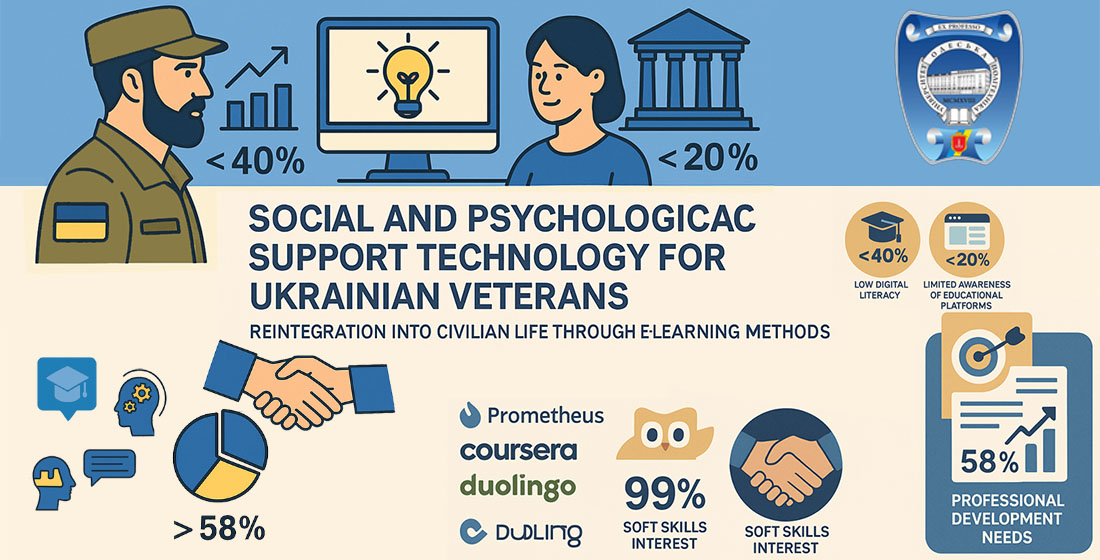
The object of research is the technology of socio-psychological support for Ukrainian veterans in the process of their reintegration into civilian life through the use of e-learning methods. The research revealed a number of critical shortcomings: insufficient digital literacy among veterans (less than 40%), limited awareness of existing educational platforms (less than 20%), and the lack of an integrated state strategy for using digital tools in the field of social and psychological rehabilitation. One of the most problematic areas is the gap between veterans’ needs for professional development (more than 58% want to radically change their specialty or get a first one), social support, and their actual level of access to adapted resources (no one refused the offered training opportunities), which complicates reintegration, reduces motivation for self-development, and exacerbates social isolation. The methods of systematic analysis, literary sources summarization, processing of data from official sources, and a sociological survey of 228 veterans were used. Using a mixed approach made it possible to comprehensively assess the level of awareness, educational needs, and psycho-emotional demands of the target group. The results indicate that veterans are highly interested in developing soft skills (99%), professional retraining, and self-realization. Reserves in the functioning of the support system were identified, in particular, the potential of the Prometheus, Coursera, and Duolingo platforms to provide personalized content. It is because the proposed approach has various features: flexibility, accessibility regardless of dwelling, adaptation to the cultural context, and integration of elements of social and psychological support. This creates conditions for improving the level of veterans’ self-regulation, emotional stability, and professional adaptation. Compared to known support models, e-learning technologies provide scalability, rapid implementation, and the possibility of long-term monitoring of the effectiveness of reintegration measures. The increase in the number of veterans who independently wish to engage in education using digital technologies is 90% annually within the framework of the public management and administration program of Odesa Polytechnic. All respondents emphasize receiving socio-psychological support during the learning process.
References
- Analitychna informatsiia za danymy Ministerstva u spravakh veteraniv Ukrainy. Ministerstvo u Spravakh Veteraniv Ukrainy. Available at: https://data.mva.gov.ua/
- Obraz veteraniv v ukrainskomu suspilstvi (2024). Ukrainskyi veteranskyi fond, Sotsiolohichna hrupa “Reitynh”. Available at: https://veteranfund.com.ua/wp-content/uploads/2024/12/RG_UA_Veterans_1000_UA_122024_press.pdf
- Vorona, P. V., Vorona, L. I. (2016). Post-traumatic syndrome, caused by the ATO area, and features to overcome: pedagogical and psychological aspects. Imidzh suchasnoho pedahoha, 9 (168), 49–53. Available at: https://dspace.luguniv.edu.ua/xmlui/handle/123456789/8949
- Barnett, A., Savic, M., Forbes, D., Best, D., Sandral, E., Bathish, R. et al. (2021). Transitioning to civilian life: The importance of social group engagement and identity among Australian Defence Force veterans. Australian & New Zealand Journal of Psychiatry, 56 (8), 1025–1033. https://doi.org/10.1177/00048674211046894
- Malyovanyi, M., Ulyanych, Y., Pidlubna, O. (2022). Professional and social adaptation of military officers, veterans and their family members in Ukraine. Collected Works of Uman National University of Horticulture, 2 (101), 197–207. https://doi.org/10.32782/2415-8240-2022-101-2-197-207
- Moos, R. H., Schaefer, J. A.; Moos, R. H. (Ed.) (1986). Life Transitions and Crises. Coping with Life Crises. Plenum Press, 3–28. https://doi.org/10.1007/978-1-4684-7021-5_1
- Vashchenko, I. V., Ivanenko, B. B. (2018). Psychological resources of the personality in overcoming difficult life situations. Problems of Modern Psychology, 40, 33–49. https://doi.org/10.32626/2227-6246.2018-40.33-49
- Mental health (2022). World Health Organization. Available at: https://www.who.int/news-room/fact-sheets/detail/mental-health-strengthening-our-response
- Karamushka, L. M. (2022). Psykhichne zdorovia osobystosti pid chas viiny: yak yoho zberehty ta pidtrymaty. Instytut psykholohii imeni H. S. Kostiuka NAPN Ukrainy, 52. Available at: https://lib.iitta.gov.ua/id/eprint/730974/1/Карамушка%20Л._Методичні%20рекомендації.pdf
- Pedersen, C. L., Wieser, C. (2021). Veteran Transition from Military to Civilian Life: Towards a Sociocultural Framework for Social Support. Scandinavian Journal of Military Studies, 4 (1), 158–171. https://doi.org/10.31374/sjms.97
- Sachdev, S., Dixit, S. (2023). Military to civilian cultural transition experiences of retired military personnel: A systematic meta-synthesis. Military Psychology, 36 (6), 579–592. https://doi.org/10.1080/08995605.2023.2237835
- Kramer, C. B., Nelson, K. M., Sayre, G., Williams, J. L., Spruill, L., Fennell, T. et al. (2024). “Veteran to Veteran, There’s Automatically a Trust”: A Qualitative Study of Veterans’ Experiences in a Peer Health-Coaching Program for Hypertension. AJPM Focus, 3 (6), 100257. https://doi.org/10.1016/j.focus.2024.100257
- Kroll-Desrosiers, A., Finley, E. P., Hamilton, A. B., Cabassa, L. J. (2023). Evidence-Based Intervention Adaptations Within the Veterans Health Administration: a Scoping Review. Journal of General Internal Medicine, 38 (10), 2383–2395. https://doi.org/10.1007/s11606-023-08218-z
- Metodychni rekomendatsii shchodo orhanizatsii roboty pomichnykiv veterana v hromadi ta vzaiemodii z zainteresovanymy subiektamy (2024). Kyiv: Tsentr bezpekovykh doslidzhen “SENSS”. Available at: https://mva.gov.ua/storage/app/sites/1/Методичні%20рекомендації/rekomendatsii-web-3.pdf
- Leshchenko, N. (2024). Osoblyvosti sotsialno-psykholohichnoi pidtrymky na shliakhu do profesiinoi pereoriientatsii veteraniv viiny v Ukraini. Pidtrymka psykholohichnoho zdorovia osobystosti v umovakh viiny: mizhnarodnyi dosvid ta ukrainski realii. Donetskyi DonOblIPPO, 120–126. Available at: https://ippo.dn.ua/images/files/materials/SUPPORTING_OF_PSYCHOLOGICAL_WELL-BEING_OF_THE_INDIVIDUAL_IN_THE_WAR_CONDITIONS_INTERNATIONAL_EXPERIENCE_AND_UKRAINIAN_REALITIES.pdf#page=121
- Levinstein, Y., Zerach, G., Levi-Belz, Y., Bonanno, G. A. (2024). Trajectories of moral injury and their associations with posttraumatic stress symptoms among recently discharged Israeli veterans. Journal of Psychiatric Research, 177, 321–329. https://doi.org/10.1016/j.jpsychires.2024.07.025
- Rattray, N., Flanagan, M., Salyers, M., Natividad, D., Do, A.-N., Frankel, R. et al. (2023). The Association Between Reintegration, Perceptions of Health and Flourishing During Transition from Military to Civilian Life Among Veterans with Invisible Injuries. Journal of Veterans Studies, 9 (1), 224–234. https://doi.org/10.21061/jvs.v9i1.432
- Biscoe, N., Bonson, A., Nickerson, A., Murphy, D. (2023). Factors associated with exposure to potentially morally injurious events (PMIEs) and moral injury in a clinical sample of veterans. European Journal of Trauma & Dissociation, 7 (3), 100343. https://doi.org/10.1016/j.ejtd.2023.100343
- Fry, K. M., Bennett, D. C., Roberge, E. M., McClain, C. M., Rugo-Cook, K., Brewczynski, J., Pryor, C. (2024). The effects of Religiosity, Spirituality, and sense of purpose on posttraumatic stress disorder treatment outcomes among Veterans. Journal of Psychiatric Research, 176, 276–281. https://doi.org/10.1016/j.jpsychires.2024.05.054
- McGuire, A. P., Riera, A., Lascano, X. (2025). Adapting MOVED as a web-based moral elevation intervention for veterans with PTSD: Using feedback from a pilot trial and subject matter experts. Contemporary Clinical Trials Communications, 44, 101445. https://doi.org/10.1016/j.conctc.2025.101445
- Varker, T., Cowlishaw, S., Baur, J., McFarlane, A. C., Lawrence-Wood, E., Metcalf, O. et al. (2022). Problem anger in veterans and military personnel: Prevalence, predictors, and associated harms of suicide and violence. Journal of Psychiatric Research, 151, 57–64. https://doi.org/10.1016/j.jpsychires.2022.04.004
- Malik, T. H. (2022). Military-civilian partner selection for mental health management: An analysis of organisational and technological legitimacy. Ethics, Medicine and Public Health, 20, 100733. https://doi.org/10.1016/j.jemep.2021.100733
- Tautz, D., Sprenger, D. A., Schwaninger, A. (2021). Evaluation of four digital tools and their perceived impact on active learning, repetition and feedback in a large university class. Computers & Education, 175, 104338. https://doi.org/10.1016/j.compedu.2021.104338
- Hinostroza, J. E., Armstrong-Gallegos, S., Villafaena, M. (2024). Roles of digital technologies in the implementation of inquiry-based learning (IBL): A systematic literature review. Social Sciences & Humanities Open, 9, 100874. https://doi.org/10.1016/j.ssaho.2024.100874
- Kulal, A., Dinesh, S., Abhishek, N., Anchan, A. (2024). Digital access and learning outcomes: a study of equity and inclusivity in distance education. International Journal of Educational Management, 38 (5), 1391–1423. https://doi.org/10.1108/ijem-03-2024-0166
- Ifenthaler, D., Cooper, M., Daniela, L., Sahin, M. (2023). Social anxiety in digital learning environments: an international perspective and call to action. International Journal of Educational Technology in Higher Education, 20 (1). https://doi.org/10.1186/s41239-023-00419-0
- Nguyen, A. J., Russell, T., Skavenski, S., Bogdanov, S., Lomakina, K., Ivaniuk, I. et al. (2023). Development and piloting of a mental health prevention and referral program for veterans and their families in Ukraine. Global Health: Science and Practice, 11 (3). https://doi.org/10.9745/ghsp-d-22-00488
- Levis, M., Levy, J., Dimambro, M., Dufort, V., Ludmer, D. J., Goldberg, M., Shiner, B. (2024). Using natural language processing to evaluate temporal patterns in suicide risk variation among high-risk Veterans. Psychiatry Research, 339, 116097. https://doi.org/10.1016/j.psychres.2024.116097
- Ryan, A. T., Brenner, L. A., Ulmer, C. S., Mackintosh, M.-A., Greene, C. J. (2023). The Use of Evaluation Panels During the Development of a Digital Intervention for Veterans Based on Cognitive Behavioral Therapy for Insomnia: Qualitative Evaluation Study. JMIR Formative Research, 7, e40104. https://doi.org/10.2196/40104
- Van Doren, N., Ng, H., Rawat, E., McKenna, K. R., Blonigen, D. M. (2024). Virtual reality mindfulness training for veterans in residential substance use treatment: Pilot study of feasibility and acceptability. Journal of Substance Use and Addiction Treatment, 161, 209315. https://doi.org/10.1016/j.josat.2024.209315
- Lahutina, S., Frankova, I., Gruen, M., Vermetten, E., Zohar, J., Spitschan, M., Bajbouj, M. (2024). A digital self-help tool to promote mental well-being for Ukrainians affected by war – Assessing predictors of stress. Neuroscience Applied, 3, 104089. https://doi.org/10.1016/j.nsa.2024.104089
- Pearson, R., Carl, E., Creech, S. K. (2022). Computerized Psychological Interventions in Veterans and Service Members: Systematic Review of Randomized Controlled Trials. Journal of Medical Internet Research, 24 (6), e30065. https://doi.org/10.2196/30065
- Balan, O. S., Morris, K., Shepel, M. Ye., Balan, A. A., Savchenko, D. V., Samarchenko, I. I. (2023). Instrumenty tsyfrovizatsii yak zasib pidvyshchennia rivnia dostupnosti do yakisnoi osvity i uspishnoi adaptatsii veteraniv. Odeska politekhnika; Universytet Portsmutu. Available at: https://economics.net.ua/files/analytics/UUT6_Veterans_Analytics_U.pdf
- Analiz potreb ta problem veteraniv ta veteranok za 2024 rik. Veteranskyi fond. Available at: https://veteranfund.com.ua/analitics/analiz-potreb-ta-problem-veteraniv-ta-veteranok-za-2024-rik/
- Pro proiekt “Stvoreno zakhysnykamy”. Ministerstvo u spravakh veteraniv. Available at: https://mva.gov.ua/veteranam/pro-proekt
- Economic Scientific Portal. Available at: https://economics.net.ua/en/uut6
Downloads
Published
How to Cite
Issue
Section
License
Copyright (c) 2025 Oleksandr Balan, Maryna Shepel, Alla Balan, Olena Lypynska, Iryna Boiko

This work is licensed under a Creative Commons Attribution 4.0 International License.
The consolidation and conditions for the transfer of copyright (identification of authorship) is carried out in the License Agreement. In particular, the authors reserve the right to the authorship of their manuscript and transfer the first publication of this work to the journal under the terms of the Creative Commons CC BY license. At the same time, they have the right to conclude on their own additional agreements concerning the non-exclusive distribution of the work in the form in which it was published by this journal, but provided that the link to the first publication of the article in this journal is preserved.





