Determining the influence of phytoextracts on the quality formation of bakery products
DOI:
https://doi.org/10.15587/2706-5448.2025.341512Keywords:
food colorants, phenolic compounds, anthocyanins, Clitoria ternatea, extraction, antioxidant activityAbstract
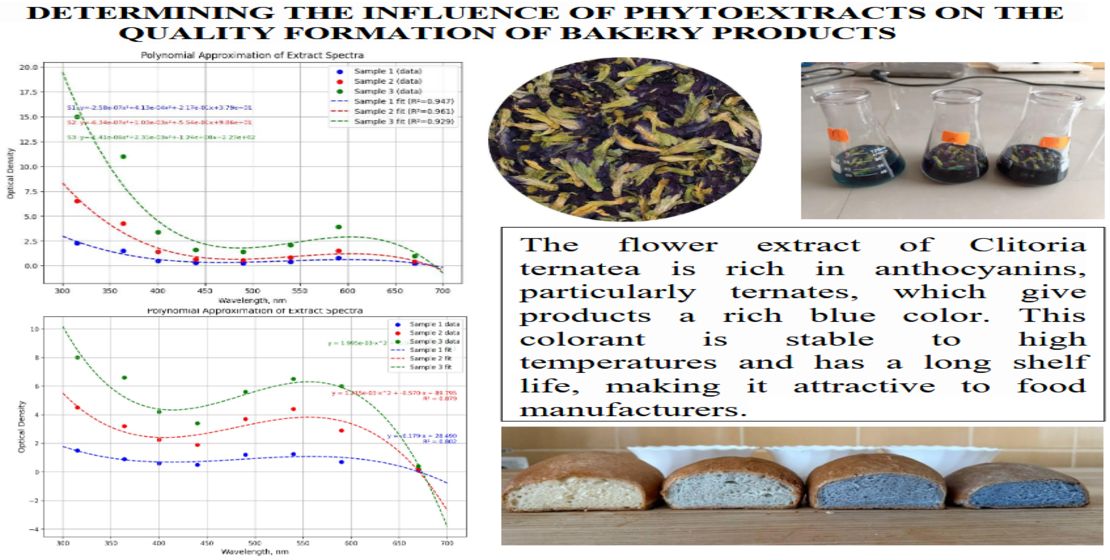
The object of the study is the technology of bakery products using Clitoria ternatea extracts and establishing their impact on the consumer characteristics of buns. The paper considers the possibility of using environmentally safe plant raw materials in the production of food products.
One of the problem areas in the use of the extract is the sensitivity of Clitoria ternatea anthocyanins to technological influences (temperature, acidity), color instability, specific organoleptic indicators of finished products and the impact on the physicochemical quality indicators of the semi-finished product and the finished product.
During the study, Clitoria ternatea and Malva mauritiana extracts were used. It was found that the extract from Clitoria ternatea has a significantly higher content of coloring substances at all levels of the hydromodule (0.5:50; 1.5:50; 2.5:50), which reflects a higher concentration of pigments in the raw material or their higher solubility, therefore Clitoria ternatea extracts were chosen. Increasing the concentration of flowers in the extract contributed to an increase in the content of polyphenols, flavonoids, a decrease in the acidity of the extracts, the density of the solutions almost did not change. Replacing water with Clitoria ternatea extract in the technology of bakery products contributed to a change in the physicochemical parameters of the dough and the finished product. The acidity of the dough and the finished product increased, the humidity decreased, the porosity of the finished product decreased.
As a result of the study, a technology of bakery products was developed using an aqueous extract of Clitoria ternatea flowers (hydromodulus 3.0:100), which provides a balance between technological and organoleptic properties. The samples had an exotic blue color, demonstrated better microbiological stability compared to the control, and the study of friability confirmed a positive effect on the preservation of crumb freshness compared to the control for 72 hours.
References
- Lebedenko, T. E., Novichkova, T. P, Sokolova, N. Iu., Miserzhi, M. D. (2011). Novye istochniki biologicheski aktivnykh komponentov dlia proizvodstva khleba. Zernovi produkty i kombikormy, 3 (43), 23–28.
- Mohamad, M. F., Dailin, D. J., Gomaa, S., Nurjayadi, М., El Enshasy, H. (2019). Natural colorant for food: A healthy alternative. International Journal of Scientific & Technology Research, 8 (11), 3161–3166. Available at: https://www.ijstr.org/final-print/nov2019/Natural-Colorant-For-Food-A-Healthy-Alternative.pdf
- Vega, E. N., Ciudad-Mulero, M., Fernández-Ruiz, V., Barros, L., Morales, P. (2023). Natural Sources of Food Colorants as Potential Substitutes for Artificial Additives. Foods, 12 (22), 4102. https://doi.org/10.3390/foods12224102
- Fu, X., Wu, Q., Wang, J., Chen, Y., Zhu, G., Zhu, Z. (2021). Spectral Characteristic, Storage Stability and Antioxidant Properties of Anthocyanin Extracts from Flowers of Butterfly Pea (Clitoria ternatea L.). Molecules, 26 (22), 7000. https://doi.org/10.3390/molecules26227000
- Vidana Gamage, G. C., Lim, Y. Y., Choo, W. S. (2021). Anthocyanins from Clitoria ternatea flower: Biosynthesis, extraction, stability, antioxidant activity, and applications. Frontiers in Plant Science, 12, 792303. https://doi.org/10.3389/fpls.2021.792303
- Netravati, N., Gomez, S., Pathrose, B., Raj, M. N., Joseph, M. P., Kuruvila, B. (2022). Comparative evaluation of anthocyanin pigment yield and its attributes from Butterfly pea (Clitorea ternatea L.) flowers as prospective food colorant using different extraction methods. Future Foods, 6, 100199. https://doi.org/10.1016/j.fufo.2022.100199
- Fuzetti, C. G., Castilhos, M. B. M., Nicoletti, V. R. (2022). Microencapsulation of natural blue dye from butterfly pea (Clitoria ternatea L.) flowers: The application of different carriers. Journal of Food Processing and Preservation, 46 (4). https://doi.org/10.1111/jfpp.16420
- Riniati, R., Widiastuti, E., Ismail, M. N., Mochamad, K. (2024). Optimization of Total Anthocyanin Content Extraction from Dried Butterfly Pea Flowers (Clitoria ternatea L.) Using Microwave Assisted Extraction (MAE) Method. Fluida, 17 (2), 71–77. https://doi.org/10.35313/fluida.v17i2.6049
- Maneeratanachot, S., Chetpattananondh, P., Kungsanant, S. (2024). Encapsulation of anthocyanin from butterfly pea flowers (Clitoria ternatea L.) extract using foam-mat drying. Food and Bioproducts Processing, 145, 105–115. https://doi.org/10.1016/j.fbp.2024.03.003
- Koirala, P., Sriprablom, J., Winuprasith, T. (2023). Anthocyanin-Rich Butterfly Pea Petal Extract Loaded Double Pickering Emulsion Containing Nanocrystalline Cellulose: Physicochemical Properties, Stability, and Rheology. Foods, 12 (22), 4173. https://doi.org/10.3390/foods12224173
- Singh, R., Yu, C.-C., Chen, G.-W., Chen, C.-H., Sinaki, N. Y., Lin, J. et al. (2022). Butterfly Pea Flower as a Novel Ingredient to Produce Antioxidant-Enriched Yellow Pea-Based Breakfast Cereals. Foods, 11 (21), 3447. https://doi.org/10.3390/foods11213447
- Hasanah, N. N., Mohamad Azman, E. M., Rozzamri, A., Zainal Abedin, N. H. Z., Ismail-Fitry, M. R. (2023). A Systematic Review of Butterfly Pea Flower (Clitoria ternatea L.): Extraction and Application as a Food Freshness pH-Indicator for Polymer-Based Intelligent Packaging. Polymers, 15 (11), 2541. https://doi.org/10.3390/polym15112541
- Thanh, V. T., Tran, N. Y. T., Linh, N. T. V., Vy, T. A., Truc, T. T. (2020). Application of anthocyanin natural colors from Butterfly Pea (Clitoria ternatea L.) extracts to cupcake. IOP Conference Series: Materials Science and Engineering, 736 (6), 062014. https://doi.org/10.1088/1757-899x/736/6/062014
- Ab Rashid, S., Tong, W. Y., Leong, C. R., Abdul Ghazali, N. M., Taher, M. A., Ahmad, N. et al. (2021). Anthocyanin Microcapsule from Clitoria ternatea: Potential Bio-preservative and Blue Colorant for Baked Food Products. Arabian Journal for Science and Engineering, 46 (1), 65–72. https://doi.org/10.1007/s13369-020-04716-y
- Generalic Mekinic, I., Simat, V. (2025). Bioactive Compounds in Foods: New and Novel Sources, Characterization, Strategies, and Applications. Foods, 14 (9), 1617. https://doi.org/10.3390/foods14091617
- Willett, W., Rockström, J., Loken, B., Springmann, M., Lang, T., Vermeulen, S. et al. (2019). Food in the Anthropocene: the EAT–Lancet Commission on healthy diets from sustainable food systems. The Lancet, 393 (10170), 447–492. https://doi.org/10.1016/s0140-6736(18)31788-4
- Yilmaz, H., Yilmaz, A. (2025). Hidden Hunger in the Age of Abundance: The Nutritional Pitfalls of Modern Staple Crops. Food Science & Nutrition, 13 (2). https://doi.org/10.1002/fsn3.4610
- Bhardwaj, R. L., Parashar, A., Parewa, H. P., Vyas, L. (2024). An Alarming Decline in the Nutritional Quality of Foods: The Biggest Challenge for Future Generations’ Health. Foods, 13 (6), 877. https://doi.org/10.3390/foods13060877
- Bareetseng, S. (2022). The Worldwide Herbal Market: Trends and Opportunities. Journal of Biomedical Research & Environmental Sciences, 3 (5), 575–584. https://doi.org/10.37871/jbres1482
- Parvin, S., Reza, A., Das, S., Miah, Md. M. U., Karim, S. (2023). Potential Role and International Trade of Medicinal and Aromatic Plants in the World. European Journal of Agriculture and Food Sciences, 5 (5), 89–99. https://doi.org/10.24018/ejfood.2023.5.5.701
- Ivanišová, E., Kačániová, M., A. Savitskaya, T., D. Grinshpan, D.; Ahmad, R. S. (Ed.) (2021). Medicinal Herbs: Important Source of Bioactive Compounds for Food Industry. Herbs and Spices – New Processing Technologies. IntechOpen. https://doi.org/10.5772/intechopen.98819
- Rahaie, S., Gharibzahedi, S. M. T., Razavi, S. H., Jafari, S. M. (2012). Recent developments on new formulations based on nutrient-dense ingredients for the production of healthy-functional bread: a review. Journal of Food Science and Technology, 51 (11), 2896–2906. https://doi.org/10.1007/s13197-012-0833-6
- Đurović, S., Vujanović, M., Radojković, M., Filipović, J., Filipović, V., Gašić, U. et al. (2020). The functional food production: Application of stinging nettle leaves and its extracts in the baking of a bread. Food Chemistry, 312, 126091. https://doi.org/10.1016/j.foodchem.2019.126091
- Vivek-Ananth, R. P., Mohanraj, K., Sahoo, A. K., Samal, A. (2022). IMPPAT 2.0: an enhanced and expanded phytochemical atlas of Indian medicinal plants. bioRxiv. https://doi.org/10.1101/2022.06.17.496609
- Al-Rubaye, A. F., Kaizal, A. F., Hameed, I. H. (2017). Phytochemical Screening of Methanolic Leaves Extract of Malva sylvestris. International Journal of Pharmacognosy and Phytochemical Research, 9 (4). https://doi.org/10.25258/phyto.v9i4.8127
- Chua, L. S., Thong, H. Y., Soo, J. (2024). Effect of pH on the extraction and stability of anthocyanins from jaboticaba berries. Food Chemistry Advances, 5, 100835. https://doi.org/10.1016/j.focha.2024.100835
- Lijon, M. B., Meghla, N. S., Jahedi, E., Rahman, M. A., Hossain, I. (2017). Phytochemistry and pharmacological activities of Clitoria ternatea. International Jo
Downloads
Published
How to Cite
Issue
Section
License
Copyright (c) 2025 Oksana Melnyk, Oleksandr Matisov, Andriy Foshchan, Larysa Sharan, Svitlana Omelchenko, Aliona Dikhtyar, Vitaliy Shutyuk, Tatyana Marenkova, Larysa Chepurda, Olexandr Kurakin

This work is licensed under a Creative Commons Attribution 4.0 International License.
The consolidation and conditions for the transfer of copyright (identification of authorship) is carried out in the License Agreement. In particular, the authors reserve the right to the authorship of their manuscript and transfer the first publication of this work to the journal under the terms of the Creative Commons CC BY license. At the same time, they have the right to conclude on their own additional agreements concerning the non-exclusive distribution of the work in the form in which it was published by this journal, but provided that the link to the first publication of the article in this journal is preserved.





