Assessment of the risk of pollution of the ecosystem and agricultural products in the zone of military conflict
DOI:
https://doi.org/10.15587/2706-5448.2025.341902Keywords:
heavy metals, soil, milk safety, ecosystem contamination, military influenceAbstract
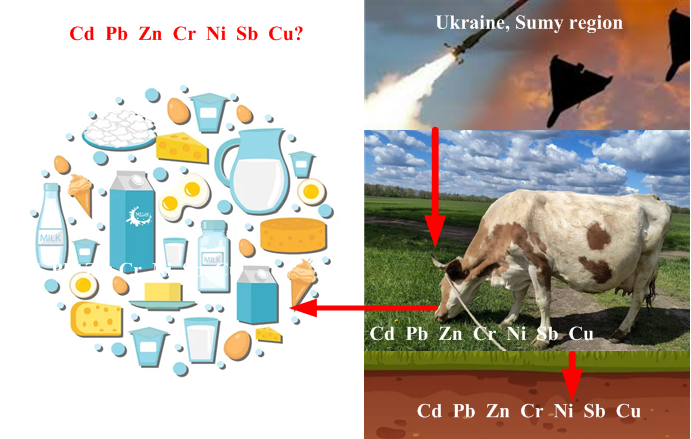
The object of research is the content of toxic elements in soils, pasture grass and cows' milk in settlements located near the combat zone. However, there is virtually no data on the contamination of territories located near the epicenter of military events. This does not make it possible to assess all potential risks of ecosystem contamination caused by military actions. The samples were collected in the territory of the Mykolaivka village community (Ukraine), which is located within a 50-kilometer zone from the state border with Russia. It was found that with an increase in the intensity of drone attacks (by 40%) and missile attacks (by 25%), an increase in the content of toxic metals Cd, Pb, and Cu in the soil was observed. The concentration of Cd (17.63 ± 0.27 ppm) found in sample S5 is the most threatening, as it is 294 times higher than the WHO recommended permissible level. In the tested soil samples, the maximum permissible concentration of lead is observed to be exceeded by 0.2–1 ppm. In May 2025, its content in the soil sampled in the village of Ulyanivka increased by 2.89 ppm, in the village of Tovsta by 2.57 ppm. In the pasture grass sample G3, an excess of Cd (0.07 ± 0.04 ppm), Pb (1.59 ± 0.44 ppm), and Zn (15.45 ± 4.74 ppm) was recorded. Cd content in milk in May 2025 ranges from 0.012–0.016 ± 0.01 ppm, which is 5–6 times higher than the WHO recommended values. Exceedance of the permissible lead level was also recorded in all samples, with the highest proportion (< 0.23 ± 0.11 ppm) in sample M9. The findings highlight the harmful effects of military activities on ecosystems and the safety of agricultural products, even in regions near conflict zones where no active combat is taking place. To address this, ongoing monitoring of soil and vegetation contamination, along with regular assessments of milk quality in these areas, is strongly recommended.
Supporting Agency
- This research was funded by the National Research Foundation of Ukraine under research topic 0125U001049 “Studying the impact of military actions on the possibility of obtaining safe agricultural products”.
References
- Fernandez-Lopez, C., Posada-Baquero, R., Ortega-Calvo, J.-J. (2022). Nature-based approaches to reducing the environmental risk of organic contaminants resulting from military activities. Science of The Total Environment, 843, 157007. https://doi.org/10.1016/j.scitotenv.2022.157007
- Solokha, M., Demyanyuk, O., Symochko, L., Mazur, S., Vynokurova, N., Sementsova, K., Mariychuk, R. (2024). Soil Degradation and Contamination Due to Armed Conflict in Ukraine. Land, 13 (10), 1614. https://doi.org/10.3390/land13101614
- Skalny, A. V., Aschner, M., Bobrovnitsky, I. P., Chen, P., Tsatsakis, A., Paoliello, M. M. B., Buha Djordevic, A., Tinkov, A. A. (2021). Environmental and health hazards of military metal pollution. Environmental Research, 201, 111568. https://doi.org/10.1016/j.envres.2021.111568
- Shukla, S., Mbingwa, G., Khanna, S., Dalal, J., Sankhyan, D., Malik, A., Badhwar, N. (2023). Environment and health hazards due to military metal pollution: A review. Environmental Nanotechnology, Monitoring & Management, 20, 100857. https://doi.org/10.1016/j.enmm.2023.100857
- Altahaan, Z., Dobslaw, D. (2024). The Impact of War on Heavy Metal Concentrations and the Seasonal Variation of Pollutants in Soils of the Conflict Zone and Adjacent Areas in Mosul City. Environments, 11 (11), 247. https://doi.org/10.3390/environments11110247
- Bolan, N., Kumar, M., Singh, E., Kumar, A., Singh, L., Kumar, S. et al. (2022). Antimony contamination and its risk management in complex environmental settings: A review. Environment International, 158, 106908. https://doi.org/10.1016/j.envint.2021.106908
- Al Lami, M. H., Jawad Al Obaidy, A. H. M., Al Sudani, I. M. (2021). Assessment of ecological pollution of heavy metals in surface soils of different sites within northwest of iraq. IOP Conference Series: Earth and Environmental Science, 779 (1), 012063. https://doi.org/10.1088/1755-1315/779/1/012063
- Wirtu, Y. D., Abdela, U. (2025). Impact of war on the environment: ecocide. Frontiers in Environmental Science, 13. https://doi.org/10.3389/fenvs.2025.1539520
- Norouzirad, R., González-Montaña, J.-R., Martínez-Pastor, F., Hosseini, H., Shahrouzian, A., Khabazkhoob, M. et al. (2018). Lead and cadmium levels in raw bovine milk and dietary risk assessment in areas near petroleum extraction industries. Science of The Total Environment, 635, 308–314. https://doi.org/10.1016/j.scitotenv.2018.04.138
- Pšenková, M., Toman, R., Tančin, V. (2020). Concentrations of toxic metals and essential elements in raw cow milk from areas with potentially undisturbed and highly disturbed environment in Slovakia. Environmental Science and Pollution Research, 27 (21), 26763–26772. https://doi.org/10.1007/s11356-020-09093-5
- Boudebbouz, A., Boudalia, S., Bousbia, A., Habila, S., Boussadia, M. I., Gueroui, Y. (2021). Heavy metals levels in raw cow milk and health risk assessment across the globe: A systematic review. Science of the Total Environment, 751, 141830. https://doi.org/10.1016/j.scitotenv.2020.141830
- Meng, X., Lu, B., Liu, C., Zhang, Z., Chen, J., Herrmann, H., Li, X. (2023). Abrupt exacerbation in air quality over Europe after the outbreak of Russia-Ukraine war. Environment International, 178, 108120. https://doi.org/10.1016/j.envint.2023.108120
- Filho, W. L., Fedoruk, M., Paulino Pires Eustachio, J. H., Splodytel, A., Smaliychuk, A., Szynkowska-Jóźwik, M. I. (2024). The environment as the first victim: The impacts of the war on the preservation areas in Ukraine. Journal of Environmental Management, 364, 121399. https://doi.org/10.1016/j.jenvman.2024.121399
- Strokal, V., Berezhniak, Y., Naumovska, O., Palamarchuk, S. (2025). The impact of the Russian-Ukrainian war on the soil-surface water interactions. https://doi.org/10.5194/egusphere-egu24-1115
- Datsko, O., Zakharchenko, E., Butenko, Y., Melnyk, O., Kovalenko, I., Onychko, V. et al. (2024). Ecological Assessment of Heavy Metal Content in Ukrainian Soils. Journal of Ecological Engineering, 25 (11), 100–108. https://doi.org/10.12911/22998993/192669
- Samilyk, M., Synenko, T. (2025). Assessment of the impact of military actions on the safety of soil and agricultural products. EUREKA: Life Sciences, 2, 60–67. https://doi.org/10.21303/2504-5695.2025.003879
- Li, Q., Wang, Y., Li, Y., Li, L., Tang, M., Hu, W. et al. (2022). Speciation of heavy metals in soils and their immobilization at micro-scale interfaces among diverse soil components. Science of The Total Environment, 825, 153862. https://doi.org/10.1016/j.scitotenv.2022.153862
- Adamczyk-Szabela, D., Wolf, W. M. (2022). The Impact of Soil pH on Heavy Metals Uptake and Photosynthesis Efficiency in Melissa officinalis, Taraxacum officinalis, Ocimum basilicum. Molecules, 27 (15), 4671. https://doi.org/10.3390/molecules27154671
Downloads
Published
How to Cite
Issue
Section
License
Copyright (c) 2025 Maryna Samilyk, Tetiana Synenko, Natalia Bolgova, Bohdan Lukhanin, Nataliia Borozenets

This work is licensed under a Creative Commons Attribution 4.0 International License.
The consolidation and conditions for the transfer of copyright (identification of authorship) is carried out in the License Agreement. In particular, the authors reserve the right to the authorship of their manuscript and transfer the first publication of this work to the journal under the terms of the Creative Commons CC BY license. At the same time, they have the right to conclude on their own additional agreements concerning the non-exclusive distribution of the work in the form in which it was published by this journal, but provided that the link to the first publication of the article in this journal is preserved.





