Development of an audit-integrated conceptual model for sustainable innovation management in motor transport enterprises: a viable systems approach
DOI:
https://doi.org/10.15587/2706-5448.2025.342312Keywords:
sustainable innovation, business processes, viable system model, audit, regulation, resilience, adaptability, recoveryAbstract
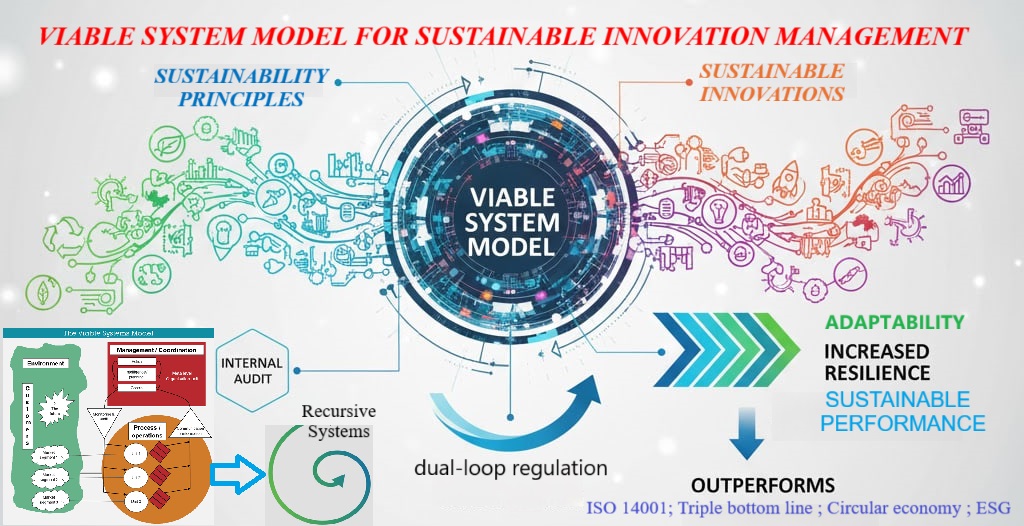
The object of this research is the system of sustainable innovation management in motor transport enterprises (MTEs). The problem addressed concerns the lack of integrated frameworks that combine sustainability, innovation, and audit mechanisms, which limits adaptability, resilience, and strategic alignment in MTEs, particularly under volatile markets and post-conflict recovery conditions in Ukraine. The research develops and establishes an audit-integrated conceptual model based on the viable systems approach (VSA) and the viable system model (VSM). The model aligns strategic, tactical, and operational subsystems with dual-loop regulation, combining deviation-based operational control with disturbance-based adaptive control. Internal audit functions are embedded to ensure accountability, transparency, continuous monitoring, and systemic integration of sustainable innovations. A comparative analysis with existing approaches, including the triple bottom line concept, circular economy principles, ISO 14001, and ESG frameworks, was conducted using the fuzzy analytic hierarchy process (Fuzzy-AHP). This method enabled a multi-criteria expert evaluation under conditions of uncertainty and provided quantitative validation of the advantages of the proposed VSM-based model. The results confirmed that the model ensures comprehensive systemic integration, positions innovation as a structural driver of development, enhances organizational resilience, and institutionalizes internal audit as a governance mechanism. The practical significance is the applicability of the model in ecological modernization, digital transformation, and post-conflict recovery of transport enterprises, particularly in developing economies with resource constraints. In practice, it supports managers and policymakers in designing adaptive strategies, embedding audit into business processes, and improving resilience, competitiveness, and sustainability performance.
References
- $155 billion – the total amount of damages caused to Ukraine’s infrastructure due to the war (2024). Kyiv School of Economics. Available at: https://kse.ua/about-the-school/news/155-billion-the-total-amount-of-damages-caused-to-ukraine-s-infrastructure-due-to-the-war-as-of-january-2024/
- Nazvano sumu zbytkiv, yakykh zavdala ukrainskomu dovkilliu viina (2024). Analitychnyi portal Slovo i Dilo. Available at: https://www.slovoidilo.ua/2024/01/21/novyna/bezpeka/nazvano-sumu-zbytkiv-yakyx-zavdala-ukrayinskomu-dovkillyu-vijna
- Syrtseva, S., Ivaniuk, U., Fedotova, I., Hurina, O., Dovzhyk, O., Nazarenko, O. (2022). Innovative potential and development of Ukrainian small enterpris-es during the war (2022–2023). Revista Amazonia Investiga, 11 (58), 222–232. https://doi.org/10.34069/ai/2022.58.10.24
- Novikova, I., Zabarna, E., Volkova, O., Fedotova, I., Korolkov, V. (2023). Economic prospects of post-war recovery: challenges and opportunities for sustainable development in Ukraine. Financial and Credit Activity Problems of Theory and Practice, 3 (50), 298–307. https://doi.org/10.55643/fcaptp.3.50.2023.4091
- Cillo, V., Petruzzelli, A. M., Ardito, L., Del Giudice, M. (2019). Understanding sustainable innovation: A systematic literature review. Corporate Social Responsibility and Environmental Management, 26 (5), 1012–1025. https://doi.org/10.1002/csr.1783
- Silvestre, B. S., Ţîrcă, D. M. (2019). Innovations for sustainable development: Moving toward a sustainable future. Journal of Cleaner Production, 208, 325–332. https://doi.org/10.1016/j.jclepro.2018.09.244
- Duong, L. N. K., Wang, J. X., Wood, L. C., Reiners, T., Koushan, M. (2021). The value of incremental environmental sustainability innovation in the construction industry: an event study. Construction Management and Economics, 39 (5), 398–418. https://doi.org/10.1080/01446193.2021.1901950
- Carmagnac, L., Naoui-Outini, F. (2022). Emotions and ends matter: Exploring the Practice of Sustainable Innovation Diffusion. Supply Chain Forum: An International Journal, 23 (4), 397–408. https://doi.org/10.1080/16258312.2022.2128693
- Kusi-Sarpong, S., Gupta, H., Sarkis, J. (2018). A supply chain sustainability innovation framework and evaluation methodology. International Journal of Production Research, 57 (7), 1990–2008. https://doi.org/10.1080/00207543.2018.1518607
- Zailani, S., Govindan, K., Iranmanesh, M., Shaharudin, M. R., Sia Chong, Y. (2015). Green innovation adoption in automotive supply chain: the Malaysian case. Journal of Cleaner Production, 108, 1115–1122. https://doi.org/10.1016/j.jclepro.2015.06.039
- Lopes, J. M., Gomes, S., Pacheco, R., Monteiro, E., Santos, C. (2022). Drivers of Sustainable Innovation Strategies for Increased Competition among Companies. Sustainability, 14 (9), 5471. https://doi.org/10.3390/su14095471
- Nosratabadi, S., Mosavi, A., Shamshirband, S., Kazimieras Zavadskas, E., Rakotonirainy, A., Chau, K. W. (2019). Sustainable Business Models: A Review. Sustainability, 11 (6), 1663. https://doi.org/10.3390/su11061663
- Bocken, N. M. P., Geradts, T. H. J. (2020). Barriers and drivers to sustainable business model innovation: Organization design and dynamic capabilities. Long Range Planning, 53 (4), 101950. https://doi.org/10.1016/j.lrp.2019.101950
- Evans, S., Vladimirova, D., Holgado, M., Van Fossen, K., Yang, M., Silva, E. A., Barlow, C. Y. (2017). Business Model Innovation for Sustainability: Towards a Unified Perspective for Creation of Sustainable Business Models. Business Strategy and the Environment, 26 (5), 597–608. https://doi.org/10.1002/bse.1939
- Guldmann, E., Huulgaard, R. D. (2020). Barriers to circular business model innovation: A multiple-case study. Journal of Cleaner Production, 243, 118160. https://doi.org/10.1016/j.jclepro.2019.118160
- Varadarajan, R. (2015). Innovating for sustainability: a framework for sustainable innovations and a model of sustainable innovations orientation. Journal of the Academy of Marketing Science, 45 (1), 14–36. https://doi.org/10.1007/s11747-015-0461-6
- Jeurissen, R. (2000). John Elkington, Cannibals With Forks: The Triple Bottom Line of 21st Century Business. Journal of Business Ethics, 23 (2), 229–231. https://doi.org/10.1023/a:1006129603978
- Jayashree, S., Reza, M. N. H., Malarvizhi, C. A. N., Mohiuddin, M. (2021). Industry 4.0 implementation and Triple Bottom Line sustainability: An empirical study on small and medium manufacturing firms. Heliyon, 7 (8), e07753. https://doi.org/10.1016/j.heliyon.2021.e07753
- Geissdoerfer, M., Savaget, P., Bocken, N. M. P., Hultink, E. J. (2017). The Circular Economy – A new sustainability paradigm? Journal of Cleaner Production, 143, 757–768. https://doi.org/10.1016/j.jclepro.2016.12.048
- Hartley, K., Schülzchen, S., Bakker, C. A., Kirchherr, J. (2023). A policy framework for the circular economy: Lessons from the EU. Journal of Cleaner Production, 412, 137176. https://doi.org/10.1016/j.jclepro.2023.137176
- Mukherjee, P. K., Das, B., Bhardwaj, P. K., Tampha, S., Singh, H. K., Chanu, L. D. et al. (2023). Socio-economic sustainability with circular economy – An alternative approach. Science of the Total Environment, 904, 166630. https://doi.org/10.1016/j.scitotenv.2023.166630
- Ofori, E. K., Asongu, S. A., Ali, E. B., Gyamfi, B. A., Ahakwa, I. (2024). Environmental impact of ISO 14001 certification in promoting sustainable development: The moderating role of innovation and structural change in BRICS, MINT, and G7 economies. Energy & Environment. https://doi.org/10.1177/0958305x241246193
- Zimon, D., Madzik, P., Sroufe, R. (2020). The Influence of ISO 9001 & ISO 14001 on Sustainable Supply Chain Management in the Textile Industry. Sustainability, 12 (10), 4282. https://doi.org/10.3390/su12104282
- Martiny, A., Taglialatela, J., Testa, F., Iraldo, F. (2024). Determinants of environmental social and governance (ESG) performance: A systematic literature review. Journal of Cleaner Production, 456, 142213. https://doi.org/10.1016/j.jclepro.2024.142213
- Beer, S. (1979). The Heart of Enterprise. London: John Wiley. Available at: https://archive.org/details/heartofenterpris0000beer
- Beer, S. (1994). Brain of the Firm. Chichester: John Wiley. Available at: https://ia802300.us.archive.org/25/items/brain-of-the-firm-reclaimed-v-1/Brain%20of%20the%20Firm%20-%20Stafford%20Beer.pdf
- Scoones, I., Stirling, A., Abrol, D., Atela, J., Charli-Joseph, L., Eakin, H. et al. (2020). Transformations to sustainability: combining structural, systemic and enabling approaches. Current Opinion in Environmental Sustainability, 42, 65–75. https://doi.org/10.1016/j.cosust.2019.12.004
- Kimpimäki, J.-P., Malacina, I., Lähdeaho, O. (2022). Open and sustainable: An emerging frontier in innovation management? Technological Forecasting and Social Change, 174, 121229. https://doi.org/10.1016/j.techfore.2021.121229
- Williams, A., Kennedy, S., Philipp, F., Whiteman, G. (2017). Systems thinking: A review of sustainability management research. Journal of Cleaner Production, 148, 866–881. https://doi.org/10.1016/j.jclepro.2017.02.002
- Reynolds, M., Holwell, S. (Eds.) (2010). Systems Approaches to Managing Change: A Practical Guide. London: Springer. https://doi.org/10.1007/978-1-84882-809-4
- Barile, S., Quattrociocchi, B., Calabrese, M., Iandolo, F. (2018). Sustainability and the Viable Systems Approach: Opportunities and Issues for the Governance of the Territory. Sustainability, 10 (3), 790. https://doi.org/10.3390/su10030790
- Iandolo, F., Barile, S., Armenia, S., Carrubbo, L. (2018). A system dynamics perspective on a viable systems approach definition for sustainable value. Sustainability Science, 13 (5), 1245–1263. https://doi.org/10.1007/s11625-018-0565-2
- Formisano, V., Quattrociocchi, B., Fedele, M., Calabrese, M. (2018). From Viability to Sustainability: The Contribution of the Viable Systems Approach (VSA). Sustainability, 10 (3), 725. https://doi.org/10.3390/su10030725
- Britchenko, I., Fedotova, I., Shersheniuk, O., Prokopenko, M., Vazov, R.; Levchenko, I., Dmytriiev, I. (Eds.) (2021). Management of a viable enterprise on the basis of the approach to management of a “living” organization and the concept of viable systems. Problems and prospects of development of the road transport complex: financing, management, innovation, quality, safety – integrated approach. Kharkiv: TECHNOLOGY CENTER PC, 63–80. https://doi.org/10.15587/978-617-7319-45-9.ch5
- Adamides, E. D., Georgousoglou, K., Mouzakitis, Y. (2023). Designing a Flexible and Adaptive Municipal Waste Management Organisation Using the Viable System Model. Sustainability, 15 (18), 13323. https://doi.org/10.3390/su151813323
- Vilalta-Perdomo, E., Salinas-Navarro, D. E., Michel-Villarreal, R., García Bustamante, R. (2022). Digitalization of the Logistics Process in Short Food Supply Chains. An online Viable System Model application during the COVID-19 pandemic. Systemic Practice and Action Research, 36, 509–534. https://doi.org/10.1007/s11213-022-09619-7
- Chaudhry, I. S. (2022). Viable system model: a tool for managing sustainable development holistically. Management & Sustainability: An Arab Review, 1 (1), 50–65. https://doi.org/10.1108/msar-01-2022-0008
- Štrukelj, T., Zlatanović, D., Nikolić, J., Sternad Zabukovšek, S. (2021). The viable system model’s support to social responsibility. Kybernetes, 50 (3), 812–835. https://doi.org/10.1108/k-12-2019-0860
- Lowe, D., Espinosa, A., Yearworth, M. (2020). Constitutive rules for guiding the use of the viable system model: Reflections on practice. European Journal of Operational Research, 287 (3), 1014–1035. https://doi.org/10.1016/j.ejor.2020.05.030
- Fedotova, I., Shynkarenko, V., Kryvoruchko, O. (2018). Development of the Viable System Model of Partner Relationship Management of the Company. International Journal of Engineering & Technology, 7 (4.3), 445–450. https://doi.org/10.14419/ijet.v7i4.3.19913
- Emrouznejad, A., Ho, W. (2017). Fuzzy Analytic Hierarchy Process. Chapman and Hall/CRC. https://doi.org/10.1201/9781315369884
Downloads
Published
How to Cite
Issue
Section
License
Copyright (c) 2025 Iryna Fedotova, Nadiia Bocharova, Grygorii Azarenkov, Oksana Pysarchuk, Yevheniia Tupytska, Agnieszka Rachwal-Mueller

This work is licensed under a Creative Commons Attribution 4.0 International License.
The consolidation and conditions for the transfer of copyright (identification of authorship) is carried out in the License Agreement. In particular, the authors reserve the right to the authorship of their manuscript and transfer the first publication of this work to the journal under the terms of the Creative Commons CC BY license. At the same time, they have the right to conclude on their own additional agreements concerning the non-exclusive distribution of the work in the form in which it was published by this journal, but provided that the link to the first publication of the article in this journal is preserved.





