Розроблення методологічного базису оцінювання резильєнтності соціально-економічних систем в контексті сталого розвитку
DOI:
https://doi.org/10.15587/2706-5448.2025.347161Ключові слова:
індекс макроекономічної резильєнтності (MRI), соціально-економічна нерівність, шкала стійкості, стійкість соціально-економічних систем, сталий розвитокАнотація
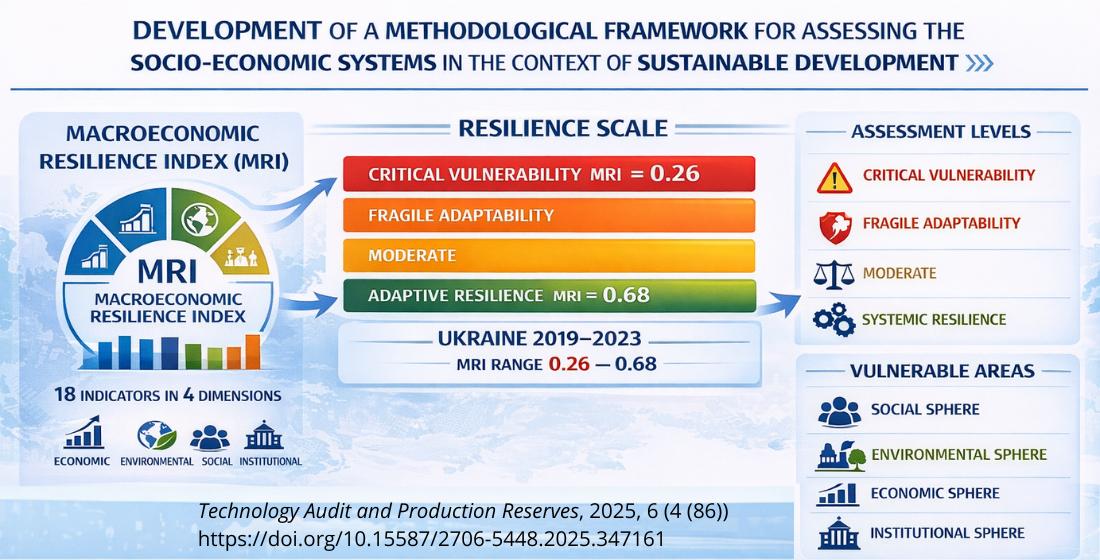
Об’єктом дослідження є методологічні засади оцінювання рівня резильєнтності соціально-економічної системи в контексті управління сталим розвитком. Головна проблема, на якій фокусувалось дослідження, полягає у визначенні здатності економіки адаптуватися до зовнішніх і внутрішніх шоків, для мінімізації їхнього впливу, щоб забезпечувати сталий розвиток. Запропонований макроекономічний індекс резильєнтності (MRI) побудовано з використанням контент-аналізу, системного, індексного та кількісного підходів. Сформована система оцінювання макроекономічного індексу резильєнтності охоплює 18 індикаторів, що об’єднані в чотири виміри стійкості: економічний, екологічний, соціальний та інституційний. За кожним виміром розраховується субіндекс, що дозволяє проводити декомпозиційний аналіз адаптивного потенціалу кожної сфери управління. Запропонована чотирьохрівнева шкала оцінки резильєнтності соціально-економічної системи дозволяє кількісно оцінити її стан та встановити вразливі сфери управління. Шкала визначає певний стан системи: критичну вразливість; крихку адаптивність; помірну; адаптивну та системну резильєнтність. Використання методології макроекономічного індексу резильєнтності (MRI) дозволяє оцінювати здатність соціально-економічної системи адаптуватись, відновлюватись та підтримувати життєздатність в кризових умовах. Застосування запропонованої методології до оцінки кейсу України у період 2019–2023 рр. дозволило встановити, що соціально-економічна система по шкалі резильєнтності знаходиться в інтервалі від стану вразливості MRI = 0,26 до адаптивної стійкості MRI = 0,68. Встановлено, що критично вразливими сферами для відновлення соціально-економічної системи є соціальна та екологічна, тоді як фундамент життєстійкості української макроекономіки створювали економічна та інституційна сфери. Запропонована система оцінювання забезпечує основу для розробки практичних рекомендацій щодо зміцнення адаптивного потенціалу та підтримки стійкості та сталості розвитку соціально-економічних систем.
Посилання
- Barmour, Z., Ahmadi, S., Shokouhyar, S. (2024). Managing supply chain resilience assessment model-relevant factors and activities using an FCM-FBWM approach. Heliyon, 10 (12), e32165. https://doi.org/10.1016/j.heliyon.2024.e32165
- Savytska, N., Zhehus, O., Polevych, K., Prydko, O., Bubenets, I. (2024). Enterprise Resilience Behavioral Management in a Decision Support System. Journal of Information Technology Management, 16 (4), 100‒121. https://doi.org/10.22059/jitm.2024.99053
- Savytska, N., Babenko, V., Chmil, H., Priadko, O., Bubenets, I. (2023). Digitalization of Business Development Marketing Tools in the B2C Market. Journal of Information Technology Management, 15 (1), 124–134. https://doi.org/10.22059/jitm.2023.90740
- Pylypenko, A. A., Savytska, N. L., Vaksman, R. V., Uhodnikova, O. I., Schevchenko, V. S. (2019). Methodical maintenance of management of logistic activity of the trade enterprise: Economic and legal support. Journal of Advanced Research in Law and Economics, 10 (6), 1723–1731. Available at: https://journals.aserspublishing.eu/jarle/article/view/4943
- Shtal, T., Proskurnina, N., Savytska, N., Mykhailova, M., Bubenets, I. (2023). Analysis of the Vectors of Digital Transformation of Retail Trade in Ukraine: Determination Methodology and Trends. Economic Affairs, 68. https://doi.org/10.46852/0424-2513.2s.2023.42
- Jollès, M., Meyermans, E., Vašíček, B. (2023). Determinants of macroeconomic resilience in the euro area: An empirical assessment of national policy levers. Economic Systems, 47 (3), 101093. https://doi.org/10.1016/j.ecosys.2023.101093
- Zou, Z., Cheng, C., Song, Z., Wu, X. (2025). Economic resilience of regions within the global supply network in the aftermath of disaster: A case study of Typhoon Mangkhut. International Journal of Disaster Risk Reduction, 118, 105275. https://doi.org/10.1016/j.ijdrr.2025.105275
- Walker, B. H. (2020). Resilience: what it is and is not. Ecology and Society, 25 (2). https://doi.org/10.5751/es-11647-250211
- Zarghami, S., Kaleji, L. K., Abhari, M. (2023). Resilience analysis of the local communities from a political economy perspective in Zanjan, Iran. Scientific Reports, 13 (1). https://doi.org/10.1038/s41598-023-46838-x
- Rezaei Soufi, H., Esfahanipour, A., Akbarpour Shirazi, M. (2022). A quantitative approach for analysis of macroeconomic resilience due to socio-economic shocks. Socio-Economic Planning Sciences, 79, 101101. https://doi.org/10.1016/j.seps.2021.101101
- Martin, R., Sunley, P.; Bristow, G., Healy, A. (Eds.) (2020). Regional economic resilience: evolution and evaluation. Handbook on Regional Economic Resilience. Vol. 2. Edward Elgar Publishing, 10–35. Available at: https://ideas.repec.org/h/elg/eechap/16700_2.html
- Shiozaki, Y., Nagamatsu, S., Sato, K., Bhattacharya, Y. (2024). A systematic literature review of empirical validation of disaster resilience indicators. International Journal of Disaster Risk Reduction, 111, 104681. https://doi.org/10.1016/j.ijdrr.2024.104681
- Bolson, N., Yutkin, M., Rees, W., Patzek, T. (2022). Resilience rankings and trajectories of world’s countries. Ecological Economics, 195, 107383. https://doi.org/10.1016/j.ecolecon.2022.107383
- Pileggi, S. F. (2022). Holistic Resilience Index: measuring the expected country resilience to pandemic. Quality & Quantity, 56 (6), 4107–4127. https://doi.org/10.1007/s11135-021-01296-3
- Libanova, E. (2025). Resilience of the Socio-Economic System of Ukraine to the Shocks Caused by the War: Specifics of Formation and Response. Demography and Social Economy, 4 (58), 3–23. https://doi.org/10.15407/dse2024.04.003
- Wu, Y., Zhang, J. (2025). Digital inclusive finance and rural households’ economic resilience. Finance Research Letters, 74, 106706. https://doi.org/10.1016/j.frl.2024.106706
- Bertram, L., Schiefeling, M., Kaufmann, R., Korinek, L., Hafele, J. (2024). Building back better? Economic resilience in the era of the Recovery and Resilience Facility. ZOE Institute for Future-fit Economies: Cologne. Available at: https://zoe-institut.de/wp-content/uploads/2024/02/Building-Back-Better-economic-resilience-RRF.pdf
- Pells, Sh. (2023). Resilience – definitions, concepts and measurement. CEU Working Paper 23/02. Ministry of Business, Innovation & Employment. New Zealand. Available at: https://www.mbie.govt.nz/dmsdocument/26810-resilience-definitions-concepts-and-measurement-a-literature-review-pdf
- Beker, T., Aikhenhrin, B., Horodnichenko, Yu., Guriev, S., Johnson, S., Mylovanov, T. et al. (2022). A Blueprint for the Reconstruction of Ukraine. London: Centre for Economic Policy Research Press. Available at: https://cepr.org/system/files/publication-files/147614-a_blueprint_for_the_reconstruction_of_ukraine.pdf
- Schwark, F., Tryphonides, A. (2025). Technical change and macroeconomic resilience to sectoral shock. Economics Letters, 246. https://doi.org/10.1016/j.econlet.2024.112077
- Kuhn, M., Luo, J., Manovskii, I., Qiu, X. (2023). Coordinated firm-level work processes and macroeconomic resilience. Journal of Monetary Economics, 137, 107–127. https://doi.org/10.1016/j.jmoneco.2023.05.001
- GHG emissions of all world countries (2024). European Commission. Available at: https://edgar.jrc.ec.europa.eu/report_2024
- Ukraine’s Greenhouse Gas Inventory 1990–2023 (2025). Kyiv. Available at: https://mepr.gov.ua/wp-content/uploads/2025/03/Ukraine_NID_2025.pdf
- FAOSTAT (2023). Available at: https://www.fao.org/faostat/en/#country/230
- Country Trends. Global Footprint Network. Available at: https://data.footprintnetwork.org/#/countryTrends?cn=230&type=BCpc,EFCpc
- All Country Scores (2023). Index of Economic Freedom. Available at: https://www.heritage.org/index/pages/all-country-scores
- Kaufmann, D., Kraay, A. (2024). The Worldwide Governance Indicators: Methodology and 2024 Update. World Bank Policy Research Working Paper No. 10952. Available at: https://documents1.worldbank.org/curated/en/099005210162424110/pdf/IDU-7c6f0b9e-f0c2-4b1d-b30d-76c4644af69e.pdf
- National Bank of Ukraine. Available at: https://bank.gov.ua/en/statistic/sector-external
- Macroeconomic Indicators (2024). Statistics. National Bank of Ukraine. Available at: https://bank.gov.ua/ua/statistic/macro-indicators
- Ekonomika Ukrainy. Minfin. Available at: https://index.minfin.com.ua/ua/economy
- Demohrafichnyi prohnoz po Ukraini 2024. Available at: https://www.demography.org.ua/
- AlTi Global Social Progress Index (2025). Social Progress Imperative. Available at: https://www.socialprogress.org/alti-global-social-progress-index
- Unemployment rate. International Monetary Fund. Available at: https://www.imf.org/external/datamapper/LUR@WEO/UKR
- Corruption Perceptions Index 2024. Transparency International. Available at: https://www.transparency.org/en/cpi/2024/index/ukr
- Gini index. World Bank Group. Available at: https://data.worldbank.org/indicator/SI.POV.GINI
- Worldwide Governance Indicators. World Bank Group. Available at: https://www.worldbank.org/en/publication/worldwide-governance-indicators
- Basanets, O. (2024). Naibilshe dehradatsiia zemel proiavliaietsia v hospodarstvakh z zembankom ponad 5 tys.ha. SuperAgronom. Available at: https://superagronom.com/news/18312-naybilshe-degradatsiya-zemel-proyavlyayetsya-v-gospodarstvah-z-zembankom-ponad-5-tis-ga
- Hvelesiani, A. H., Chernichenko, V. V. (2023). The Review of Approaches to Definition the Concept and Indicators of Socio-Economic Systems Resilience: International Experience. Statistics of Ukraine, 102 (3-4), 4–15. https://doi.org/10.31767/10.31767/su.3-4(102-103)2023.03-04.01
- Khaustova, V. Ye., Reshetnyak, O. I. (2023). Resilience of Economy: Its Essence and Challenges for Ukraine. Business Inform, 7 (546), 30–41. https://doi.org/10.32983/2222-4459-2023-7-30-41
- Pakhucha, E., Sievidova, I., Romaniuk, I., Bilousko, T., Tkachenko, S., Diadin, A., Babko, N. (2023). Investigating the Impact of Structural Changes: The Socio-Economic Security Framework. European Journal of Sustainable Development, 12 (1), 180–198. https://doi.org/10.14207/ejsd.2023.v12n1p180
- Sachs, J., Schmidt-Traub, G., Kroll, C., Lafortune, G., Fuller, G., Woelm, F. (2022). Sustainable Development Report 2022. From Crisis to Sustainable Development: the SDGs as Roadmap to 2030 and Beyond. Includes the SDG Index and Dashboards. Cambridge University Press. https://doi.org/10.1017/9781009210058
- OECD Economic Outlook (2023). Paris: OECD Publishing, 2 (114). https://doi.org/10.1787/7a5f73ce-en
##submission.downloads##
Опубліковано
Як цитувати
Номер
Розділ
Ліцензія
Авторське право (c) 2025 Nataliia Savytska, Elina Pakhucha, Janina Sawicka, Kateryna Olinichenko, Mariia Mykhailova, Andrii Polevych

Ця робота ліцензується відповідно до Creative Commons Attribution 4.0 International License.
Закріплення та умови передачі авторських прав (ідентифікація авторства) здійснюється у Ліцензійному договорі. Зокрема, автори залишають за собою право на авторство свого рукопису та передають журналу право першої публікації цієї роботи на умовах ліцензії Creative Commons CC BY. При цьому вони мають право укладати самостійно додаткові угоди, що стосуються неексклюзивного поширення роботи у тому вигляді, в якому вона була опублікована цим журналом, але за умови збереження посилання на першу публікацію статті в цьому журналі.