Inclusion and holes detection in 3D objects using numerical modeling and neural networks
DOI:
https://doi.org/10.15587/2706-5448.2026.352493Keywords:
YOLO, steady-heat thermography, non-destructive testing, synthetic data generation, numerical modelingAbstract
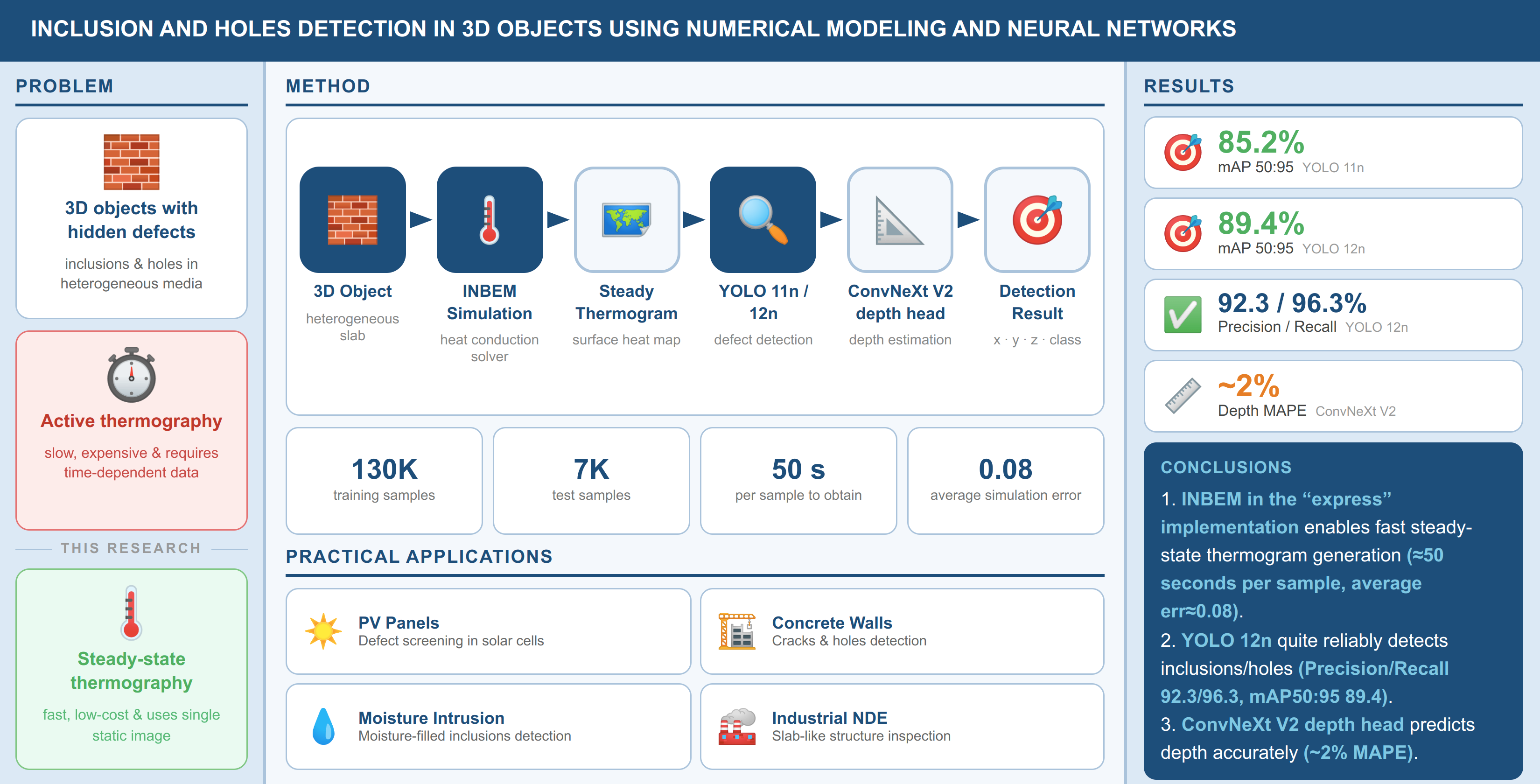
The object of research is a stationary heat-conduction process in three-dimensional heterogeneous media which components are in ideal thermal contact.
The addressed problem is the difficulties in detecting, localizing, and classifying inclusions in 3D objects. Most methods rely on employing active thermography which produces data as time-dependent sequences. Both capturing and processing it is quite costly and resource required.
The paper proposes a hybrid approach that relies on steady-heat thermograms, which are significantly easier and cheaper to capture. The developed approach uses one of the variants of the indirect near-boundary element method (INBEM), SOTA detectors (YOLO 11n and 12n), and a custom depth head based on ConvNeXt V2. Additionally, the paper showed that attention-centric architecture is promising for processing steady heat images.
INBEM with near-boundary elements in the form of families of points achieves an execution time of approximately 50 seconds per sample, with a general maximum error of approximately 0.08. This enabled the creation of a large dataset, comprising approximately 130K samples. Additionally, a testing dataset with a size of 7K and slightly different variance is obtained. Both YOLO 11n and 12n showed mAP50:95 metric results on the testing dataset of 85.2% and 89.4%, respectively. The precision/recall for both models are the following: 92.0/92.8 and 92.3/96.3. The depth head showed a MAPE of about 2%.
The proposed method focuses on detecting inclusions and holes using steady heat images, so it is suitable for relatively low-cost analysis, as obtaining such data is easier and quicker than collecting time-dependent data. It may be useful to screen slab-like structures, such as photovoltaic panels. Wall diagnostics is one possible future application area, as the work can be extended to semi-infinite objects. Thus, the results may serve as a basis for a low-cost inspection tool.
References
- Rezayiye, R. K., Ibarra-Castanedo, C., Maldague, X. (2024). Methods for Corrosion Detection in Pipes Using Thermography: A Case Study on Synthetic Datasets. Algorithms, 17 (10), 439. https://doi.org/10.3390/a17100439
- Salah, M., Werghi, N., Svetinovic, D., Abdulrahman, Y. (2025). Multi-Modal Attention Networks for Enhanced Segmentation and Depth Estimation of Subsurface Defects in Pulse Thermography. ArXiv. https://doi.org/10.48550/arxiv.2501.09994
- Sels, S., Bogaerts, B., Verspeek, S., Ribbens, B., Steenackers, G., Penne, R. et al. (2020). 3D Defect detection using weighted principal component thermography. Optics and Lasers in Engineering, 128, 106039. https://doi.org/10.1016/j.optlaseng.2020.106039
- Dudzik, S. (2015). Two-stage neural algorithm for defect detection and characterization uses an active thermography. Infrared Physics & Technology, 71, 187–197. https://doi.org/10.1016/j.infrared.2015.03.003
- Szymanik, B., Psuj, G., Hashemi, M., Lopato, P. (2021). Detection and Identification of Defects in 3D-Printed Dielectric Structures via Thermographic Inspection and Deep Neural Networks. Materials, 14 (15), 4168. https://doi.org/10.3390/ma14154168
- Kumar, R., Puranik, V. E., Gupta, R. (2024). Unveiling the Potential of Infrared Thermography in Quantitative Investigation of Potential-Induced Degradation in Crystalline Silicon PV Module. Solar Energy Advances, 4, 100049. https://doi.org/10.1016/j.seja.2023.100049
- Spajić, M., Talajić, M., Mršić, L. (2024). Using CNNs for Photovoltaic Panel Defect Detection via Infrared Thermography to Support Industry 4.0. Business Systems Research Journal, 15 (1), 45–66. https://doi.org/10.2478/bsrj-2024-0003
- Di Tommaso, A., Betti, A., Fontanelli, G., Michelozzi, B. (2022). A multi-stage model based on YOLOv3 for defect detection in PV panels based on IR and visible imaging by unmanned aerial vehicle. Renewable Energy, 193, 941–962. https://doi.org/10.1016/j.renene.2022.04.046
- Ta, Q. T., Mac, V. H., Huh, J., Yim, H. J., Lee, G. (2025). Automatic detection of subsurface defects in concrete structures using state-of-the-art deep learning-based object detectors on the infrared dataset. Engineering Structures, 329, 119829. https://doi.org/10.1016/j.engstruct.2025.119829
- Jeon, M., Yoo, S., Kim, S.-W. (2022). A Contactless PCBA Defect Detection Method: Convolutional Neural Networks With Thermographic Images. IEEE Transactions on Components, Packaging and Manufacturing Technology, 12 (3), 489–501. https://doi.org/10.1109/tcpmt.2022.3147319
- Liu, J., Long, X., Jiang, C., Liao, W. (2024). Multi-feature vision transformer for automatic defect detection and quantification in composites using thermography. NDT & E International, 143, 103033. https://doi.org/10.1016/j.ndteint.2023.103033
- Wu, Z., Chen, S., Feng, F., Qi, J., Feng, L., Tao, N. et al. (2023). Automatic defect detection and three-dimensional reconstruction from pulsed thermography images based on a bidirectional long-short term memory network. Engineering Applications of Artificial Intelligence, 124, 106574. https://doi.org/10.1016/j.engappai.2023.106574
- Resendiz-Ochoa, E., Trejo-Chavez, O., Saucedo-Dorantes, J. J., Morales-Hernandez, L. A., Cruz-Albarran, I. A. (2024). Application of Thermography and Convolutional Neural Network to Diagnose Mechanical Faults in Induction Motors and Gearbox Wear. Applied System Innovation, 7 (6), 123. https://doi.org/10.3390/asi7060123
- Era, I. Z., Zhou, F., Raihan, A. S., Ahmed, I., Abul-Haj, A., Craig, J. et al. (2024). In-Situ Melt Pool Characterization via Thermal Imaging for Defect Detection in Directed Energy Deposition Using Vision Transformers. ArXiv. https://doi.org/10.48550/arxiv.2411.12028
- Zheng, S., Zhang, J., Zu, R., Li, Y. (2024). Vision transformer-enhanced thermal anomaly detection in building facades through fusion of thermal and visible imagery. Journal of Asian Architecture and Building Engineering, 24 (4), 2854–2868. https://doi.org/10.1080/13467581.2024.2379866
- Campione, I., Lucchi, F., Santopuoli, N., Seccia, L. (2020). 3D Thermal Imaging System with Decoupled Acquisition for Industrial and Cultural Heritage Applications. Applied Sciences, 10 (3), 828. https://doi.org/10.3390/app10030828
- Sabathiel, S., Sanchis-Alepuz, H., Wilson, A. S., Reynvaan, J., Stipsitz, M. (2024). Neural network-based reconstruction of steady-state temperature systems with unknown material composition. Scientific Reports, 14 (1). https://doi.org/10.1038/s41598-024-73380-1
- Zhuravchak, L. M., Zabrods’ka, N. V. (2010). Nonstationary thermal fields in inhomogeneous materials with nonlinear behavior of the components. Materials Science, 46 (1), 36–46. https://doi.org/10.1007/s11003-010-9261-9
- Zhuravchak, L., Kruk, O. (2015). Consideration of the nonlinear behavior of environmental material and a three-dimensional internal heat sources in mathematical modeling of heat conduction. Mathematical Modeling and Computing, 2 (1), 107–113. https://doi.org/10.23939/mmc2015.01.107
- Zhuravchak, L. (2019). Computation of pressure change in piecewise-homogeneous reservoir for elastic regime by indirect near-boundary element method. 2019 IEEE 14th International Conference on Computer Sciences and Information Technologies (CSIT), 141–144. https://doi.org/10.1109/stc-csit.2019.8929820
- Zhuravchak, L.; Shakhovska, N., Medykovskyy, M. O. (Eds.) (2019). Mathematical Modelling of Non-stationary Processes in the Piecewise-Homogeneous Domains by Near-Boundary Element Method. Advances in Intelligent Systems and Computing IV. Cham: Springer, 64–77. https://doi.org/10.1007/978-3-030-33695-0_6
- Havdulskyi, R., Zhuravchak, L. (2025). Recognition of inclusion characteristics using neural network methods in stationary process modeling. Visnyk Natsionalnoho universytetu “Lvivska politekhnika”. Seriia Informatsiini systemy ta merezhi, 17, 75–92. https://doi.org/10.23939/sisn2025.17.075
- Havdulskyi, R., Zhuravchak, L., Yakovyna, V.; Hovorushchenko, T., Savenko, O., Popov, P. T., Lysenko, S. (Eds.) (2025). Inclusion parameters estimation using INBEM and CNNs with gradient-based feature extraction. 2nd International Workshop on Intelligent & CyberPhysical Systems (ICyberPhyS 2025). CEUR Workshop Proceedings, 4013. Available at: https://ceur-ws.org/Vol-4013/paper2.pdf
- Khanam, R., Hussain, M. (2024). YOLOv11: An Overview of the Key Architectural Enhancements. ArXiv. https://doi.org/10.48550/arxiv.2410.17725
- Tian, Y., Ye, Q., Doermann, D. (2025). YOLOv12: Attention-Centric Real-Time Object Detectors. ArXiv. https://doi.org/10.48550/arxiv.2502.12524
- Sharma, A., Kumar, V., Longchamps, L. (2024). Comparative performance of YOLOv8, YOLOv9, YOLOv10, YOLOv11 and Faster R-CNN models for detection of multiple weed species. Smart Agricultural Technology, 9, 100648. https://doi.org/10.1016/j.atech.2024.100648
- Jaeger, B. E., Schmid, S., Grosse, C. U., Gögelein, A., Elischberger, F. (2022). Infrared Thermal Imaging-Based Turbine Blade Crack Classification Using Deep Learning. Journal of Nondestructive Evaluation, 41 (4). https://doi.org/10.1007/s10921-022-00907-9
- Zhuravchak, L. M., Zabrodska, N. V. (2020). Using of partly-boundary elements as a version of the indirect near-boundary element method for potential field modeling. Mathematical Modeling and Computing, 8 (1), 1–10. https://doi.org/10.23939/mmc2021.01.001
- Zhuravchak, L. M. (2024). Potential field modeling by combination of near-boundary and contact elements with non-classical finite differences in a heterogeneous medium. Mathematical Modeling and Computing, 11 (2), 373–384. https://doi.org/10.23939/mmc2024.02.373
- Zhuravchak, L., Zabrodska, N. (2024). Algorithm for determining inclusion parameters in solving inverse problems of geoelectrical exploration using the profiling method. Geodynamics, 1 (36), 98–107. https://doi.org/10.23939/jgd2024.01.098
- Russakovsky, O., Deng, J., Su, H., Krause, J., Sanjeev Satheesh, Ma, S. et al. (2014). ImageNet Large Scale Visual Recognition Challenge. ArXiv. https://doi.org/10.48550/arxiv.1409.0575
- Woo, S., Debnath, S., Hu, R., Chen, X., Liu, Z., Kweon, I. S. et al. (2023). ConvNeXt V2: Co-designing and Scaling ConvNets with Masked Autoencoders. ArXiv. https://doi.org/10.48550/arxiv.2301.00808
- Shazeer, N. (2020). GLU Variants Improve Transformer. ArXiv. https://doi.org/10.48550/arXiv.2002.05202
- Arora, I. (2024). Improving Performance of Data Science Applications in Python. Indian Journal Of Science And Technology, 17 (24), 2499–2507. https://doi.org/10.17485/ijst/v17i24.914
- Zhuravchak, L. (2023). Computational Aspects of the Use of Different Types of Near-boundary elements in Modeling the Non-stationary Heat Conduction Process. 2023 IEEE 18th International Conference on Computer Science and Information Technologies (CSIT). Lviv: IEEE, 1–5. https://doi.org/10.1109/csit61576.2023.10324216
- Sapkota, R., Harsha, C. R., Sharda, A., Karkee, M. (2025). YOLO26: Key Architectural Enhancements and Performance Benchmarking for Real-Time Object Detection. ArXiv. https://doi.org/10.48550/arxiv.2509.25164
Downloads
Published
How to Cite
Issue
Section
License
Copyright (c) 2026 Roman Havdulskyi, Liubov Zhuravchak

This work is licensed under a Creative Commons Attribution 4.0 International License.
The consolidation and conditions for the transfer of copyright (identification of authorship) is carried out in the License Agreement. In particular, the authors reserve the right to the authorship of their manuscript and transfer the first publication of this work to the journal under the terms of the Creative Commons CC BY license. At the same time, they have the right to conclude on their own additional agreements concerning the non-exclusive distribution of the work in the form in which it was published by this journal, but provided that the link to the first publication of the article in this journal is preserved.