Розробка прогностичної теплової моделі на основі підходу еквівалентних джерел для зварювання труб із сталі X70 методом SMAW
DOI:
https://doi.org/10.15587/2706-5448.2026.352967Ключові слова:
моделювання зварювання, чисельне проєктування, SMAW зварювання, еквівалентне джерело тепла, параметри коригуванняАнотація
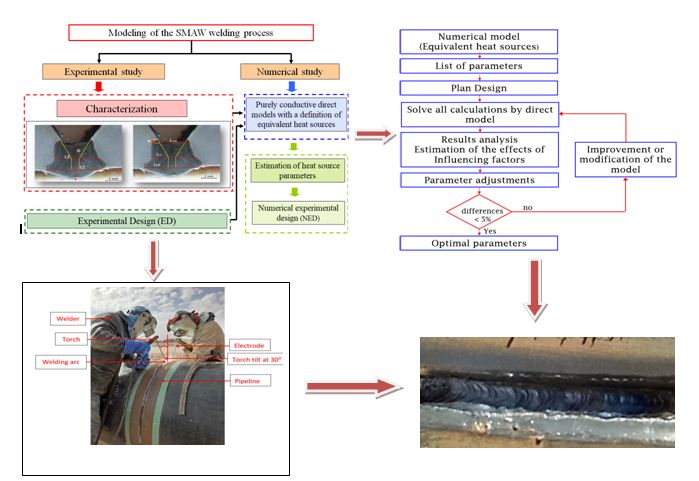
Об’єктом дослідження є науковий підхід до моделювання теплових явищ під час зварювальних робіт при зварюванні трубопроводів методом SMAW (ручне дугове зварювання). Дана модель може бути використана для розрахунку змін температурних полів, а також напружень та деформацій.
Освоєння зварювальних процесів вимагає розуміння різноманітних явищ. Це вимагає проведення численних випробувань, які є дуже дорогими для виробників. Тому ідеальним рішенням було б розробити прогностичні чисельні моделі, що дозволяють аналізувати поведінку вузлів. Процес SMAW використовується для заповнення фаски між двома деталями. Тому дуже важливо визначити підведення тепла, яке може бути описане за допомогою підходу еквівалентного джерела тепла. Складність реалізації цього підходу полягає у оцінці різних параметрів моделі. З цією метою було запропоновано розробити простий та надійний підхід, який полягає у використанні методу чисельного планування експериментів (ПЕ).
У цьому дослідженні було вирішено вибрати чотири параметри моделі (rsurf_sup, rsurf_inf, r0 і λ) та чотири цільові функції, що характеризують форму зони зрощення (Lsup, Lm, Linf, H). Попередні результати показують хорошу відповідність між прямою моделлю та розмірами, зафіксованими на макрографічних зрізах, за винятком ширини серединної сторони зони зрощення (Lm), де спостерігається значне відхилення 11,4% між вимірюваннями та моделлю. Крім того, неруйнівний контроль показує, що rsurf_inf є фактором, що найбільше впливає на Lm. Коригування коефіцієнта rsurf_inf на 0,5 від його значення в центральній точці змінює значення Lm з 3,25 мм до 3,09 мм. Це коригування оптимізує цифрову модель, покращуючи її та зменшуючи розбіжність між моделюванням та експериментом для функції Lm з 11,4% до 1,2%. Результати цього дослідження дозволяють підвищити надійність нафтопереробних об'єктів (трубопровідних вузлів). Наукова новизна цієї роботи полягає у застосуванні простого та надійного наукового підходу до оптимізації нефізичних параметрів (параметрів еквівалентного джерела тепла) при моделюванні зварювальних процесів.
Посилання
- Goldak, J., Chakravarti, A., Bibby, M. (1984). A new finite element model for welding heat sources. Metallurgical Transactions B, 15 (2), 299–305. https://doi.org/10.1007/bf02667333
- Yu, D., Yang, C., Sun, Q., Dai, L., Wang, A., Xuan, H. (2023). Impact of process parameters on temperature and residual stress distribution of X80 pipe girth welds. International Journal of Pressure Vessels and Piping, 203, 104939. https://doi.org/10.1016/j.ijpvp.2023.104939
- Kong, F., Ma, J., Kovacevic, R. (2011). Numerical and experimental study of thermally induced residual stress in the hybrid laser–GMA welding process. Journal of Materials Processing Technology, 211 (6), 1102–1111. https://doi.org/10.1016/j.jmatprotec.2011.01.012
- Liu, S., Sun, J., Wei, F., Lu, M. (2018). Numerical simulation and experimental research on temperature and stress fields in TIG welding for plate of RAFM steel. Fusion Engineering and Design, 136, 690–693. https://doi.org/10.1016/j.fusengdes.2018.03.058
- Bidi, L., Mattei, S., Cicala, E., Andrzejewski, H., Le Masson, P., Schroeder, J. (2011). The use of exploratory experimental designs combined with thermal numerical modelling to obtain a predictive tool for hybrid laser/MIG welding and coating processes. Optics & Laser Technology, 43 (3), 537–545. https://doi.org/10.1016/j.optlastec.2010.07.011
- Zubairuddin, M., Albert, S. K., Vasudevan, M., Mahadevan, S., Chaudhari, V., Suri, V. K. (2017). Numerical simulation of multi-pass GTA welding of grade 91 steel. Journal of Manufacturing Processes, 27, 87–97. https://doi.org/10.1016/j.jmapro.2017.04.031
- Bendaoud, I., Matteï, S., Cicala, E., Tomashchuk, I., Andrzejewski, H., Sallamand, P. et al. (2014). The numerical simulation of heat transfer during a hybrid laser–MIG welding using equivalent heat source approach. Optics & Laser Technology, 56, 334–342. https://doi.org/10.1016/j.optlastec.2013.09.007
- Obeid, O., Alfano, G., Bahai, H., Jouhara, H. (2018). Numerical simulation of thermal and residual stress fields induced by lined pipe welding. Thermal Science and Engineering Progress, 5, 1–14. https://doi.org/10.1016/j.tsep.2017.10.005
- Goldak, J., Bibby, M., Moore, J., House, R., Patel, B. (1986). Computer modeling of heat flow in welds. Metallurgical Transactions B, 17 (3), 587–600. https://doi.org/10.1007/bf02670226
- Li, W., Yu, R., Huang, D., Wu, J., Wang, Y., Hu, T. et al. (2019). Numerical simulation of multi-layer rotating arc narrow gap MAG welding for medium steel plate. Journal of Manufacturing Processes, 45, 460–471. https://doi.org/10.1016/j.jmapro.2019.07.035
- Pichot, F., Danis, M., Lacoste, E., Danis, Y. (2013). Numerical definition of an equivalent GTAW heat source. Journal of Materials Processing Technology, 213 (7), 1241–1248. https://doi.org/10.1016/j.jmatprotec.2013.01.009
- Danis, Y., Lacoste, E., Arvieu, C. (2010). Numerical modeling of inconel 738LC deposition welding: Prediction of residual stress induced cracking. Journal of Materials Processing Technology, 210 (14), 2053–2061. https://doi.org/10.1016/j.jmatprotec.2010.07.027
- Farias, R. M., Teixeira, P. R. F., Vilarinho, L. O. (2021). An efficient computational approach for heat source optimization in numerical simulations of arc welding processes. Journal of Constructional Steel Research, 176, 106382. https://doi.org/10.1016/j.jcsr.2020.106382
- Lei, Y., Zhu, Q., Zhang, L., Gu, K., Ju, X. (2010). Simulation on the welding of CLAM steel. Fusion Engineering and Design, 85 (7–9), 1503–1507. https://doi.org/10.1016/j.fusengdes.2010.04.014
- Bag, S., Trivedi, A., De, A. (2009). Development of a finite element based heat transfer model for conduction mode laser spot welding process using an adaptive volumetric heat source. International Journal of Thermal Sciences, 48 (10), 1923–1931. https://doi.org/10.1016/j.ijthermalsci.2009.02.010
- Flint, T. F., Francis, J. A., Smith, M. C., Balakrishnan, J. (2017). Extension of the double-ellipsoidal heat source model to narrow-groove and keyhole weld configurations. Journal of Materials Processing Technology, 246, 123–135. https://doi.org/10.1016/j.jmatprotec.2017.02.002
- Chen, L., Mi, G., Zhang, X., Wang, C. (2019). Numerical and experimental investigation on microstructure and residual stress of multi-pass hybrid laser-arc welded 316L steel. Materials & Design, 168, 107653. https://doi.org/10.1016/j.matdes.2019.107653
- Farias, R. M., Teixeira, P. R. F., Vilarinho, L. O. (2022). Variable profile heat source models for numerical simulations of arc welding processes. International Journal of Thermal Sciences, 179, 107593. https://doi.org/10.1016/j.ijthermalsci.2022.107593
- Mondal, A. K., Kumar, B., Bag, S., Nirsanametla, Y., Biswas, P. (2021). Development of avocado shape heat source model for finite element based heat transfer analysis of high-velocity arc welding process. International Journal of Thermal Sciences, 166, 107005. https://doi.org/10.1016/j.ijthermalsci.2021.107005
- Belitzki, A., Marder, C., Huissel, A., Zaeh, M. F. (2016). Automated heat source calibration for the numerical simulation of laser beam welded components. Production Engineering, 10 (2), 129–136. https://doi.org/10.1007/s11740-016-0664-9
- Gannon, L., Liu, Y., Pegg, N., Smith, M. (2010). Effect of welding sequence on residual stress and distortion in flat-bar stiffened plates. Marine Structures, 23 (3), 385–404. https://doi.org/10.1016/j.marstruc.2010.05.002
- Azadi Moghaddam, M., Golmezergi, R., Kolahan, F. (2016). Multi-variable measurements and optimization of GMAW parameters for API-X42 steel alloy using a hybrid BPNN–PSO approach. Measurement, 92, 279–287. https://doi.org/10.1016/j.measurement.2016.05.049
- García-García, V., Reyes-Calderón, F., Camacho-Arriaga, J. C. (2016). Optimization of experimental temperature measurement in GTAW process by means of DoE technique and computational modeling. Measurement, 88, 297–309. https://doi.org/10.1016/j.measurement.2016.03.049
- Fu, G., Gu, J., Lourenco, M. I., Duan, M., Estefen, S. F. (2014). Parameter determination of double-ellipsoidal heat source model and its application in the multi-pass welding process. Ships and Offshore Structures, 10 (2), 204–217. https://doi.org/10.1080/17445302.2014.937059
- Bidi, L., Le Masson, P., Cicala, E., Primault, C. (2017). Experimental design method to the weld bead geometry optimization for hybrid laser-MAG welding in a narrow chamfer configuration. Optics & Laser Technology, 89, 114–125. https://doi.org/10.1016/j.optlastec.2016.09.046
- Wang, H., Woo, W., Kim, D.-K., Em, V., Lee, S. Y. (2018). Effect of chemical dilution and the number of weld layers on residual stresses in a multi-pass low-transformation-temperature weld. Materials & Design, 160, 384–394. https://doi.org/10.1016/j.matdes.2018.09.016
- Forouzan, M. R., Heidari, A., Golestaneh, S. J. (2009). FE simulation of submerged arc welding of API 5L-X70 straight seam oil and gas pipes. Journal of Computational Methods in Engineering, 28, 93–110 Available at: https://jcme.iut.ac.ir/article_3029_3925785f0e7afbb5933eb87d589edb33.pdf
- Bensiali, H., Bidi, L., Cicala, E., Le Masson, P., Chibani, M. E. B., Boulahlib, M. S. (2021). Effects of operating parameters on weld bead morphology with welding operations of API 5L X70 steel pipes by SMAW process. Welding in the World, 65 (6), 1119–1129. https://doi.org/10.1007/s40194-021-01085-4
- Bidi, L., Le Masson, P., Cicala, E. (2024). Influences of laser on the energy parameters of the electric arc in the case of laser-MIG hybrid welding. The International Journal of Advanced Manufacturing Technology, 131 (7–8), 4055–4069. https://doi.org/10.1007/s00170-024-13244-0
- Goupy, J. (2001). Introduction aux plans d’expériences. Paris: Dunod. Available at: https://iadji.com/wp-content/uploads/2020/08/Introduction-aux-Plans-dExperiences.pdf
- Montgomery, D. C. (1991). Design and analysis of experiments. Singapore: John Wiley & Sons. Available at: https://www.scribd.com/document/405637459/Douglas-C-Montgomery-Design-and-analysis-of-experiments-Wiley-1991-pdf?language_settings_changed=English
##submission.downloads##
Опубліковано
Як цитувати
Номер
Розділ
Ліцензія
Авторське право (c) 2026 Adel Chouiter, Lyes Bidi, Hadjer Bensiali, Rachid Chaib, Philippe Le Masson

Ця робота ліцензується відповідно до Creative Commons Attribution 4.0 International License.
Закріплення та умови передачі авторських прав (ідентифікація авторства) здійснюється у Ліцензійному договорі. Зокрема, автори залишають за собою право на авторство свого рукопису та передають журналу право першої публікації цієї роботи на умовах ліцензії Creative Commons CC BY. При цьому вони мають право укладати самостійно додаткові угоди, що стосуються неексклюзивного поширення роботи у тому вигляді, в якому вона була опублікована цим журналом, але за умови збереження посилання на першу публікацію статті в цьому журналі.