Determination of the impact of traffic delays at signalized intersections on the travel time of a fire engine to the place of a call
DOI:
https://doi.org/10.15587/2706-5448.2026.353012Keywords:
signalized intersection, travel route, traffic delay, fire, travel time, fire engineAbstract
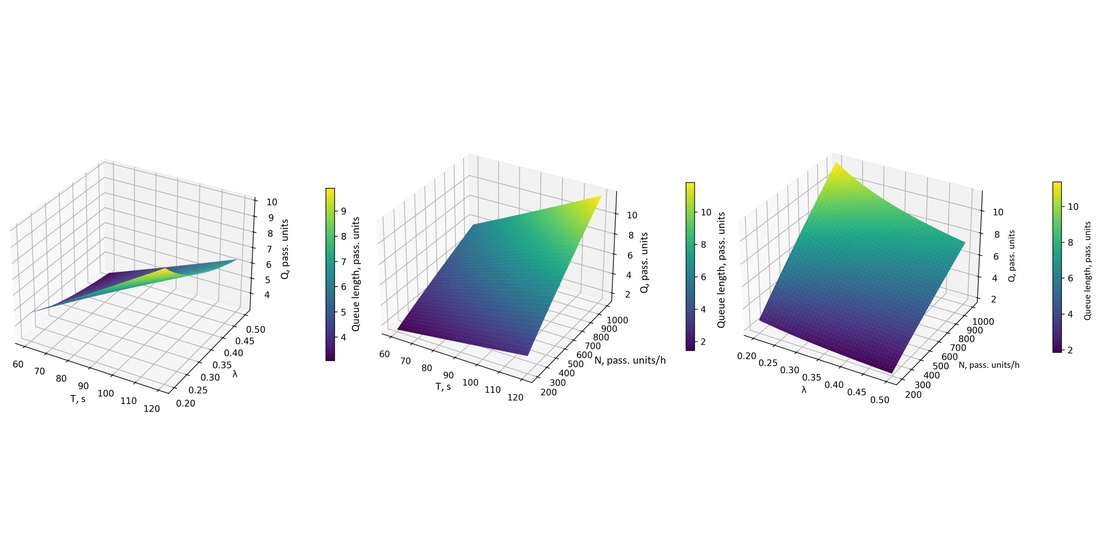
The paper outlines the problem of the influence of various factors, in particular traffic delays at signalized intersections, on the movement of a fire engine to the place of a call. The object of research is the process of queue formation of vehicles at a signalized intersection, which leads to delays of a fire engine during its response. The conditions for queue formation at signalized intersections were identified, under which the queue may reach its maximum value or remain in a continuous growth mode. Thus, prerequisites for further research were established, and the maximum traffic flow intensity of 1000 passenger car units was selected. Using simulation modeling in the PTV Vissim environment, a model of a signalized intersection with a two-lane approach was developed. This model enables simulation of intersection crossing by varying traffic flow intensity, signal cycle length, and the proportion of green time within each cycle. Experimental studies of the maximum queue length were conducted using the full factorial experiment method. A relationship was obtained to determine the maximum queue length at a signalized intersection as a function of traffic flow intensity, signal cycle length, and the proportion of green time in each cycle. The magnitude of the influence of each identified parameter on queue formation at the intersection was analyzed separately. It was established that increasing the proportion of the green signal from 0.20 to 0.50 reduces the queue length by approximately 35–40%. An increase in traffic intensity from 200 to 1000 passenger car units per hour leads to an approximately fourfold increase in queue length. The obtained relationships can be further used in the development of new or the improvement of existing models for determining optimal response routes of emergency vehicles to the place of a call, taking into account possible delays at signalized intersections.
References
- Hao, Z., Wang, Y., Yang, X. (2024). Every Second Counts: A Comprehensive Review of Route Optimization and Priority Control for Urban Emergency Vehicles. Sustainability, 16 (7), 2917. https://doi.org/10.3390/su16072917
- Pasnak, I., Renkas, A. (2020). Optimization of the duration of emergency vehicle movement to the place of fire. Transport Problems, 15 (4, Part 1), 117–124. https://doi.org/10.21307/tp-2020-053
- Hulida, E., Pasnak, I., Koval, O., Tryhuba, A. (2019). Determination of the Critical Time of Fire in the Building and Ensure Successful Evacuation of People. Periodica Polytechnica Civil Engineering, 63 (1), 308–316. https://doi.org/10.3311/ppci.12760
- Behrooz, H., Ilbeigi, M. (2025). Adaptive emergency evacuation routing: a graph-based approach. International Journal of Transportation Science and Technology, 20, 178–192. https://doi.org/10.1016/j.ijtst.2024.11.010
- Huliak, M., Marková, I. (2026). Analysis of access roads, boarding areas and arrival times of firefighting units to selected heritage wooden buildings. Transportation Research Procedia, 93, 1006–1012. https://doi.org/10.1016/j.trpro.2025.12.035
- Wu, J., Kulcsár, B., Ahn, S., Qu, X. (2020). Emergency vehicle lane pre-clearing: From microscopic cooperation to routing decision making. Transportation Research Part B: Methodological, 141, 223–239. https://doi.org/10.1016/j.trb.2020.09.011
- Musolino, G., Polimeni, A., Rindone, C., Vitetta, A. (2013). Travel Time Forecasting and Dynamic Routes Design for Emergency Vehicles. Procedia – Social and Behavioral Sciences, 87, 193–202. https://doi.org/10.1016/j.sbspro.2013.10.603
- Humayun, M., Almufareh, M. F., Jhanjhi, N. Z. (2022). Autonomous Traffic System for Emergency Vehicles. Electronics, 11 (4), 510. https://doi.org/10.3390/electronics11040510
- Huang, D., Wang, S., Liu, Z. (2021). A systematic review of prediction methods for emergency management. International Journal of Disaster Risk Reduction, 62, 102412. https://doi.org/10.1016/j.ijdrr.2021.102412
- Wang, W., Wu, S., Wang, S., Zhen, L., Qu, X. (2021). Emergency facility location problems in logistics: Status and perspectives. Transportation Research Part E: Logistics and Transportation Review, 154, 102465. https://doi.org/10.1016/j.tre.2021.102465
- Wu, J., Qu, X. (2022). Intersection control with connected and automated vehicles: a review. Journal of Intelligent and Connected Vehicles, 5 (3), 260–269. https://doi.org/10.1108/jicv-06-2022-0023
- Li, Z., Wang, Q., Wang, J., He, Z. (2024). A Flexible Cooperative MARL Method for Efficient Passage of an Emergency CAV in Mixed Traffic. IEEE Transactions on Intelligent Transportation Systems, 25 (8), 8898–8912. https://doi.org/10.1109/tits.2024.3411487
- Nahofti Kohneh, J., Murray-Tuite, P. (2025). Two-Level Routing Framework to Facilitate the Movement of Emergency Response Vehicles in a Transportation Network. Transportation Research Record: Journal of the Transportation Research Board, 2679 (11), 1143–1170. https://doi.org/10.1177/03611981251351873
- Chen, Y., Wang, J., Lo, S., Sung, W. (2024). An emergency vehicle traffic signal preemption system considering queue spillbacks along routes and negative impacts on non‐priority traffic. IET Intelligent Transport Systems, 18 (8), 1385–1395. Portico. https://doi.org/10.1049/itr2.12518
- Pasnak, I., Prydatko, O., Gavrilyk, A. (2016). Development of algorithms for efficient management of fire rescue units. Eastern-European Journal of Enterprise Technologies, 3 (3 (81)), 22–28. https://doi.org/10.15587/1729-4061.2016.71604
Downloads
Published
How to Cite
Issue
Section
License
Copyright (c) 2026 Ivan Pasnak

This work is licensed under a Creative Commons Attribution 4.0 International License.
The consolidation and conditions for the transfer of copyright (identification of authorship) is carried out in the License Agreement. In particular, the authors reserve the right to the authorship of their manuscript and transfer the first publication of this work to the journal under the terms of the Creative Commons CC BY license. At the same time, they have the right to conclude on their own additional agreements concerning the non-exclusive distribution of the work in the form in which it was published by this journal, but provided that the link to the first publication of the article in this journal is preserved.