Gaining a deeper understanding of the behavior of soil mixing under the aging effect by comparing predictive approach and practical results
DOI:
https://doi.org/10.15587/2706-5448.2026.353663Keywords:
fine particles, soil-mixing, durability, damage, aging cycle, compressive strength, cement dosageAbstract
The object of this research is the behavior of soil mixing column.
The problem that this research aims to address is to better understand the behavior of soil mixtures under the effect of wetting-drying cycles (aging) and its impact on unconfined compressive strength.
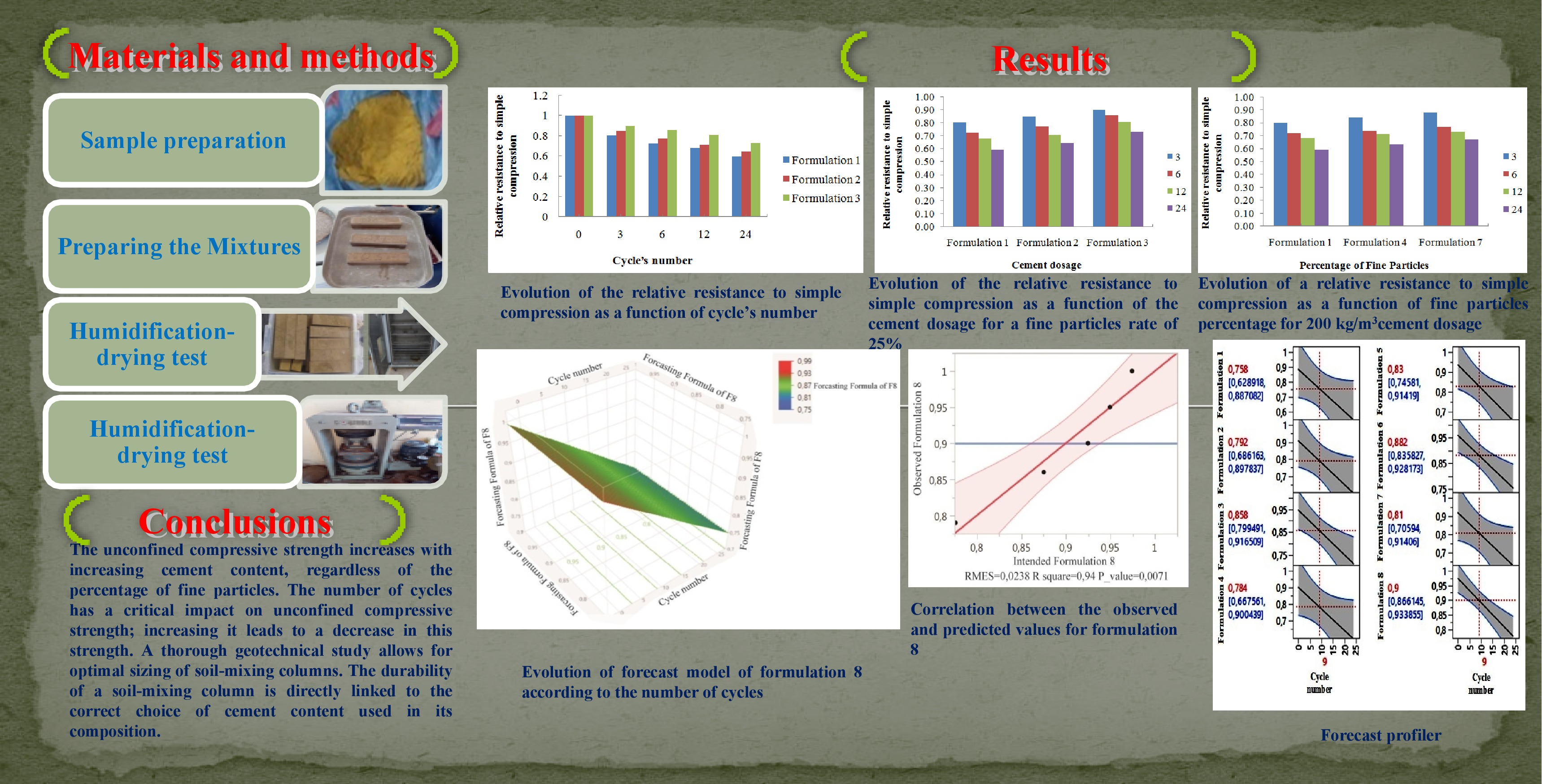
The research consists of a parametric laboratory (experimental) research, with the preparation of different mixtures containing varying percentages of fine particles, cement, and water/cement (W/C) ratios. Eight different formulations were studied: a reference formulation, three formulations with 25% fine particles and different cement dosages, three formulations with 10% fine particles, and two with 5% fine particles. A reference sample was used to track the evolution of these results. This variation in mixture composition allows to observe the influence of particle size distribution, clay content, and cement content on the relative unconfined compressive strength of the prisms. The results show that the relative compressive strength of the prisms decreases by approximately 41% between 3 and 24 cycles, regardless of the cement content. It increases by 18 to 25% with increasing cement content for all formulations, but decreases by approximately 23% with increasing fine particle content. This research allowed to propose an equation to predict the evolution of relative compressive strength as a function of time, the number of wetting-drying cycles, cement content, and fine particle content. The various results obtained highlight the influence of fine particle and cement content on the performance and durability of soil mixing columns, and underscore the importance of conducting a thorough parametric research in the laboratory to facilitate the efficient and economical design of these columns.
References
- Terashi, M. (2003). The State of Practice in Deep Mixing Methods. Grouting and Ground Treatment, 25–49. https://doi.org/10.1061/40663(2003)2
- Denies, N., Huybrechts, N. (2017). Deep mixing method for the construction of earth and water retaining walls. RILEM Technical Letters, 2, 1–9. https://doi.org/10.21809/rilemtechlett.2017.27
- Tinoco, J., Gomes Correia, A., Cortez, P. (2014). Support vector machines applied to uniaxial compressive strength prediction of jet grouting columns. Computers and Geotechnics, 55, 132–140. https://doi.org/10.1016/j.compgeo.2013.08.010
- Topolnicki, M., Soltys, G. (2012). Novel Application of Wet Deep Soil Mixing for Foundation of Modern Wind Turbines. Grouting and Deep Mixing 2012, 533–542. https://doi.org/10.1061/9780784412350.0039
- Moseley, M. P., Kirsch, K. (Eds.). (2004). Ground Improvement. https://doi.org/10.1201/9780203489611
- Tinoco, J., Gomes Correia, A., Cortez, P. (2011). Application of data mining techniques in the estimation of the uniaxial compressive strength of jet grouting columns over time. Construction and Building Materials, 25 (3), 1257–1262. https://doi.org/10.1016/j.conbuildmat.2010.09.027
- Kamdem, A., Elat, E., Eslami, J., Amba, J. C., Sali, M., Mbessa, M., Noumowé, A. (2024). Influence of the Nature of Cement on the Physical and Mechanical Properties of Soil Concretes from Sandy Clay and Laterite. CivilEng, 5 (2), 307–326. https://doi.org/10.3390/civileng5020016
- Rapport de sol N°056/2012. Elaboré par Laboratoire de l’Habitat de Construction de l’Est, 6–22. Available at: https://lnhc-dz.com
- Helson, O., Beaucour, A.-L., Eslami, J., Noumowe, A., Gotteland, P. (2017). Physical and mechanical properties of soilcrete mixtures: Soil clay content and formulation parameters. Construction and Building Materials, 131, 775–783. https://doi.org/10.1016/j.conbuildmat.2016.11.021
- Design of experiments. Moresteam. Available at: https://www.moresteam.com/toolbox/design-of-experiments
Downloads
Published
How to Cite
Issue
Section
License
Copyright (c) 2026 Farouk Menari, Sabah Moussaoui, Mourad Belgasmia, Khelifa Abbeche

This work is licensed under a Creative Commons Attribution 4.0 International License.
The consolidation and conditions for the transfer of copyright (identification of authorship) is carried out in the License Agreement. In particular, the authors reserve the right to the authorship of their manuscript and transfer the first publication of this work to the journal under the terms of the Creative Commons CC BY license. At the same time, they have the right to conclude on their own additional agreements concerning the non-exclusive distribution of the work in the form in which it was published by this journal, but provided that the link to the first publication of the article in this journal is preserved.