Identification of influential railway stations using local synchronization in complex networks of train formation plans
DOI:
https://doi.org/10.15587/2706-5448.2026.356296Keywords:
railway, wagon flow, railway stations, train formation plan, Kuramoto model, local synchronizationAbstract
The object of research is the dynamic processes of coordination of interactions among railway stations within the train formation plan (TFP) network. The problem addressed lies in the insufficiency of traditional topological approaches for identifying influential stations in railway networks. An analysis based solely on degree centrality indicators does not allow the detection of hidden sources of dynamic vulnerability.
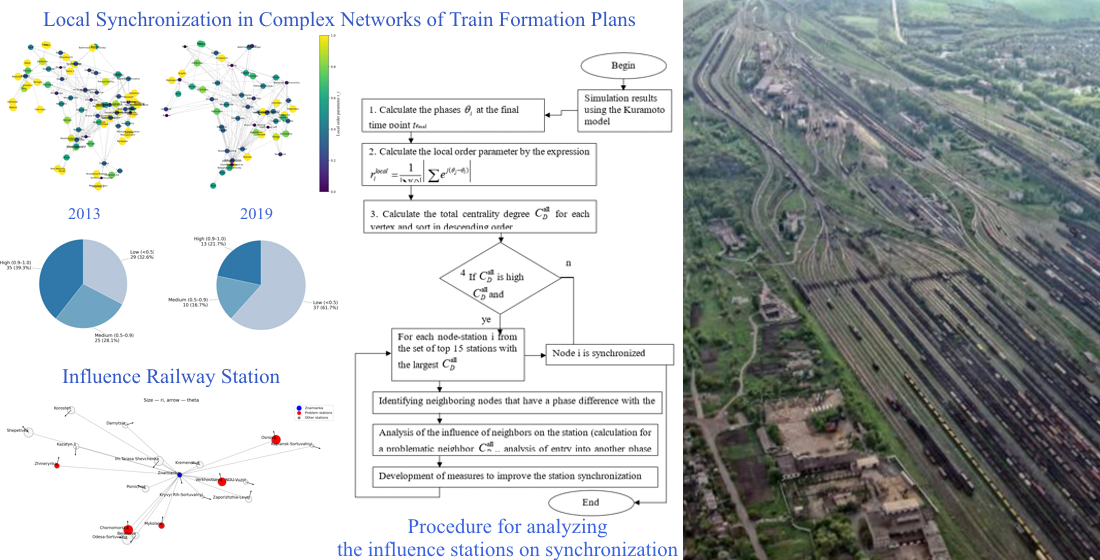
An approach is proposed for identifying critical stations and links that reduce the coherence of the TFP network, based on the investigation of local synchronization characteristics. A procedure for analyzing station influence is developed through the integration of centrality measures with a local order parameter calculated using the Kuramoto model. The application of the proposed procedure to real TFP networks representing different structural states revealed changes in local synchronization characteristics. The average value of the local order parameter within the largest strongly connected component decreased from 0.6664 to 0.4976. It was established that topologically significant marshalling stations may exhibit low values of the local order parameter, that is, they may remain locally desynchronized from their immediate neighborhood. It is substantiated that the key factor reducing local synchronization of stations is the phase heterogeneity of their nearest neighborhood, in particular the presence of adjacent stations belonging to other phase clusters.
The practical application of the results is possible provided that the TFP is formalized as a network model and data on the structure of train assignments are available. The proposed approach can be used to support managerial decision-making regarding adjustments to the TFP, improvement of station coordination, and enhancement of the resilience of the railway system under structural changes.
References
- Butko, T., Prokhorchenko, A., Kyman, A. (2015). Formalization of the technology of arranging tactical group trains. Eastern-European Journal of Enterprise Technologies, 4 (3 (76)), 38–43. https://doi.org/10.15587/1729-4061.2015.47886
- Cargo transportation. JSC Ukrzaliznytsia. Available at: https://www.uz.gov.ua/cargo_transportation
- Zahorianskyi, V., Zahorianska, O., Moroz, M., Moroz, O. (2022). Development of a Model for Minimizing the Energy Costs of the Transport and Technological Complex. 2022 IEEE 4th International Conference on Modern Electrical and Energy System (MEES), 1–5. https://doi.org/10.1109/mees58014.2022.10005635
- Zhao, Y., Li, D., Yin, Y., Zhao, X. (2023). Integrated optimization of demand-driven timetable, train formation plan and rolling stock circulation with variable running times and dwell times. Transportation Research Part E: Logistics and Transportation Review, 171, 103035. https://doi.org/10.1016/j.tre.2023.103035
- Prokhorchenko, A., Kyman, A., Kravchenko, M., Medvediev, I. (2026). Structural evolution of Ukraine’s freight rail transportation system under partial network loss. Journal of Transport Geography, 131, 104554. https://doi.org/10.1016/j.jtrangeo.2026.104554
- Wang, W., Du, W., Liu, K., Tong, L. (2022). The Evolution of China’s Railway Network (CRN) 1999–2019: Urbanization Impact and Regional Connectivity. Urban Rail Transit, 8 (2), 134–145. https://doi.org/10.1007/s40864-022-00168-9
- Panchenko, A., Prokhorchenko, A., Panchenko, S., Dekarchuk, O., Gurin, D., Medvediev, I. (2020). Predicting the estimated time of cargo dispatch from a marshaling yard. Eastern-European Journal of Enterprise Technologies, 4 (3 (106)), 6–15. https://doi.org/10.15587/1729-4061.2020.209912
- Yanovska, V., Król, M., Pittman, R. (2025). The logistics of grain exports from wartime Ukraine: What are the highest priority areas to Address? Transportation Research Interdisciplinary Perspectives, 30, 101363. https://doi.org/10.1016/j.trip.2025.101363
- Arenas, A., Díaz-Guilera, A., Kurths, J., Moreno, Y., Zhou, C. (2008). Synchronization in complex networks. Physics Reports, 469 (3), 93–153. https://doi.org/10.1016/j.physrep.2008.09.002
- Kuramoto, Y.; Araki, H. (Ed.) (1975). Self-entrainment of a population of coupled non-linear oscillators. International Symposium on Mathematical Problems in Theoretical Physics. Springer, 420–422. https://doi.org/10.1007/bfb0013365
- Acebrón, J. A., Bonilla, L. L., Pérez Vicente, C. J., Ritort, F., Spigler, R. (2005). The Kuramoto model: A simple paradigm for synchronization phenomena. Reviews of Modern Physics, 77 (1), 137–185. https://doi.org/10.1103/revmodphys.77.137
- Tang, Y., Qian, F., Gao, H., Kurths, J. (2014). Synchronization in complex networks and its application – A survey of recent advances and challenges. Annual Reviews in Control, 38 (2), 184–198. https://doi.org/10.1016/j.arcontrol.2014.09.003
- Motter, A. E., Myers, S. A., Anghel, M., Nishikawa, T. (2013). Spontaneous synchrony in power-grid networks. Nature Physics, 9 (3), 191–197. https://doi.org/10.1038/nphys2535
- Shahal, S., Wurzberg, A., Sibony, I., Duadi, H., Shniderman, E., Weymouth, D. et al. (2020). Synchronization of complex human networks. Nature Communications, 11 (1). https://doi.org/10.1038/s41467-020-17540-7
- Rodriguez, M., Fathy, H. K. (2022). Distributed Kuramoto Self-Synchronization of Vehicle Speed Trajectories in Traffic Networks. IEEE Transactions on Intelligent Transportation Systems, 23 (7), 6786–6796. https://doi.org/10.1109/tits.2021.3062178
- Kyman, A., Prokhorchenko, A., Panchenko, A., Zolotarov, S., Kravchenko, M., Prokhorchenko, H., Orda, O. (2025). Devising of a method for analysing the propagation speed of car flows in a train formation plan based on synchronisation theory in complex networks. Eastern-European Journal of Enterprise Technologies, 5 (3 (137)), 56–67. https://doi.org/10.15587/1729-4061.2025.341559
- Zabaleta-Ortega, Á., Masoller, C., Guzmán-Vargas, L. (2025). Unveiling synchronization transitions in networks of coupled oscillators through persistent homology of local structures. Scientific Reports, 15 (1). https://doi.org/10.1038/s41598-025-27083-w
- Chen, J., Cao, J., Huang, W. (2023). Traffic-driven explosive synchronization with adaptive local routing in complex networks. Chaos, Solitons & Fractals, 168, 113142. https://doi.org/10.1016/j.chaos.2023.113142
- Li, X., Ye, J., Ji, P. (2026). The impact of topological heterogeneity on local synchronization in complex networks. Chaos, Solitons & Fractals, 204, 117745. https://doi.org/10.1016/j.chaos.2025.117745
- Rodrigues, F. A., Peron, T. K. DM., Ji, P., Kurths, J. (2016). The Kuramoto model in complex networks. Physics Reports, 610, 1–98. https://doi.org/10.1016/j.physrep.2015.10.008
- Newman, J., Rowland Adams, J., Clemson, P. T., Stefanovska, A. (2025). An order parameter for synchronisation of angular velocities. The European Physical Journal Special Topics. https://doi.org/10.1140/epjs/s11734-025-01984-3
- Lind, P. G., Gallas, J. A. C., Herrmann, H. J.; Ausloos, M., Dirickx, M. (Eds.) (2006). Coherence in Complex Networks of Oscillators. The Logistic Map and the Route to Chaos. Springer, 77–97. https://doi.org/10.1007/3-540-32023-7_5
- Zhou, M., Li, X., Xiong, W., Wu, X., Liao, H. (2019). Cooperation of local and collective synchronization in complex networks. Physica A: Statistical Mechanics and Its Applications, 526, 120963. https://doi.org/10.1016/j.physa.2019.04.199
- Strogatz, S. H. (2000). From Kuramoto to Crawford: exploring the onset of synchronization in populations of coupled oscillators. Physica D: Nonlinear Phenomena, 143 (1–4), 1–20. https://doi.org/10.1016/s0167-2789(00)00094-4
Downloads
Published
How to Cite
Issue
Section
License
Copyright (c) 2026 Andrii Kyman, Andrii Prokhorchenko, Mykhailo Kravchenko, Mykhailo Muzykin

This work is licensed under a Creative Commons Attribution 4.0 International License.
The consolidation and conditions for the transfer of copyright (identification of authorship) is carried out in the License Agreement. In particular, the authors reserve the right to the authorship of their manuscript and transfer the first publication of this work to the journal under the terms of the Creative Commons CC BY license. At the same time, they have the right to conclude on their own additional agreements concerning the non-exclusive distribution of the work in the form in which it was published by this journal, but provided that the link to the first publication of the article in this journal is preserved.