Determination of force and energy parameters in impact fracture processes of materials of various strengths and rheology properties
DOI:
https://doi.org/10.15587/2706-5448.2026.356852Keywords:
impact fracture modeling, pendulum impactor, Johnson-Holmquist rheological model, sliding contact energy, impact strength, energy dissipation factorAbstract
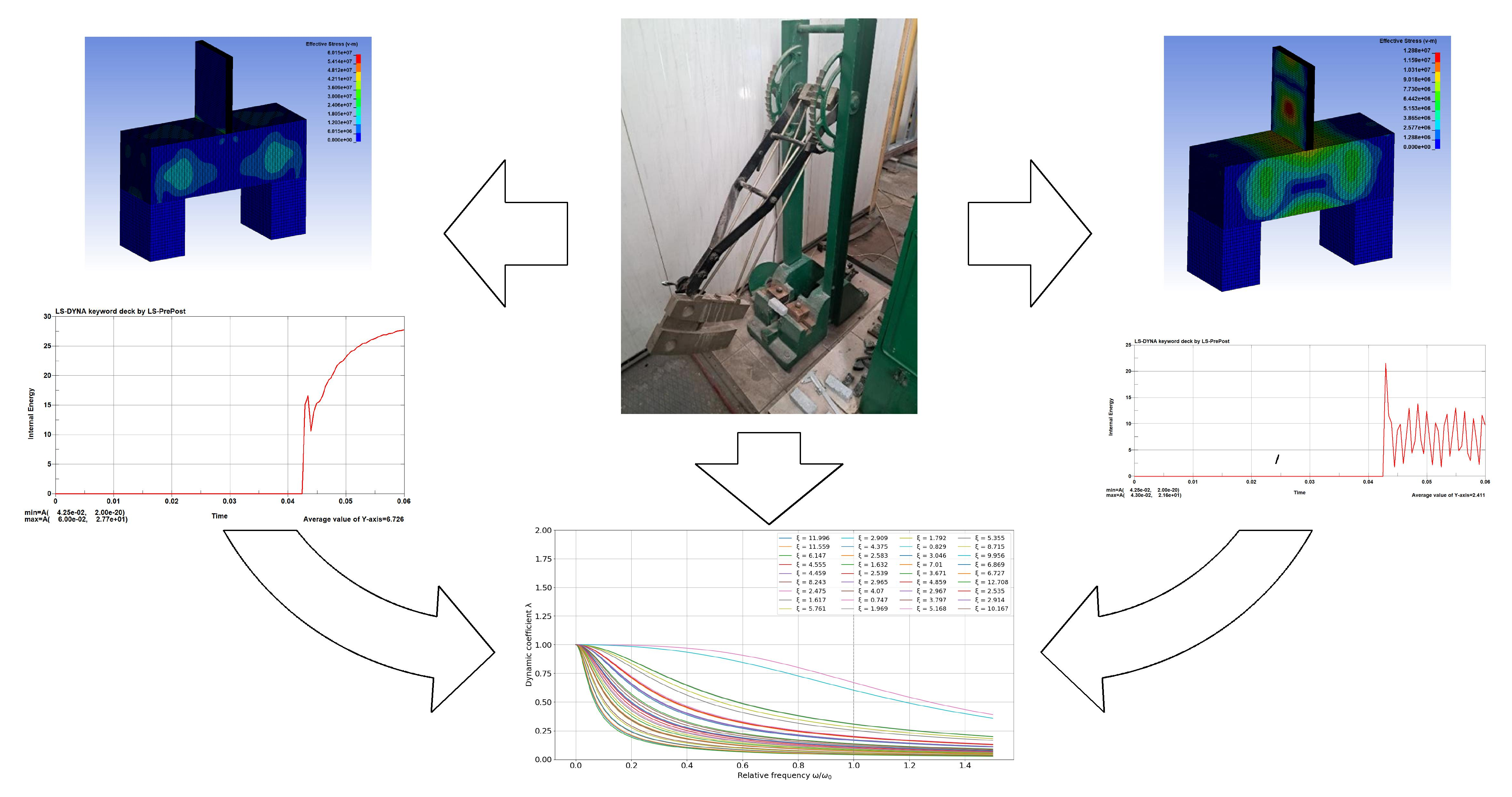
The object of research is the processes of impact fracture of materials of different strengths and rheological properties.
The problem of determining the force and energy parameters remains the lack of a generally accepted model of the processes of fracture of materials of different strengths and their rheological properties. In most crushing machines in the crushing chamber, the destruction of materials is accompanied by impact loads or is generally shock (impact crushers).
The work includes studies of material destruction using the example of granite. The analysis of Johnson-Holmquist models was carried out, according to the plastic fracture model, which is designed to model the behavior of brittle materials, according to the fracture model of porous materials, especially concretes, which are subjected to large deformations, high strain rates and high pressure. It was found that during impact loading, maximum stresses arise on the impact surface, and also spread along the beam to the inner edges of the supports. The difference between the internal and kinetic energies for the JH2 body was 9.2 J, while for the JH1 body it was 15.3 J. The study on the pendulum impactor allowed to estimate the energy spent on the fracture of the material sample. It was established that if the crack crosses the intergranular boundary due to the action of local stress concentration, new cracks appear in the corresponding cleavage planes of neighboring grains, which require additional energy input to the sample. To estimate the dissipated energy in the fracture process, it was proposed to introduce an appropriate resistance coefficient. Based on experimental data, the resistance coefficient value was established for various rocks. The obtained research results can be used in the development and study of equipment for crushing materials. The value of the specific fracture energy can be used to study dynamic processes in building structures under excessive loads.
References
- Dedov, O., Vabishchevych, M., Skoruk, O., Twardowski, G. (2024). Study of the Effects of Natural And Man-Made Origin On the Technical Condition of Architectural Monuments. International Journal of Conservation Science, 15 (SI), 195–204. https://doi.org/10.36868/ijcs.2024.si.16
- Casagrande, L., Villa, E., Nespoli, A., Occhiuzzi, A., Bonati, A., Auricchio, F. (2019). Innovative dampers as floor isolation systems for seismically-retrofit multi-storey critical facilities. Engineering Structures, 201, 109772. https://doi.org/10.1016/j.engstruct.2019.109772
- Yue, Y., Wang, H., Zhang, S. (2024). Dynamical Modeling and Dynamic Characteristics Analysis of a Coaxial Dual-Rotor System. Journal of Dynamics, Monitoring and Diagnostics, 3 (2), 99–111. https://doi.org/10.37965/jdmd.2024.524
- Mishchuk, Y., Nazarenko, I. (2023). Analysis of the energy laws of material destruction. Strength of Materials and Theory of Structures, 110, 294–315. https://doi.org/10.32347/2410-2547.2023.110.294-315
- Kammer, D. S., McLaskey, G. C., Abercrombie, R. E., Ampuero, J.-P., Cattania, C., Cocco, M. et al. (2024). Earthquake energy dissipation in a fracture mechanics framework. Nature Communications, 15 (1). https://doi.org/10.1038/s41467-024-47970-6
- Chen, C.-H., Bouchbinder, E., Karma, A. (2017). Instability in dynamic fracture and the failure of the classical theory of cracks. Nature Physics, 13 (12), 1186–1190. https://doi.org/10.1038/nphys4237
- Zhou, X., Jia, Z. (2024). Dynamic propagation of moving cracks in brittle materials by field-enriched finite element method. Engineering Fracture Mechanics, 305, 110177. https://doi.org/10.1016/j.engfracmech.2024.110177
- Kamran, M., Liu, H., Fukuda, D., Jia, P., Min, G., Chan, A. (2025). State-of-the-Art Review and Prospect of Modelling the Dynamic Fracture of Rocks Under Impact Loads and Application in Blasting. Geosciences, 15 (8), 314. https://doi.org/10.3390/geosciences15080314
- Nazarenko, I., Dedov, O., Bernyk, I., Pereginets, I., Titova, L., Rogovskii, I., Ruchynskyi, M.; Nazarenko, I. (Ed.) (2021). Research of technical systems of processes of mixing materials. Dynamic processes in technological technical systems. Kharkiv: TECHNOLOGY CENTER PC, 57–76. https://doi.org/10.15587/978-617-7319-49-7.ch4
- Javed, R. A., Zhu, S. F., Farid, M. (2013). Dynamic Fracture Toughness: Critical Review of Materials and Developments. Applied Mechanics and Materials, 389, 289–297. https://doi.org/10.4028/www.scientific.net/amm.389.289
- Nazarenko, I., Dedov, O., Mishchuk, Y., Slipetskyi, V., Delembovskyi, M., Zalisko, I., Nesterenko, M.; Nazarenko, I. (Ed.) (2021). Research of stress-strain state of elements of technological technical constructions. Dynamic processes in technological technical systems. Kharkiv: TECHNOLOGY CENTER PC, 140–179. https://doi.org/10.15587/978-617-7319-49-7.ch8
- Vabishchevych, M., Dedov, O., Diachenko, O., Lytvyn, O. (2025). Research of the design of a T-shaped node of cold-rolled profiles, the connection of which is made by a plate using a bolt connection. Strength of Materials and Theory of Structures, 114, 62–75. https://doi.org/10.32347/2410-2547.2025.114.62-75
- Li, P., Liu, Y., Zhang, J., Dong, Z., Wu, X., Miao, S., Cai, M. (2025). Dynamic Failure Mechanism and Fractal Features of Fractured Rocks Under Quasi-Triaxial Static Pressures and Repeated Impact Loading. Fractal and Fractional, 9 (2), 71. https://doi.org/10.3390/fractalfract9020071
- Li, M., Zhu, F., Mao, Y., Pu, H., Chen, Y., Wu, P., Wu, B. (2025). Dynamic direct tensile mechanical response characteristics and damage fracture mechanism of water-saturated frozen sandstone. Journal of Materials Research and Technology, 35, 4955–4974. https://doi.org/10.1016/j.jmrt.2025.02.153
- Titov, D., Zahorsky, D., Hryhoriev, Y., Balyk, S., Kozariz, V. (2025). Experimental specification of the nature of rock mass fragmentation by blasting of borehole charges of variable length. Technology Audit and Production Reserves, 3 (1 (83)), 78–85. https://doi.org/10.15587/2706-5448.2025.331974
- Zhang, K., Zhang, L., Liu, F., Yu, Y., Wang, S. (2024). Quantitative investigation of rock dynamic failure using Voronoi-based discontinuous deformation analysis. Geomechanics and Geophysics for Geo-Energy and Geo-Resources, 10 (1). https://doi.org/10.1007/s40948-024-00767-9
- Javed, R. A., Shifan, Z., Guo, C., Vecchio, K. S., Jiang, F. (2015). Investigation into dynamic response of a three-point bend specimen in a Hopkinson bar loaded fracture test using numerical methods. Advances in Mechanical Engineering, 7 (7). https://doi.org/10.1177/1687814015591315
- Wu, Y., Yin, T., Liu, X., Tan, X., Yang, Z., Li, Q. (2022). Determination of dynamic mode I fracture toughness of rock at ambient high temperatures using notched semi-circular bend method. Transactions of Nonferrous Metals Society of China, 32 (9), 3036–3050. https://doi.org/10.1016/s1003-6326(22)66001-1
Downloads
Published
How to Cite
Issue
Section
License
Copyright (c) 2026 Ivan Nazarenko, Oleg Dedov, Yevhen Mishchuk, Iryna Bernyk, Artur Onyshchenko, Mykola Kuzminets, Valentyn Chernysh, Mykola Nesterenko

This work is licensed under a Creative Commons Attribution 4.0 International License.
The consolidation and conditions for the transfer of copyright (identification of authorship) is carried out in the License Agreement. In particular, the authors reserve the right to the authorship of their manuscript and transfer the first publication of this work to the journal under the terms of the Creative Commons CC BY license. At the same time, they have the right to conclude on their own additional agreements concerning the non-exclusive distribution of the work in the form in which it was published by this journal, but provided that the link to the first publication of the article in this journal is preserved.





