Development a mathematical model of processes inside RF hollow cathode taking viscosity into account in electron dynamics
DOI:
https://doi.org/10.15587/2706-5448.2026.356937Keywords:
high-frequency cathode, viscosity tensor, potential barrier, skin-layer, bipolar layerAbstract
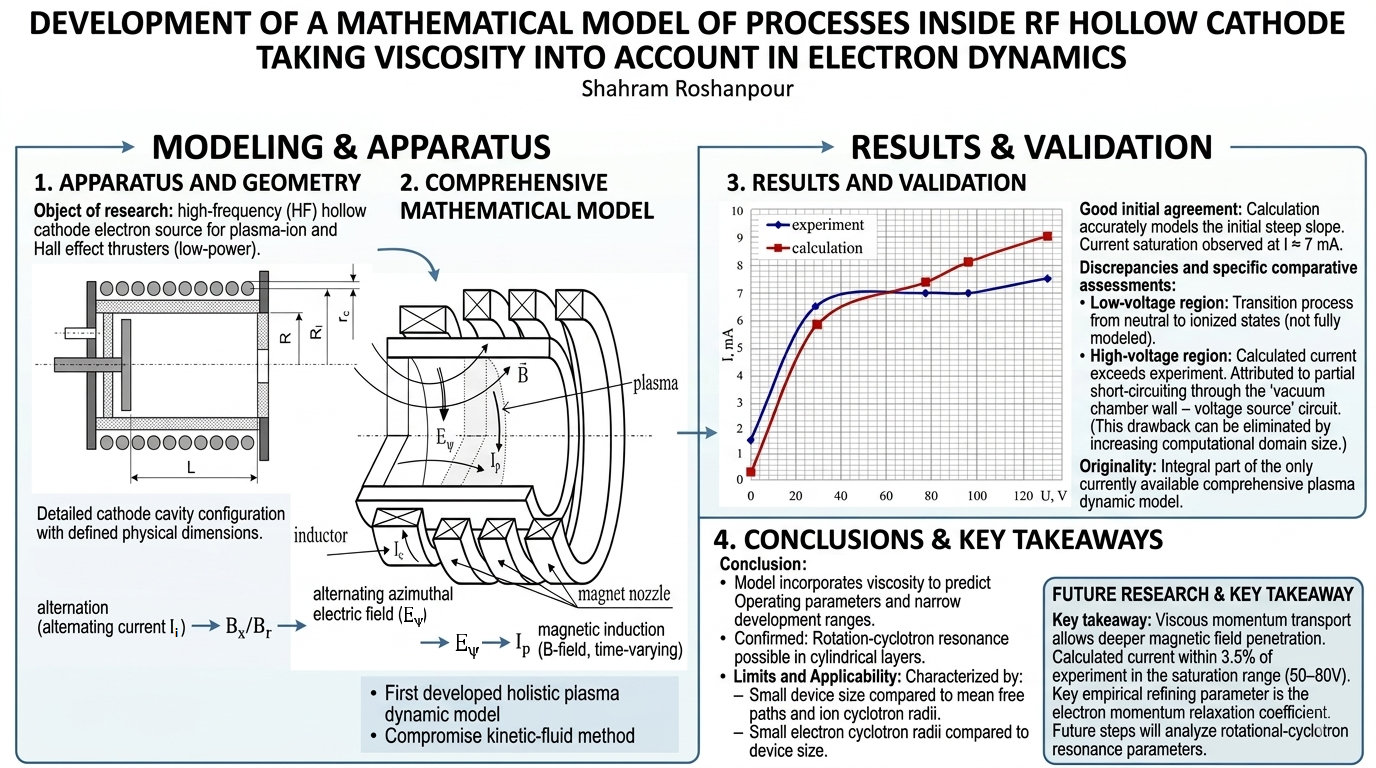
The object of research is high-frequency hollow cathode as electron sources in plasma-ion thrusters and Hall effect thrusters with relatively low-power.
Publications devoted to high-frequency (helicon) thrusters consider Trivelpiece-Gould waves, helicon waves, as well as ion-cyclotron and electron-cyclotron resonance, as mechanisms for absorbing electromagnetic energy. In this case, electron scattering by atoms and ions within the thruster channel is considered a factor in plasma thermalization. The discharge conditions and the dimensions of the low-power cathode cavity virtually eliminate the occurrence of these effects, while significantly enhancing the relaxation of electron momentum due to non-mirror reflection from the potential barrier in the boundary bipolar layer. The parameters describing the results of this reflection within the cavity volume are the axial-azimuth and radial-azimuth components of the electron viscosity tensor, corresponding to the electron momentum flux in the direction of zero mass flow. It is shown that viscous electron momentum transport facilitates magnetic field penetration deeper into the plasma than is predicted by classical skin-layer theory, which considers the relaxation of electrons motion only because of collisions in the volume. Conditions under which rotation-cyclotron resonance is possible are identified. The input of viscosity into electrons thermalization process is shown.
The results obtained in the work can be used in predicting operating parameters and narrowing the range of parameter variations when developing laboratory models.
References
- Myers, R. M., Oleson, S. R., McGuire, M., Meckel, N. J., Cassady, R. J. (1995). Pulsed Plasma Thruster Technology for Small Satellite Missions. The 9th AIAA, Utah State University Conference on Small Satellites, 14. Available at: https://ntrs.nasa.gov/api/citations/19960011377/downloads/19960011377.pdf
- Aoyagi, J., Hatakeyama, T., Irie, M., Okutsu, A., Takegahara, H., Watanabe, H. (2007). Preliminary Study on Radio Frequency Neutralizer for Ion Engine. The 30th International Electric Propulsion Conf, 5. Available at: https://electricrocket.org/IEPC/IEPC-2007-226.pdf
- Squire, J. P., Chang-Diaz, F. R., Jacobson, V. T., Glover, T. W., Baity, F. W., Carter, M. D. et al. (2003). Investigation of a Light Gas Helicon Plasma Source for the VASIMR Space Propulsion System. AIP Conference Proceedings, 694, 423–426. https://doi.org/10.1063/1.1638071
- Zhu, Q., Su, Y. (2024). A Non-inductive Coil Design Used to Provide High-Frequency and Large Currents. Sensors, 24 (7), 2027. https://doi.org/10.3390/s24072027
- Akhiezer, A. I., Akhiezer, I. A., Polovin, R. V., Sitenko, A. G., Stepanov, K. N. (2011). Plasma Electrodynamics. Vol. 1. Linear Theory. Pergamon press, 422. Available at: https://api.pageplace.de/preview/DT0400.9781483152158_A23873861/preview-9781483152158_A23873861.pdf
- Shinohara, S. (2018). Helicon high-density plasma sources: physics and applications. Advances in Physics: X, 3 (1), 1420424. https://doi.org/10.1080/23746149.2017.1420424
- Chen, F. F. (2001). Collisional, magnetic, and nonlinear skin effect in radio-frequency plasmas. Physics of Plasmas, 8 (6), 3008–3017. https://doi.org/10.1063/1.1367322
- Korzec, D., Schott, M., Engemann, J. (1995). Radio frequency hollow cathode discharge for large-area double-sided foil processing. Journal of Vacuum Science & Technology A: Vacuum, Surfaces, and Films, 13 (3), 843–848. https://doi.org/10.1116/1.579839
- Touš, J., Šícha, M., Hubička, Z., Soukup, L., Jastrabík, L., Čada, M., Tichý, M. (2002). The Radio Frequency Hollow Cathode Discharge Induced by the RF Discharge in the Plasma-Jet Chemical Reactor. Contributions to Plasma Physics, 42 (1), 119–131. https://doi.org/10.1002/1521-3986(200201)42:1<119::aid-ctpp119>3.0.co;2-7
- Smirnov, P., Smirnova, M., Schein, J., Khartov, S. (2019). Research and development of radio-frequency cathode-neutralizer. The 36th International Electric Propulsion Conference, 7. Available at: https://electricrocket.org/2019/840.pdf
- Roshanpur, S. (2013). Electron gas parameters change inside langmuir layer in electric propulsion devices. Eastern-European Journal of Enterprise Technologies, 4 (5 (64)), 36–39. https://doi.org/10.15587/1729-4061.2013.16675
- Nesterenko, S., Zhihao, H., Roshanpour, S. (2025). Compromise kinetic-fluid model of electrons dynamics in electric propulsion devices with closed electrons drift as an alternative to the hybrid PIC-Fluid method. Aerospace Technic and Technology, 1, 28–37. https://doi.org/10.32620/aktt.2025.1.03
- Nesterenko, S. Yu., Roshanpour, Sh. (2013). Particles velocity distribution function moments equations set in rarified medium of inductive sources of plasma, electrons and ions. Aviation and space engineering and technology, 7 (104), 117–120. Available at: http://nbuv.gov.ua/UJRN/aktit_2013_7_23
- Roshanpour, S. (2025). Viscous Absorption of Electromagnetic Capacity in Radio Frequency Low Current Hollow Cathode. XIV Naukova konferentsiia «Naukovi Pidsumky 2025 Roku», 73. Available at: https://entc.com.ua/download/НАУКОВІ%20ПІДСУМКИ%202025.pdf
- Roshanpour, S. (2025). Computer modeling of non-emission electron source with high-frequency ionization. ScienceRise, 2, 79–91. https://doi.org/10.21303/2313-8416.2025.003885
Downloads
Published
How to Cite
Issue
Section
License
Copyright (c) 2026 Shahram Roshanpour

This work is licensed under a Creative Commons Attribution 4.0 International License.
The consolidation and conditions for the transfer of copyright (identification of authorship) is carried out in the License Agreement. In particular, the authors reserve the right to the authorship of their manuscript and transfer the first publication of this work to the journal under the terms of the Creative Commons CC BY license. At the same time, they have the right to conclude on their own additional agreements concerning the non-exclusive distribution of the work in the form in which it was published by this journal, but provided that the link to the first publication of the article in this journal is preserved.





