Improvement of methodology for assessing the dynamics of degradation and direct economic losses of the agricultural sector in the conditions of modern challenges caused by military actions
DOI:
https://doi.org/10.15587/2706-5448.2026.358139Keywords:
dynamics of agricultural sector degradation, satellite data, vegetation indices, “scissors” effect, structural order index, direct economic lossesAbstract
The object of research is the process of assessing the dynamics of degradation and direct economic losses of the agricultural sector. The hypothesis of research is based on the assumption that the regression model is able to provide a reliable short-term assessment (with a lag of 1 year) of the actual state of land use.
Improved methodology for assessing the dynamics of degradation and direct economic losses in the agricultural sector, which, unlike the known ones, involves the following stages:
– analysis of the dynamics of the Red and NIR channels within the study area to identify patterns of degradation of agrophytocenoses;
– determination of a statistical criterion of landscape structural order (OSI) to differentiate target crops from ruderal vegetation;
– conducting a linear regression analysis to determine the areas of active production based on the spectral characteristics of satellite data.
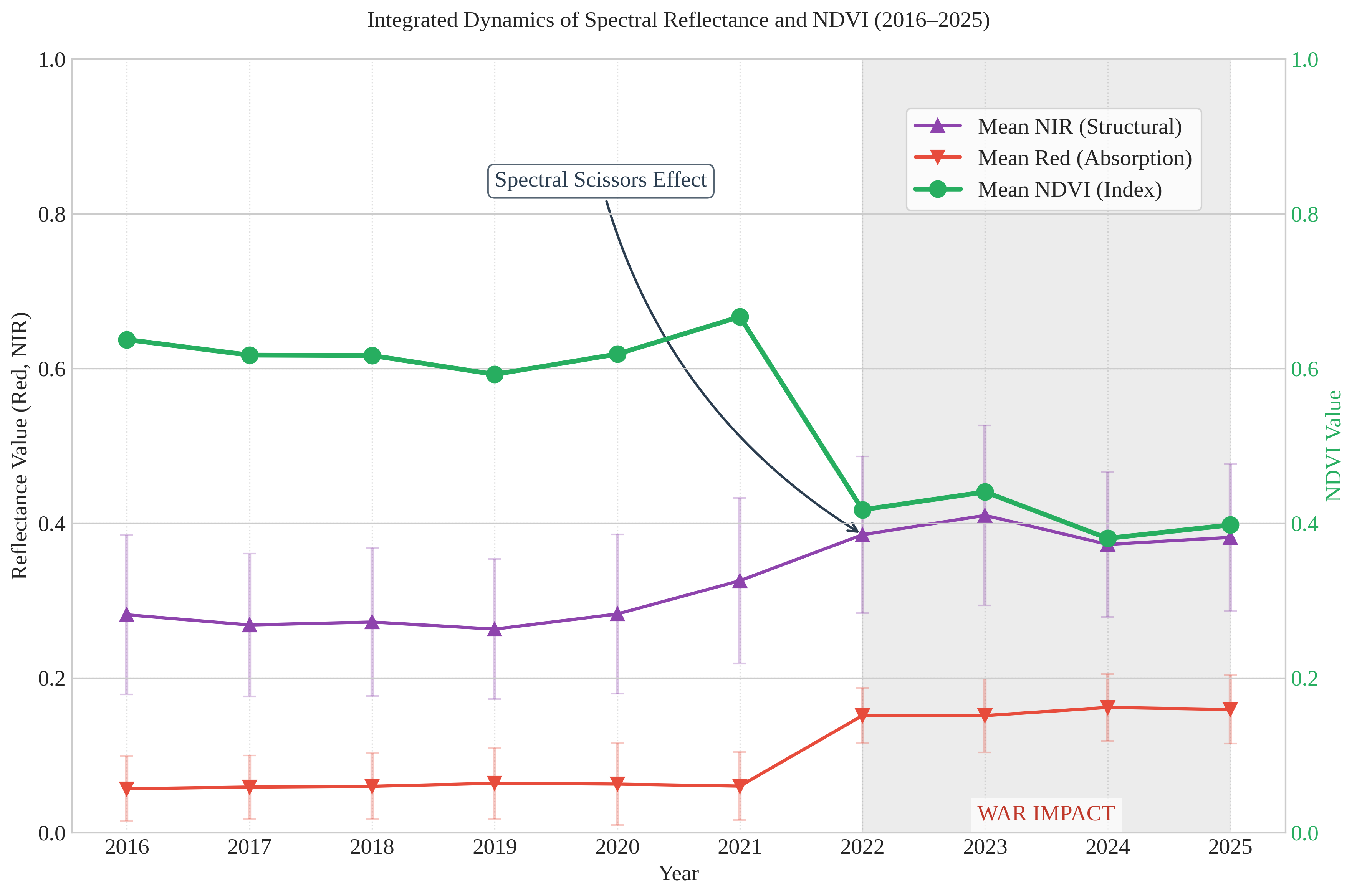
Experimental studies have been conducted to assess the volume of direct economic losses in the agricultural sector for the period 2022–2025. Analysis of the dynamics of spectral channels for 2016–2025 showed that starting from 2022, a “scissors” effect has been observed – a steady increase in the average in the Red channel and a decrease in NDVI, which is a sign of land withdrawal from cultivation. In the pre-war period, OSI values were in the range of 0.3–0.7, and starting from 2022 they became negative (about –1.5), which corresponds to the loss of structural integrity of the agricultural landscape. The calculated direct economic losses in the agricultural sector of the Kyiv region (Ukraine) for 2022–2025 are 491.7–548.11 million USD, depending on the calculation method. The gap between official statistics and the calculation method (37.26 million USD) corresponds to the crop that was sown but not harvested due to military threats.
References
- Mkrtchian, A., Müller, D. (2024). Assessing the impact of the Russian invasion on crop production in Ukraine with open satellite data. Ukrainian Analytical Digest, 5, 8–14. Available at: https://www.ssoar.info/ssoar/handle/document/94116
- Kussul, N., Yailymova, H., Drozd, S. (2022). Detection of War-Damaged Agricultural Fields of Ukraine Based on Vegetation Indices Using Sentinel-2 Data. 2022 12th International Conference on Dependable Systems, Services and Technologies (DESSERT). Athens: IEEE, 1–5. https://doi.org/10.1109/dessert58054.2022.10018739
- Sentinel–2. Copernicus Data Space Ecosystem. Available at: https://surl.li/ghfgxu
- Shumilo, L., Drozd, S., Kussul, N. (2025). Satellite data aids the study of the war’s environmental and economic consequences for Ukraine’s agriculture sector. Ukraine War Environmental Consequences Work Group. Available at: https://surl.lu/ojfaoi
- Khudov, H., Makoveichuk, O., Tokarev, S., Andriushchenko, A., Pukhovyi, O., Rohulia, O. et al. (2026). Improving a method for filtering images acquired from a space-based radar observation system based on the Kuan algorithm. Eastern-European Journal of Enterprise Technologies, 1 (9 (139)), 40–46. https://doi.org/10.15587/1729-4061.2026.352347
- Xu, N., Zhuang, H., Chen, Y., Wu, S., Liu, R. (2025). Mapping Multi-Crop Cropland Abandonment in Conflict-Affected Ukraine Based on MODIS Time Series Analysis. Land, 14 (8), 1548. https://doi.org/10.3390/land14081548
- Kussul, N., Shelestov, A., Yailymov, B., Yailymova, H., Lemoine, G., Deininger, K. (2025). Assessment of war-induced agricultural land use changes in Ukraine using machine learning applied to Sentinel satellite data. International Journal of Applied Earth Observation and Geoinformation, 140, 104551. https://doi.org/10.1016/j.jag.2025.104551
- Losses and damages of the agricultural sector of Ukraine amount to more than $80 billion – KSE Agrocenter (2024). Kyiv School of Economics. Available at: https://kse.ua/about-the-school/news/losses-and-damages-of-the-agricultural-sector-of-ukraine-amount-to-more-than-80-billion-kse-agrocenter/ Last accessed: 23.02.2026
- Ukraine – Third Rapid Damage and Needs Assessment (RDNA3): February 2022 – December 2023 (2024). Washington: World Bank. Available at: https://documents.worldbank.org/en/publication/documents-reports/documentdetail/099021324115085807
- Ukraine Emergency and Early Recovery Response Plan 2025–2026 (2025). FAO. Available at: https://openknowledge.fao.org/items/9616d132-b487-41ed-a778-9ec2eb0689d0 Last accessed: 23.02.2026
- Strapchuk, O., Manaloor, V., Strapchuk, S. (2026). Assessment of the impact of factors on the yield of strategic crops in Ukraine under climate change. Agricultural and Resource Economics: International Scientific E-Journal, 12 (1), 247–278. https://doi.org/10.51599/are.2026.12.01.09
- Report on Damages to Ukraine’s Infrastructure from the Russian Invasion (2024). Kyiv School of Economics. Available at: https://kse.ua/wp-content/uploads/2025/02/KSE_Damages_Report-November-2024---ENG.pdf
- Becker-Reshef, I., Barker, B., Humber, M., Puricelli, E., Sanchez, A., Sahajpal, R. et al. (2019). The GEOGLAM crop monitor for AMIS: Assessing crop conditions in the context of global markets. Global Food Security, 23, 173–181. https://doi.org/10.1016/j.gfs.2019.04.010
- Weldegebriel, L., Negash, E., Nyssen, J.,Lobell, D. B. (2024). Eyes in the sky on Tigray, Ethiopia – Monitoring the impact of armed conflict on cultivated highlands using satellite imagery. Science of Remote Sensing, 9, 100133. https://doi.org/10.1016/j.srs.2024.100133
- Hazaymeh, K., Sahwan, W., Al Shogoor, S., Schütt, B. (2022). A Remote Sensing-Based Analysis of the Impact of Syrian Crisis on Agricultural Land Abandonment in Yarmouk River Basin. Sensors, 22 (10), 3931. https://doi.org/10.3390/s22103931
- Asrat, D., Anteneh, A. (2020). Status of food insecurity in dryland areas of Ethiopia: A review. Cogent Food & Agriculture, 6 (1), 1853868. https://doi.org/10.1080/23311932.2020.1853868
- Campbell, J. B., Wynne, R. H., Thomas, V. A. (2022). Introduction to remote sensing. New York: Guilford Press, 634. Available at: https://www.guilford.com/books/Introduction-to-Remote-Sensing/Campbell-Wynne-Thomas/9781462549405?srsltid=AfmBOopXHjBkb4xEEQKsSxvSEjt1cwGc3y5-Kc0QY4a5P-wN8uQIqi9u
- Baumann, M., Kuemmerle, T. (2016). The impacts of warfare and armed conflict on land systems. Journal of Land Use Science, 11 (6), 672–688. https://doi.org/10.1080/1747423x.2016.1241317
- He, S., Shao, H., Xian, W., Yin, Z., You, M., Zhong, J. et al. (2022). Monitoring Cropland Abandonment in Hilly Areas with Sentinel-1 and Sentinel-2 Timeseries. Remote Sensing, 14 (15), 3806. https://doi.org/10.3390/rs14153806
- Sourav, Kaur, N., Kaur, B. (2024). Crop Classification using Sentinel-1 and Sentinel-2: A Machine Learning Method. 2024 Second International Conference on Data Science and Information System (ICDSIS). Hassan: IEEE, 1–6. https://doi.org/10.1109/icdsis61070.2024.10594331
- Sakuma, A., Yamano, H. (2020). Satellite Constellation Reveals Crop Growth Patterns and Improves Mapping Accuracy of Cropping Practices for Subtropical Small-Scale Fields in Japan. Remote Sensing, 12 (15), 2419. https://doi.org/10.3390/rs12152419
- Kolotii, A., Shelestov, A., Zhdanova, O., Volkova, Ye. (2026). The Impact of War on Economic Activity in Ukraine: Using Nighttime Light Satellite Data to Assess the State of the Economy. Cybernetics and Systems Analysis, 62 (1), 165–180. https://doi.org/10.1007/s10559-026-00855-6
- Kogan, F., Kussul, N., Adamenko, T., Skakun, S., Kravchenko, O., Kryvobok, O. et al. (2013). Winter wheat yield forecasting in Ukraine based on Earth observation, meteorological data and biophysical models. International Journal of Applied Earth Observation and Geoinformation, 23, 192–203. https://doi.org/10.1016/j.jag.2013.01.002
- Berger, K., Hostert, P., Schlerf, M., Immitzer, M., Szantoi, Z., Okujeni, A. et al. (2026). Advancing optical earth observation for EU policies: needs, opportunities, recommendations. Environmental Sciences Europe, 38 (1). https://doi.org/10.1186/s12302-026-01346-3
- Filho, W. L., Fedoruk, M., Paulino Pires Eustachio, J. H., Splodytel, A., Smaliychuk, A., Szynkowska-Jóźwik, M. I. (2024). The environment as the first victim: The impacts of the war on the preservation areas in Ukraine. Journal of Environmental Management, 364, 121399. https://doi.org/10.1016/j.jenvman.2024.121399
- Chen, B., Tu, Y., An, J., Wu, S., Lin, C., Gong, P. (2024). Quantification of losses in agriculture production in eastern Ukraine due to the Russia-Ukraine war. Communications Earth & Environment, 5 (1). https://doi.org/10.1038/s43247-024-01488-3
- Li, Y., Yao, K., Meng, Q., Wang, Y., Xiao, R., Liu, Y. et al. (2026). Dynamic patterns and driving factors of productive cropland in Ukraine before and after Russia-Ukraine conflict. Geography and Sustainability, 7 (1), 100401. https://doi.org/10.1016/j.geosus.2025.100401
- Cao, C., Dragićević, S., Li, S. (2019). Short-Term Forecasting of Land Use Change Using Recurrent Neural Network Models. Sustainability, 11 (19), 5376. https://doi.org/10.3390/su11195376
- Post-disaster needs assessments guidelines: Volume B – Agriculture, Livestock, Fisheries and Forestry (2017). The World Bank. Available at: https://www.preventionweb.net/publication/documents-and-publications/post-disaster-needs-assessments-guidelines-volume-b
- Kucher, A. (2022). Methodology for assessing damages and losses caused by the armed aggression to the land fund and soils: problems and directions of improvement. Journal of Innovations and Sustainability, 6 (2), 10. https://doi.org/10.51599/is.2022.06.02.10
- Datsko, O., Melnyk, O., Kovalenko, I., Butenko, A., Zakharchenko, E., Ilchenko, V. et al. (2025). Estimation of the content of trace metals in Ukrainian military-affected soils. Notulae Botanicae Horti Agrobotanici Cluj-Napoca, 53 (1), 14328. https://doi.org/10.15835/nbha53114328
- Silske hospodarstvo Ukrainy za 2024 rik. Derzhavna sluzhba statystyky Ukrainy. Available at: https://www.ukrstat.gov.ua/operativ/menu/menu_u/cg.htm
- Martyshev, P., Bogonos, M., Nivievskyi, O., Neyter, R., Litvinov, V., Kolodiazhnyi, I. et al. (2025). AgroDigest Ukraine. Kyiv School of Economics. Available at: https://kse.ua/AgroDigest_Ukraine_January_2025.pdf
- Harvest-2024: The Ministry of Agrarian Policy forecasts 74 million tonnes of grains and oilseeds, – the Committee on Agrarian and Land Policy (2024). Verkhovna Rada of Ukraine. Available at: https://www.rada.gov.ua/en/news/News/248628.html
- Kravchenko, S., Malik, M., Shpykuliak, O. (2024). Development of integration structures in the agricultural sector of the economy in wartime conditions. Ekonomika APK, 32 (2), 10–27. https://doi.org/10.32317/ekon.apk/2.2025.10
- Khudov, H., Makoveichuk, O., Butko, I., Butko, M., Khudolei, V., Kukhtyk, S. (2022). The development of a management decision-making method based on the analysis of information from space observation systems. Eastern-European Journal of Enterprise Technologies, 6 (9 (120)), 59–69. https://doi.org/10.15587/1729-4061.2022.269027
- Khudov, H., Makoveichuk, O., Khizhnyak, I., Varvarov, V., Zots, F. (2025). Experimental studies of the image segmentation method quality from unmanned aerial vehicles based on the Ant Colony Optimization algorithm under the influence of additive Gaussian noise. Advanced Information Systems, 9 (3), 14–21. https://doi.org/10.20998/2522-9052.2025.3.02
Downloads
Published
How to Cite
Issue
Section
License
Copyright (c) 2026 Mykola Butko, Igor Butko, Oleksandr Makoveichuk, Vladislav Tiutiunnyk, Hennadii Khudov

This work is licensed under a Creative Commons Attribution 4.0 International License.
The consolidation and conditions for the transfer of copyright (identification of authorship) is carried out in the License Agreement. In particular, the authors reserve the right to the authorship of their manuscript and transfer the first publication of this work to the journal under the terms of the Creative Commons CC BY license. At the same time, they have the right to conclude on their own additional agreements concerning the non-exclusive distribution of the work in the form in which it was published by this journal, but provided that the link to the first publication of the article in this journal is preserved.