Verification of the mathematical model of the mass flow rate of moist bulk materials for concrete mixing plant feeding systems
DOI:
https://doi.org/10.15587/2706-5448.2026.360402Keywords:
concrete mixing plant, loosener, moist sand, dosing stabilization, mathematical model, verificationAbstract
The object of this research is a mathematical model of mass flow rate of moist bulk materials (construction sand) in feeding systems of concrete mixing plants (CMPs). The subject of the research is the experimental verification of this mathematical model under real production conditions.
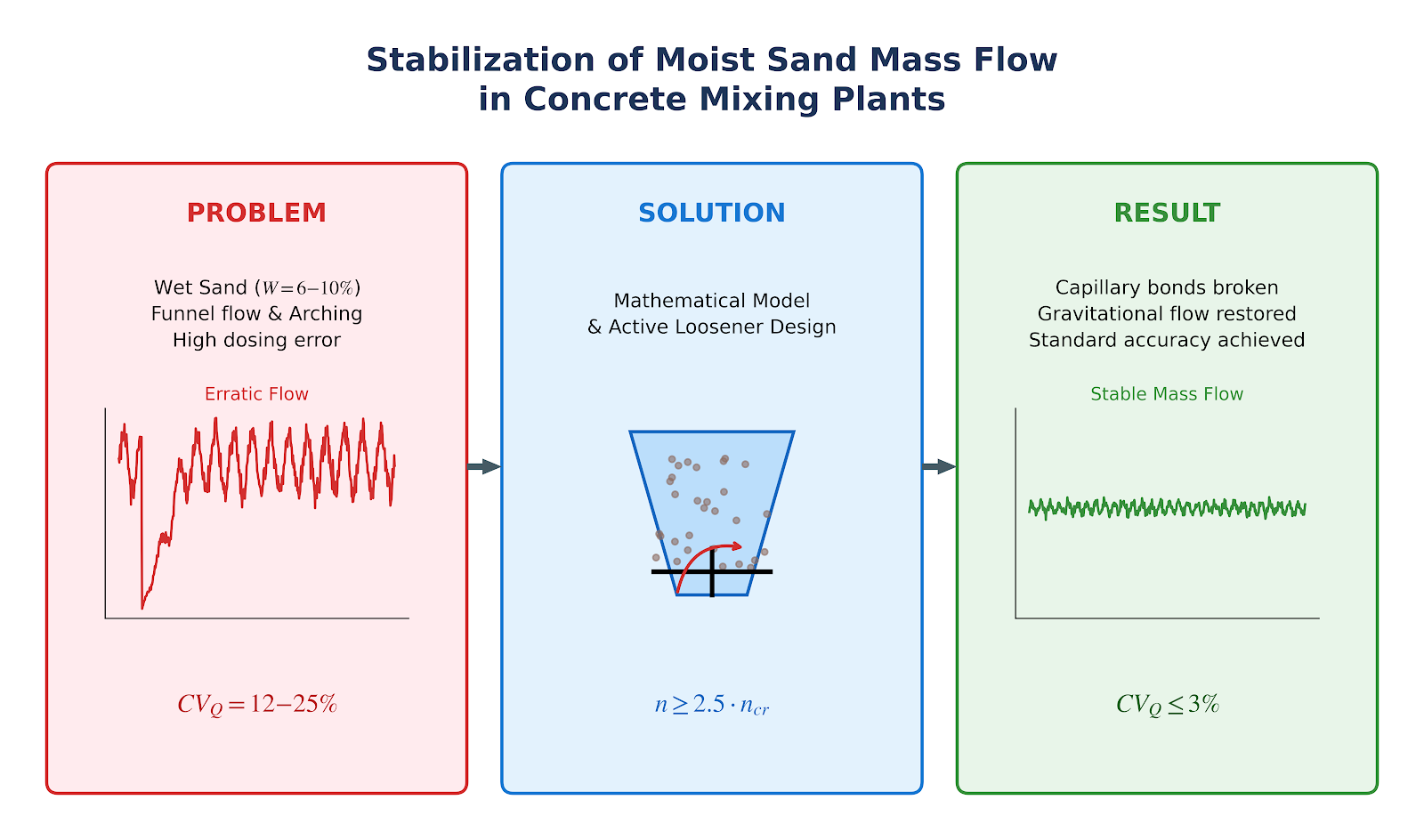
The problem addressed concerns the critical instability of mass flow rate when using natural washed sand. Increased moisture content (6–10%) changes the mass flow regime to a funnel flow and causes the formation of arches above the discharge opening. The coefficient of variation in dosing under such conditions reaches 12–25%, which is 4–8 times higher than the state standard for accuracy.
The mathematical model was verified using results obtained on a real CMP with a capacity of 60 m³/h, designed and commissioned by the authors and still in operation today. They confirm that installing an active loosener with a rotational speed of ωpr ≥ 2.5 · ωcr completely solves the problem of stabilizing the dosage across the entire range of production moisture contents. Threshold rotational speeds have been established depending on moisture content (specifically, 87 rpm for 6%). A constructed three–dimensional response surface demonstrates that, for a guaranteed dosing error of ≤3%, the working speed of the loosener must be 2.5 times higher than the threshold. Adherence to this operating mode reduces the actual variation to 1.8%. A mathematical model of mass flow rate (R² = 0.963) was also statistically described, and empirical coefficients were determined: pin resistance in the material (1.12) and mechanism efficiency (2.8).
This effect is explained by the artificial, abrupt transition of the material from a vortex flow regime back to a bulk flow regime. Upon reaching the critical rotation speed of the pins, the capillary bonds between the grains are intensively broken, thereby reducing the effective angle of internal friction and completely eliminating stagnant zones in the hopper. All of this instantly restores stable, continuous gravitational flow.
The results are practically applicable to the engineering calculation of feeding systems for concrete mixing plants and can be adapted for related industrial sectors.
References
- Janssen, H. A. (1895). Versuche über Getreidedruck in Silozellen. Zeitschrift des Vereines Deutscher Ingenieure, 39, 1045–1049. Available at: https://blog.espe-bretagne.fr/ktiblog/wp-content/uploads/2013/12/Janssen1895.pdf
- Johanson, J. R. (1964). Stress and Velocity Fields in the Gravity Flow of Bulk Solids. Journal of Applied Mechanics, 31 (3), 499–506. https://doi.org/10.1115/1.3629668
- Jenike, A. W. (1964). Storage and Flow of Solids. Bulletin of the University of Utah, 53 (26). Available at: https://digital.library.unt.edu/ark:/67531/metadc1067072/m1/1/
- Nedderman, R. M. (1992). Statics and Kinematics of Granular Materials. Cambridge: Cambridge University Press. https://doi.org/10.1017/cbo9780511600043
- Schulze, D. (2008). Powders and Bulk Solids: Behavior, Characterization, Storage and Flow. Berlin: Springer, 512. https://doi.org/10.1007/978-3-540-73768-1
- Rhodes, M. (Ed.) (2008). Introduction to Particle Technology. Wiley. https://doi.org/10.1002/9780470727102
- ISO 5725-1:2023. Accuracy (trueness and precision) of measurement methods and results. Part 1: General principles and definitions (2023). International Organization for Standardization. Available at: https://www.iso.org/standard/69418.html
- ISO/IEC 17025:2017. General requirements for the competence of testing and calibration laboratories (2017). International Organization for Standardization. Available at: https://www.iso.org/standard/66912.html
- DSTU B V.2.7-175:2008. Building materials. GUIDE ON THE USE OF CHEMICAL ADMIXTURES TO CONCRETES AND MORTARS. (2010). Kyiv: Minrehionbud Ukrayiny. Available at: https://ybeton.od.ua/wp-content/uploads/%D0%94%D0%A1%D0%A2%D0%A3-%D0%9D-%D0%91-%D0%92.2.7-1752008.-%D0%91%D1%83%D0%B4%D1%96%D0%B2%D0%B5%D0%BB%D1%8C%D0%BD%D1%96-%D0%BC%D0%B0%D1%82%D0%B5%D1%80%D1%96%D0%B0%D0%BB%D0%B8.-%D0%9D%D0%B0%D1%81%D1%82%D0%B0%D0%BD%D0%BE%D0%B2%D0%B0-%D1%89%D0%BE%D0%B4%D0%BE-%D0%B7%D0%B0%D1%81%D1%82%D0%BE%D1%81%D1%83%D0%B2%D0%B0%D0%BD%D0%BD%D1%8F-%D1%85%D1%96%D0%BC%D1%96%D1%87%D0%BD%D0%B8%D1%85-%D0%B4%D0%BE%D0%B1%D0%B0%D0%B2%D0%BE%D0%BA-%D1%83-%D0%B1%D0%B5%D1%82%D0%BE%D0%BD%D0%B0%D1%85-%D1%96-%D0%B1%D1%83%D0%B4%D1%96%D0%B2%D0%B5%D0%BB%D1%8C%D0%BD%D0%B8%D1%85-%D1%80%D0%BE%D0%B7%D1%87%D0%B8%D0%BD%D0%B0%D1%85.pdf
- DSTU B V.2.7-96-2000. Building materials Ready-mixed concrete. Specifications. (2000). Kyiv: Derzhbud Ukrayiny. Available at: https://ybeton.od.ua/wp-content/uploads/2015/04/%D0%94%D0%A1%D0%A2%D0%A3-%D0%91-%D0%92.2.7-96-2000.pdf
- Levchenko, O., Korobko, B. (2024). Optimization of the concrete production process in terms of energy consumption. Technology Audit and Production Reserves, 6 (1 (80)), 11–15. https://doi.org/10.15587/2706-5448.2024.319827
- Petruniak, M., Rubel, V., Chevhanova, V., Kulakova, S. (2021). Application of grout slurries with the defecate addition for effective well cementing. Mining of Mineral Deposits, 15 (1), 59–65. https://doi.org/10.33271/mining15.01.059
Downloads
Published
How to Cite
Issue
Section
License
Copyright (c) 2026 Oleksandr Levchenko, Bogdan Korobko, Oleksandr Ivakhno, Victoriia Rubel

This work is licensed under a Creative Commons Attribution 4.0 International License.
The consolidation and conditions for the transfer of copyright (identification of authorship) is carried out in the License Agreement. In particular, the authors reserve the right to the authorship of their manuscript and transfer the first publication of this work to the journal under the terms of the Creative Commons CC BY license. At the same time, they have the right to conclude on their own additional agreements concerning the non-exclusive distribution of the work in the form in which it was published by this journal, but provided that the link to the first publication of the article in this journal is preserved.