Advantages of the end-to-end Hybrid AWRED architecture in terms of the efficiency of visual anomaly detection under conditions of training data deficiency compared with the classical CNN + One-Class SVM ensemble
DOI:
https://doi.org/10.15587/2706-5448.2026.362237Keywords:
end-to-end architecture, Hybrid AWRED, One-Class SVM, dynamic weighting, class imbalance, visual controlAbstract
The object of research is the process of detecting visual anomalies in images under conditions of reduction of the training sample and class imbalance, relevant for visual monitoring systems of IT infrastructure and telecommunication equipment, including recognition of microcracks on printed circuit boards, corrosion on antennas, and damages of fiber-optic lines. The problem lies in the fact that with a small volume of training data two-stage approaches lose stability, reducing defect recognition accuracy. This concerns schemes in which a convolutional autoencoder is combined with an external classifier One-Class SVM. Under such conditions, the latent representation is formed with lower quality, and the ranking of anomalies becomes less reliable.
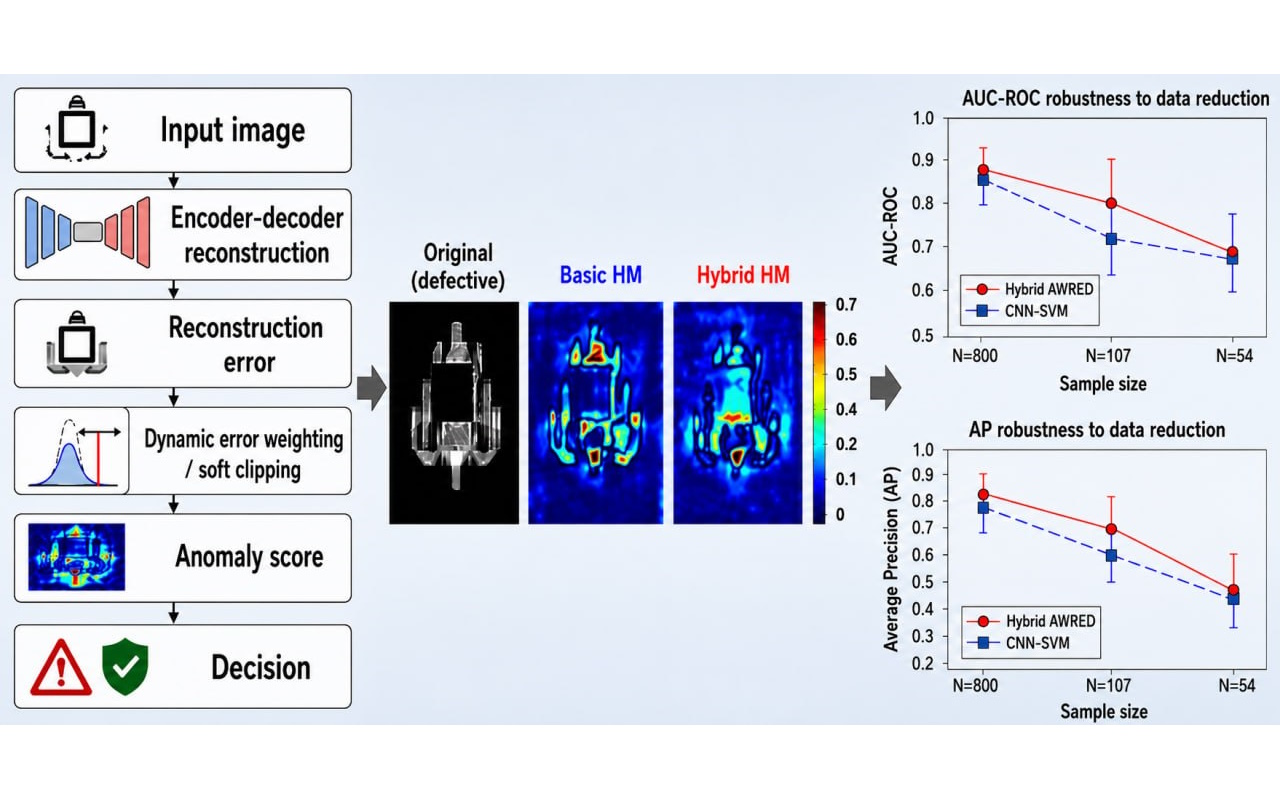
As an alternative, the Hybrid AWRED v4 architecture was used, in which anomaly detection is performed directly in the space of reconstruction errors without an external classifier. The approach is based on an objective function that combines dynamic weighting and an adaptive cutoff threshold.
The verification was carried out on three datasets of 800, 107, and 54 images. For each dataset, eight runs were performed. On the sample N = 800, the CNN + AWRED architecture showed better Precision, F1-Score, and MCC than the CNN + SVM ensemble. At N = 107, the advantage of the proposed approach was manifested in AUC-ROC and AP.
For the micro-sample N = 54, the threshold metrics of both approaches were close, while AUC-ROC and AP remained higher in the baseline model. This indicates that with such a data volume both approaches approach the limit of their effectiveness without additional expansion of the sample. It was established that Hybrid AWRED reaches the early stopping criterion earlier, and its heat maps form clearer zones in defect areas. The approach is promising for automation of visual control under deficit of training data.
References
- Cao, Y., Xiang, H., Zhang, H., Zhu, Y., Ting, K. M. (2025). Anomaly Detection Based on Isolation Mechanisms: A Survey. Machine Intelligence Research, 22 (5), 849–865. https://doi.org/10.1007/s11633-025-1554-4
- Tao, X., Gong, X., Zhang, X., Yan, S., Adak, C. (2022). Deep Learning for Unsupervised Anomaly Localization in Industrial Images: A Survey. IEEE Transactions on Instrumentation and Measurement, 71, 1–21. https://doi.org/10.1109/tim.2022.3196436
- Mehta, D., Klarmann, N. (2023). Autoencoder-Based Visual Anomaly Localization for Manufacturing Quality Control. Machine Learning and Knowledge Extraction, 6 (1), 1–17. https://doi.org/10.3390/make6010001
- Paolini, D., Dini, P., Soldaini, E., Saponara, S. (2025). One-Class Anomaly Detection for Industrial Applications: A Comparative Survey and Experimental Study. Computers, 14 (7), 281. https://doi.org/10.3390/computers14070281
- Saeedi, J., Giusti, A. (2022). Anomaly Detection for Industrial Inspection using Convolutional Autoencoder and Deep Feature-based One-class Classification. Proceedings of the 17th International Joint Conference on Computer Vision, Imaging and Computer Graphics Theory and Applications, 85–96. https://doi.org/10.5220/0010780200003124
- Yang, M., Liu, J., Yang, Z., Wu, Z. (2024). SLSG: Industrial image anomaly detection with improved feature embeddings and one-class classification. Pattern Recognition, 156, 110862. https://doi.org/10.1016/j.patcog.2024.110862
- Liu, J., Xie, G., Wang, J., Li, S., Wang, C., Zheng, F., Jin, Y. (2024). Deep Industrial Image Anomaly Detection: A Survey. Machine Intelligence Research, 21 (1), 104–135. https://doi.org/10.1007/s11633-023-1459-z
- Li, Z., Yan, Y., Wang, X., Ge, Y., Meng, L. (2025). A survey of deep learning for industrial visual anomaly detection. Artificial Intelligence Review, 58 (9). https://doi.org/10.1007/s10462-025-11287-7
- Wang, X., Chen, Y., Zhu, W. (2021). A Survey on Curriculum Learning. IEEE Transactions on Pattern Analysis and Machine Intelligence, 44 (9). https://doi.org/10.1109/tpami.2021.3069908
- Dovzhenko, T. (2026). Hybrid awred: synergy of adaptive reconstruction and topological clustering for anomaly detection in multimodal data. Zviazok, 1, 80–88. https://doi.org/10.31673/2412-9070.2026.017405
- Dovzhenko, T. P., Zinchenko, O. V. (2026). Robustness of Deep Intrusion Detection Models Under Massive Cyberattacks: Stress-Testing and Architectural Features of Hybrid AWRED. Telecommunication and Information Technologies, 90 (1), 199–207. https://doi.org/10.31673/2412-4338.2026.019019
- Dovzhenko, T. (2026). Topological anchoring and adaptive penalties: the HYBRID AWRED architecture for defect recognition in contaminated visual data. Connectivity, 180 (2), 62–71. https://doi.org/10.31673/2412-9070.2026.027603
- Saha, B. (2022). Caltech-101 dataset. Available at: https://www.kaggle.com/datasets/imbikramsaha/caltech-101
- Belhadri, A., Benchennane, I. (2025). Optimizing deep learning models: A review. Multiagent and Grid Systems, 21 (2), 73–95. https://doi.org/10.1177/15741702251370052
- Wang, X., Jin, Y., Schmitt, S., Olhofer, M. (2023). Recent Advances in Bayesian Optimization. ACM Computing Surveys, 55 (13s), 1–36. https://doi.org/10.1145/3582078
- Chicco, D., Jurman, G. (2023). The Matthews correlation coefficient (MCC) should replace the ROC AUC as the standard metric for assessing binary classification. BioData Mining, 16 (1). https://doi.org/10.1186/s13040-023-00322-4
- Jung, S., Dagobert, T., Morel, J.-M., Facciolo, G. (2024). A Review of t-SNE. Image Processing on Line, 14, 250–270. https://doi.org/10.5201/ipol.2024.528
Downloads
Published
How to Cite
Issue
Section
License
Copyright (c) 2026 Tymur Dovzhenko, Kamila Storchak

This work is licensed under a Creative Commons Attribution 4.0 International License.
The consolidation and conditions for the transfer of copyright (identification of authorship) is carried out in the License Agreement. In particular, the authors reserve the right to the authorship of their manuscript and transfer the first publication of this work to the journal under the terms of the Creative Commons CC BY license. At the same time, they have the right to conclude on their own additional agreements concerning the non-exclusive distribution of the work in the form in which it was published by this journal, but provided that the link to the first publication of the article in this journal is preserved.





