Інтегрований підхід ERP-BPMS для оптимізації управління житлово-комунального господарства: кваліфікація персоналу, витрати на обслуговування та вибір підрядника
DOI:
https://doi.org/10.15587/2706-5448.2025.326994Ключові слова:
ERP-BPMS, житло, комунальний, інтегральний, оцінювання, витрати, аутсорсинг, персонал, управління, оптимізаціяАнотація
Об'єктом дослідження є інтегрована ERP–BPMS-платформа для оптимізації управління житлово-комунальними послугами (ЖКП). Найбільш проблемним аспектом є розрізненість процесів оцінювання кваліфікації персоналу, прогнозування витрат на обслуговування та ухвалення рішень щодо аутсорсингу, що призводить до нерівномірних показників, підвищеного рівня діагностичних помилок і затримок при усуненні несправностей в умовах обмежених бюджетів.
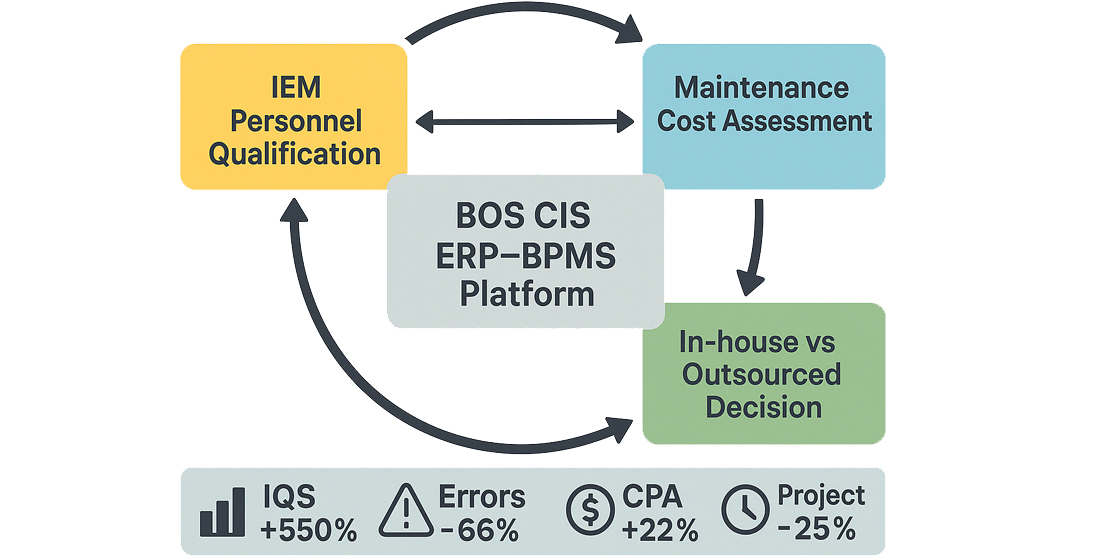
У дослідженні застосовано три підходи: інтегральний метод оцінювання (ІМО) для кількісної оцінки компетенцій персоналу, модуль оцінки витрат на обслуговування для точнішого планування бюджету та механізм на базі ІМО для вибору між виконанням робіт власними силами або через аутсорсинг. Ці методи інтегровано в систему Business Operation System – Central Information System (BOS CIS) із роллю інформаційного адміністратора (ІА) для перевірки цифрових журналів з ручними контрольними списками.
Впровадження підвищило інтегральний показник кваліфікації з 9,8 до 64,0, зменшивши діагностичні помилки на 66 % і час усунення неполадок на 50 %. Точність прогнозування витрат зросла з 0,76 до 0,93, а аутсорсинг скоротив тривалість проєктів на 25–28,6 % і покращив фінансову ефективність на 6 %. Час пошуку даних скоротився на 75 %, а коефіцієнт використання інформації зріс з 65 % до 88 %. Ці покращення пов'язані з обробкою позитивних і негативних факторів у реальному часі та гібридною системою верифікації.
Завдяки такому поєднанню забезпечується оптимальний розподіл ресурсів та зменшення ризиків за умов обмежених коштів. На відміну від систем, що охоплюють окремі аспекти, інтегрований підхід одночасно впливає на формування кваліфікованого персоналу, прогнозування витрат і аутсорсингові стратегії, підвищуючи прозорість та гнучкість.
Платформу рекомендовано для масштабних сервісних середовищ, де критичними є безперервність роботи, оптимізація витрат та якість послуг. Поєднання автоматизованої аналітики з фаховим наглядом створює надійну модель для підвищення ефективності проєктів і стратегічного планування в умовах ресурсних обмежень.
Посилання
- Smolinska, N., Sokil, V. (2021). Directions of improvement of activity of housing and communal enterprises. Herald of Khmelnytskyi National University, 294 (3), 229–237. https://doi.org/10.31891/2307-5740-2021-294-3-37
- Mottaeva, A., Borisova, A. (2019). Improvement of quality of housing-and-communal services management. E3S Web of Conferences, 138, 02015. https://doi.org/10.1051/e3sconf/201913802015
- Taruta, S. V. (2022). Management of housing and communal services in apartment building: evaluation of alternative methods. Omsk Scientific Bulletin. Series Society. History. Modernity, 7 (1), 138–146. https://doi.org/10.25206/2542-0488-2022-7-1-138-146
- Sergeeva, I. G., Medvedeva, O. E., Vasilenok, V. L. (2020). Smart Technologies in Housing and Communal Services. Proceedings of the III International Scientific and Practical Conference “Digital Economy and Finances” (ISPC-DEF 2020). https://doi.org/10.2991/aebmr.k.200423.002
- AL-Zaidi, M. M., Al-Samarae, S. A.-D. (2020). Employing Smart Systems In Integrated Management Of Infrastructure For Housing Projects. The Iraqi Journal of Architecture and Planning, 19 (2), 72–87. https://doi.org/10.36041/iqjap.v19i2.518
- Borkovskaya, V. (2018). Project Management Risks in the Sphere of Housing and Communal Services. MATEC Web of Conferences, 251, 06025. https://doi.org/10.1051/matecconf/201825106025
- Chernenko, Y., Danchenko, O., Melenchuk, V. (2022). Conceptual model of risk management in development projects of providers of housing and utility services. Management of Development of Complex Systems, 51, 41–48. https://doi.org/10.32347/2412-9933.2022.51.41-48
- Teller, J., Gemünden, H. G., Kock, A. (2014). Risk Management in Project Portfolios is More than Managing Project Risks: A Contingency Perspective on Risk Management. Project Management Journal, 45 (4), 67–80. https://doi.org/10.1002/pmj.21431
- Dobrosavljevic, A., Urošević, S., Astratova, G. (2019). Assessment of HR competencies in housing and communal utility services taking into account consumer perception. Upravlenets, 10 (1), 72–77. https://doi.org/10.29141/2218-5003-2019-10-1-7
- Hewavitharana, T., Nanayakkara, S., Perera, A., Perera, J. (2019). Impact of enterprise resource planning (ERP) systems to the construction industry. International Journal of Research in Electronics and Computer Engineering, 7 (2), 887–893.
- Alexander, A., Li, Y., Plante, R. (2023). Comparative study of two menus of contracts for outsourcing the maintenance function of a process having a linear failure rate. IISE Transactions, 55 (12), 1230–1241. https://doi.org/10.1080/24725854.2023.2175939
- Rahimi, F., Møller, C., Hvam, L. (2015). Business process management and IT management: The missing integration. International Journal of Information Management, 36 (1), 142–154. https://doi.org/10.1016/j.ijinfomgt.2015.10.004
- Loggen, T., Ravesteyn, P. (2023). How does BPM maturity affect process performance? Communications of the IIMA, 20 (2). https://doi.org/10.58729/1941-6687.1437
- Tidd, J., Bessant, J. (2018). Managing innovation: Integrating technological, market and organizational change. Wiley.
- Bilir, C., Yafez, E. (2022). Project success/failure rates in Turkey. International Journal of Information Systems and Project Management, 9 (4). https://doi.org/10.12821/ijispm090402
- Rahi, K., Bourgault, M., Preece, C. (2022). Risk and vulnerability management, project agility and resilience: a comparative analysis. International Journal of Information Systems and Project Management, 9 (4), 5–21. https://doi.org/10.12821/ijispm090401
- Varajão, J., Trigo, A., Pereira, J. L., Moura, I. (2022). Information systems project management success. International Journal of Information Systems and Project Management, 9 (4), 62–74. https://doi.org/10.12821/ijispm090404
- Gavali, A., Halder, S. (2019). Identifying critical success factors of ERP in the construction industry. Asian Journal of Civil Engineering, 21 (2), 311–329. https://doi.org/10.1007/s42107-019-00192-4
- Westphal, P., Sohal, A. (2016). Outsourcing decision-making: does the process matter? Production Planning & Control, 27 (11), 894–908. https://doi.org/10.1080/09537287.2016.1159350
- Emelyanov, D. I., Ponyavina, N. A., Chesnokova, E. A., Bredikhina, N. V. (2018). Planning of repair construction works in the solution of problems of technical operation of the residential real estate. Proceedings of the Southwest State University, 22 (3), 40–50. https://doi.org/10.21869/2223-1560-2018-22-3-40-50
- Gončarovs, M., Geipele, I. (2023). Qualification of the Residential House Administrator in the Sustainable Housing Conservation Context. Baltic Journal of Real Estate Economics and Construction Management, 11 (1), 315–322. https://doi.org/10.2478/bjreecm-2023-0020
- Kedir, F., Hall, D. M., Brantvall, S., Lessing, J., Hollberg, A., Soman, R. K. (2023). Circular information flows in industrialized housing construction: the case of a multi-family housing product platform in Sweden. Construction Innovation, 24 (5), 1354–1379. https://doi.org/10.1108/ci-08-2022-0199
- Jayamaha, B. H. V. H., Perera, B. A. K. S., Gimhani, K. D. M., Rodrigo, M. N. N. (2023). Adaptability of enterprise resource planning (ERP) systems for cost management of building construction projects in Sri Lanka. Construction Innovation, 24(5), 1255–1279. https://doi.org/10.1108/ci-05-2022-0108
- Mbachu, J. (2008). Conceptual framework for the assessment of subcontractors’ eligibility and performance in the construction industry. Construction Management and Economics, 26 (5), 471–484. https://doi.org/10.1080/01446190801918730
- Zubair, M. U., Farid, O., Hassan, M. U., Aziz, T., Ud-Din, S. (2024). Framework for Strategic Selection of Maintenance Contractors. Sustainability, 16 (6), 2488. https://doi.org/10.3390/su16062488
- Hallgren, K. A. (2012). Computing Inter-Rater Reliability for Observational Data: An Overview and Tutorial. Tutorials in Quantitative Methods for Psychology, 8 (1), 23–34. https://doi.org/10.20982/tqmp.08.1.p023
- Au-Yong, C. P., Chua, S. J. L., Ali, A. S., Tucker, M. (2019). Optimising maintenance cost by prioritising maintenance of facilities services in residential buildings. Engineering, Construction and Architectural Management, 26 (8), 1593–1607. https://doi.org/10.1108/ecam-07-2018-0265
- Farahani, A., Wallbaum, H., Dalenbäck, J.-O. (2018). Optimized maintenance and renovation scheduling in multifamily buildings – a systematic approach based on condition state and life cycle cost of building components. Construction Management and Economics, 37 (3), 139–155. https://doi.org/10.1080/01446193.2018.1512750
- Chen, W., Chen, K., Cheng, J. C. P., Wang, Q., Gan, V. J. L. (2018). BIM-based framework for automatic scheduling of facility maintenance work orders. Automation in Construction, 91, 15–30. https://doi.org/10.1016/j.autcon.2018.03.007
- Piasny, J., Pasławski, J. (2015). Selection of Subcontractors as the Quality Improvement Tool in Housing Construction. Procedia Engineering, 122, 274–281. https://doi.org/10.1016/j.proeng.2015.10.036
- Stenström, C., Norrbin, P., Parida, A., Kumar, U. (2015). Preventive and corrective maintenance – cost comparison and cost-benefit analysis. Structure and Infrastructure Engineering, 12 (5), 603–617. https://doi.org/10.1080/15732479.2015.1032983
- Nikolaiev, V., Shcherbyna, A., Siniak, N., Nikolaieva, T. (2021). Different Management Functions in Housing Operation Practice: Ukrainian Case Study. Real Estate Management and Valuation, 29 (2), 29–37. https://doi.org/10.2478/remav-2021-0011
- Scott, W. R. (2013). Institutions and Organizations: Ideas, Interests, and Identities. SAGE Publications.
- Jiang, K., Messersmith, J. (2017). On the shoulders of giants: a meta-review of strategic human resource management. The International Journal of Human Resource Management, 29 (1), 6–33. https://doi.org/10.1080/09585192.2017.1384930
- Sedayu, A., Mangkoedihardjo, S. (2019). Housing Project Performance Evaluation with Review Sharia Construction Management. Current World Environment, 14 (2), 239–244. https://doi.org/10.12944/cwe.14.2.08
- Szelągowski, M., Berniak-Woźny, J., Lupeikiene, A. (2022). The Direction of the Future Development of ERP and BPMS: Towards a Single Unified Class? Digital Business and Intelligent Systems, 111–124. https://doi.org/10.1007/978-3-031-09850-5_8
- Pontoh, G. T., Indrijawati, A., Handayanto, A. B., Tahang, R. A., Supardi, T. S. (2024). Transforming public sector operations with enterprise resource planning: Opportunities, challenges, and best practices. Corporate Law and Governance Review, 6 (2), 8–24. https://doi.org/10.22495/clgrv6i2p1
- Shi, C., Chen, Y., Hua, Y., Tang, Y. (2022). Understanding subcontracting organizational arrangements for construction projects in China: integrating capabilities and uncertainty. Engineering, Construction and Architectural Management, 30 (6), 2381–2399. https://doi.org/10.1108/ecam-11-2019-0631
- Inkinen, H. (2016). Review of empirical research on knowledge management practices and firm performance. Journal of Knowledge Management, 20 (2), 230–257. https://doi.org/10.1108/jkm-09-2015-0336
- Mottaeva, A. (2019). Methodical approach to the assessment of housing-and-communal services management. E3S Web of Conferences, 110, 02164. https://doi.org/10.1051/e3sconf/201911002164
- Park, M., Kwon, N., Lee, J., Lee, S., Ahn, Y. (2019). Probabilistic Maintenance Cost Analysis for Aged Multi-Family Housing. Sustainability, 11 (7), 1843. https://doi.org/10.3390/su11071843
- Dragone, I. S., Biotto, C. N., Serra, S. M. B. (2021). Evaluation of Lean Principles in Building Maintenance Management. Proc. 29th Annual Conference of the International Group for Lean Construction (IGLC), 13–22. https://doi.org/10.24928/2021/0151
- Schuh, G., Jussen, P., Optehostert, F. (2019). Iterative Cost Assessment of Maintenance Services. Procedia CIRP, 80, 488–493. https://doi.org/10.1016/j.procir.2019.01.067
- Pan, Y., Zhang, L. (2021). A BIM-data mining integrated digital twin framework for advanced project management. Automation in Construction, 124, 103564. https://doi.org/10.1016/j.autcon.2021.103564
- Abraham, R., Schneider, J., Vom Brocke, J. (2019). Data governance: A conceptual framework, structured review, and research agenda. International Journal of Information Management, 49, 424–438. https://doi.org/10.1016/j.ijinfomgt.2019.07.008
- Sri, M. T., Suresh, N., Varalakshmi, T. (2024). Integration of ERP in optimizing business process. International Research Journal on Advanced Engineering and Management, 2 (5), 1584–1587. https://doi.org/10.47392/irjaem.2024.0216
- Wouters, M., Stecher, J. (2017). Development of real-time product cost measurement: A case study in a medium-sized manufacturing company. International Journal of Production Economics, 183, 235–244. https://doi.org/10.1016/j.ijpe.2016.10.018
- Mohammed, A., Busaeedi, N., Mohamed, A., Saud, S. (2022). Smart project management system (SPMS) – An integrated and predictive solution for proactively managing oil & gas client projects. https://doi.org/10.2118/210877-ms
- Grakhov, V. P., Kuznecov, A. L., Kislyakova, Yu. G., Simakova, U. F., Knyazeva, Y. O. (2021). Implementation of Digital Project Management for Construction and Operation of Energy-Efficient Residential Buildings. Science & Technique, 20 (1), 66–74. https://doi.org/10.21122/2227-1031-2021-20-1-66-74
- Matos, R., Rodrigues, F., Rodrigues, H., Costa, A. (2021). Building condition assessment supported by Building Information Modelling. Journal of Building Engineering, 38, 102186. https://doi.org/10.1016/j.jobe.2021.102186
- Kim, H. G., Kim, S. S. (2023). Complementary Methodology for Energy Efficiency Ratio-Based Assessments with Change-Point Model Parameters. Buildings, 13 (11), 2703. https://doi.org/10.3390/buildings13112703
- Teece, D. J. (2007). Explicating dynamic capabilities: the nature and microfoundations of (sustainable) enterprise performance. Strategic Management Journal, 28 (13), 1319–1350. https://doi.org/10.1002/smj.640
##submission.downloads##
Опубліковано
Як цитувати
Номер
Розділ
Ліцензія
Авторське право (c) 2025 Yuri Chernenko, Olena Danchenko, Valentyn Tkachenko

Ця робота ліцензується відповідно до Creative Commons Attribution 4.0 International License.
Закріплення та умови передачі авторських прав (ідентифікація авторства) здійснюється у Ліцензійному договорі. Зокрема, автори залишають за собою право на авторство свого рукопису та передають журналу право першої публікації цієї роботи на умовах ліцензії Creative Commons CC BY. При цьому вони мають право укладати самостійно додаткові угоди, що стосуються неексклюзивного поширення роботи у тому вигляді, в якому вона була опублікована цим журналом, але за умови збереження посилання на першу публікацію статті в цьому журналі.