Development of a strategy for using the bispectrum of dangerous parameters to determine an informative signs of detection of materials inflammation
DOI:
https://doi.org/10.15587/2706-5448.2025.335092Keywords:
informative sign, ignition detection, bispectrum, dangerous parameters of the gas environment, premisesAbstract
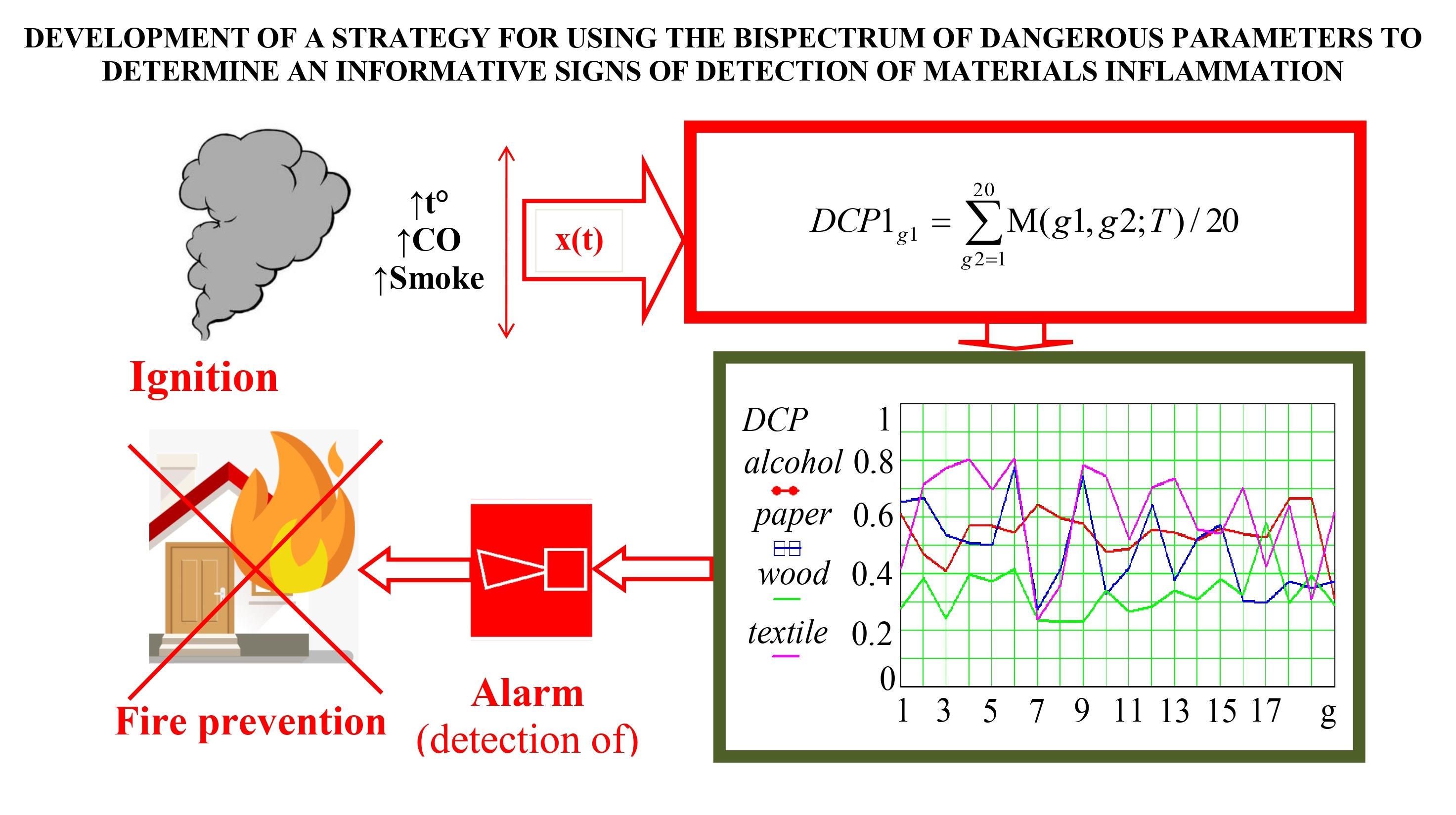
The object of the study is an informative sign of detecting ignition of materials in premises based on the assessment of the bispectrum of a dangerous parameter of the gas environment. The problem is to develop a strategy for using the bispectrum to determine an informative sign of detecting ignition of materials based on the observation of an arbitrary dangerous parameter of the gas environment in the premises. It is proposed to determine a new informative sign by a measure of the average degree of "order" for each frequency in the spectrum of dynamics of an arbitrary dangerous parameter of the gas environment at a fixed observation interval. The proposed informative sign was experimentally verified by studying the spectra of the average degree of “order” of the dynamics of the main dangerous parameters of the gas environment during the ignition of materials in a laboratory chamber. It was established that during the ignition of materials, the values of the average degree of “order” of the dynamics of temperature and carbon monoxide concentration for all studied frequencies of the spectrum are significantly reduced and do not exceed the value of 0.1. This indicates a loss of the average degree of “order” for all studied frequencies of the spectrum of dynamics of temperature and carbon monoxide concentration. At the same time, the value of the average degree of “order” of the dynamics of the specific optical density of smoke with respect to the studied frequencies does not change significantly. The obtained results are useful from a theoretical point of view by using the bispectrum for an informative sign of ignition and a measure of the average degree of “order” for an arbitrary dangerous parameter of the gas environment. The practical significance lies in the possibility of further improvement of existing fire protection of objects in order to prevent fires.
References
- Pospelov, B., Rybka, E., Polkovnychenko, D., Myskovets, I., Bezuhla, Y., Butenko, T. et al. (2023). Comparison of bicoherence on the ensemble of realizations and a selective evaluation of the bispectrum of the dynamics of dangerous parameters of the gas medium during fire. Eastern-European Journal of Enterprise Technologies, 2 (10 (122)), 14–21. https://doi.org/10.15587/1729-4061.2023.276779
- Sadkovyi, V., Andronov, V., Semkiv, O., Kovalov, A., Rybka, E., Otrosh, Y. et al. (2021). Fire resistance of reinforced concrete and steel structures. Kharkiv: РС ТЕСHNOLOGY СЕNTЕR, 180. https://doi.org/10.15587/978-617-7319-43-5
- Nikias, C. L., Raghuveer, M. R. (1987). Bispectrum estimation: A digital signal processing framework. Proceedings of the IEEE, 75 (7), 869–891. https://doi.org/10.1109/proc.1987.13824
- Totsky, A. V., Zelensky, A. A., Kravchenko, V. F. (2015). Bispectral Methods of Signal Processing: Applications in Radar, Telecommunications and Digital Image Restoration. Berlin, München, Boston: De Gruyter, 203. https://doi.org/10.1515/9783110368888
- Cheng, C., Sun, F., Zhou, X. (2011). One fire detection method using neural networks. Tsinghua Science and Technology, 16 (1), 31–35. https://doi.org/10.1016/s1007-0214(11)70005-0
- Ding, Q., Peng, Z., Liu, T., Tong, Q. (2014). Multi-Sensor Building Fire Alarm System with Information Fusion Technology Based on D-S Evidence Theory. Algorithms, 7 (4), 523–537. https://doi.org/10.3390/a7040523
- BS EN 54-30:2015. Fire detection and fire alarm systems – Part 30: Multi-sensor fire detectors. Point detectors using a combination of carbon monoxide and heat sensors (2015). Available at: https://standards.iteh.ai/catalog/standards/cen/ed5ec3f0-1e86-488f-93e4-bffd1e60da24/en-54-30-2015?srsltid=AfmBOoqsU4jyvPf8I3oOQMPUUTVC2HxSmzDcpEJc34wrJALkOWr7MTT9
- BS EN 54-31:2014. Fire detection and fire alarm systems – Part 31: Multi-sensor fire detectors. Point detectors using a combination of smoke, carbon monoxide and optionally heat sensors (2014). Available at: https://standards.iteh.ai/catalog/standards/cen/40570bab-0b10-4d86-aa64-3cce3be84086/en-54-31-2014-fpra1-2015?srsltid=AfmBOooz9291E5XcWrPoh1QLlaxEt9Wq_F60n-NBofLV7B-SHS6_iepZ
- ISO 7240-8:2014. Fire detection and alarm systems. Part 8: Point-type fire detectors using a carbon monoxide sensor in combination with a heat sensor (2014). International Organization for Standardization.
- Aspey, R. A., Brazier, K. J., Spencer, J. W. (2005). Multiwavelength sensing of smoke using a polychromatic LED: Mie extinction characterization using HLS analysis. IEEE Sensors Journal, 5 (5), 1050–1056. https://doi.org/10.1109/jsen.2005.845207
- Chen, S.-J., Hovde, D. C., Peterson, K. A., Marshall, A. W. (2007). Fire detection using smoke and gas sensors. Fire Safety Journal, 42 (8), 507–515. https://doi.org/10.1016/j.firesaf.2007.01.006
- Shi, M., Bermak, A., Chandrasekaran, S., Amira, A., Brahim-Belhouari, S. (2008). A Committee Machine Gas Identification System Based on Dynamically Reconfigurable FPGA. IEEE Sensors Journal, 8 (4), 403–414. https://doi.org/10.1109/jsen.2008.917124
- Skinner, A. J., Lambert, M. F. (2006). Using Smart Sensor Strings for Continuous Monitoring of Temperature Stratification in Large Water Bodies. IEEE Sensors Journal, 6 (6), 1473–1481. https://doi.org/10.1109/jsen.2006.881373
- Cheon, J., Lee, J., Lee, I., Chae, Y., Yoo, Y., Han, G. (2009). A Single-Chip CMOS Smoke and Temperature Sensor for an Intelligent Fire Detector. IEEE Sensors Journal, 9 (8), 914–921. https://doi.org/10.1109/jsen.2009.2024703
- Wu, Y., Harada, T. (2004). Study on the Burning Behaviour of Plantation Wood. Scientia Silvae Sinicae, 40, 131.
- Ji, J., Yang, L., Fan, W. (2003). Experimental Study on Effects of Burning Behaviours of Materials Caused by External Heat Radiation. JCST, 9, 139.
- Peng, X., Liu, S., Lu, G. (2005). Experimental Analysis on Heat Release Rate of Materials. Journal of Chongqing University, 28, 122.
- Pospelov, B., Rybka, E., Samoilov, M., Morozov, I., Bezuhla, Y., Butenko, T. et al. (2022). Defining the features of amplitude and phase spectra of dangerous factors of gas medium during the ignition of materials in the premises. Eastern-European Journal of Enterprise Technologies, 2 (10 (116)), 57–65. https://doi.org/10.15587/1729-4061.2022.254500
- Heskestad, G., Newman, J. S. (1992). Fire detection using cross-correlations of sensor signals. Fire Safety Journal, 18 (4), 355–374. https://doi.org/10.1016/0379-7112(92)90024-7
- Gottuk, D. T., Wright, M. T., Wong, J. T., Pham, H. V., Rose-Pehrsson, S. L., Hart, S. et al. (2002). Prototype Early Warning Fire Detection Systems: Test Series 4 Results. NRL/MR/6180-02-8602. Naval Research Laboratory.
- Pospelov, B., Rybka, E., Savchenko, A., Dashkovska, O., Harbuz, S., Naden, E. et al. (2022). Peculiarities of amplitude spectra of the third order for the early detection of indoor fires. Eastern-European Journal of Enterprise Technologies, 5 (10 (119)), 49–56. https://doi.org/10.15587/1729-4061.2022.265781
- Pospelov, B., Andronov, V., Rybka, E., Chubko, L., Bezuhla, Y., Gordiichuk, S. et al. (2023). Revealing the peculiarities of average bicoherence of frequencies in the spectra of dangerous parameters of the gas environment during fire. Eastern-European Journal of Enterprise Technologies, 1 (10 (121)), 46–54. https://doi.org/10.15587/1729-4061.2023.272949
- Pospelov, B., Andronov, V., Rybka, E., Bezuhla, Y., Liashevska, O., Butenko, T. et al. (2022). Empirical cumulative distribution function of the characteristic sign of the gas environment during fire. Eastern-European Journal of Enterprise Technologies, 4 (10 (118)), 60–66. https://doi.org/10.15587/1729-4061.2022.263194
- Sadkovyi, V., Pospelov, B., Rybka, E., Kreminskyi, B., Yashchenko, O., Bezuhla, Y. et al. (2022). Development of a method for assessing the reliability of fire detection in premises. Eastern-European Journal of Enterprise Technologies, 3 (10 (117)), 56–62. https://doi.org/10.15587/1729-4061.2022.259493
- Popov, O., Kovach, V., Iatsyshyn, A., Lahoiko, A., Ryzhchenko, O., Dement, M. (2023). Features Function of Radiation Monitoring System World’s Countries of Developed Nuclear Energy. Systems, Decision and Control in Energy V. Cham: Springer, 471–497. https://doi.org/10.1007/978-3-031-35088-7_25
- Jeong, J. (2004). EEG dynamics in patients with Alzheimer’s disease. Clinical Neurophysiology, 115 (7), 1490–1505. https://doi.org/10.1016/j.clinph.2004.01.001
- Saeed, M., Alfatih, S. (2013). Nonlinearity detection in hydraulic machines utilizing bispectral analysis. TJ Mechanical engineering and machinery, 13–21.
- Yang, B., Wang, M., Zan, T., Gao, X., Gao, P. (2021). Application of Bispectrum Diagonal Slice Feature Analysis in Tool Wear States Monitoring. Research Square. https://doi.org/10.21203/rs.3.rs-775113/v1
- Yang, K., Zhang, R., Chen, S., Zhang, F., Yang, J., Zhang, X. (2015). Series Arc Fault Detection Algorithm Based on Autoregressive Bispectrum Analysis. Algorithms, 8 (4), 929–950. https://doi.org/10.3390/a8040929
- Cui, L., Xu, H., Ge, J., Cao, M., Xu, Y., Xu, W. et al. (2021). Use of Bispectrum Analysis to Inspect the Non-Linear Dynamic Characteristics of Beam-Type Structures Containing a Breathing Crack. Sensors, 21 (4), 1177. https://doi.org/10.3390/s21041177
- Max, J. (1981). Methodes et techniques de traitement du signal et applications aux mesures physiques: Tome I. Principes généraux et méthodes classiques. Troisième édition revue et augmentée. Paris: Masson, 302.
- Mohankumar, K. (2015). Implementation of an underwater target classifier using higher order spectral features. [PhD thesis].
- Dubinin, D., Cherkashyn, O., Maksymov, A., Beliuchenko, D., Hovalenkov, S., Shevchenko, S. et al. (2020). Investigation of the effect of carbon monoxide on people in case of fire in a building. Sigurnost, 62 (4), 347–357. https://doi.org/10.31306/s.62.4.2
- Optical/Heat Multisensor Detector (2019). Discovery, 1, 4.
- Hulse, L. M., Galea, E. R., Thompson, O. F., Wales, D. (2020). Perception and recollection of fire hazards in dwelling fires. Safety Science, 122, 104518. https://doi.org/10.1016/j.ssci.2019.104518
Downloads
Published
How to Cite
Issue
Section
License
Copyright (c) 2025 Igor Tolok, Boris Pospelov, Evgenіy Rybka, Yurii Kozar, Olekcii Krainiukov, Yuriy Yatsentyuk, Yurii Olshevskyi, Olena Petrova, Natalia Shevchuk, Alla Ziuzko

This work is licensed under a Creative Commons Attribution 4.0 International License.
The consolidation and conditions for the transfer of copyright (identification of authorship) is carried out in the License Agreement. In particular, the authors reserve the right to the authorship of their manuscript and transfer the first publication of this work to the journal under the terms of the Creative Commons CC BY license. At the same time, they have the right to conclude on their own additional agreements concerning the non-exclusive distribution of the work in the form in which it was published by this journal, but provided that the link to the first publication of the article in this journal is preserved.





