Розробка стратегій для підвищення кібербезпеки та цифрової довіри в цифровому середовищі Азербайджану
DOI:
https://doi.org/10.15587/2706-5448.2025.342927Ключові слова:
кібербезпека, цифрова довіра, фішинг-атаки, порушення безпеки даних, шахрайські діїАнотація
Це дослідження зосереджено на оцінці практик кібербезпеки та рівня цифрової довіри в Азербайджані, а також на виявленні основних слабких місць на основі реальних даних.
Об'єктом дослідження є практики кібербезпеки та цифрова довіра серед організацій та користувачів в Азербайджані.
Дослідження розв'язує проблему недостатності емпіричних даних щодо практик кібербезпеки та цифрової довіри в Азербайджані, що сприяє низькій обізнаності, слабкому впровадженню заходів безпеки, частим кіберінцидентам та обмеженій довірі до цифрових послуг та законодавства.
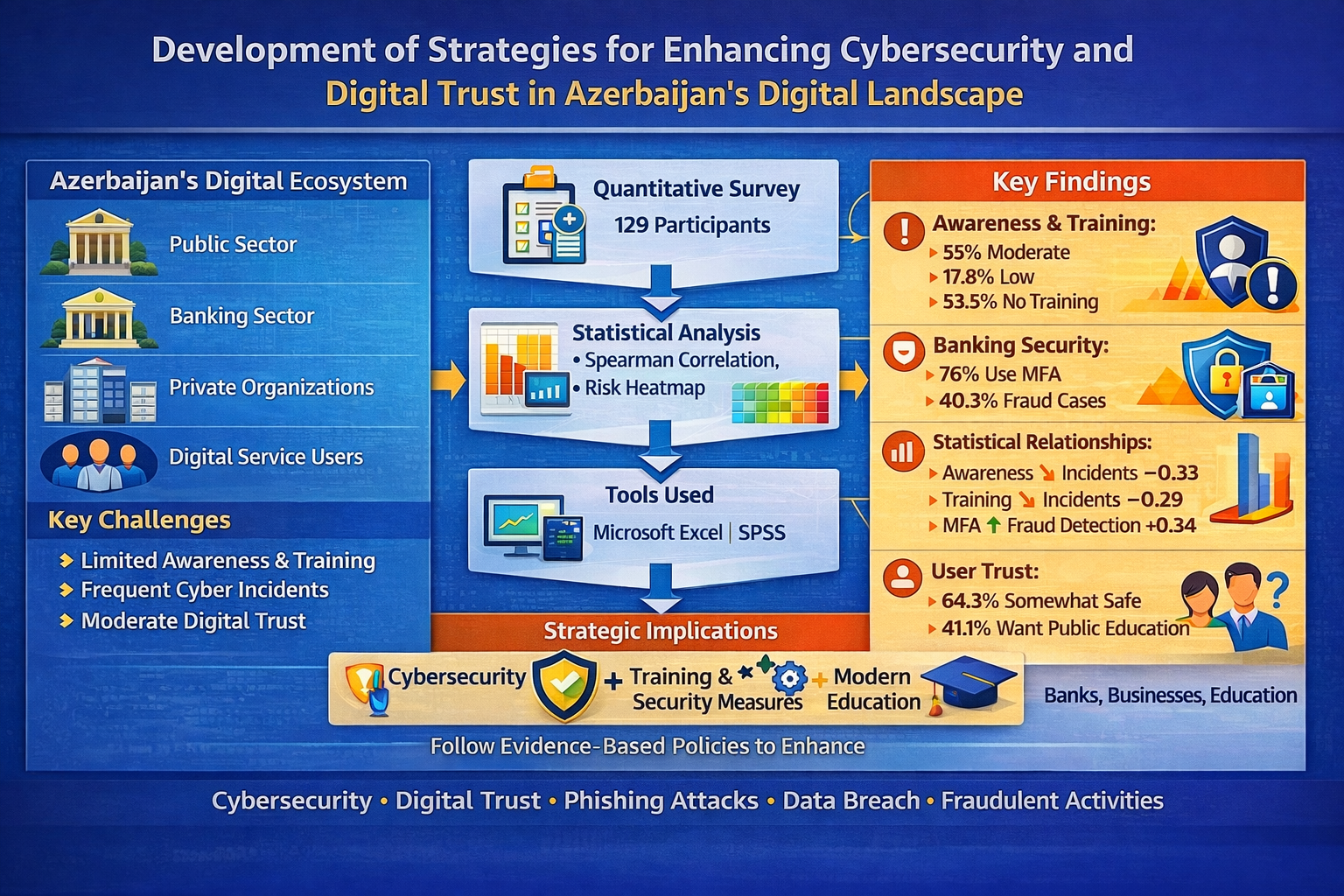
Методологія дослідження включала кількісне опитування 129 учасників, кореляційний аналіз Спірмена та моделювання теплової карти ризиків. Аналіз даних проводився за допомогою персонального комп'ютера з програмним забезпеченням Microsoft Excel та SPSS (Statistical Package for the Social Sciences).
Результати показують, що 55% організацій мають помірний рівень обізнаності з питань кібербезпеки, 17,8% мають низький рівень обізнаності, а 53,5% не проводять навчання співробітників з питань кібербезпеки. Хоча 76% банків використовують багатофакторну автентифікацію (MFA), 40,3% стикалися з випадками шахрайства. Кореляційний аналіз Спірмена вказує на негативний взаємозв'язок між обізнаністю та кіберінцидентами (–0,33) і між навчанням та інцидентами (–0,29), тоді як використання MFA демонструє позитивну кореляцію з виявленням шахрайства (+0,3446). Крім того, 64,3% користувачів почуваються досить безпечно, а 41,1% вважають державну освіту найважливішою сферою, яка потребує вдосконалення.
Результати дослідження показують, що недостатнє навчання, неповне впровадження сучасних заходів захисту та слабка освіта населення збільшують ризики кібербезпеки навіть в організаціях із помірним рівнем обізнаності. Ці результати можуть допомогти Державній службі спеціального зв'язку та інформаційної безпеки (SSSCIS) у вдосконаленні Національної стратегії кібербезпеки та сприяти банкам, підприємствам та навчальним закладам у зміцненні практик кібербезпеки на період 2025–2030 років.
Посилання
- Maurer, T., Morgus, R. (2014). Compilation of existing cybersecurity and information security related definitions. New America. Available at: https://static.newamerica.org/attachments/175-compilation-of-existing-cybersecurity-and-information-security-related-definitions/OTI_Compilation_of_Existing_Cybersecurity_and_Information_Security_Related_Definitions_Updated122015.pdf
- Hao, X., Li, Y., Ren, S., Wu, H., Hao, Y. (2023). The role of digitalization on green economic growth: Does industrial structure optimization and green innovation matter? Journal of Environmental Management, 325, 116504. https://doi.org/10.1016/j.jenvman.2022.116504
- Kluiters, L., Srivastava, M., Tyll, L. (2022). The impact of digital trust on firm value and governance: an empirical investigation of US firms. Society and Business Review, 18 (1), 71–103. https://doi.org/10.1108/sbr-07-2021-0119
- Uchendu, B., Nurse, J. R. C., Bada, M., Furnell, S. (2021). Developing a cyber security culture: Current practices and future needs. Computers & Security, 109, 102387. https://doi.org/10.1016/j.cose.2021.102387
- Shikhaliyev, R. (2023). Cybersecurity analysis of industrial control systems. Problems of Information Society, 14 (2), 47–54. https://doi.org/10.25045/jpis.v14.i2.06
- Manjikian, M. (2017). Cybersecurity Ethics. Routledge, 246. https://doi.org/10.4324/9781315196275
- Kostopoulos, G. K. (2017). Cyberspace and cybersecurity. Auerbach Publications. https://doi.org/10.1201/9781315116488
- Veríssimo, P., Rodrigues, L. (2001). Fundamental Security Concepts. Distributed Systems for System Architects. Boston: Springer, 377–393. https://doi.org/10.1007/978-1-4615-1663-7_16
- Kim, L.; Hübner, U. H., Mustata Wilson, G., Morawski, T. S., Ball, M. J. (Eds.) (2022). Cybersecurity: Ensuring Confidentiality, Integrity, and Availability of Information. Nursing Informatics. Cham: Springer, 391–410. https://doi.org/10.1007/978-3-030-91237-6_26
- Shah, S. S., Shah, S. A. H. (2024). Trust as a determinant of social welfare in the digital economy. Social Network Analysis and Mining, 14 (1). https://doi.org/10.1007/s13278-024-01238-5
- Herath, S. K., Herath, L. M., Yoo, J. K. (2024). Opportunities and Challenges of Digital Audits and Compliance. Impact of Digitalization on Reporting, Tax Avoidance, Accounting, and Green Finance, 1–35. https://doi.org/10.4018/979-8-3693-1678-8.ch001
- Ablyazov, T., Asaturova, J., Koscheyev, V. (2018). Digital technologies: new forms and tools of business activity. SHS Web of Conferences, 44, 00004. https://doi.org/10.1051/shsconf/20184400004
- Osburg, T. (2019). Changing Relevance of Trust in Digital Worlds. Media Trust in a Digital World, 15–33. https://doi.org/10.1007/978-3-030-30774-5_2
- Huda, M. (2023). Trust as a key element for quality communication and information management: insights into developing safe cyber-organisational sustainability. International Journal of Organizational Analysis, 32 (8), 1539–1558. https://doi.org/10.1108/ijoa-12-2022-3532
- Guo, Y. (2022). Digital Trust and the Reconstruction of Trust in the Digital Society: An Integrated Model based on Trust Theory and Expectation Confirmation Theory. Digital Government: Research and Practice, 3 (4), 1–19. https://doi.org/10.1145/3543860
- PwC UK. Available at: https://www.pwc.co.uk Last accessed: 09.01.2025.
- Tariq, N. (2018). Impact of cyberattacks on financial institutions. Journal of Internet Banking and Commerce, 23 (2), 1–11. Available at: https://www.icommercecentral.com/open-access/impact-of-cyberattacks-on-financial-institutions.pdf
- Rezaei, F. (2019). Iran’s Military Capability: The Structure and Strength of Forces. Insight Turkey, 21 (4), 183–216. Available at: https://www.insightturkey.com/articles/irans-military-capability-the-structure-and-strength-of-forces
- Berglyd, K. J. T. (2022). Strategic Culture and State Behaviour in Cyberspace: How Iran’s Strategic Culture Influences its Behaviour in Cyberspace. [Master's Thesis]. Available at: https://www.duo.uio.no/bitstream/handle/10852/96599/1/STV4992-Master-s-Thesis-Knut-Joachim-Tander–Berglyd-Spring-2022.pdf
- Perwej, Dr. Y., Qamar Abbas, S., Pratap Dixit, J., Akhtar, Dr. N., Kumar Jaiswal, A. (2021). A Systematic Literature Review on the Cyber Security. International Journal of Scientific Research and Management, 9 (12), 669–710. https://doi.org/10.18535/ijsrm/v9i12.ec04
- Saleh, M. E., Aly, A. A., Omara, F. A. (2016). Data Security Using Cryptography and Steganography Techniques. International Journal of Advanced Computer Science and Applications, 7 (6). https://doi.org/10.14569/ijacsa.2016.070651
- Chio, C., Freeman, D. (2018). Machine learning and security: Protecting systems with data and algorithms. O’Reilly Media, 383. Available at: https://virtualmmx.ddns.net/gbooks/MachineLearningandSecurity.pdf
- Carr, M., Shahandashti, S. F.; Hölbl, M., Rannenberg, K., Welzer, T. (Eds.) (2020). Revisiting Security Vulnerabilities in Commercial Password Managers. ICT Systems Security and Privacy Protection. Cham: Springer, 265–279. https://doi.org/10.1007/978-3-030-58201-2_18
- Stobert, E., Biddle, R. (2018). The Password Life Cycle. ACM Transactions on Privacy and Security, 21 (3), 1–32. https://doi.org/10.1145/3183341
- Rizvi, S., Orr, R., Cox, A., Ashokkumar, P., Rizvi, M. R. (2020). Identifying the attack surface for IoT network. Internet of Things, 9, 100162. https://doi.org/10.1016/j.iot.2020.100162
- Borky, J. M., Bradley, T. H. (2019). Protecting Information with Cybersecurity. Effective Model-Based Systems Engineering. Cham: Springer, 345–404. https://doi.org/10.1007/978-3-319-95669-5_10
- Michael, K., Kobran, S., Abbas, R., Hamdoun, S. (2019). Privacy, Data Rights and Cybersecurity: Technology for Good in the Achievement of Sustainable Development Goals. 2019 IEEE International Symposium on Technology and Society (ISTAS). https://doi.org/10.1109/istas48451.2019.8937956
- Chitadze, N. (2023). Basic Principles of Information and Cyber Security. Analyzing New Forms of Social Disorders in Modern Virtual Environments, 193–223. https://doi.org/10.4018/978-1-6684-5760-3.ch009
- Lundgren, B., Möller, N. (2019). Defining Information Security. Science and Engineering Ethics, 25 (2), 419–441. https://doi.org/10.1007/s11948-017-9992-1
- Villalón-Fonseca, R. (2022). The nature of security: A conceptual framework for integral-comprehensive modeling of IT security and cybersecurity. Computers & Security, 120, 102805. https://doi.org/10.1016/j.cose.2022.102805
- Saber, J. A. (2016). Determining small business cybersecurity strategies to prevent data breaches. [Doctoral dissertation; Walden University]. Available at: https://scholarworks.waldenu.edu/dissertations/4991/
- Razikin, K., Soewito, B. (2022). Cybersecurity decision support model to designing information technology security system based on risk analysis and cybersecurity framework. Egyptian Informatics Journal, 23 (3), 383–404. https://doi.org/10.1016/j.eij.2022.03.001
- Abrahams, T. O., Ewuga, S. K., Dawodu, S. O., Adegbite, A. O., Hassan, A. O. (2024). А review of cybersecurity strategies in modern organizations: examining the evolution and effectiveness of cybersecurity measures for data protection. Computer Science & IT Research Journal, 5 (1), 1–25. https://doi.org/10.51594/csitrj.v5i1.699
- Priyadarshini, I.; Le, D., Kumar, R., Mishra, B. K., Khari, M., Chatterjee, J. M. (Eds.) (2019). Introduction on cybersecurity. Cyber security in parallel and distributed computing: Concepts, techniques, applications and case studies, 1–37. https://doi.org/10.1002/9781119488330
- Astani, M., Ready, K. J. (2016). Trends and preventive strategies for mitigating cybersecurity breaches in organizations. Issues in Information Systems, 17 (2). https://doi.org/10.48009/2_iis_2016_208-214
- Paleri, P. (2022). Revisiting National Security: Prospecting Governance for Human Well-Being. Singapore: Springer. https://doi.org/10.1007/978-981-16-8293-3
- Taherdoost, H. (2022). Cybersecurity vs. Information Security. Procedia Computer Science, 215, 483–487. https://doi.org/10.1016/j.procs.2022.12.050
- Mishra, A. (2022). Modern Cybersecurity Strategies for Enterprises: Protect and Secure Your Enterprise Networks, Digital Business Assets, and Endpoint Security with Tested and Proven Methods. BPB Publications, 564. Available at: https://bpbonline.com/products/modern-cybersecurity-strategies-for-enterprises
- Brundage, M., Avin, S., Clark, J., Toner, H., Eckersley, P., Garfinkel, B. et al. (2018). The malicious use of artificial intelligence: Forecasting, prevention, and mitigation. arXiv. https://doi.org/10.48550/arXiv.1802.07228
- Alexei, A., Alexei, A. (2023). The difference between cyber security vs information security. Journal of Engineering Science, 29 (4), 72–83. https://doi.org/10.52326/jes.utm.2022.29(4).08
- Safitra, M. F., Lubis, M., Fakhrurroja, H. (2023). Counterattacking Cyber Threats: A Framework for the Future of Cybersecurity. Sustainability, 15 (18), 13369. https://doi.org/10.3390/su151813369
- Ahmed, S., Khan, M. (2023). Securing the Internet of Things (IoT): A comprehensive study on the intersection of cybersecurity, privacy, and connectivity in the IoT ecosystem. AI, IoT and the Fourth Industrial Revolution Review, 13 (9), 1–17. Available at: https://ru.scribd.com/document/798142114/Securing-the-Internet-of-Things?utm_source
- Al Hayajneh, A., Thakur, H. N., Thakur, K. (2023). The Evolution of Information Security Strategies: A Comprehensive Investigation of INFOSEC Risk Assessment in the Contemporary Information Era. Computer and Information Science, 16 (4). https://doi.org/10.5539/cis.v16n4p1
- Manning, E. (2023). Optimizing Incident Management Processes for Effective Cybersecurity Incident Response. [Master’s thesis; National College of Ireland]. Available at: https://norma.ncirl.ie/7296/
- Manoharan, A., Sarker, M. (2022). Revolutionizing cybersecurity: unleashing the power of artificial intelligence and machine learning for nextgeneration threat detection. International Research Journal of Modernization in Engineering Technology & Science, 4 (12). https://doi.org/10.56726/irjmets32644
- Salem, A. H., Azzam, S. M., Emam, O. E., Abohany, A. A. (2024). Advancing cybersecurity: a comprehensive review of AI-driven detection techniques. Journal of Big Data, 11 (1). https://doi.org/10.1186/s40537-024-00957-y
- Tar, S. J. (2024). Factors That Influence Cybersecurity Risk Management Within the Department of Homeland Security. [Doctoral dissertation; Capitol Technology University].
- Stine, K., Quinn, S., Witte, G., Gardner, R. K. (2020). Integrating Cybersecurity and Enterprise Risk Management (ERM). National Institute of Standards and Technology. https://doi.org/10.6028/nist.ir.8286
- Loi, M., Christen, M. (2020). Ethical Frameworks for Cybersecurity. The Ethics of Cybersecurity, 73–95. https://doi.org/10.1007/978-3-030-29053-5_4
- Ganin, A. A., Quach, P., Panwar, M., Collier, Z. A., Keisler, J. M., Marchese, D. et al. (2017). Multicriteria Decision Framework for Cybersecurity Risk Assessment and Management. Risk Analysis, 40 (1), 183–199. https://doi.org/10.1111/risa.12891
- Cardona, L. A. L. (2021). Technological trends. Ingeniería Solidaria, 17 (1), 1–28. https://doi.org/10.16925/2357-6014.2021.01.02
- Gangwar, S., Narang, V. (2022). A Survey on Emerging Cyber Crimes and Their Impact Worldwide. Research Anthology on Combating Cyber-Aggression and Online Negativity. IGI Global Scientific Publishing, 1583–1595. https://doi.org/10.4018/978-1-6684-5594-4.ch080
- Allende López, M., Da Silva, M. M. (2019). Quantum Technologies: Digital Transformation, Social Impact, and Cross-sector Disruption. Inter-American Development Bank. https://doi.org/10.18235/0001613
- Fukushima, A. (2021). Promises and challenges of digital connectivity. European University Institute. Available at: https://cadmus.eui.eu/entities/publication/e9f6e26a-af6f-514f-8e9e-a36f99888c18
- Source: Statista 2023. ResearchGate. Available at: https://www.researchgate.net/figure/Source-Statista-2023_fig1_373775351
- Uma, M., Padmavathi, G. (2013). A survey on various cyber attacks and their classification. International Journal of Network Security, 15 (5), 390–396. Available at: http://ijns.jalaxy.com.tw/contents/ijns-v15-n5/ijns-2013-v15-n5-p390-396.pdf
##submission.downloads##
Опубліковано
Як цитувати
Номер
Розділ
Ліцензія
Авторське право (c) 2025 Khayala Alasgarova, Sahib Ramazanov

Ця робота ліцензується відповідно до Creative Commons Attribution 4.0 International License.
Закріплення та умови передачі авторських прав (ідентифікація авторства) здійснюється у Ліцензійному договорі. Зокрема, автори залишають за собою право на авторство свого рукопису та передають журналу право першої публікації цієї роботи на умовах ліцензії Creative Commons CC BY. При цьому вони мають право укладати самостійно додаткові угоди, що стосуються неексклюзивного поширення роботи у тому вигляді, в якому вона була опублікована цим журналом, але за умови збереження посилання на першу публікацію статті в цьому журналі.