Аналітичне визначення абсолютних деформацій та меж зони контакту деформованого колеса з деформованою поверхнею
DOI:
https://doi.org/10.15587/2706-5448.2025.346717Ключові слова:
деформоване колесо, деформована опорна поверхня, абсолютні деформації, границі зони контактуАнотація
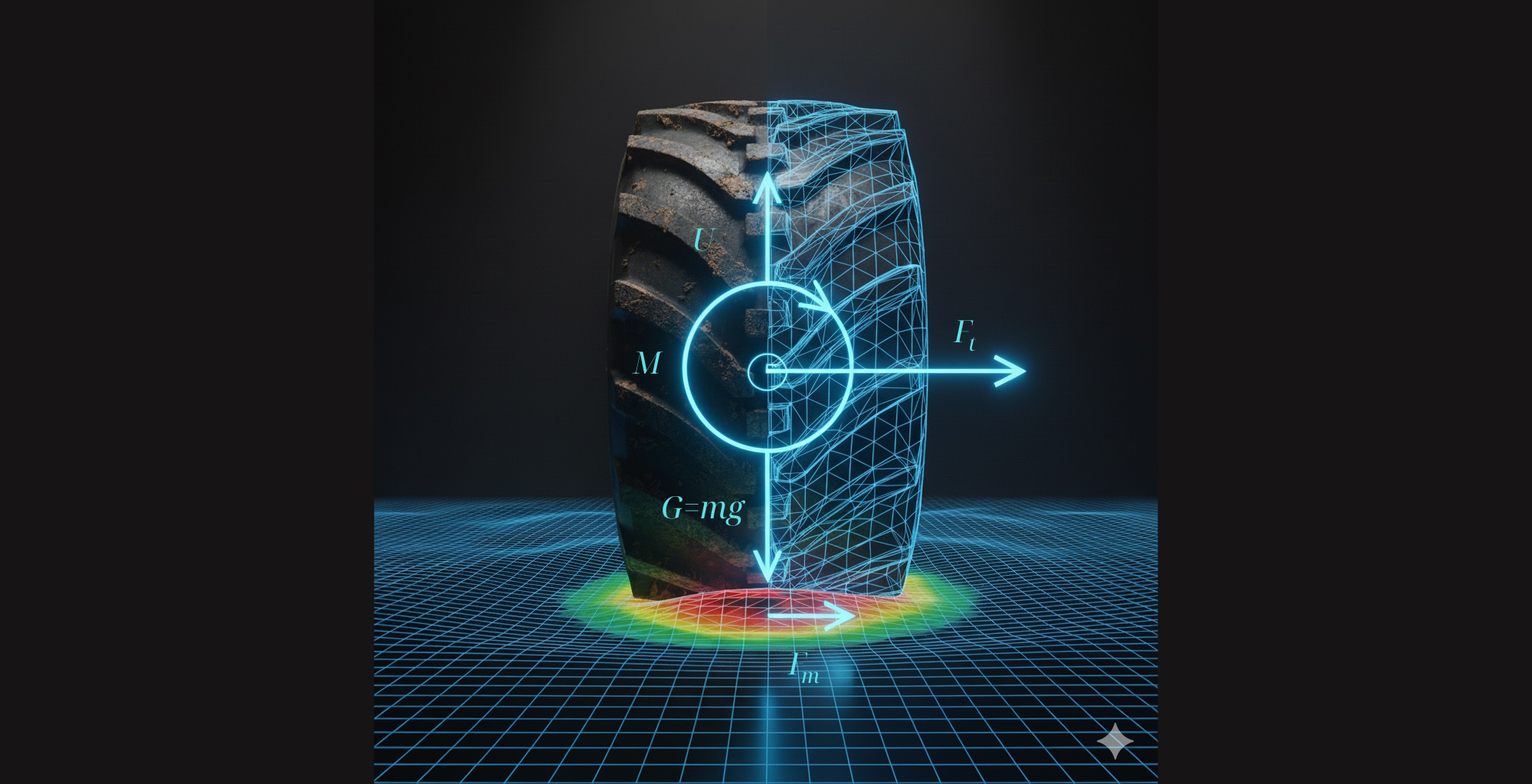
Об'єктом дослідження є контактна взаємодія між деформівним колесом (шиною) та деформівною опорною поверхнею. Одним з найбільш проблемних місць є визначення меж зони контакту як функції прикладених навантажень, геометрії колеса та механічних властивостей контактуючих поверхонь, а також необхідність зменшення енергоспоживання й ущільнення ґрунту в контексті роботи ходових систем транспортних засобів.
У ході дослідження використовували методи механіки суцільних деформівних середовищ для визначення деформівних властивостей контактуючих поверхонь. Дослідження ґрунтувались на попередніх результатах розподілу контактних сил, отриманих за допомогою бігармонічних потенціальних аналітичних функцій, що базуються на методах Буссінеску та Черруті.
Отримано аналітичні залежності зв'язку передньої та задньої границь контакту деформівного колеса (шини) з деформівною поверхнею. Це пов'язано з тим, що запропонований підхід враховує деформації та напруження у середовищах контактуючих тіл з урахуванням їх механічних властивостей, і є більш інформативним порівняно з методами теоретичної й аналітичної механіки. Дослідження виявило, що потенціал для покращення функціонування об'єкта криється в оптимізації вибору параметрів і режимів роботи ходових систем, що безпосередньо впливає на тягово-зчіпні характеристики колеса.
Завдяки цьому забезпечується можливість отримання оптимізованих значень геометричної величини поверхні контакту. У порівнянні з аналогічними відомими підходами, це забезпечує підвищення тягової ефективності приводних коліс, мінімізацію ковзання коліс до прийнятних показників, що безпосередньо вирішує ключові завдання у галузі сільськогосподарської та позашляхової техніки, сприяючи зменшенню енергоспоживання й ущільнення ґрунту.
Посилання
- Johnson, K. L. (1985). Contact Mechanics. London: Cambridge University Press. https://doi.org/10.1017/cbo9781139171731
- Kovbasa, V. P. (2006). Mekhaniko-tekhnolohichne obgruntuvannia optymizatsii robochykh orhaniv z gruntom. [Doctoral dissertation; Natsionalnyi universytet bioresursiv i pryrodokorystuvannia Ukrainy]. Available at: https://uacademic.info/ua/document/0506U000111#!
- Guthrie, A. G., Botha, T. R., Els, P. S. (2017). 3D contact patch measurement inside rolling tyres. Journal of Terramechanics, 69, 13–21. https://doi.org/10.1016/j.jterra.2016.09.004
- Yamashita, H., Jayakumar, P., Alsaleh, M., Sugiyama, H. (2017). Physics-Based Deformable Tire–Soil Interaction Model for Off-Road Mobility Simulation and Experimental Validation. Journal of Computational and Nonlinear Dynamics, 13 (2). https://doi.org/10.1115/1.4037994
- Kushnarov, A. S., Kochev, V. I. (1989). Mekhaniko-tekhnologicheskie osnovy obrabotki pochvy. Kyiv: Urozhai, 144.
- Johnson, W., Mellor, P. B. (1973). Engineering plasticity. London, New York: Van Nostrand Reinhold Co. Available at: https://www.scribd.com/document/489339320/Engineering-Plasticity-by-W-Johnson-and-P-B-Mellor-pdf
- Kovbasa, V. P., Solomka, A. V., Spirin, A. V., Kucheruk, V. Yu., Karabekova, D. Zh., Khassenov, A. K. (2020). Theoretical determination of the distribution of forces and the size of the boundaries of the contact in the interaction of the deformable drive wheel with the soil. Bulletin of the Karaganda University “Physics Series”, 99 (3), 62–72. https://doi.org/10.31489/2020ph3/62-72
- Kovbasa, V., Priliepo, N. (2025). Determination of analytical dependencies of distributed forces in a deformable wheel – deformable surface contact zone. Technology Audit and Production Reserves, 3 (1 (83)), 6–12. https://doi.org/10.15587/2706-5448.2025.329471
- Yang, W., Tiecheng, S., Yongjie, L., Chundi, S. (2016). Prediction for Tire – Pavement Contact Stress under Steady – State Conditions based on 3D Finite Element Method. Journal of Engineering Science and Technology Review, 9 (4), 17–25. https://doi.org/10.25103/jestr.094.04
- Swamy, V. S., Pandit, R., Yerro, A., Sandu, C., Rizzo, D. M., Sebeck, K., Gorsich, D. (2023). Review of modeling and validation techniques for tire-deformable soil interactions. Journal of Terramechanics, 109, 73–92. https://doi.org/10.1016/j.jterra.2023.05.007
##submission.downloads##
Опубліковано
Як цитувати
Номер
Розділ
Ліцензія
Авторське право (c) 2025 Volodymyr Kovbasa, Nataliia Priliepo

Ця робота ліцензується відповідно до Creative Commons Attribution 4.0 International License.
Закріплення та умови передачі авторських прав (ідентифікація авторства) здійснюється у Ліцензійному договорі. Зокрема, автори залишають за собою право на авторство свого рукопису та передають журналу право першої публікації цієї роботи на умовах ліцензії Creative Commons CC BY. При цьому вони мають право укладати самостійно додаткові угоди, що стосуються неексклюзивного поширення роботи у тому вигляді, в якому вона була опублікована цим журналом, але за умови збереження посилання на першу публікацію статті в цьому журналі.