Розробка гібридної нечіткої системи підтримки прийняття рішень для оцінювання ефективності артилерійського вогню в умовах дії невизначених збурень
DOI:
https://doi.org/10.15587/2706-5448.2026.351953Ключові слова:
артилерійська стрільба, оцінка ефективності, знос ствола, система підтримки прийняття рішень, нечітка логікаАнотація
Об’єктом дослідження є процеси визначення ефективності вогню артилерійських установок в умовах дії невизначених збурень, до яких відносяться зношення ствола гармати, зниження якості зарядів та снарядів певної партії. У даній роботі вирішувалася проблема забезпечення адекватності оцінювання ефективності артилерійського вогню у випадках, коли параметри ствола гармати, якість порохових зарядів або снарядів відхиляються від номінальних значень та визначаються неточно.
У дослідженні використовувалися методи нечіткої логіки для формалізації процесів прийняття рішень в умовах невизначеності, а також методи математичного моделювання та статистичного аналізу для симуляції послідовностей стрільб і визначення оцінок ефективності.
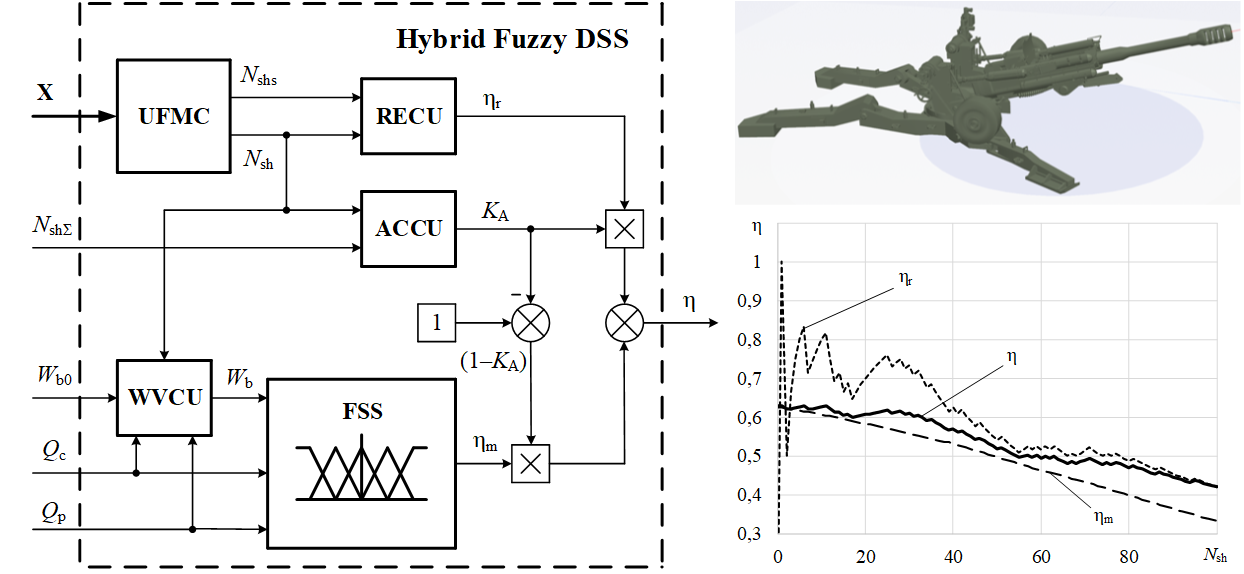
Розроблено та апробовано гібридну нечітко-логічну систему підтримки прийняття рішень (СППР), яка дозволяє здійснювати комплексне та високоточне оцінювання ефективності вогню артилерійських установок. При формуванні оцінок наведена СППР враховує три ключові параметри, що характеризують найбільш суттєві джерела невизначеності: зношення ствола, зниження якості зарядів, зниження якості снарядів.
Одержано результати обчислювальних експериментів для різних реалістичних сценаріїв артилерійського вогню. У свою чергу, досліджувалися артилерійські установки з початковими значеннями зносу ствола 0,1 та 0,25 при застосуванні зарядів та снарядів різної якості. В ході проведених експериментів встановлено, що запропонована система забезпечує отримання адекватної, практично корисної оцінки ефективності вогню артилерійських установок за реалістичних умов невизначеності. Зокрема, розраховані значення ефективності протягом усього процесу стрільби змінювалися не більше ніж на 12% у перших трьох експериментах та не більше 21% у наступних трьох.
Розроблена СППР може бути застосована у сучасних артилерійських комплексах для підвищення ефективності прийняття керувальних рішень, зменшення частки промахів, економії дефіцитних боєприпасів і зниження ризику ураження техніки та особового складу.
Посилання
- Bartulović, V., Trzun, Z., Hoić, M. (2023). Use of Unmanned Aerial Vehicles in Support of Artillery Operations. Strategos, 7 (1), 71–92. Available at: https://hrcak.srce.hr/305562
- Chávez, K., Swed, O. (2023). Emulating underdogs: Tactical drones in the Russia-Ukraine war. Contemporary Security Policy, 44 (4), 592–605. https://doi.org/10.1080/13523260.2023.2257964
- Oprean, L.-G. (2023). Artillery and Drone Action Issues in the War in Ukraine. Scientific Bulletin, 28 (1), 73–78. https://doi.org/10.2478/bsaft-2023-0008
- Świętochowski, N. (2023). Field Artillery in the defensive war of Ukraine 2022-2023Part I. Combat potential, tasks and tactics. Scientific Journal of the Military University of Land Forces, 210 (4), 341–358. https://doi.org/10.5604/01.3001.0054.1631
- Świętochowski, N. (2024). Field Artillery in the defensive war of Ukraine 2022-2023. Part II. Methods of task implementation. Scientific Journal of the Military University of Land Forces, 211 (1), 57–76. https://doi.org/10.5604/01.3001.0054.4136
- Brzozowski, M., Pakowski, M., Nowakowski, M., Myszka, M., Michalczewski, M. (2019). Radars with the function of detecting and tracking artillery shells – selected methods of field testing. 2019 IEEE 5th International Workshop on Metrology for AeroSpace (MetroAeroSpace). Turin, 429–434. https://doi.org/10.1109/metroaerospace.2019.8869656
- Kislitsyn, A., Dorofeev, N. (2021). Directions for the development of domestic self-propelled artillery systems based on the analysis of samples of artillery weapons from the leading countries of the world. Social Development and Security, 11 (6), 98–107. https://doi.org/10.33445/sds.2021.11.6.7
- Ganjiyev, S. J., Usmonov, S. R., Karimov, A. Kh. (2023). Use of artillery in modern war: a brief analysis of the Ukrainian conflict. Galaxy International Interdisciplinary Research Journal, 11 (3), 118–121. Available at: https://internationaljournals.co.in/index.php/giirj/article/view/3646
- Oprean, L.-G. (2020). Artillery from the Perspective of Firing Effects and Ensured Capabilities. Scientific Bulletin, 25 (2), 107–113. https://doi.org/10.2478/bsaft-2020-0015
- Petlyuk, I., Shchavinsky, Y. (2021). Use of simulation modeling systems for determination of appropriate characteristics of prospective artillery weapons. Collection of Scientific Works of Odesa Military Academy, 1 (14), 11–22. https://doi.org/10.37129/2313-7509.2020.14.1.11-22
- STANAG 4355 The Lieske modified point mass and five degrees of freedom trajectory models – AOP-4355 EDITION A (2022). Washington: United States Department of Defense. Available at: https://quicksearch.dla.mil/qsDocDetails.aspx?ident_number=107513
- Zhuravlev, А., Orlov, S., Shuliakov, S. (2020). Mathematical model of the flight path of a projectile of a long-range artillery system. Systems of Arms and Military Equipment, 3 (63), 62–68. https://doi.org/10.30748/soivt.2020.63.09
- Khalil, M. (2022). Study on modeling and production inaccuracies for artillery firing. Archive of Mechanical Engineering, 69 (1), 165–183. https://doi.org/10.24425/ame.2021.139802
- Khudov, H., Yuzova, I., Lisohorskyi, B., Solomonenko, Y., Mykus, S., Irkha, A. et al. (2021). Development of methods for determining the coordinates of firing positions of roving mortars by a network of counter-battery radars. EUREKA: Physics and Engineering, 3, 140–150. https://doi.org/10.21303/2461-4262.2021.001821
- Shim, Y., Atkinson, M. P. (2018). Analysis of artillery shoot‐and‐scoot tactics. Naval Research Logistics, 65 (3), 242–274. https://doi.org/10.1002/nav.21803
- Grishyn, M., Maksymova, O., Kirkopulo, K., Klymchuk, O. (2025). Development of methods of artillery control for suppression of an enemy amphibious operation in video game simulations. Technology Audit and Production Reserves, 1 (2 (81)), 26–33. https://doi.org/10.15587/2706-5448.2025.321797
- Wang, X., Li, X., Sun, Q., Xia, C., Chen, Y.-H. (2025). Improved Manta Ray Foraging Optimization for PID Control Parameter Tuning in Artillery Stabilization Systems. Biomimetics, 10 (5), 266. https://doi.org/10.3390/biomimetics10050266
- Xiao, H., Yang, G., Ge, J. (2017). Surrogate-based multi-objective optimization of firing accuracy and firing stability for a towed artillery. Journal of Vibroengineering, 19 (1), 290–301. https://doi.org/10.21595/jve.2016.17108
- Mady, M., Khalil, M., Yehia, M. (2020). Modelling and Production of artillery firing-tables: case-study. Journal of Physics: Conference Series, 1507 (8), 082043. https://doi.org/10.1088/1742-6596/1507/8/082043
- Manev, N., Achkoski, J., Petreski, D., Gocic, M., Rancic, D. (2017). Smart field artillery information system: Model development with an emphasis on collisions in single sign-on authentication. Vojnotehnicki Glasnik, 65 (2), 442–463. https://doi.org/10.5937/vojtehg65-12703
- Sun, Y., Zhang, S., Lu, G., Zhao, J., Tian, J., Xue, J. (2022). Research on a Simulation Algorithm for Artillery Firepower Assignment According to Region. 2022 3rd International Conference on Computer Science and Management Technology (ICCSMT). Shanghai, 353–356. https://doi.org/10.1109/iccsmt58129.2022.00082
- Wang, L., Chen, Z., Yang, G. (2021). An Uncertainty Analysis Method for Artillery Dynamics with Hybrid Stochastic and Interval Parameters. Computer Modeling in Engineering & Sciences, 126 (2), 479–503. https://doi.org/10.32604/cmes.2021.011954
- Litsman, A., Nesterov, D. (2020) Definitions degree of influence of individual factors on mechanical equipment failure rate during artillery operation. Collection of scientific works of the National Academy of the State Border Guard Service of Ukraine. Series: Military and Technical Sciences, 80, 283–99. https://doi.org/10.32453/3.v80i2.204
- Kumar, D., Kalra, S., Jha, M. S. (2022). A concise review on degradation of gun barrels and its health monitoring techniques. Engineering Failure Analysis, 142, 106791. https://doi.org/10.1016/j.engfailanal.2022.106791
- Shen, C., Zhou, K., Lu, Y., Li, J. (2019). Modeling and simulation of bullet-barrel interaction process for the damaged gun barrel. Defence Technology, 15 (6), 972–986. https://doi.org/10.1016/j.dt.2019.07.009
- Dobrynin, Y., Maksymov, M., Boltenkov, V. (2020). Development of a method for determining the wear of artillery barrels by acoustic fields of shots. Eastern-European Journal of Enterprise Technologies, 3 (5 (105)), 6–18. https://doi.org/10.15587/1729-4061.2020.206114
- Boltenkov, V., Brunetkin, O., Dobrynin, Y., Maksymova, O., Kuzmenko, V., Gultsov, P. et al. (2021). Devising a method for improving the efficiency of artillery shooting based on the Markov model. Eastern-European Journal of Enterprise Technologies, 6 (3 (114)), 6–17. https://doi.org/10.15587/1729-4061.2021.245854
- Toshev, O., Kirkopulo, K., Klymchuk, O., Maksymov, M. (2025). Optimization of ammunition preparation strategies for modern artillery operations in computer simulation. Technology Audit and Production Reserves, 2 (2 (82)), 50–57. https://doi.org/10.15587/2706-5448.2025.326225
- Mendel, J. M. (2024). Explainable Uncertain Rule-Based Fuzzy Systems. Cham: Springer, 580. https://doi.org/10.1007/978-3-031-35378-9
- Kondratenko, Y., Kozlov, O., Zheng, Y., Wang, J., Kuzmenko, V., Aleksieieva, A. B. (2024) Bio-inspired optimization of fuzzy control system for inspection robotic platform: comparative analysis of hybrid swarm methods. CEUR Workshop Proceedings, 3711, 109–123. Available at: https://ceur-ws.org/Vol-3711/paper7.pdf
- Skakodub, O., Kozlov, O., Kondratenko, Y. (2021). Optimization of Linguistic Terms’ Shapes and Parameters: Fuzzy Control System of a Quadrotor Drone. 2021 11th IEEE International Conference on Intelligent Data Acquisition and Advanced Computing Systems: Technology and Applications (IDAACS), 566–571. https://doi.org/10.1109/idaacs53288.2021.9660926
- Kozlov, O. (2021). Information Technology for Designing Rule bases of Fuzzy Systems using Ant Colony Optimization. International Journal of Computing, 20 (4), 471–486. https://doi.org/10.47839/ijc.20.4.2434
- Congxiang, L., Kozlov, O., Kondratenko, G., Aleksieieva, A. (2024). Decision Support System for Maintenance Planning of Vortex Electrostatic Precipitators Based on IoT and AI Techniques. Research Tendencies and Prospect Domains for AI Development and Implementation. New York: River Publishers, 87–105. https://doi.org/10.1201/9788770046947-5
- Solesvik, M., Kondratenko, Y., Kondratenko, G., Sidenko, I., Kharchenko, V., Boyarchuk, A. (2017). Fuzzy decision support systems in marine practice. 2017 IEEE International Conference on Fuzzy Systems (FUZZ-IEEE), 1–6. https://doi.org/10.1109/fuzz-ieee.2017.8015471
- Maksymov, M., Kozlov, O., Dobrynin, Y., Sidelnykov, O., Kapalin, V., Vodichev, V. (2025). Verification of artillery systems’ shots: selection of the most appropriate sensors based on the fuzzy evaluation model. EUREKA: Physics and Engineering, 2, 199–210. https://doi.org/10.21303/2461-4262.2025.003662
- Pedrycz, W., Li, K., Reformat, M. (2015). Evolutionary Reduction of Fuzzy Rule-Based Models. Fifty Years of Fuzzy Logic and Its Applications. Cham: Springer, 459–481. https://doi.org/10.1007/978-3-319-19683-1_23
- Volna, E. (2017). Fuzzy-based decision strategy in real-time strategic games. AIP Conference Proceedings, 1906, 080002. https://doi.org/10.1063/1.5012346
- Werners, B., Kondratenko, Y. (2017). Alternative Fuzzy Approaches for Efficiently Solving the Capacitated Vehicle Routing Problem in Conditions of Uncertain Demands. Complex Systems: Solutions and Challenges in Economics, Management and Engineering. Cham: Springer, 521–543. https://doi.org/10.1007/978-3-319-69989-9_31
- Raskin, L., Sira, O. (2020). Development of methods for extension of the conceptual and analytical framework of the fuzzy set theory. Eastern-European Journal of Enterprise Technologies, 6 (4 (108)), 14–21. https://doi.org/10.15587/1729-4061.2020.217630
- Kozlov, O. V. (2021). Optimal Selection of Membership Functions Types for Fuzzy Control and Decision Making Systems. CEUR Workshop Proceedings, 2853, 238–247. Available at: https://ceur-ws.org/Vol-2853/paper22.pdf
- Kozlov, O., Kondratenko, G., Aleksieieva, A., Maksymov, M. (2025). Complex Structural-Parametric Optimization of Fuzzy Control Systems Based on Bioinspired Algorithms. CEUR Workshop Proceedings, 4048, 1–15. Available at: https://ceur-ws.org/Vol-4048/paper01.pdf
- Kozlov, O., Kondratenko, G., Aleksieieva, A., Maksymov, M., Tarakhtij, O. (2024). Swarm optimization of the drone’s intelligent control system: comparative analysis of hybrid techniques. CEUR Workshop Proceedings, 3790, 1–12. https://ceur-ws.org/Vol-3790/paper01.pdf
- Maksymov, M., Kozlov, O., Shynder, A., Maksymova, O., Aleksieieva, A. (2025). Development of mathematical models for temperature control objects in thermal destruction systems based on transient process identification. EUREKA: Physics and Engineering, 3, 207–220. https://doi.org/10.21303/2461-4262.2025.003802
##submission.downloads##
Опубліковано
Як цитувати
Номер
Розділ
Ліцензія
Авторське право (c) 2026 Maksym Maksymov, Oleksiy Kozlov, Oleksiy Maksymov, Ruslan Riaboshapka

Ця робота ліцензується відповідно до Creative Commons Attribution 4.0 International License.
Закріплення та умови передачі авторських прав (ідентифікація авторства) здійснюється у Ліцензійному договорі. Зокрема, автори залишають за собою право на авторство свого рукопису та передають журналу право першої публікації цієї роботи на умовах ліцензії Creative Commons CC BY. При цьому вони мають право укладати самостійно додаткові угоди, що стосуються неексклюзивного поширення роботи у тому вигляді, в якому вона була опублікована цим журналом, але за умови збереження посилання на першу публікацію статті в цьому журналі.