Enhancement of the measurement method for the radar cross section of unmanned aerial vehicles in the X-band under anechoic chamber conditions
DOI:
https://doi.org/10.15587/2706-5448.2026.353043Keywords:
unmanned aerial vehicle (UAV), radar cross section (RCS), effective scattering surface, backscatter pattern measurement, anechoic chamberAbstract
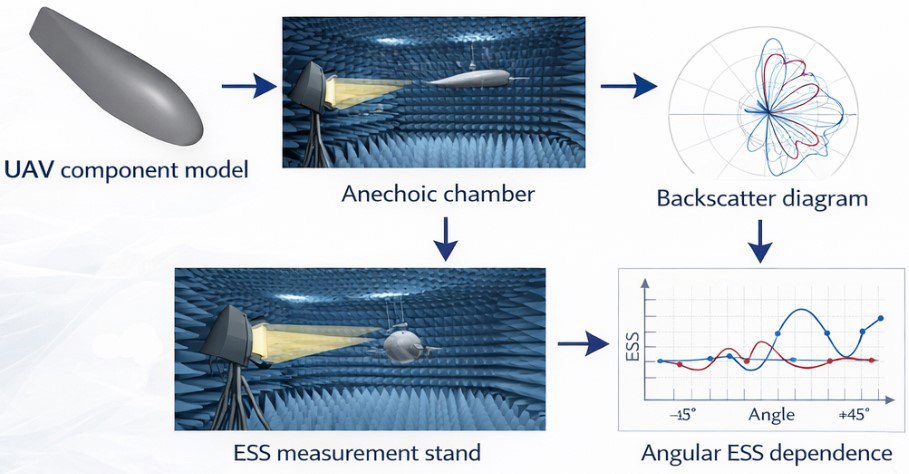
The object of research is the process of measuring the effective scattering surface of an unmanned aerial vehicle (UAV) in the X-band of electromagnetic waves in an anechoic chamber. The problem being solved is to obtain reliable initial data for assessing the radar visibility and probability of detecting UAVs based on their backscatter diagrams. The aim of research is to improve the method of measuring the effective scattering surface (ESS) of UAV components in the X-band in an anechoic chamber and its experimental testing. As a result of the research, a technology for measuring the angular dependence of the ESS in the X-band was formed, which includes compensation of the background signal, calibration of the measuring equipment, ESS determination of the object and automation of the measurement process. The technology includes the design of the anechoic chamber, the structure of the measuring stand, the method of compensation of the background reflection, measurement of the reflected signal power, calibration of the measuring equipment, ESS calculation. The conducted field experiments allowed to obtain the characteristics of the secondary scattering of UAV components in the angle sector ±45°, while the measurement error of static reference objects did not exceed ±1 dB. Comparison of experimental results with the data of mathematical modeling based on integral equations and the physical theory of diffraction confirmed the reliability of the improved approach. The obtained results can be used to increase the accuracy of assessing the radar visibility of small-sized UAVs and improve the means of their detection.
References
- Zhuk, S., Bilorus, A., Bomberher, V., Lukovskiy, I. (2025). Use of unmanned systems in modern military operations: analysis of efficiency and risks. Collection of Scientific Works of the National Academy of the State Border Guard Service of Ukraine. Series: Military and Technical Sciences, 99 (2), 4–14. https://doi.org/10.32453/3.v99i2.1882
- Vorobiov, Yu., Maiorova, K., Popov, A., Diachenko, Yu., Bezkorovainyi, V. (2025). Development of an ontological decision support system for selection of aircraft-type unmanned aerial vehicles. Science and technology today, 11 (52), 1944–1961. https://doi.org/10.52058/2786-6025-2025-11(52)-1944-1961
- Kovalov, K. (2025). UAVs in the reconnaissance and fire control system: current status and prospects. International scientific journal “Grail of Science”, 55, 339–345. https://doi.org/10.36074/grail-of-science.22.08.2025.039
- Bezpilotni systemy ta REB: pidsumky ta dosiahnennia sichnia 2025 roku. Zbroini Syly Ukrainy. Available at: https://www.zsu.gov.ua/news/bezpilotni-systemy-ta-reb-pidsumky-ta-dosyagnennya-sichnya-2025-roku
- Vorobiov, I., Maiorova, K., Sosunov, A. (2026). Methodology for assessing the economic efficiency of using an ontology-based decision support system for selecting aircraft-type unmanned aerial vehicles. Aerospace Technic and Technology, 1, 84–94. https://doi.org/10.32620/aktt.2026.1.08
- Jenn, D. C. (2024). Radar Cross Section. Encyclopedia of RF and Microwave Engineering, 1–43. https://doi.org/10.1002/0471654507.erfme058
- Shevchenko, S. (2025). An improved methodology for determining unmanned aerial vehicles radar visibility characteristics in a model experiment. Scientific Works of Kharkiv National Air Force University, 4 (82), 72–82. https://doi.org/10.30748/zhups.2024.82.09
- Knott, E. F. (1993). Radar Cross Section Measurements. New York: Springer. https://doi.org/10.1007/978-1-4684-9904-9
- Ezuma, M., Anjinappa, C. K., Semkin, V., Guvenc, I. (2022). Comparative Analysis of Radar-Cross-Section- Based UAV Recognition Techniques. IEEE Sensors Journal, 22 (18), 17932–17949. https://doi.org/10.1109/jsen.2022.3194527
- Sukharevsky, O., Zalevsky, G., Vasilets, V., Galkin, Y., Horielyshev, S., Sadovyi, K. (2021). Radar scattering characteristics of tactical unmanned aerial vehicle in VHF, S and X frequency bands. Science and Technology of the Air Force of Ukraine,, 4 (45), 82–92. https://doi.org/10.30748/nitps.2021.45.10
- Surhai, M. V., Zalevskyi, H. S., Vasylets, V. O., Sukharevskyi, O. I. (2017). Otsiniuvannia rivnia radiolokatsiinoi pomitnosti snariadu raketnoi systemy zalpovoho vohniu “Hrad” u riznykh diapazonakh dovzhyn khvyl. Zbirnyk naukovykh prats Kharkivskoho natsionalnoho universytetu Povitrianykh Syl, 2 (51), 142–148. Available at: http://nbuv.gov.ua/UJRN/ZKhUPS_2017_2_30
- Liu, J., Yinchai, W., Wei, F., Han, Q., Tao, Y., Zhao, L. et al. (2023). Secure Cloud-Aided Approximate Nearest Neighbor Search on High-Dimensional Data. IEEE Access, 11, 109027–109037. https://doi.org/10.1109/access.2023.3321457
- Hemming, L. H. (2002). Anechoic Chamber Design Techniques. Electromagnetic Anechoic Chambers. Wiley-IEEE Press, 57–72. https://doi.org/10.1109/9780470544501.ch5
- Popov, A., Kalimullin, D. (2020). Automatization of Antenna Measurements in the Anechoic Chamber. 2020 IEEE Ukrainian Microwave Week (UkrMW). Kharkiv: IEEE, 183–186. https://doi.org/10.1109/ukrmw49653.2020.9252594
- Sukharevsky, O. I. (2018). Electromagnetic Wave Scattering by Aerial and Ground Radar Objects. CRC Press, 334. https://doi.org/10.1201/9781315214511
- Zalevsky, G. S., Sukharevsky, O. I., Vasylets, V. A. (2021). Integral equation modelling of unmanned aerial vehicle radar scattering characteristics in VHF to S frequency bands. IET Microwaves, Antennas & Propagation, 15 (10), 1299–1309. Portico. https://doi.org/10.1049/mia2.12164
- Ufimtsev, P. Y. (2014). Fundamentals of the physical theory of diffraction. Wiley-IEEE Press, 496. Available at: https://download.e-bookshelf.de/download/0002/4020/78/L-G-0002402078-0003467319.pdf
- Panwar, R., Puthucheri, S., Singh, D. (2018). Experimental Demonstration of Novel Hybrid Microwave Absorbing Coatings Using Particle-Size-Controlled Hard–Soft Ferrite. IEEE Transactions on Magnetics, 54 (11), 1–5. https://doi.org/10.1109/tmag.2018.2828782
- Zhao, H., Chen, J., Zhuang, M., Yang, X., Zhuo, J. (2024). A Novel Radar Cross-Section Calculation Method Based on the Combination of the Spectral Element Method and the Integral Method. Symmetry, 16 (5), 542. https://doi.org/10.3390/sym16050542
Downloads
Published
How to Cite
Issue
Section
License
Copyright (c) 2026 Anatoliy Popov, Iurii Vorobiov, Kateryna Maiorova, Mariya Bortsova

This work is licensed under a Creative Commons Attribution 4.0 International License.
The consolidation and conditions for the transfer of copyright (identification of authorship) is carried out in the License Agreement. In particular, the authors reserve the right to the authorship of their manuscript and transfer the first publication of this work to the journal under the terms of the Creative Commons CC BY license. At the same time, they have the right to conclude on their own additional agreements concerning the non-exclusive distribution of the work in the form in which it was published by this journal, but provided that the link to the first publication of the article in this journal is preserved.