Development of a method for determining the wear of an artillery mount barrel under conditions of uncertain disturbances based on fuzzy logic and stochastic modeling
DOI:
https://doi.org/10.15587/2706-5448.2026.360861Keywords:
artillery firing, barrel wear determination, fuzzy logic, rule base, stochastic modelingAbstract
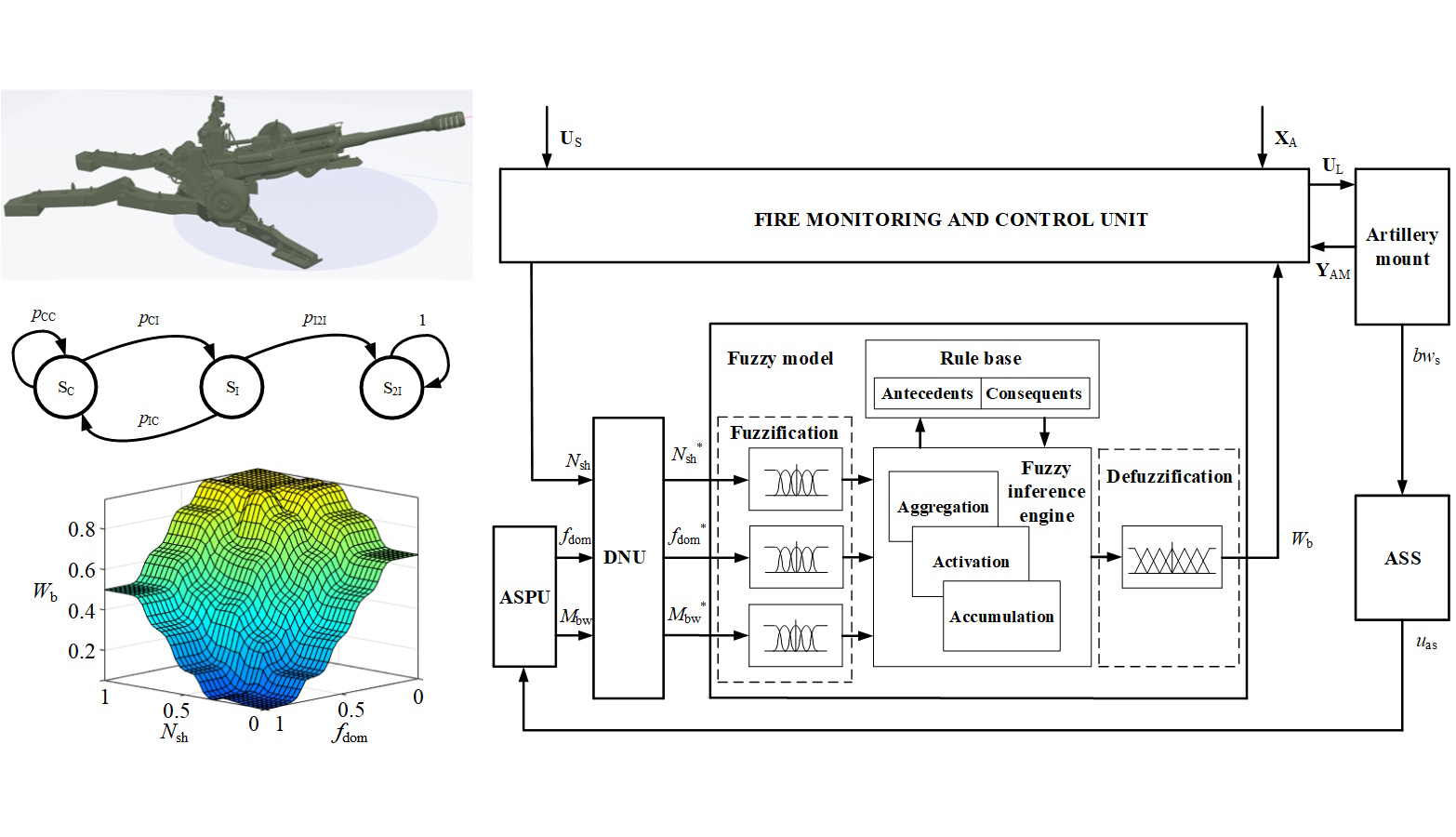
The object of research is the processes of determining the wear of gun barrels and controlling the firing of artillery mounts under conditions of uncertain disturbances. This work addresses the problem of ensuring the adequacy of determining the current wear of the barrel and adaptive adjustment of the settings of the artillery mount when firing in short series from different positions. At the same time, the research considered the effect of random disturbing influences on the mount, including the failure of the projectile leading belt and the low quality of the powder charge.
The research used fuzzy logic methods to calculate the current value of barrel wear based on the parameters of the ballistic wave of the shot and taking into account the total gun firing. Also, stochastic modeling methods, in particular, Markov chains, were used to simulate the processes of firing under conditions of random disturbances.
A method for determining the current barrel wear based on fuzzy logic has been developed and investigated, which allows for adaptive adjustment of artillery mount settings when firing in short bursts under conditions of uncertain disturbances. To correctly determine wear, the proposed method uses three information channels, including the dominant frequency and depth of frequency modulation of the ballistic wave, as well as the total gun firing rate.
The results of computational experiments were obtained, confirming the high efficiency of the developed method in comparison with other known methods. In particular, an increase in firing efficiency by 14.5% and a reduction in the time spent at firing positions by 3 min. were achieved when compared with the most effective method using measurements of the dominant frequency of the ballistic wave.
The developed method can be used for diagnostics and control of modern artillery systems to increase firing efficiency and reduce the time spent at firing positions.
References
- Ganjiyev, S. J., Usmonov, S. R., Karimov, A. Kh. (2023). Use of artillery in modern war (a brief analysis of the Ukrainian conflict). Galaxy International Interdisciplinary Research Journal, 11 (3), 118–121. Available at: https://internationaljournals.co.in/index.php/giirj/article/view/3646
- Kislitsyn, A., Dorofeev, N. (2021). Directions for the development of domestic self-propelled artillery systems based on the analysis of samples of artillery weapons from the leading countries of the world. Social Development and Security, 11 (6), 98–107. https://doi.org/10.33445/sds.2021.11.6.7
- Zhuravlev, А., Orlov, S., Shuliakov, S. (2020). Mathematical model of the flight path of a projectile of a long-range artillery system. Systems of Arms and Military Equipment, 3 (63), 62–68. https://doi.org/10.30748/soivt.2020.63.09
- Khalil, M. (2022). Study on modeling and production inaccuracies for artillery firing. Archive of Mechanical Engineering, 69 (1), 165–183. https://doi.org/10.24425/ame.2021.139802
- STANAG 4355 The Lieske modified point mass and five degrees of freedom trajectory models – AOP-4355 EDITION A. (No enabled versions) (2022) Washington: United States: United States Department of Defense.
- Bartulović, V., Trzun, Z., Hoić, M. (2023). Use of Unmanned Aerial Vehicles in Support of Artillery Operations. Strategos, 7 (1), 71–92. Available at: https://hrcak.srce.hr/305562
- Oprean, L.-G. (2023). Artillery and Drone Action Issues in the War in Ukraine. Scientific Bulletin, 28 (1), 73–78. https://doi.org/10.2478/bsaft-2023-0008
- Khudov, H., Yuzova, I., Lisohorskyi, B., Solomonenko, Y., Mykus, S., Irkha, A. et al. (2021). Development of methods for determining the coordinates of firing positions of roving mortars by a network of counter-battery radars. EUREKA: Physics and Engineering, 3, 140–150. https://doi.org/10.21303/2461-4262.2021.001821
- Xiao, H., Yang, G., Ge, J. (2017). Surrogate-based multi-objective optimization of firing accuracy and firing stability for a towed artillery. Journal of Vibroengineering, 19 (1), 290–301. https://doi.org/10.21595/jve.2016.17108
- Wang, X., Li, X., Sun, Q., Xia, C., Chen, Y.-H. (2025). Improved Manta Ray Foraging Optimization for PID Control Parameter Tuning in Artillery Stabilization Systems. Biomimetics, 10 (5), 266. https://doi.org/10.3390/biomimetics10050266
- Świętochowski, N. (2023). Field Artillery in the defensive war of Ukraine 2022–2023. Part I. Combat potential, tasks and tactics. Scientific Journal of the Military University of Land Forces, 210 (4), 341–358. https://doi.org/10.5604/01.3001.0054.1631
- Świętochowski, N. (2024). Field Artillery in the defensive war of Ukraine 2022-2023. Part II. Methods of task implementation. Scientific Journal of the Military University of Land Forces, 211 (1), 57–76. https://doi.org/10.5604/01.3001.0054.4136
- Shen, C., Zhou, K.-D., Lu, Y., Li, J.-S. (2019). Modeling and simulation of bullet-barrel interaction process for the damaged gun barrel. Defence Technology, 15 (6), 972–986. https://doi.org/10.1016/j.dt.2019.07.009
- Dobrynin, Y., Maksymov, M., Boltenkov, V. (2020). Development of a method for determining the wear of artillery barrels by acoustic fields of shots. Eastern-European Journal of Enterprise Technologies, 3 (5 (105)), 6–18. https://doi.org/10.15587/1729-4061.2020.206114
- Werners, B., Kondratenko, Y. (2017). Alternative Fuzzy Approaches for Efficiently Solving the Capacitated Vehicle Routing Problem in Conditions of Uncertain Demands. Complex Systems: Solutions and Challenges in Economics, Management and Engineering. Cham: Springer, 521–543. https://doi.org/10.1007/978-3-319-69989-9_31
- Congxiang, L., Kozlov, O., Kondratenko, G., Aleksieieva, A.; Kondratenko, Y. P., Shevchenko, A. I. (Eds.) (2024). Decision Support System for Maintenance Planning of Vortex Electrostatic Precipitators Based on IoT and AI Techniques. Research Tendencies and Prospect Domains for AI Development and Implementation. New York: River Publishers, 87–105. https://doi.org/10.1201/9788770046947-5
- Skakodub, O., Kozlov, O., Kondratenko, Y. (2021). Optimization of Linguistic Terms’ Shapes and Parameters: Fuzzy Control System of a Quadrotor Drone. 2021 11th IEEE International Conference on Intelligent Data Acquisition and Advanced Computing Systems: Technology and Applications (IDAACS), 566–571. https://doi.org/10.1109/idaacs53288.2021.9660926
- Kozlov, O. (2021). Information Technology for Designing Rule bases of Fuzzy Systems using Ant Colony Optimization. International Journal of Computing, 20 (4), 471–486. https://doi.org/10.47839/ijc.20.4.2434
- Kozlov, O., Kondratenko, G., Aleksieieva, A., Maksymov, M., Tarakhtij, O. (2024). Swarm optimization of the drone’s intelligent control system: comparative analysis of hybrid techniques. CEUR Workshop Proceedings, 3790, 1–12. Available at: https://ceur-ws.org/Vol-3790/paper01.pdf
- Grishyn, M., Maksymova, O., Kirkopulo, K., Klymchuk, O. (2025). Development of methods of artillery control for suppression of an enemy amphibious operation in video game simulations. Technology Audit and Production Reserves, 1 (2 (81)), 26–33. https://doi.org/10.15587/2706-5448.2025.321797
- Shim, Y., Atkinson, M. P. (2018). Analysis of artillery shoot‐and‐scoot tactics. Naval Research Logistics (NRL), 65 (3), 242–274. https://doi.org/10.1002/nav.21803
- Litsman, A., Nesterov, D. (2020). Definitions degree of influence of individual factors on mechanical equipment failure rate during artillery operation. Collection of Scientific Works of the National Academy of the State Border Guard Service of Ukraine. Series: Military and Technical Sciences, 80 (2), 283–299. https://doi.org/10.32453/3.v80i2.204
- Kumar, D., Kalra, S., Jha, M. S. (2022). A concise review on degradation of gun barrels and its health monitoring techniques. Engineering Failure Analysis, 142, 106791. https://doi.org/10.1016/j.engfailanal.2022.106791
- Wang, L., Chen, Z., Yang, G. (2021). An Uncertainty Analysis Method for Artillery Dynamics with Hybrid Stochastic and Interval Parameters. Computer Modeling in Engineering & Sciences, 126 (2), 479–503. https://doi.org/10.32604/cmes.2021.011954
- Mendel, J. M. (2024). Explainable Uncertain Rule-Based Fuzzy Systems. Cham: Springer. https://doi.org/10.1007/978-3-031-35378-9
- Zheng, Y., Wang, J., Kozlov, O., Kondratenko, G., Aleksieieva, A.; Shevchenko, A. I., Kondratenko, Y. P. (Eds.) (2026). Optimization-oriented Synthesis of Rule Bases of Intelligent Systems: Application Features for Complex Plants’ Control. Artificial Intelligence: Achievements and Recent Developments. Denmark: River Publishers, Gistrup, 83–111. https://doi.org/10.1201/9788743800989-4
- Pujaru, K., Adak, S., Kar, T. K., Patra, S., Jana, S. (2024). A Mamdani fuzzy inference system with trapezoidal membership functions for investigating fishery production. Decision Analytics Journal, 11, 100481. https://doi.org/10.1016/j.dajour.2024.100481
- Boltenkov, V., Brunetkin, O., Dobrynin, Y., Maksymova, O., Kuzmenko, V., Gultsov, P. et al. (2021). Devising a method for improving the efficiency of artillery shooting based on the Markov model. Eastern-European Journal of Enterprise Technologies, 6 (3 (114)), 6–17. https://doi.org/10.15587/1729-4061.2021.245854
- Maksymov, M., Kozlov, O., Shynder, A., Maksymova, O., Aleksieieva, A. (2025). Development of mathematical models for temperature control objects in thermal destruction systems based on transient process identification. EUREKA: Physics and Engineering, 3, 207–220. https://doi.org/10.21303/2461-4262.2025.003802
- Kondratenko, Y., Kozlov, O., Zheng, Y., Wang, J., Kuzmenko, V., Aleksieieva, A. (2024) Bio-inspired optimization of fuzzy control system for inspection robotic platform: comparative analysis of hybrid swarm methods. CEUR Workshop Proceedings, 3711, 109–123. Available at: https://ceur-ws.org/Vol-3711/paper7.pdf
- Kozlov, O., Kondratenko, G., Aleksieieva, A., Maksymov, M. (2025) Complex Structural-Parametric Optimization of Fuzzy Control Systems Based on Bioinspired Algorithms. CEUR Workshop Proceedings, 4048, 1–15. Available at: https://ceur-ws.org/Vol-4048/paper01.pdf
Downloads
Published
How to Cite
Issue
Section
License
Copyright (c) 2026 Maksym Maksymov, Oleksiy Kozlov, Oleksiy Maksymov, Ruslan Riaboshapka

This work is licensed under a Creative Commons Attribution 4.0 International License.
The consolidation and conditions for the transfer of copyright (identification of authorship) is carried out in the License Agreement. In particular, the authors reserve the right to the authorship of their manuscript and transfer the first publication of this work to the journal under the terms of the Creative Commons CC BY license. At the same time, they have the right to conclude on their own additional agreements concerning the non-exclusive distribution of the work in the form in which it was published by this journal, but provided that the link to the first publication of the article in this journal is preserved.





