An integrated assessment of geomechanical and energy parameters for deep pit reclamation via regenerative conveyors: a Kryvyi Rih case study
DOI:
https://doi.org/10.15587/2706-5448.2026.364282Keywords:
reclamation, open-pit, conveyor, regeneration, geomechanics, efficiency, dumping, recovery, decarbonization, modelingAbstract
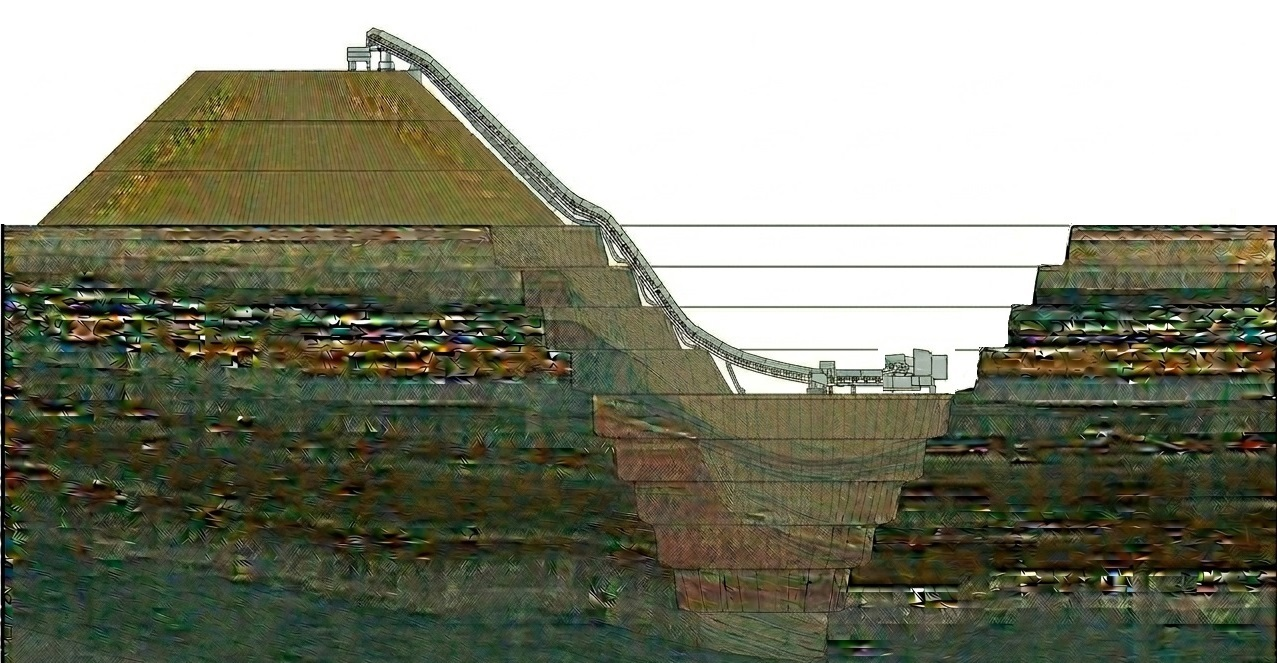
The object of research is the technological process of rock mass handling. During active mining, this process required moving the overburden from the pit to surface terrain dumps. Once extraction was completed, the operation shifted to mine reclamation through in-pit dumping. At that stage, the stored rock mass was relocated from external dumps back into the mined-out space using regenerative conveyor systems. The main problem to be solved involved reducing the energy footprint of such reclamation operations without sacrificing the geomechanical stability of the dump slope. Conventional haulage methods relied heavily on fossil fuels, leading to carbon emissions and high operating costs. This economic and environmental burden demanded a shift toward technologies capable of capturing the gravitational potential energy of the relocated rock mass.
The research combined limit equilibrium analysis for slope stability evaluation with numerical modeling of the interconnected energy and geomechanical balance. To pinpoint exactly where gravity acted on each rock volume, a step-by-step vertical discretization of the benches was applied, coupled with the geometric centroid method.
Modeling of the reclamation system designed for a 500-meter-deep pit in Ukraine's Kryvyi Rih region proved that regenerative conveyors are capable of accumulating up to 542.36 million kWh of energy (1.24–1.34 kWh/m³). Calculations revealed a 6.9% technological gap from the theoretical limit. The centroid method yielded zero mathematical error, whereas the area bisection technique underestimated the energy potential by 11.7%.
These findings offered a practical framework for designing reclamation and decarbonization strategies at deep open-pit mines. By leveraging the patented technological solution (Ukrainian Patent No. 158796), mining operators could transform standard environmental cleanup operations into a revenue-generating energy asset.
References
- Polozhennia pro proiektuvannia vnutrishnikh vidvaliv ta skladuvannia vyrobnychykh vidkhodiv u zalizorudnykh ta fliusovykh karierakh (2004). Nakaz Ministerstva promyslovoi polityky Ukrainy No. 412. 17.08.2004. Available at: https://zakon.rada.gov.ua/laws/show/z1027-04
- Drizhenko, A., Adamchuk, A., Tamouya, S., Telnov, V. (2018). Research of inside dump parameters in worked-out area of deep opencast mines. Zbirnyk naukovykh prats Natsionalnoho hirnychoho universytetu, 53, 56–65. Available at: http://nbuv.gov.ua/UJRN/znpngu_2018_53_8
- Drizhenko, A. Yu. (2014). Vidkryti hirnychi roboty. Natsionalnyi hirnychyi universytet, 590.
- Legwaila, I. A., Lange, E., Cripps, J. (2015). Quarry reclamation in england: a review of techniques. Journal American Society of Mining and Reclamation, 4 (2), 55–79. https://doi.org/10.21000/jasmr15020055
- Antonik, V., Shtanko, L., Antonik, I., Ivachenko, V. (2022). New technology of reclamation of slopes of waste and excavated rocks of mines and quarries. IOP Conference Series: Earth and Environmental Science, 1049 (1), 12003. https://doi.org/10.1088/1755-1315/1049/1/012003
- Chelopo, D., Gupta, K. (2025). Exploring the Economic Hypothetical for Downhill Belt Conveyors Equipped with Three-Phase Active Front-End Load Converters. Technologies, 13 (5), 185. https://doi.org/10.3390/technologies13050185
- Semenchenko, A., Stadnik, M., Belytsky, P., Semenchenko, D. (2018). The increase of the belt conveyors energy efficiency in intensive mining conditions. Journal of Donetsk Mining Institute, 2, 91–106. https://doi.org/10.31474/1999-981x-2018-2-91
- Kawalec, W., Król, R., Suchorab, N. (2020). Regenerative Belt Conveyor versus Haul Truck-Based Transport: Polish Open-Pit Mines Facing Sustainable Development Challenges. Sustainability, 12 (21), 9215. https://doi.org/10.3390/su12219215
- Kawalec, W., Król, R. (2021). Generating of Electric Energy by a Declined Overburden Conveyor in a Continuous Surface Mine. Energies, 14 (13), 4030. https://doi.org/10.3390/en14134030
- Bolotnikov, A. V., Brovko, D. V., Romanenko, A. O., Romanenko, O. V., Demchenko, D. A. (2025). Pat. No. 158796. Sposib rekultyvatsii vidpratsovanykh karieriv. MKP E 21C 41/00, E 21C 41/32. No. u202404117; declareted: 19.08.2024; published: 20.03.2025, Bul. No. 12.
Downloads
Published
How to Cite
Issue
Section
License
Copyright (c) 2026 Andrii Bolotnikov, Andrii Romanenko, Dmytro Brovko, Volodymyr Peregudov, Yurii Kryvenko, Oleksandr Romanenko

This work is licensed under a Creative Commons Attribution 4.0 International License.
The consolidation and conditions for the transfer of copyright (identification of authorship) is carried out in the License Agreement. In particular, the authors reserve the right to the authorship of their manuscript and transfer the first publication of this work to the journal under the terms of the Creative Commons CC BY license. At the same time, they have the right to conclude on their own additional agreements concerning the non-exclusive distribution of the work in the form in which it was published by this journal, but provided that the link to the first publication of the article in this journal is preserved.