Assessment of endothelial nitric oxide synthase activity and stable nitric oxide metabolite levels in pregnant women with hypertensive disorders
DOI:
https://doi.org/10.15587/2519-4798.2025.340456Keywords:
hypertensive disorders of pregnancy, preeclampsia, nitric oxide, nitric oxide synthase, endothelial nitric oxide synthase (eNOS), stable NO metabolites, endothelial dysfunction, oxidative stress, nitric oxide bioavailability, biomarkersAbstract
The aim. To evaluate nitric oxide system parameters in pregnant women with hypertensive disorders by assessing the levels of stable NO metabolites and the activity of endothelial NO synthase.
Materials and methods. A prospective controlled study included 65 pregnant women in the third trimester of pregnancy. The main group comprised 35 patients with gestational hypertension or preeclampsia, while the control group included 30 women with physiological pregnancies. Endothelial NO synthase (eNOS) activity was assessed spectrophotometrically by the stoichiometric oxidation of NADPH during the conversion of L-arginine to NO. The concentration of stable NO metabolites: nitrates and nitrites (NOx) was determined spectrophotometrically using the Griess reagent with preliminary reduction of nitrates to nitrites. For statistical analysis, the Mann-Whitney U test and Spearman’s rank correlation coefficient were applied.
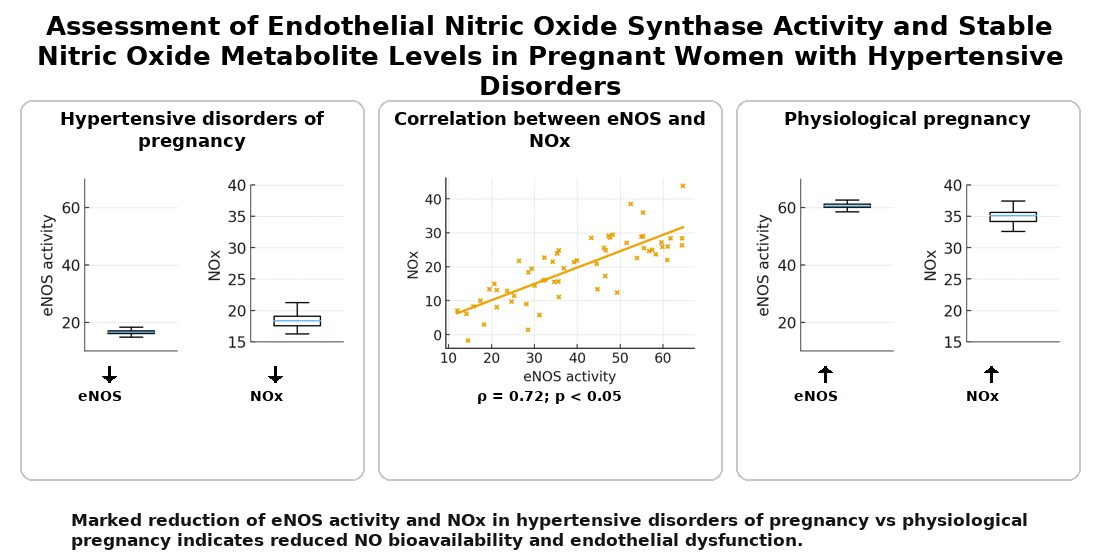
Results. In women with hypertensive disorders, eNOS activity was more than 3.5 times lower compared to the control group: 16.70 [16.10-17.60] vs. 60.45 [59.55-62.25] nmol/mg protein/min (p < 0.05). The NOx concentration was also nearly halved: 18.60 [17.80-19.25] vs. 34.80 [32.90-36.80] µmol/L (p < 0.05). A positive correlation was found between eNOS activity and NOx concentration (ρ = 0.72; p < 0.05), confirming their physiological interrelation.
Conclusions. Pregnant women with hypertensive disorders demonstrated a marked decrease in eNOS activity and stable NO metabolite levels, indicating significantly reduced NO bioavailability. These findings are consistent with current concepts regarding the role of endothelial dysfunction and oxidative stress in the pathogenesis of preeclampsia. Assessment of these biomarkers may have promising value for early diagnosis, prognosis of pregnancy complications, and may provide a rationale for novel preventive strategies
References
- Trends in maternal mortality 2000 to 2023: estimates by WHO, UNICEF, UNFPA, World Bank Group and UNDESA/Population Division (2025). World Health Organization, UNICEF, UNFPA, World Bank Group, UNDESA/Population Division. Geneva: World Health Organization.
- Brown, M. A., Magee, L. A., Kenny, L. C., Karumanchi, S. A., McCarthy, F. P., Saito, S. et al. (2018). Hypertensive Disorders of Pregnancy: ISSHP Classification, Diagnosis, and Management Recommendations for International Practice. Hypertension, 72 (1), 24–43. https://doi.org/10.1161/hypertensionaha.117.10803
- Rana, S., Lemoine, E., Granger, J. P., Karumanchi, S. A. (2019). Preeclampsia: Pathophysiology, Challenges, and Perspectives. Circulation Research, 124 (7), 1094–1112. https://doi.org/10.1161/circresaha.118.313276
- Guerby, P., Tasta, O., Swiader, A., Pont, F., Bujold, E., Parant, O. et al. (2021). Role of oxidative stress in the dysfunction of the placental endothelial nitric oxide synthase in preeclampsia. Redox Biology, 40, 101861. https://doi.org/10.1016/j.redox.2021.101861
- Sutton, E. F., Gemmel, M., Powers, R. W. (2020). Nitric oxide signaling in pregnancy and preeclampsia. Nitric Oxide, 95, 55–62. https://doi.org/10.1016/j.niox.2019.11.006
- Lundberg, J. O., Weitzberg, E. (2022). Nitric oxide signaling in health and disease. Cell, 185 (16), 2853–2878. https://doi.org/10.1016/j.cell.2022.06.010
- Barbouti, A., Varvarousis, D. N., Kanavaros, P. (2025). The Role of Oxidative Stress-Induced Senescence in the Pathogenesis of Preeclampsia. Antioxidants, 14 (5), 529. https://doi.org/10.3390/antiox14050529
- Osol, G., Ko, N. L., Mandalà, M. (2017). Altered Endothelial Nitric Oxide Signaling as a Paradigm for Maternal Vascular Maladaptation in Preeclampsia. Current Hypertension Reports, 19 (10). https://doi.org/10.1007/s11906-017-0774-6
- Zullino, S., Buzzella, F., Simoncini, T. (2018). Nitric oxide and the biology of pregnancy. Vascular Pharmacology, 110, 71–74. https://doi.org/10.1016/j.vph.2018.07.004
- Standarty medychnoi dopomohy «Normalna vahitnist» (2022). Nakaz MOZ Ukrainy No. 1437. 09.08.2025. Available at: https://www.dec.gov.ua/wp-content/uploads/2022/08/2022_1437_smd_nv.pdf
- Yedynyi klinichnyi protokol pervynnoi, vtorynnoi (spetsializovanoi) ta tretynnoi (vysokospetsializovanoi) medychnoi dopomohy «Hipertenzyvni rozlady pid chas vahitnosti, polohiv ta v pisliapolohovyi period» (UKPMD) (2022). Nakaz MOZ Ukrainy No. 151. 24.01.2025. Available at: https://www.dec.gov.ua/wp-content/uploads/2022/01/2022_151_ykpmd_giprozlvagitn.pdf
- Chekman, I. S., Bieliienchev, I. F., Nahorna, O. O., Horchakova, N. O., Lukianchuk, V. D., Bukhtiiarova, N. V. et al. (2016). Doklinichne vyvchennia spetsyfichnoi aktyvnosti potentsiinykh likarskykh zasobiv pervynnoi ta vtorynnoi neiroprotektsii. Kyiv, 93.
- Afrose, D., Alfonso-Sánchez, S., McClements, L. (2024). Targeting oxidative stress in preeclampsia. Hypertension in Pregnancy, 44(1). https://doi.org/10.1080/10641955.2024.2445556
- Staff, A. C. (2019). The two-stage placental model of preeclampsia: An update. Journal of Reproductive Immunology, 134-135, 1–10. https://doi.org/10.1016/j.jri.2019.07.004
- Dimitriadis, E., Rolnik, D. L., Zhou, W., Estrada-Gutierrez, G., Koga, K., Francisco, R. P. V. et al. (2023). Pre-eclampsia. Nature Reviews Disease Primers, 9 (1). https://doi.org/10.1038/s41572-023-00417-6
- Burton, G. J., Redman, C. W., Roberts, J. M., Moffett, A. (2019). Pre-eclampsia: pathophysiology and clinical implications. BMJ, l2381. https://doi.org/10.1136/bmj.l2381
- Grzeszczak, K., Łanocha-Arendarczyk, N., Malinowski, W., Ziętek, P., Kosik-Bogacka, D. (2023). Oxidative Stress in Pregnancy. Biomolecules, 13 (12), 1768. https://doi.org/10.3390/biom13121768
Downloads
Published
How to Cite
Issue
Section
License
Copyright (c) 2025 Volodymyr Sіusіuka, Mykhailo Kyrychenko

This work is licensed under a Creative Commons Attribution 4.0 International License.
Our journal abides by the Creative Commons Attribution 4.0 International License copyright rights and permissions for open access journals.
Authors, who are published in this journal, agree to the following conditions:
1. The authors reserve the right to authorship of the work and pass the first publication right of this work to the journal under the terms of a Creative Commons Attribution 4.0 International License, which allows others to freely distribute the published research with the obligatory reference to the authors of the original work and the first publication of the work in this journal.
2. The authors have the right to conclude separate supplement agreements that relate to non-exclusive work distribution in the form in which it has been published by the journal (for example, to upload the work to the online storage of the journal or publish it as part of a monograph), provided that the reference to the first publication of the work in this journal is included.
3. Authors have the right to store the final accepted version of the article in an institutional, thematic, or any other repository to ensure visibility and accessibility.


