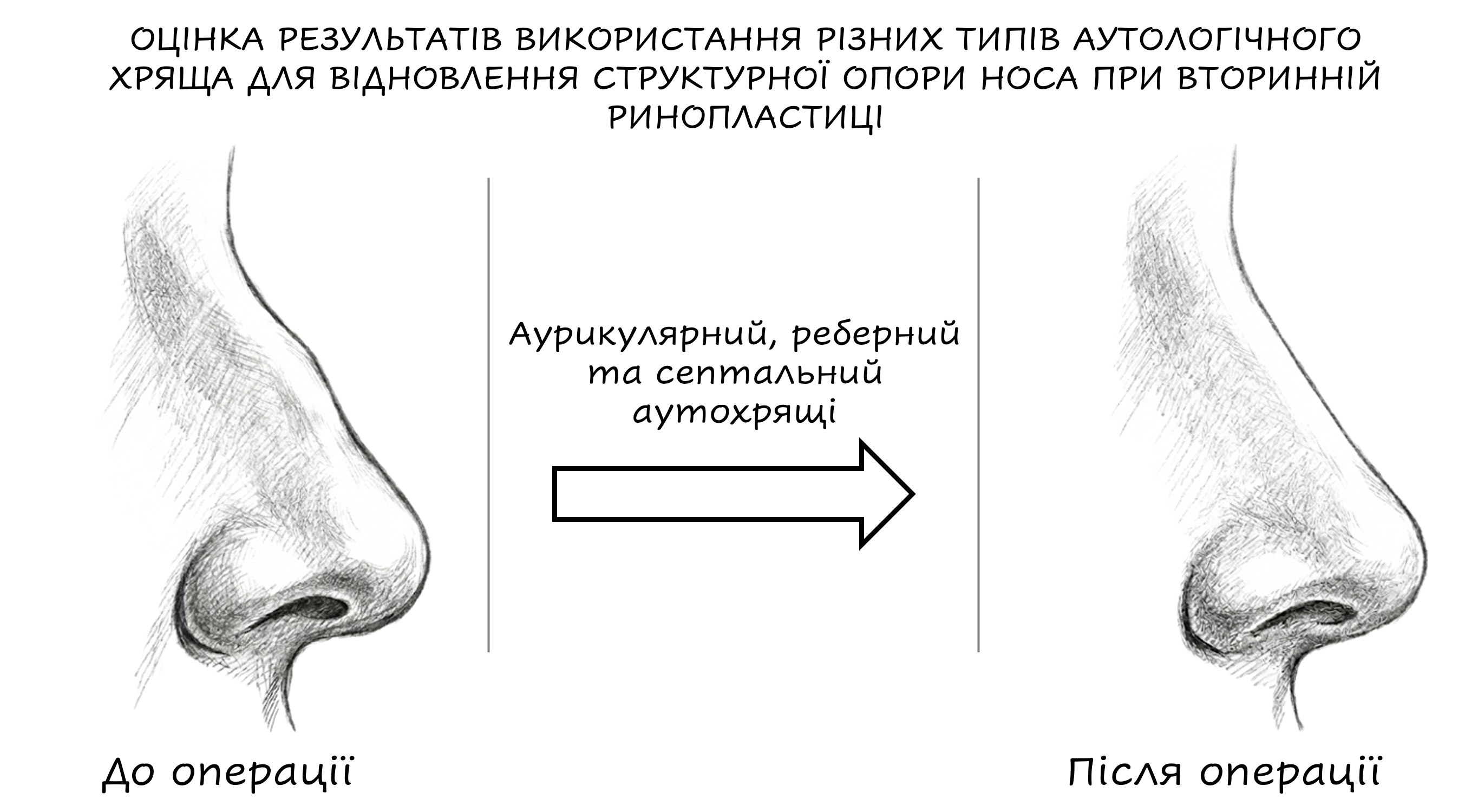
Evaluation of the results of the use of different types of autologous cartilage for restoration of structural support of the nose in secondary rhinoplasty
DOI:
https://doi.org/10.15587/2519-4798.2025.348281Keywords:
nose, nasal cavity, rhinoplasty, secondary rhinoplasty, nasal breathing, respiratory function, nasal cartilage, nasal anatomy, autologous implants, auricular cartilage, septal cartilage, costal cartilageAbstract
According to the literature, from 14 to 50% of patients after primary rhinoplasty still require repeated interventions to correct aesthetic or functional defects of the nose, for which various types of autologous cartilage grafts are used. Despite the number of possible donor sites of autologous cartilage, their resorption still remains a significant problem in the context of the stability of long-term rhinoplasty results.
Objective: To conduct a comparative assessment of the clinical results of using different types of autologous cartilage in secondary rhinoplasty.
Materials and methods. A prospective study was conducted involving 54 patients aged 18 to 60 years who underwent secondary rhinoplasty in the period from January 2022 to January 2025 and who were divided into 3 groups according to the type of autologous cartilage. The study used questionnaires NOSE, ROE, VAS (satisfaction), photometry, and statistical research methods. Evaluations of the results were carried out at 3, 6, 12, 24, 36 months of follow-up.
Results. Three months after the intervention, the median NOSE score was 35 points. The ROE level 3 months after the operation was characterized by a median of 62.5 points. During the following months, a gradual increase in this score was observed until the twelfth month. Regarding objective indicators, the width of the nose one year after the operation was 32.4 mm, the height of the nasal bridge - 4.7 mm, the projection of the nasal tip was recorded at 21.3 mm. The height of the bridge showed a tendency to decrease (to 4.0 mm after three years).
Conclusions. The use of autologous cartilage grafts in secondary rhinoplasty provides a significant improvement in functional and aesthetic results without a statistically significant difference between the study groups. The process of cartilage resorption in all cases of rhinoplasty is progressive and correlates with the observation period. In our case, resorption was observed for the entire sample from 1.5% after one year to 2.3% after three years
References
- Dandoulakis, E. (2025). Advances In Autologous Cartilage Engineering For Ear And Nasal Reconstruction: Current Status And Future Prospects. SSRN Electronic Journal. https://doi.org/10.2139/ssrn.5677985
- Apaydın, F. (2025). Surgical Anatomy of the Nasal Septum. Septal Surgery Challenges in Rhinoplasty. Cham: Springer, 11–20. https://doi.org/10.1007/978-3-031-74734-2_2
- Kao, W. K., Ho, T. (2023). The Management of Posttraumatic Nasal Deformities. Facial Plastic Surgery, 39 (6), 630–637. https://doi.org/10.1055/a-2152-8670
- Hashemi, S. M., Afshari, E., Ghazavi, H. (2022). Prevalence of Facial Asymmetry and Correction Methods for Rhinoplasty in Individuals with Deviated Nose: A Brief Review. World journal of plastic surgery, 11 (2), 18–23. https://doi.org/10.52547/wjps.11.2.18
- Toriumi, D. M., Kovacevic, M. (2022). Correction of the Saddle Nose Deformity Using the “Push Up” Technique. Facial Plastic Surgery, 38 (5), 488–494. https://doi.org/10.1055/a-1803-6341
- Pruthi, A., Dobratz, E., Dougherty, W. (2023). Management of the Middle Vault. Facial Plastic Surgery, 39 (6), 609–615. https://doi.org/10.1055/a-2148-2141
- Wright, J. M., Halsey, J. N., Rottgers, S. A. (2023). Dorsal Augmentation: A Review of Current Graft Options. Eplasty, 23, e4.
- Jiang, M., Huo, H., Zhang, L. (2024). Current practice in autologous rib and costal-cartilage harvest for rhinoplasty: A systematic review. Chinese Journal of Plastic and Reconstructive Surgery, 6 (1), 41–48. https://doi.org/10.1016/j.cjprs.2024.02.002
- Dhong, E.-S., Na, M.-W. (2021). The Resorption: The Hurdle for Autogenous-Based Asian Rhinoplasty. Asian Septorhinoplasty. Singapore: Springer, 77–89. https://doi.org/10.1007/978-981-16-0542-0_7
- Dermody, S. M., Lindsay, R. W., Justicz, N. (2023). Considerations for Optimal Grafting in Rhinoplasty. Facial Plastic Surgery, 39 (6), 625–629. https://doi.org/10.1055/a-2116-4566
- Wells, M. W., McCleary, S. P., Chang, I. A., Deleonibus, A., Kotha, V. S., Rampazzo, A. et al. (2024). A systematic review and meta-analysis of complications associated with crushed cartilage in rhinoplasty. Journal of Plastic, Reconstructive & Aesthetic Surgery, 96, 231–241. https://doi.org/10.1016/j.bjps.2024.06.019
- Lee, T.-Y., Lee, K.-I., Dhong, E.-S., Jeong, S.-H., Kim, D.-W., Han, S.-K. (2022). Long-Term Resorption Rate of Autogenous Onlay Graft in East Asian Rhinoplasty: A Retrospective Study. Plastic & Reconstructive Surgery, 149 (2), 360–371. https://doi.org/10.1097/prs.0000000000008793
Downloads
Published
How to Cite
Issue
Section
License
Copyright (c) 2025 Ivan Fastovets, Tetiana Zaporozhets

This work is licensed under a Creative Commons Attribution 4.0 International License.
Our journal abides by the Creative Commons Attribution 4.0 International License copyright rights and permissions for open access journals.
Authors, who are published in this journal, agree to the following conditions:
1. The authors reserve the right to authorship of the work and pass the first publication right of this work to the journal under the terms of a Creative Commons Attribution 4.0 International License, which allows others to freely distribute the published research with the obligatory reference to the authors of the original work and the first publication of the work in this journal.
2. The authors have the right to conclude separate supplement agreements that relate to non-exclusive work distribution in the form in which it has been published by the journal (for example, to upload the work to the online storage of the journal or publish it as part of a monograph), provided that the reference to the first publication of the work in this journal is included.
3. Authors have the right to store the final accepted version of the article in an institutional, thematic, or any other repository to ensure visibility and accessibility.