Correlation relationships between pain intensity, functional recovery of the knee joint, and clinical-laboratory characteristics in obese patients after anterior cruciate ligament reconstruction
DOI:
https://doi.org/10.15587/2519-4798.2026.363102Keywords:
isolated anterior cruciate ligament injury, obesity, body mass index, pain intensity, visual analogue scale, functional recovery of the knee joint, Lysholm scoreAbstract
Aim. To assess the impact of obesity and clinical-anamnestic characteristics of patients with isolated ACL injury on pain intensity and functional status of the knee joint in the early postoperative period.
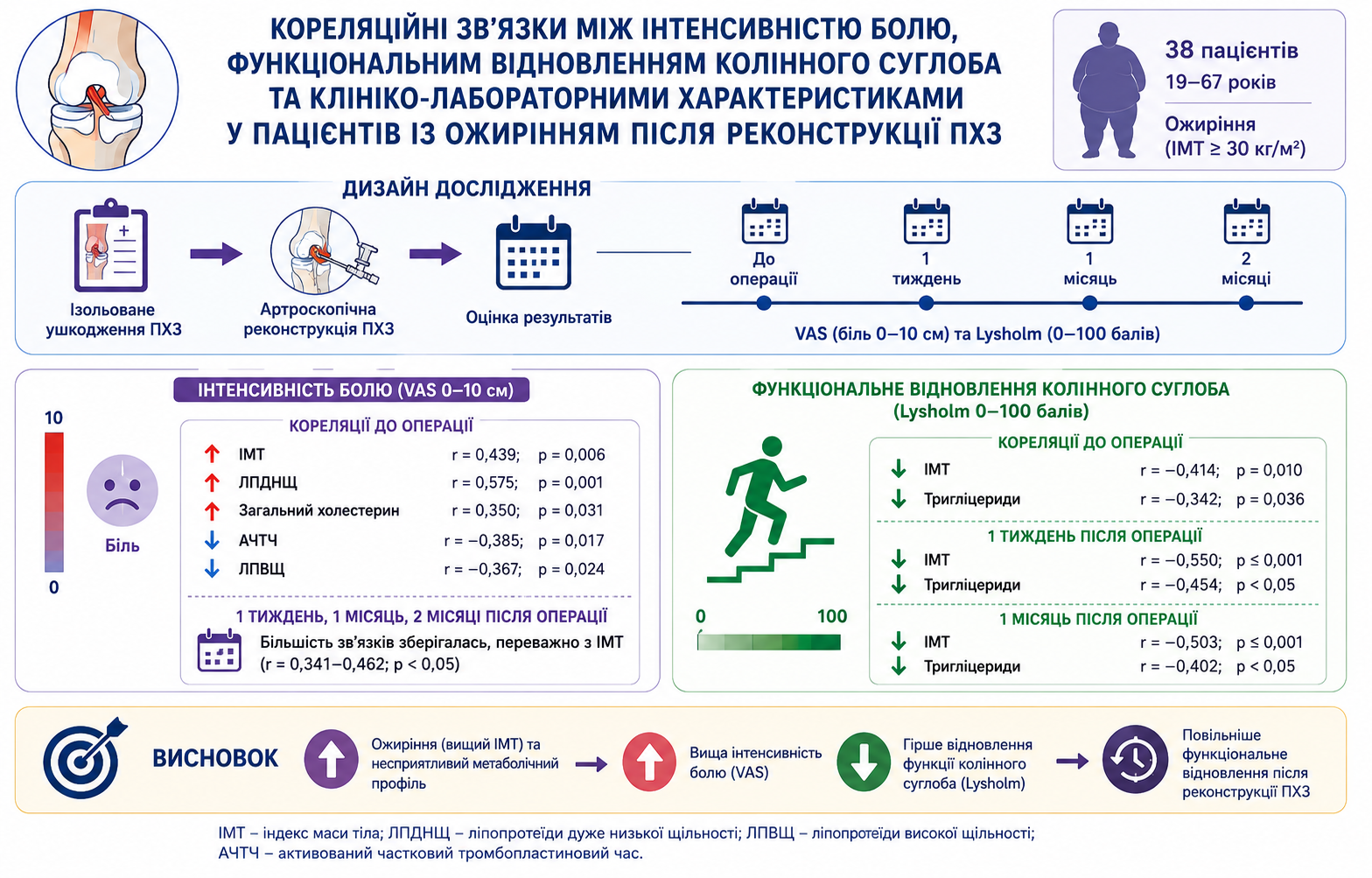
Materials and methods. A prospective single-center study was conducted involving 38 patients aged 19–67 years with isolated anterior cruciate ligament injury and obesity, defined as body mass index ≥ 30 kg/m². Correlation relationships between pain intensity according to the Visual Analog Scale, knee functional status according to the Lysholm score, and clinical-anamnestic, anthropometric, laboratory, and instrumental characteristics were analyzed. Pain intensity and functional status were assessed at four time points: before surgery, 1 week, 1 month, and 2 months after reconstruction.
Results. In obese patients, preoperative pain intensity according to the VAS showed statistically significant positive correlations with BMI (r = 0.439; p = 0.006), very low-density lipoproteins (r = 0.575; p = 0.001), and total cholesterol (r = 0.350; p = 0.031), and negative correlations with activated partial thromboplastin time (r = –0.385; p = 0.017) and high-density lipoproteins (r = –0.367; p = 0.024). At 1 week, 1 month, and 2 months, VAS pain scores remained significantly associated mainly with BMI (r = 0.341–0.462; p<0.05), and at 2 months also with systolic blood pressure (r = 0.397; p = 0.014). Lysholm scores before surgery negatively correlated with BMI (r = –0.414; p = 0.010) and triglycerides (r = –0.342; p = 0.036). At 1 week and 1 month after arthroscopic reconstruction, Lysholm scores remained associated with BMI (r = –0.550 and –0.503; p ≤ 0.001) and triglycerides (r = –0.454 and –0.402; p<0.05).
Conclusions. Obesity and an unfavorable metabolic profile are associated with higher pain intensity and slower functional recovery of the knee joint after ACL reconstruction. These findings highlight the need for a personalized approach to analgesia and rehabilitation in overweight patients undergoing arthroscopic ACL reconstruction
References
- Wang, L.-J., Zeng, N., Yan, Z.-P., Li, J.-T., Ni, G.-X. (2020). Post-traumatic osteoarthritis following ACL injury. Arthritis Research & Therapy, 22 (1). https://doi.org/10.1186/s13075-020-02156-5
- Pinto, L. V., Gouveia, F. C., Ramalho, J. F., Silva, S. R., Silva, J. R. (2023). Horseback Riding-Related Injuries in Portugal and Prevention Strategies. Journal of Sport Rehabilitation, 32 (4), 409–414. https://doi.org/10.1123/jsr.2022-0101
- Filbay, S. R., Skou, S. T., Bullock, G. S., Le, C. Y., Räisänen, A. M., Toomey, C. et al. (2022). Long-term quality of life, work limitation, physical activity, economic cost and disease burden following ACL and meniscal injury: a systematic review and meta-analysis for the OPTIKNEE consensus. British Journal of Sports Medicine, 56 (24), 1465–1474. https://doi.org/10.1136/bjsports-2022-105626
- de Jonge, R., Máté, M., Kovács, N., Imrei, M., Pap, K., Agócs, G. et al. (2024). Nonoperative Treatment as an Option for Isolated Anterior Cruciate Ligament Injury: A Systematic Review and Meta-analysis. Orthopaedic Journal of Sports Medicine, 12 (4). https://doi.org/10.1177/23259671241239665
- Dubé, M.-O., Crossley, K. M., Bruder, A. M., Patterson, B. E., Haberfield, M. J., Culvenor, A. G. (2024). Addressing rising knee injury and surgery rates with real-word data; the need for a clinical knee injury registry. JSAMS Plus, 4, 100077. https://doi.org/10.1016/j.jsampl.2024.100077
- Lim, S., Lee, S.-S., Oh, J., Lee, D.-H. (2023). Weight Is a Predictor of Delayed Operation Time in Primary Isolated Anterior Cruciate Ligament Reconstruction. Biomedicines, 11 (8), 2137. https://doi.org/10.3390/biomedicines11082137
- Martinez-Calderon, J., Infante-Cano, M., Matias-Soto, J., Perez-Cabezas, V., Galan-Mercant, A., Garcia-Muñoz, C. (2025). The Incidence of Sport-Related Anterior Cruciate Ligament Injuries: An Overview of Systematic Reviews Including 51 Meta-Analyses. Journal of Functional Morphology and Kinesiology, 10 (2), 174. https://doi.org/10.3390/jfmk10020174
- Gans, I., Retzky, J. S., Jones, L. C., Tanaka, M. J. (2018). Epidemiology of Recurrent Anterior Cruciate Ligament Injuries in National Collegiate Athletic Association Sports: The Injury Surveillance Program, 2004-2014. Orthopaedic Journal of Sports Medicine, 6 (6). https://doi.org/10.1177/2325967118777823
- Sherman, S. L., Calcei, J., Ray, T., Magnussen, R. A., Musahl, V., Kaeding, C. C. et al. (2021). ACL Study Group presents the global trends in ACL reconstruction: biennial survey of the ACL Study Group. Journal of ISAKOS, 6 (6), 322–328. https://doi.org/10.1136/jisakos-2020-000567
- Sundararajan, S. R., Ramakanth, R., Jha, A. K., Rajasekaran, S. (2022). Outside-in technique versus inside-out semitendinosus graft harvest technique in ACLR: a randomised control trial. Knee Surgery & Related Research, 34 (1). https://doi.org/10.1186/s43019-022-00144-4
- Yu, X., Hu, J., Li, Y., Wen, Y., Li, B. (2024). ACL injury management: a comprehensive review of novel biotherapeutics. Frontiers in Bioengineering and Biotechnology, 12. https://doi.org/10.3389/fbioe.2024.1455225
- Schoepp, C., Tennler, J., Praetorius, A., Dudda, M., Raeder, C. (2025). From Past to Future: Emergent Concepts of Anterior Cruciate Ligament Surgery and Rehabilitation. Journal of Clinical Medicine, 14 (19), 6964. https://doi.org/10.3390/jcm14196964
- Ricupito, R., Grassi, A., Mourad, F., Di Filippo, L., Gobbo, M., Maselli, F. (2025). Anterior Cruciate Ligament Return to Play: “A Framework for Decision Making”. Journal of Clinical Medicine, 14 (7), 2146. https://doi.org/10.3390/jcm14072146
- Ninkovic, S., Manojlovic, M., Roklicer, R., Bianco, A., Carraro, A., Matic, R. et al. (2023). The influence of body mass index on physical activity engagement following anterior cruciate ligament reconstruction: A systematic literature review. Heliyon, 9 (12), e22994. https://doi.org/10.1016/j.heliyon.2023.e22994
- Fang, Z., Liu, W. (2024). Obesity-associated outcomes after ACL reconstruction: a propensity-score-matched analysis of the US Nationwide Inpatient Sample 2005–2018. Journal of Orthopaedics and Traumatology, 25 (1). https://doi.org/10.1186/s10195-024-00779-x
- Byun, J., Yoon, H.-K., Oh, H.-C., Youk, T., Ha, J.-W., Kang, S., Park, S.-H. (2024). Relationship Between Revision Rate, Osteoarthritis, and Obesity for ACL Reconstruction: A Nationwide Retrospective Cohort Study. Orthopaedic Journal of Sports Medicine, 12 (8). https://doi.org/10.1177/23259671241266597
- Daniel, A. V., Williams, W. A., Kosko, B. J., Cohen, J. A., Carbone, A. D., Kupiszewski, S. J. (2025). Obese Patients Demonstrate Higher Failure Rates, Infection Rates, and Inferior Patient‐Reported Outcomes Compared With Nonobese Patients Following Multiligamentous Knee Surgery. Arthroscopy, Sports Medicine, and Rehabilitation, 7 (3). https://doi.org/10.1016/j.asmr.2025.101111
- Ajjawi, I., Seddio, A. E., Grauer, J. N. (2025). Obesity Correlates With 90-Day Postoperative Complications but Not 5-Year Retearing Rates After Anterior Cruciate Ligament Reconstruction. Orthopaedic Journal of Sports Medicine, 13 (7). https://doi.org/10.1177/23259671251358378
- Sane, R. M., Samant, P. D. (2023). Influence of body mass index on early post-operative functional outcomes after total knee arthroplasty: A prospective, clinical and observational study. Journal of Orthopaedics, Trauma and Rehabilitation, 30 (2), 156–162. https://doi.org/10.1177/22104917231161834
Downloads
Published
How to Cite
Issue
Section
License
Copyright (c) 2026 Andrii Drokin

This work is licensed under a Creative Commons Attribution 4.0 International License.
Our journal abides by the Creative Commons Attribution 4.0 International License copyright rights and permissions for open access journals.
Authors, who are published in this journal, agree to the following conditions:
1. The authors reserve the right to authorship of the work and pass the first publication right of this work to the journal under the terms of a Creative Commons Attribution 4.0 International License, which allows others to freely distribute the published research with the obligatory reference to the authors of the original work and the first publication of the work in this journal.
2. The authors have the right to conclude separate supplement agreements that relate to non-exclusive work distribution in the form in which it has been published by the journal (for example, to upload the work to the online storage of the journal or publish it as part of a monograph), provided that the reference to the first publication of the work in this journal is included.
3. Authors have the right to store the final accepted version of the article in an institutional, thematic, or any other repository to ensure visibility and accessibility.