Study of the association of folate cycle genes polymorphisms with changes in serotonin levels in patients with type 2 diabetes in the post-COVID period
DOI:
https://doi.org/10.15587/2519-4798.2025.330637Keywords:
enzymes of the folate cycle, polymorphisms, homocysteine, folic acid, cardiometabolic risk, coronavirus diseaseAbstract
The aim of the work was to identify relationships between modifications of the folate cycle gene structure and serum serotonin levels, depending on the presence or absence of type 2 diabetes mellitus (DM) in patients during COVID-19 and 6-9 months after recovery.
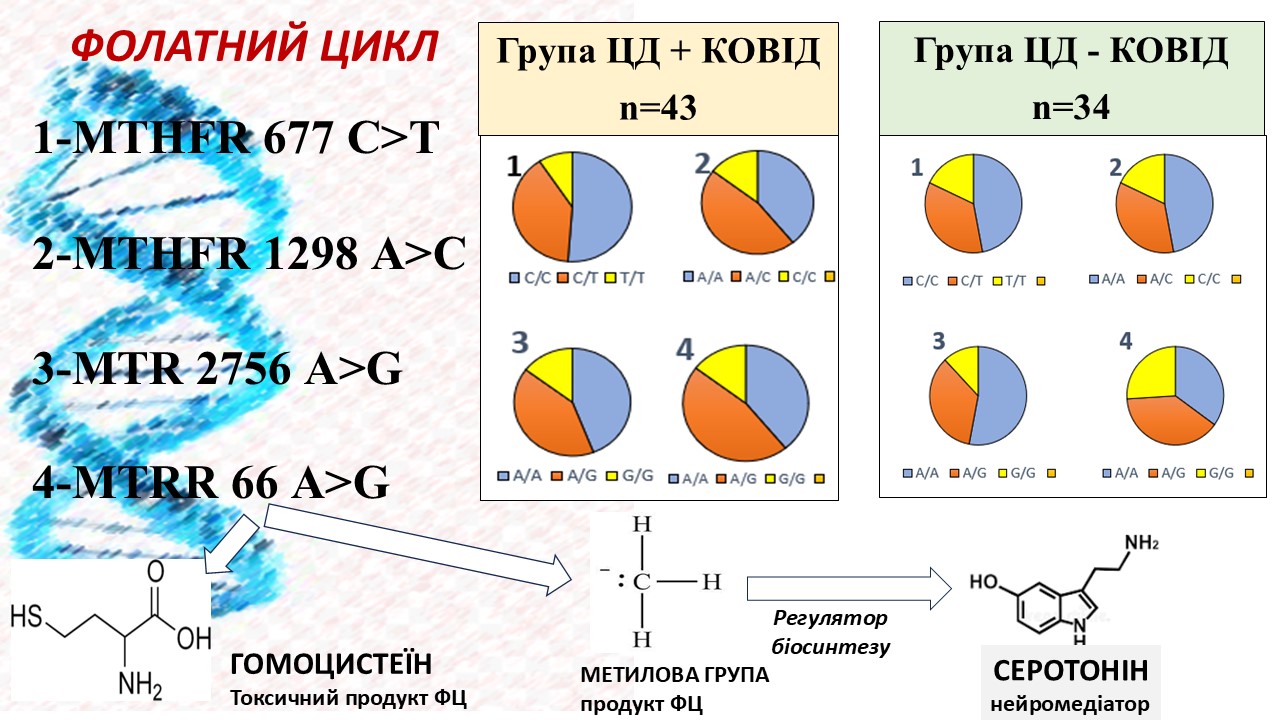
Materials and methods: 127 adult patients were examined, belonging to the following groups: 1) DM+COVID (n=43 m/f 32/11); 2) COVID without DM (n=34, m/f 19/15); 3) without DM, without COVID (n=50, m/f 30/20). Patients with COVID-19 had moderate and severe disease. At the beginning of Covid-19 treatment and 6 months after recovery, general clinical, haematological and biochemical parameters were recorded, and the concentrations of serotonin, homocysteine, folic acid, and cardiovascular biomarker ST-2 in blood serum were assessed. The molecular genetic method of real-time polymerase chain reaction characterised polymorphisms of folate cycle genes: MTHFR 677 C>T and 1298 A>C, MTR 2756 A>G, and MTRR 66 A>G.
Results. The distribution of patients by genotypes of folate cycle genes showed that group (1), compared to group (2), that group (1) compared to group (2) had a lower proportion of homozygous recessive mutations in the studied positions. Thus, in group 2, the recessive genotype MTRR 66 G/G was observed in 26 % of cases. A significant relationship was found between BMI and the initial serotonin serum level in the group (3) (R2=0,697), without a significant relationship between BMI and the initial values of homocysteine, ST-2 and folic acid. As a result of regression analysis, significant differences were found in the list of factors that affect the change in serotonin and ST-2 serum levels in the two groups of patients during treatment; differences in the influence of pneumonia indicators and the MTRR 66 A>G gene were noted.
Conclusions. The use of modern methods of molecular diagnostics, in particular the determination of folate cycle gene mutations, in combination with the assessment of the endothelium toxic product homocysteine and the neurotransmitter serotonin serum levels, allowed us to obtain a mathematical justification for the features of changes in the studied indices that occurred in the post-COVID period in patients depending on the presence of type 2 diabetes
References
- Santos, A. P., Couto, C. F., Pereira, S. S., Monteiro, M. P. (2022). Is Serotonin the Missing Link between COVID-19 Course of Severity in Patients with Diabetes and Obesity? Neuroendocrinology, 112 (11), 1039–1045. Portico. https://doi.org/10.1159/000522115
- Eteraf-Oskouei, T., Najafi, M. (2022). The relationship between the serotonergic system and COVID-19 disease: A review. Heliyon, 8 (5), e09544. https://doi.org/10.1016/j.heliyon.2022.e09544
- Nataf, S. (2020). An alteration of the dopamine synthetic pathway is possibly involved in the pathophysiology of COVID‐19. Journal of Medical Virology, 92 (10), 1743–1744. https://doi.org/10.1002/jmv.25826
- Antonini, A., Leta, V., Teo, J., Chaudhuri, K. R. (2020). Outcome of Parkinson’s Disease Patients Affected by COVID‐19. Movement Disorders, 35 (6), 905–908. https://doi.org/10.1002/mds.28104
- Attademo, L., Bernardini, F. (2021). Are dopamine and serotonin involved in COVID-19 pathophysiology? The European Journal of Psychiatry, 35 (1), 62–63. https://doi.org/10.1016/j.ejpsy.2020.10.004
- Machhi, J., Herskovitz, J., Senan, A. M., Dutta, D., Nath, B., Oleynikov, M. D. et al. (2020). The Natural History, Pathobiology, and Clinical Manifestations of SARS-CoV-2 Infections. Journal of Neuroimmune Pharmacology, 15 (3), 359–386. https://doi.org/10.1007/s11481-020-09944-5
- Santilli, F., Davì, G., Patrono, C. (2016). Homocysteine, methylenetetrahydrofolate reductase, folate status and atherothrombosis: A mechanistic and clinical perspective. Vascular Pharmacology, 78, 1–9. https://doi.org/10.1016/j.vph.2015.06.009
- Nazki, F. H., Sameer, A. S., Ganaie, B. A. (2014). Folate: Metabolism, genes, polymorphisms and the associated diseases. Gene, 533 (1), 11–20. https://doi.org/10.1016/j.gene.2013.09.063
- Ponti, G., Pastorino, L., Manfredini, M., Ozben, T., Oliva, G., Kaleci, S. et al. (2021). COVID‐19 spreading across world correlates with C677T allele of the methylenetetrahydrofolate reductase (MTHFR) gene prevalence. Journal of Clinical Laboratory Analysis, 35 (7). https://doi.org/10.1002/jcla.23798
- Petyunina, O. V., Koptsya, M. P., Vyshnevska, I. R. (2018). Biomarker ST2 in cardiovascular pathology. Ukrainian Medical Journal, 2 (2). https://doi.org/10.32471/umj.1680-3051.124.125212
- Moroianu, L.-A., Cecilia, C., Ardeleanu, V., Pantea Stoian, A., Cristescu, V., Barbu, R.-E., Moroianu, M. (2022). Clinical Study of Serum Serotonin as a Screening Marker for Anxiety and Depression in Patients with Type 2 Diabetes. Medicina, 58 (5), 652. https://doi.org/10.3390/medicina58050652
- Si, T., Zhang, W., Fu, X., Wang, Y., Liu, D., Wu, Q. (2022). Reference intervals of homocysteine in apparently healthy Chinese Han ethnic adults. Journal of Laboratory Medicine, 46 (2), 125–132. https://doi.org/10.1515/labmed-2021-0135
- Keskin, O., Seremet Keskin, A., Seremet, N. (2022). Association between low serum folic acid and vitamin B12 levels with COVID-19 prognosis. Progress Nutrition, 24 (3).
Downloads
Published
How to Cite
Issue
Section
License
Copyright (c) 2025 Angela Shuprovich, Katеrina Komissarenko, Olesia Zinych, Natalija Kushnarеva

This work is licensed under a Creative Commons Attribution 4.0 International License.
Our journal abides by the Creative Commons Attribution 4.0 International License copyright rights and permissions for open access journals.
Authors, who are published in this journal, agree to the following conditions:
1. The authors reserve the right to authorship of the work and pass the first publication right of this work to the journal under the terms of a Creative Commons Attribution 4.0 International License, which allows others to freely distribute the published research with the obligatory reference to the authors of the original work and the first publication of the work in this journal.
2. The authors have the right to conclude separate supplement agreements that relate to non-exclusive work distribution in the form in which it has been published by the journal (for example, to upload the work to the online storage of the journal or publish it as part of a monograph), provided that the reference to the first publication of the work in this journal is included.
3. Authors have the right to store the final accepted version of the article in an institutional, thematic, or any other repository to ensure visibility and accessibility.