Computer model of study of hydrodynamics of irrigant in dental root canal (an experimental study)
DOI:
https://doi.org/10.15587/2519-4798.2025.340476Keywords:
endodontics, tooth, root canal, irrigation, solution, sodium hypochlorite, flow velocity, pulpitis, periodontitis, treatmentAbstract
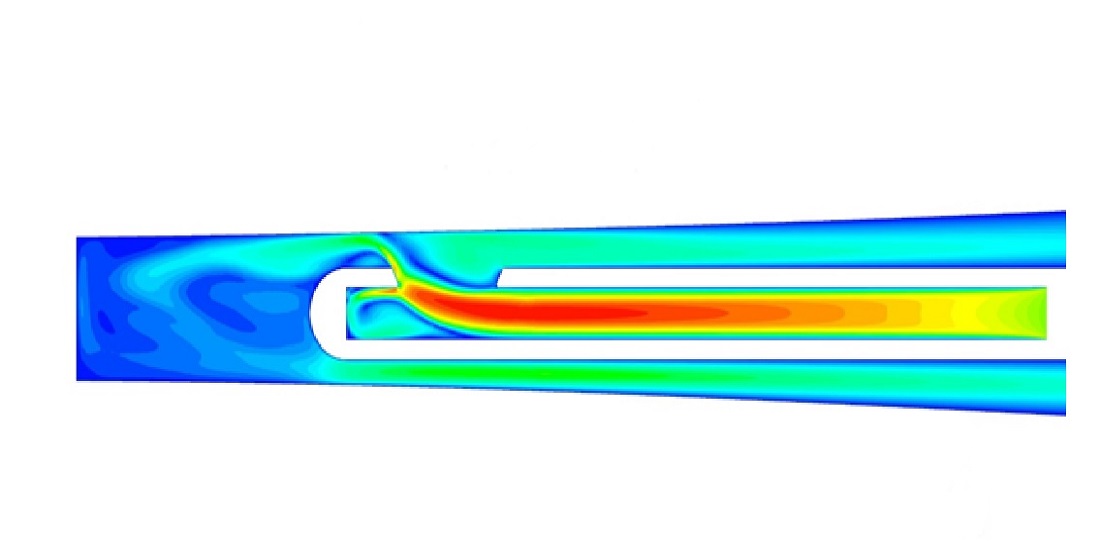
Computational fluid dynamics modelling was performed to obtain additional information about the flow of irrigant in the root canal system. The interaction between the flow rate of the irrigant, the size and taper of the root canal apex, and the type, size and depth of insertion of the endodontic needle was studied.
Aim. The aim of the study was to conduct an experimental study using computer modelling of the unsteady leakage of irrigation solution in the root canal.
Materials and methods. Computer modelling of the unsteady leakage of irrigation solution was performed using three-dimensional Reynolds-mediated Navier-Stokes equations of continuity -Stokes equations for an incompressible viscous fluid for a position corresponding to the distance from the tip of the endodontic needle to the apical opening of the root canal - 1 mm.
Results. Visualisation of the irrigant flow is presented in the form of isolines on the surfaces of the canal and in cross-sections of the calculated area, surface (boundary) and spatial flows, as well as projections of velocity vectors on the surfaces of cross-sections, and the distribution of flow parameters along the lines of the graph.
Conclusions. The study showed that the location of the irrigation needle opening towards the large diameter of the root canal, hypothetically, provides a better washing capacity for the irrigation solution
References
- Boutsioukis, C., Arias‐Moliz, M. T., Chávez de Paz, L. E. (2022). A critical analysis of research methods and experimental models to study irrigants and irrigation systems. International Endodontic Journal, 55 (S2), 295–329. https://doi.org/10.1111/iej.13710
- Love, R. M. (2010). Biofilm–substrate interaction: from initial adhesion to complex interactions and biofilm maturity. Endodontic Topics, 22 (1), 50–57. https://doi.org/10.1111/j.1601-1546.2012.00280.x
- Pereira, T. C., Boutsioukis, C., Dijkstra, R. J. B., Petridis, X., Versluis, M., de Andrade, F. B. et al. (2020). Biofilm removal from a simulated isthmus and lateral canal during syringe irrigation at various flow rates: a combined experimental and Computational Fluid Dynamics approach. International Endodontic Journal, 54 (3), 427–438. https://doi.org/10.1111/iej.13420
- Boutsioukis, C., Verhaagen, B., Versluis, M., Kastrinakis, E., Van Der Sluis, L. W. M. (2010). Irrigant flow in the root canal: experimental validation of an unsteady Computational Fluid Dynamics model using high‐speed imaging. International Endodontic Journal, 43 (5), 393–403. https://doi.org/10.1111/j.1365-2591.2010.01692.x
- Koch, J. D., Smith, N. A., Garces, D., Gao, L., Olsen, F. K. (2014). In Vitro Particle Image Velocity Measurements in a Model Root Canal: Flow around a Polymer Rotary Finishing File. Journal of Endodontics, 40 (3), 412–416. https://doi.org/10.1016/j.joen.2013.10.038
- Hodovanets, O. I., Rozhko, V. I., Basista, A. S., Petruniv, V. B., Voliak, Yu. M. (2024). Model for studying the flow of irrigation solution in the root canal. Bulletin of Problems Biology and Medicine, 2 (173), 84–86. https://doi.org/10.29254/2523-4110-2024-2-173/addition-84-86
- Verhaagen, B., Boutsioukis, C., van der Sluis, L. W. M., Versluis, M. (2014). Acoustic streaming induced by an ultrasonically oscillating endodontic file. The Journal of the Acoustical Society of America, 135 (4), 1717–1730. https://doi.org/10.1121/1.4868397
- Boutsioukis, C., Psimma, Z., Kastrinakis, E. (2013). The effect of flow rate and agitation technique on irrigant extrusion ex vivo. International Endodontic Journal, 47 (5), 487–496. https://doi.org/10.1111/iej.12176
- Macedo, R. G., Verhaagen, B., Fernandez Rivas, D., Gardeniers, J. G. E., van der Sluis, L. W. M., Wesselink, P. R., Versluis, M. (2014). Sonochemical and high-speed optical characterization of cavitation generated by an ultrasonically oscillating dental file in root canal models. Ultrasonics Sonochemistry, 21 (1), 324–335. https://doi.org/10.1016/j.ultsonch.2013.03.001
- Koch, J. D., Jaramillo, D. E., DiVito, E., Peters, O. A. (2015). Irrigant flow during photon-induced photoacoustic streaming (PIPS) using Particle Image Velocimetry (PIV). Clinical Oral Investigations, 20 (2), 381–386. https://doi.org/10.1007/s00784-015-1562-9
- Shen, Y., Gao, Y., Qian, W., Ruse, N. D., Zhou, X., Wu, H., Haapasalo, M. (2010). Three-dimensional Numeric Simulation of Root Canal Irrigant Flow with Different Irrigation Needles. Journal of Endodontics, 36 (5), 884–889. https://doi.org/10.1016/j.joen.2009.12.010
- Boutsioukis, C., Gutierrez Nova, P. (2021). Syringe Irrigation in Minimally Shaped Root Canals Using 3 Endodontic Needles: A Computational Fluid Dynamics Study. Journal of Endodontics, 47 (9), 1487–1495. https://doi.org/10.1016/j.joen.2021.06.001
- Loroño, G., Zaldivar, J. R., Arias, A., Cisneros, R., Dorado, S., Jimenez‐Octavio, J. R. (2020). Positive and negative pressure irrigation in oval root canals with apical ramifications: a computational fluid dynamics evaluation in micro‐CT scanned real teeth. International Endodontic Journal, 53 (5), 671–679. https://doi.org/10.1111/iej.13260
- Šnjarić, D., Čarija, Z., Braut, A., Halaji, A., Kovačević, M., Kuiš, D. (2012). Irrigation of human prepared root canal – ex vivo based computational fluid dynamics analysis. Croatian Medical Journal, 53 (5), 470–479. https://doi.org/10.3325/cmj.2012.53.470
- Wang, R., Shen, Y., Ma, J., Huang, D., Zhou, X., Gao, Y., Haapasalo, M. (2015). Evaluation of the Effect of Needle Position on Irrigant Flow in the C-shaped Root Canal Using a Computational Fluid Dynamics Model. Journal of Endodontics, 41 (6), 931–936. https://doi.org/10.1016/j.joen.2015.02.002
- Layton, G., Wu, W.-I., Selvaganapathy, P. R., Friedman, S., Kishen, A. (2015). Fluid Dynamics and Biofilm Removal Generated by Syringe-delivered and 2 Ultrasonic-assisted Irrigation Methods: A Novel Experimental Approach. Journal of Endodontics, 41 (6), 884–889. https://doi.org/10.1016/j.joen.2015.01.027
- Chen, J. E., Nurbakhsh, B., Layton, G., Bussmann, M., Kishen, A. (2013). Irrigation dynamics associated with positive pressure, apical negative pressure and passive ultrasonic irrigations: A computational fluid dynamics analysis. Australian Endodontic Journal, 40 (2), 54–60. https://doi.org/10.1111/aej.12027
- Verhaagen, B., Boutsioukis, C., Sleutel, C. P., Kastrinakis, E., van der Sluis, L. W. M., Versluis, M. (2013). Irrigant transport into dental microchannels. Microfluidics and Nanofluidics. https://doi.org/10.1007/s10404-013-1281-y
- Boutsioukis, C., Kastrinakis, E., Lambrianidis, T., Verhaagen, B., Versluis, M., van der Sluis, L. W. M. (2013). Formation and removal of apical vapor lock during syringe irrigation: a combined experimental and Computational Fluid Dynamics approach. International Endodontic Journal, 47 (2), 191–201. https://doi.org/10.1111/iej.12133
Downloads
Published
How to Cite
Issue
Section
License
Copyright (c) 2025 Vitaliy Rozhko, Oksana Godovanets, Anastasiia Basista, Volodymyr Petruniv, Volodymyr Kogut, Oleksii Volokitin

This work is licensed under a Creative Commons Attribution 4.0 International License.
Our journal abides by the Creative Commons Attribution 4.0 International License copyright rights and permissions for open access journals.
Authors, who are published in this journal, agree to the following conditions:
1. The authors reserve the right to authorship of the work and pass the first publication right of this work to the journal under the terms of a Creative Commons Attribution 4.0 International License, which allows others to freely distribute the published research with the obligatory reference to the authors of the original work and the first publication of the work in this journal.
2. The authors have the right to conclude separate supplement agreements that relate to non-exclusive work distribution in the form in which it has been published by the journal (for example, to upload the work to the online storage of the journal or publish it as part of a monograph), provided that the reference to the first publication of the work in this journal is included.
3. Authors have the right to store the final accepted version of the article in an institutional, thematic, or any other repository to ensure visibility and accessibility.