Особливості впливу варіантів терапії на ліпідний спектр крові у дітей з ювенільним ідіопатичним артритом
DOI:
https://doi.org/10.15587/2519-4798.2025.343791Ключові слова:
ювенільний ідіопатичний артрит, дисліпідемія, ліпідний профіль, адалімумаб, тоцилізумаб, метотрексат, коефіцієнт атерогенності, глюкокортикоїди, ліпідний парадокс, JADAS27Анотація
Мета: Метою дослідження було провести комплексну оцінку порівняння впливу різних варіантів терапії ювенільного ідіопатичного артриту (ЮІА), а саме метотрексату (МТТ), адалімумабу (АДА) та тоцилізумабу (ТОЦ), на ліпідний спектр крові у дітей для визначення потенційних метаболічних наслідків та ризику дисліпідемії.
Матеріали та методи: У дослідження було включено 120 дітей з ЮІА, що були розподілені на 3 групи: АДА (n=60), ТОЦ (n=30) та МТТ (n=30). Усі пацієнти проходили клініко-лабораторне обстеження, що включало оцінку активності захворювання за шкалою JADAS27 та аналіз ліпідного спектра крові (загальний холестерин (ЗХ), холестерин ліпопротеїнів низької щільності (ХС ЛПНЩ), холестерин ліпопротеїнів високої щільності (ХС ЛПВЩ), холестерин ліпопротеїнів дуже низької щільності (ХС ЛПДНЩ), тригліцериди (ТГ) та коефіцієнт атерогенності (КА)) в дебюті захворювання та через 3 місяці після досягнення фармакологічної ремісії.
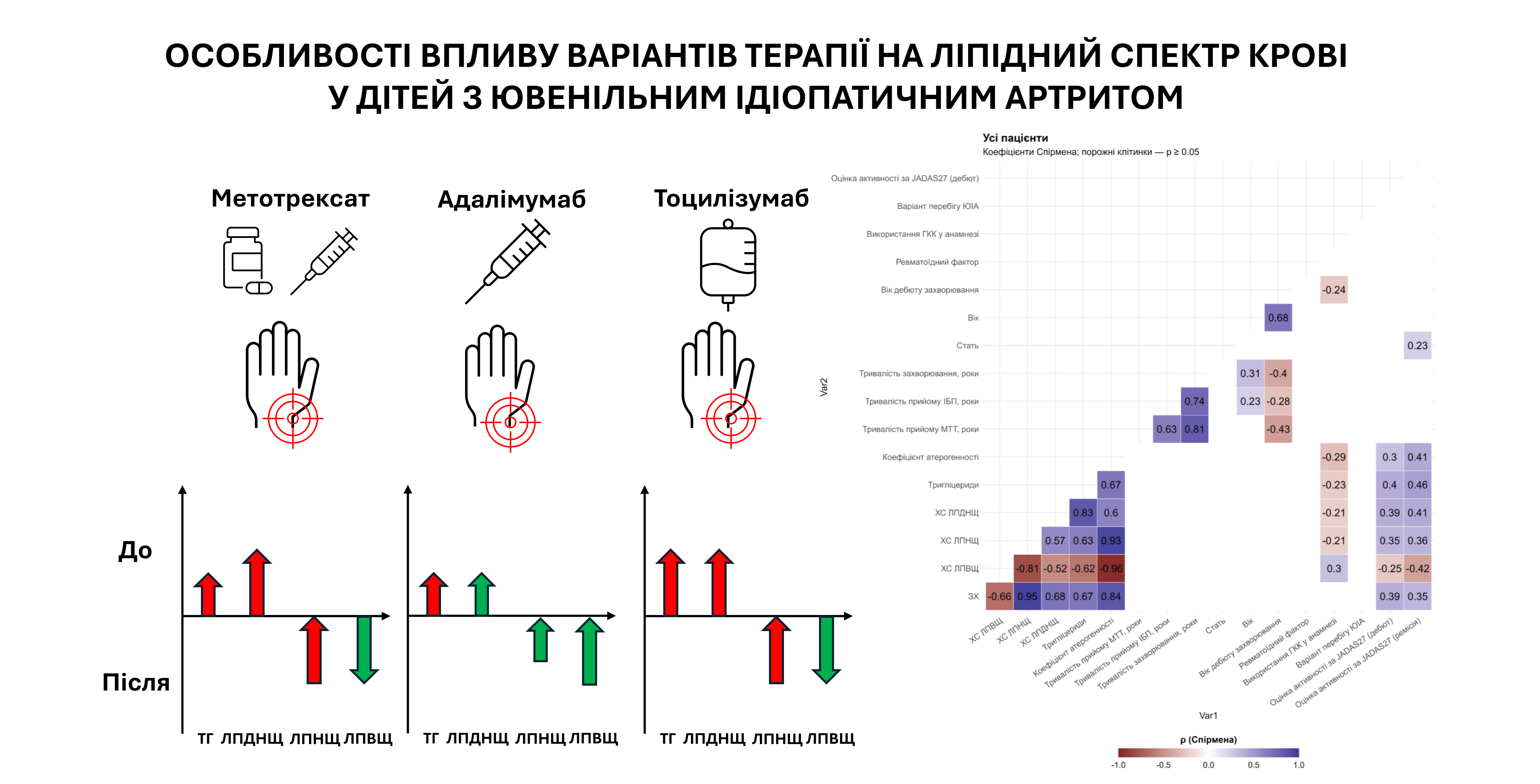
Результати: В дебюті між групами досліджуваних не було статистично достовірних відмінностей за рівнями ЗХ, ХС ЛПНЩ та КА, водночас в групі ТОЦ спостерігались вищі рівні ТГ та ХС ЛПДНЩ. Було виявлено зниження рівнів ХС ЛПНЩ та ХС ЛПВЩ в усіх групах, що свідчить про наявність «ліпідного парадоксу». У стані ремісії пацієнти групи АДА мали незмінний ліпідний профіль із зростанням рівнів ХС ЛПВЩ, тоді як у групах ТОЦ та МТТ було виявлено значне зростання атерогенних показників (ЗХ, ХС ЛПНЩ, ТГ, КА) та зниження ХС ЛПВЩ. Відносна частота виявлення дисліпідемії в період ремісії склала 33% у групі АДА, 97% – у групі ТОЦ, та 73% – у групі МТТ. Лише у групі АДА спостерігався регрес дисліпідемії у 8,3% пацієнтів. Кореляційним аналізом за Спірменом було виявлені прямі зв’язки між активністю ЮІА (JADAS27) та атерогенними ліпідами, що підтверджувало вплив запалення на ліпідний обмін навіть у стані ремісії.
Висновки: Отримані результати свідчать про те, що різні варіанти терапії ЮІА мають суттєво різний вплив на ліпідний спектр крові. Адалімумаб сприяв стабілізації та поліпшенню показників ліпідного спектра крові, в той час як використання тоцилізумабу чи метотрексату асоціювалась з розвитком атерогенної дисліпідемії. Це підтверджує необхідність моніторингу ліпідного профілю у дітей з ЮІА
Посилання
- Martini, A., Lovell, D. J., Albani, S., Brunner, H. I., Hyrich, K. L., Thompson, S. D., Ruperto, N. (2022). Juvenile idiopathic arthritis. Nature Reviews Disease Primers, 8 (1). https://doi.org/10.1038/s41572-021-00332-8
- Zhao, W.-J., Deng, J.-H., Li, C.-F. (2023). Lipid profiles in patients with juvenile idiopathic arthritis: a systematic literature review and meta-analysis. Lipids in Health and Disease, 22 (1). https://doi.org/10.1186/s12944-023-01885-1
- Drosos, A. A., Venetsanopoulou, A. A., Pelechas, E., Voulgari, P. V. (2024). Exploring Cardiovascular Risk Factors and Atherosclerosis in Rheumatoid Arthritis. European Journal of Internal Medicine, 128, 1–9. https://doi.org/10.1016/j.ejim.2024.07.016
- Aranda-Valera, I. C., Arias de la Rosa, I., Roldán-Molina, R., Ábalos-Aguilera, M. del C., Torres-Granados, C., Patiño-Trives, A. et al. (2020). Subclinical cardiovascular risk signs in adults with juvenile idiopathic arthritis in sustained remission. Pediatric Rheumatology, 18 (1). https://doi.org/10.1186/s12969-020-00448-3
- Ringold, S., Angeles‐Han, S. T., Beukelman, T., Lovell, D., Cuello, C. A., Becker, M. L. et al. (2019). 2019 American College of Rheumatology/Arthritis Foundation Guideline for the Treatment of Juvenile Idiopathic Arthritis: Therapeutic Approaches for Non‐Systemic Polyarthritis, Sacroiliitis, and Enthesitis. Arthritis Care & Research, 71 (6), 717–734. https://doi.org/10.1002/acr.23870
- Horneff, G., Minden, K., Rolland, C., Daly, A. C. H., Borlenghi, C., Ruperto, N. (2023). Efficacy and safety of TNF inhibitors in the treatment of juvenile idiopathic arthritis: a systematic literature review. Pediatric Rheumatology, 21 (1). https://doi.org/10.1186/s12969-023-00798-8
- Fragoulis, G. E., Soulaidopoulos, S., Sfikakis, P. P., Dimitroulas, T., Kitas, G. D. (2021). Effect of Biologics on Cardiovascular Inflammation: Mechanistic Insights and Risk Reduction. Journal of Inflammation Research, 14, 1915–1931. https://doi.org/10.2147/jir.s282691
- Petty, R. E., Southwood, T. R., Manners, P., Baum, J., Glass, D. N., Goldenberg, J. et al. (2004). International League of Associations for Rheumatology classification of juvenile idiopathic arthritis: second revision, Edmonton, 2001. The Journal of Rheumatology, 31 (2), 390–392.
- Expert Panel on Integrated Guidelines for Cardiovascular Health and Risk Reduction in Children and Adolescents: Summary Report (2011). Pediatrics, 128 (5), S213–S256. https://doi.org/10.1542/peds.2009-2107c
- Fragoulis, G. E., Panayotidis, I., Nikiphorou, E. (2020). Cardiovascular Risk in Rheumatoid Arthritis and Mechanistic Links: From Pathophysiology to Treatment. Current Vascular Pharmacology, 18 (5), 431–446. https://doi.org/10.2174/1570161117666190619143842
- Rigby, W. F. C., Lampl, K., Low, J. M., Furst, D. E. (2017). Review of Routine Laboratory Monitoring for Patients with Rheumatoid Arthritis Receiving Biologic or Nonbiologic DMARDs. International Journal of Rheumatology, 2017, 1–15. https://doi.org/10.1155/2017/9614241
- Nasef, S. I., Abouzied, S. S. I. M., Elfiky, S. M., Zeiton, A. (2021). P008 Lipid profile disorders in children and adolescents with Juvenile Idiopathic Arthritis. Rheumatology, 60 (5). https://doi.org/10.1093/rheumatology/keab722
- Luo, Y., Ren, X., Weng, S., Yan, C., Mao, Q., Peng, D. (2021). Improvements in High-Density Lipoprotein Quantity and Quality Contribute to the Cardiovascular Benefits by Anti-tumor Necrosis Factor Therapies in Rheumatoid Arthritis: A Systemic Review and Meta-Analysis. Frontiers in Cardiovascular Medicine, 8. https://doi.org/10.3389/fcvm.2021.765749
- Jia, X., Yang, Z., Li, J., Mei, Z., Jia, L., Yan, C. (2024). The impact of biologic agents on cardiovascular risk factors in patients with rheumatoid arthritis: A meta analysis. PLOS ONE, 19 (8), e0306513. https://doi.org/10.1371/journal.pone.0306513
- Mitra, S., Nandi, M., Mahato, S., Lahiri, D. (2024). Changes in biomarkers of lipid in juvenile idiopathic arthritis and its association with various disease parameters: a 6-month follow-up study. International Journal of Contemporary Pediatrics, 11 (6), 736–743. https://doi.org/10.18203/2349-3291.ijcp20241357
##submission.downloads##
Опубліковано
Як цитувати
Номер
Розділ
Ліцензія
Авторське право (c) 2025 Olena Onufreiv, Yeva-Emiliia Kulchytska

Ця робота ліцензується відповідно до Creative Commons Attribution 4.0 International License.
Наше видання використовує положення про авторські права Creative Commons Attribution 4.0 International License для журналів відкритого доступу.
Автори, які публікуються у цьому журналі, погоджуються з наступними умовами:
1. Автори залишають за собою право на авторство своєї роботи та передають журналу право першої публікації цієї роботи на умовах ліцензії Creative Commons Attribution 4.0 International License, котра дозволяє іншим особам вільно розповсюджувати опубліковану роботу з обов'язковим посиланням на авторів оригінальної роботи та першу публікацію роботи у цьому журналі.
2. Автори мають право укладати самостійні додаткові угоди щодо неексклюзивного розповсюдження роботи у тому вигляді, в якому вона була опублікована цим журналом (наприклад, розміщувати роботу в електронному сховищі установи або публікувати у складі монографії), за умови збереження посилання на першу публікацію роботи у цьому журналі.
3. Автори мають право зберігати остаточну прийняту версію статті в інституційному, тематичному або будь-якому іншому репозитарії з метою забезпечення видимості та доступності.