Development of a method for rapid detection of fires based on combined current sampling and dispersions of a controlled hazardous environmental parameter
DOI:
https://doi.org/10.15587/2706-5448.2025.326336Keywords:
fire detection, premises, hazardous parameters of the gas environment, sample means, sample varianceAbstract
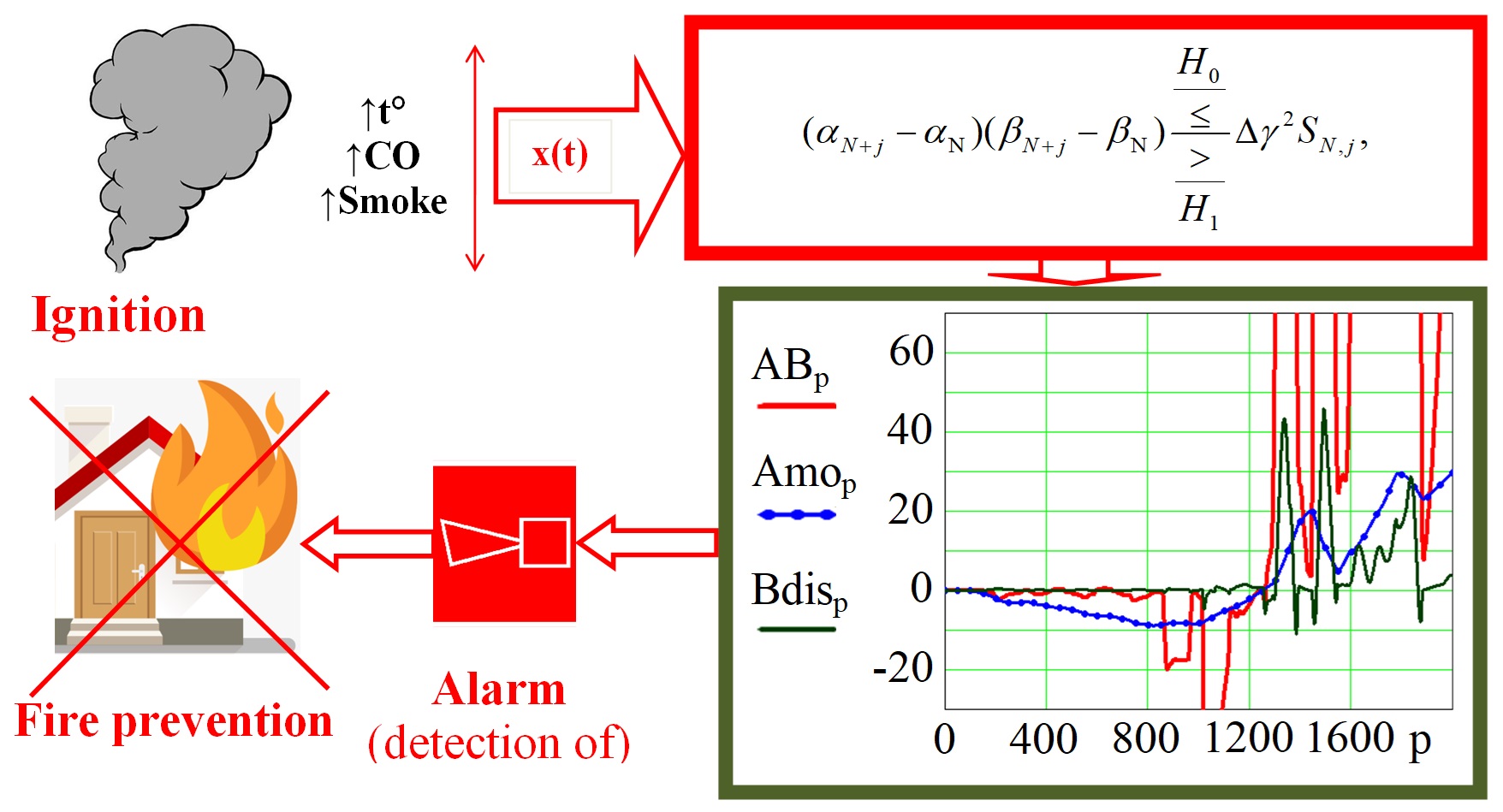
The object of research is the process of detecting the ignition of materials in a premise based on the joint use of current sample means and variances of the controlled hazardous gas environment parameter. The problem is to develop a method for detecting the ignition of materials based on the joint use of current sample means and variances of the controlled hazardous gas environment parameter in a premise. The synthesis of the optimal method for detecting fires was achieved by moving from the space of controlled hazardous gas environment parameters to the spaces of sample means, sample variances, and also the space of joint sample means and variances. Under conditions of large samples, the distribution of sample means, sample variances and its joint values asymptotically tends to a Gaussian distribution. This allows to use the likelihood ratio criterion, which is optimal, in the synthesis. Unlike the traditional approach, the likelihood ratio is current and is determined for a fixed Gaussian distribution in the case of a reliable absence of ignition. It is established that the optimal method of fire detection based on the joint use of sample means and variances with the same quality indicators outperforms the optimal methods of fire detection based only on the sample mean or sample variance of the controlled hazardous parameter of the gas environment. This is explained by the fact that the optimal method of fire detection based on the joint use of sample means and variances uses a larger amount of information contained in the controlled parameters of the gas environment. The results obtained are useful from a theoretical point of view for the proposed optimal methods of fire detection. The practical significance of the work lies in the further improvement of existing fire protection systems of facilities in order to prevent fires.
References
- Sadkovyi, V., Andronov, V., Semkiv, O., Kovalov, A., Rybka, E., Otrosh, Yu. et al.; Sadkovyi, V., Rybka, E., Otrosh, Yu. (Eds.) (2021). Fire resistance of reinforced concrete and steel structures. Kharkiv: РС ТЕСHNOLOGY СЕNTЕR, 180. http://doi.org/10.15587/978-617-7319-43-5
- Popov, O., Kovach, V., Iatsyshyn, A., Lahoiko, A., Ryzhchenko, O., Dement, M. (2023). Features function of radiation monitoring system world’s countries of developed nuclear energy. Studies in Systems, Decision and Control. Vol. 481. Cham: Springer, 471–497.
- World Fire Statistics (2022). Center for Fire Statistics of CTIF, 27, 65.
- Gottuk, D. T., Wright, M. T., Wong, J. T., Pham, H. V., Rose-Pehrsson, S. L., Hart, S. et al. (2002). Prototype early warning fire detection system: test series 4 results. NRL Ltr Rpt Ser, 6180, 0466.
- Muhammad, K., Ahmad, J., Mehmood, I., Rho, S., Baik, S. W. (2018). Convolutional Neural Networks Based Fire Detection in Surveillance Videos. IEEE Access, 6, 18174–18183. https://doi.org/10.1109/access.2018.2812835
- Sadkovyi, V., Pospelov, B., Rybka, E., Kreminskyi, B., Yashchenko, O., Bezuhla, Y. et al. (2022). Development of a method for assessing the reliability of fire detection in premises. Eastern-European Journal of Enterprise Technologies, 3 (10 (117)), 56–62. https://doi.org/10.15587/1729-4061.2022.259493
- Wu, Y., Harada, T. (2004). Study on the burning behaviour of plantation wood. Scientia Silvae Sinicae, 40, 131.
- Cheng, C., Sun, F., Zhou, X. (2011). One fire detection method using neural networks. Tsinghua Science and Technology, 16 (1), 31–35. https://doi.org/10.1016/s1007-0214(11)70005-0
- Ding, Q., Peng, Z., Liu, T., Tong, Q. (2014). Multi-Sensor Building Fire Alarm System with Information Fusion Technology Based on D-S Evidence Theory. Algorithms, 7 (4), 523–537. https://doi.org/10.3390/a7040523
- Pospelov, B., Rybka, E., Samoilov, M., Morozov, I., Bezuhla, Y., Butenko, T. et al. (2022). Defining the features of amplitude and phase spectra of dangerous factors of gas medium during the ignition of materials in the premises. Eastern-European Journal of Enterprise Technologies, 2 (10 (116)), 57–65. https://doi.org/10.15587/1729-4061.2022.254500
- Pospelov, B., Rybka, E., Savchenko, A., Dashkovska, O., Harbuz, S., Naden, E. et al. (2022). Peculiarities of amplitude spectra of the third order for the early detection of indoor fires. Eastern-European Journal of Enterprise Technologies, 5 (10 (119)), 49–56. https://doi.org/10.15587/1729-4061.2022.265781
- Pospelov, B., Andronov, V., Rybka, E., Chubko, L., Bezuhla, Y., Gordiichuk, S. et al. (2023). Revealing the peculiarities of average bicoherence of frequencies in the spectra of dangerous parameters of the gas environment during fire. Eastern-European Journal of Enterprise Technologies, 1 (10 (121)), 46–54. https://doi.org/10.15587/1729-4061.2023.272949
- McGrattan, K., Hostikka, S., McDermott, R., Floyd, J., Weinschenk, C., Overholt, K. (2016). Fire dynamics simulator technical reference guide. National Institute of Standards and Technology, 3, 6.
- Dubinin, D., Cherkashyn, O., Maksymov, A., Beliuchenko, D., Hovalenkov, S., Shevchenko, S., Avetisyan, V. (2020). Investigation of the effect of carbon monoxide on people in case of fire in a building. Sigurnost, 62 (4), 347–357. https://doi.org/10.31306/s.62.4.2
- Floyd, J., Forney, G., Hostikka, S., Korhonen, T., McDermott, R., McGrattan, K. (2013). Fire Dynamics Simulator (Version 6) User’s Guide. National Institute of Standard and Technology, 1, 1.
- Optical/Heat Multisensor Detector (2019). Discovery.
- Hulse, L. M., Galea, E. R., Thompson, O. F., Wales, D. (2020). Perception and recollection of fire hazards in dwelling fires. Safety Science, 122, 104518. https://doi.org/10.1016/j.ssci.2019.104518
- Dragotti, P. L., Vetterli, M., Blu, T. (2007). Sampling Moments and Reconstructing Signals of Finite Rate of Innovation: Shannon Meets Strang–Fix. IEEE Transactions on Signal Processing, 55 (5), 1741–1757. https://doi.org/10.1109/tsp.2006.890907
- Cramér, H. (1999). Mathematical methods of statistics. Princeton university press, 26.
- Otrosh, Y., Rybka, Y., Danilin, O., Zhuravskyi, M. (2019). Assessment of the technical state and the possibility of its control for the further safe operation of building structures of mining facilities. E3S Web of Conferences, 123, 01012. https://doi.org/10.1051/e3sconf/201912301012
Downloads
Published
How to Cite
Issue
Section
License
Copyright (c) 2025 Boris Pospelov, Evgenіy Rybka, Yurii Otrosh, Larysa Maladyka, Olekcii Krainiukov, Tymur Kurtseitov, Marharyta Vorovka, Svitlana Hryshko, Mykola Pidhorodetskyi, Olga Salamatina

This work is licensed under a Creative Commons Attribution 4.0 International License.
The consolidation and conditions for the transfer of copyright (identification of authorship) is carried out in the License Agreement. In particular, the authors reserve the right to the authorship of their manuscript and transfer the first publication of this work to the journal under the terms of the Creative Commons CC BY license. At the same time, they have the right to conclude on their own additional agreements concerning the non-exclusive distribution of the work in the form in which it was published by this journal, but provided that the link to the first publication of the article in this journal is preserved.