Розробка методу оперативного виявлення загорянь на основі сумісних поточних вибіркових середніх та дисперсій контрольованого небезпечного параметру середовища
DOI:
https://doi.org/10.15587/2706-5448.2025.326336Ключові слова:
виявлення загорянь, приміщення, небезпечні параметри газового середовища, вибіркові середні, вибіркова дисперсіяАнотація
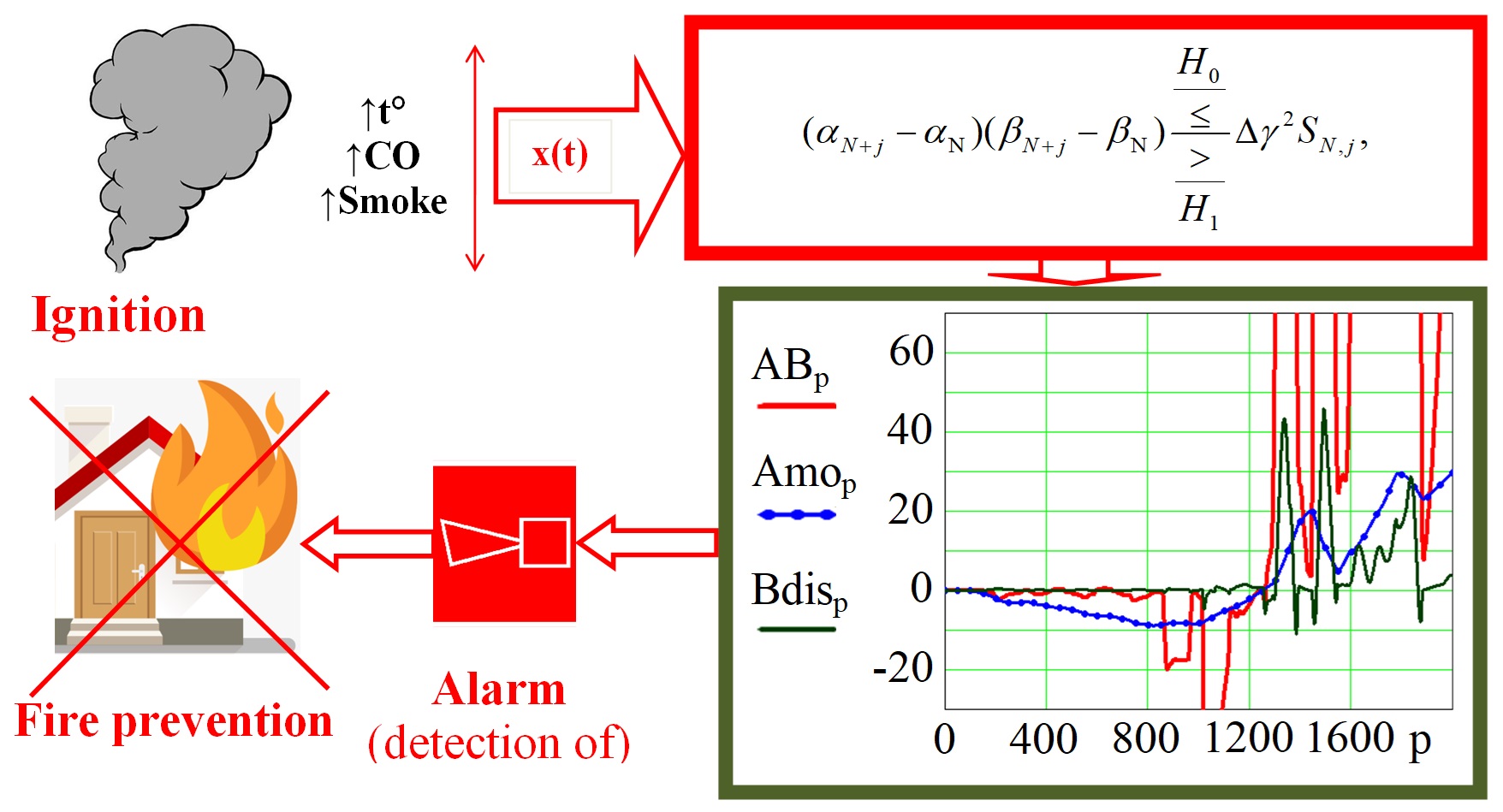
Об’єктом дослідження є процес виявлення загоряння матеріалів у приміщенні на основі спільного використання поточних вибіркових середніх та дисперсій контрольованого небезпечного параметра газового середовища. Проблема полягає в розробці методу виявлення загоряння матеріалів на основі спільного використання поточних вибіркових середніх та дисперсій контрольованого небезпечного параметра газового середовища в приміщенні. Синтез оптимального методу виявлення загорянь вдалося виконати завдяки переходу з простору контрольованих небезпечних параметрів газового середовища у простори вибіркових середніх, вибіркових дисперсій, а також простору спільних вибіркових середніх та дисперсій. За умов великих вибірок розподіл вибіркових середніх, вибіркових дисперсій та його спільних значень асимптотичне прагне до розподілу Гауса. Це дозволяє при синтезі скористатися критерієм відношення правдоподібності, який є оптимальним. На відміну від традиційного підходу, відношення правдоподібності є поточним та визначається для фіксованого розподілу Гауса у разі достовірної відсутності загоряння. Встановлено, що оптимальний метод виявлення загорянь на основі спільного використання вибіркових середніх та дисперсій при однакових показниках якості перевершує оптимальні методи виявлення загорянь на основі лише вибіркової середньої або вибіркової дисперсії контрольованого небезпечного параметра газового середовища. Пояснюється це тим, що оптимальний метод виявлення загорянь на основі спільного використання вибіркових середніх та дисперсій використовує більшу кількість інформації, яка міститься в контрольованих параметрах газового середовища. Отримані результати є корисними з теоретичної точки зору запропонованими оптимальними методами виявлення загорянь. Практичне значення роботи полягає в подальшому вдосконаленні існуючих систем протипожежного захисту об’єктів з метою запобіганню виникненню пожеж.
Посилання
- Sadkovyi, V., Andronov, V., Semkiv, O., Kovalov, A., Rybka, E., Otrosh, Yu. et al.; Sadkovyi, V., Rybka, E., Otrosh, Yu. (Eds.) (2021). Fire resistance of reinforced concrete and steel structures. Kharkiv: РС ТЕСHNOLOGY СЕNTЕR, 180. http://doi.org/10.15587/978-617-7319-43-5
- Popov, O., Kovach, V., Iatsyshyn, A., Lahoiko, A., Ryzhchenko, O., Dement, M. (2023). Features function of radiation monitoring system world’s countries of developed nuclear energy. Studies in Systems, Decision and Control. Vol. 481. Cham: Springer, 471–497.
- World Fire Statistics (2022). Center for Fire Statistics of CTIF, 27, 65.
- Gottuk, D. T., Wright, M. T., Wong, J. T., Pham, H. V., Rose-Pehrsson, S. L., Hart, S. et al. (2002). Prototype early warning fire detection system: test series 4 results. NRL Ltr Rpt Ser, 6180, 0466.
- Muhammad, K., Ahmad, J., Mehmood, I., Rho, S., Baik, S. W. (2018). Convolutional Neural Networks Based Fire Detection in Surveillance Videos. IEEE Access, 6, 18174–18183. https://doi.org/10.1109/access.2018.2812835
- Sadkovyi, V., Pospelov, B., Rybka, E., Kreminskyi, B., Yashchenko, O., Bezuhla, Y. et al. (2022). Development of a method for assessing the reliability of fire detection in premises. Eastern-European Journal of Enterprise Technologies, 3 (10 (117)), 56–62. https://doi.org/10.15587/1729-4061.2022.259493
- Wu, Y., Harada, T. (2004). Study on the burning behaviour of plantation wood. Scientia Silvae Sinicae, 40, 131.
- Cheng, C., Sun, F., Zhou, X. (2011). One fire detection method using neural networks. Tsinghua Science and Technology, 16 (1), 31–35. https://doi.org/10.1016/s1007-0214(11)70005-0
- Ding, Q., Peng, Z., Liu, T., Tong, Q. (2014). Multi-Sensor Building Fire Alarm System with Information Fusion Technology Based on D-S Evidence Theory. Algorithms, 7 (4), 523–537. https://doi.org/10.3390/a7040523
- Pospelov, B., Rybka, E., Samoilov, M., Morozov, I., Bezuhla, Y., Butenko, T. et al. (2022). Defining the features of amplitude and phase spectra of dangerous factors of gas medium during the ignition of materials in the premises. Eastern-European Journal of Enterprise Technologies, 2 (10 (116)), 57–65. https://doi.org/10.15587/1729-4061.2022.254500
- Pospelov, B., Rybka, E., Savchenko, A., Dashkovska, O., Harbuz, S., Naden, E. et al. (2022). Peculiarities of amplitude spectra of the third order for the early detection of indoor fires. Eastern-European Journal of Enterprise Technologies, 5 (10 (119)), 49–56. https://doi.org/10.15587/1729-4061.2022.265781
- Pospelov, B., Andronov, V., Rybka, E., Chubko, L., Bezuhla, Y., Gordiichuk, S. et al. (2023). Revealing the peculiarities of average bicoherence of frequencies in the spectra of dangerous parameters of the gas environment during fire. Eastern-European Journal of Enterprise Technologies, 1 (10 (121)), 46–54. https://doi.org/10.15587/1729-4061.2023.272949
- McGrattan, K., Hostikka, S., McDermott, R., Floyd, J., Weinschenk, C., Overholt, K. (2016). Fire dynamics simulator technical reference guide. National Institute of Standards and Technology, 3, 6.
- Dubinin, D., Cherkashyn, O., Maksymov, A., Beliuchenko, D., Hovalenkov, S., Shevchenko, S., Avetisyan, V. (2020). Investigation of the effect of carbon monoxide on people in case of fire in a building. Sigurnost, 62 (4), 347–357. https://doi.org/10.31306/s.62.4.2
- Floyd, J., Forney, G., Hostikka, S., Korhonen, T., McDermott, R., McGrattan, K. (2013). Fire Dynamics Simulator (Version 6) User’s Guide. National Institute of Standard and Technology, 1, 1.
- Optical/Heat Multisensor Detector (2019). Discovery.
- Hulse, L. M., Galea, E. R., Thompson, O. F., Wales, D. (2020). Perception and recollection of fire hazards in dwelling fires. Safety Science, 122, 104518. https://doi.org/10.1016/j.ssci.2019.104518
- Dragotti, P. L., Vetterli, M., Blu, T. (2007). Sampling Moments and Reconstructing Signals of Finite Rate of Innovation: Shannon Meets Strang–Fix. IEEE Transactions on Signal Processing, 55 (5), 1741–1757. https://doi.org/10.1109/tsp.2006.890907
- Cramér, H. (1999). Mathematical methods of statistics. Princeton university press, 26.
- Otrosh, Y., Rybka, Y., Danilin, O., Zhuravskyi, M. (2019). Assessment of the technical state and the possibility of its control for the further safe operation of building structures of mining facilities. E3S Web of Conferences, 123, 01012. https://doi.org/10.1051/e3sconf/201912301012
##submission.downloads##
Опубліковано
Як цитувати
Номер
Розділ
Ліцензія
Авторське право (c) 2025 Boris Pospelov, Evgenіy Rybka, Yurii Otrosh, Larysa Maladyka, Olekcii Krainiukov, Tymur Kurtseitov, Marharyta Vorovka, Svitlana Hryshko, Mykola Pidhorodetskyi, Olga Salamatina

Ця робота ліцензується відповідно до Creative Commons Attribution 4.0 International License.
Закріплення та умови передачі авторських прав (ідентифікація авторства) здійснюється у Ліцензійному договорі. Зокрема, автори залишають за собою право на авторство свого рукопису та передають журналу право першої публікації цієї роботи на умовах ліцензії Creative Commons CC BY. При цьому вони мають право укладати самостійно додаткові угоди, що стосуються неексклюзивного поширення роботи у тому вигляді, в якому вона була опублікована цим журналом, але за умови збереження посилання на першу публікацію статті в цьому журналі.