The effect of adding quicklime on stabilization of expansive soils
DOI:
https://doi.org/10.15587/2706-5448.2025.326784Keywords:
quicklime, soil water content, soil specific gravity, soil tension, volume swelling, soil stabilization, expansive soilAbstract
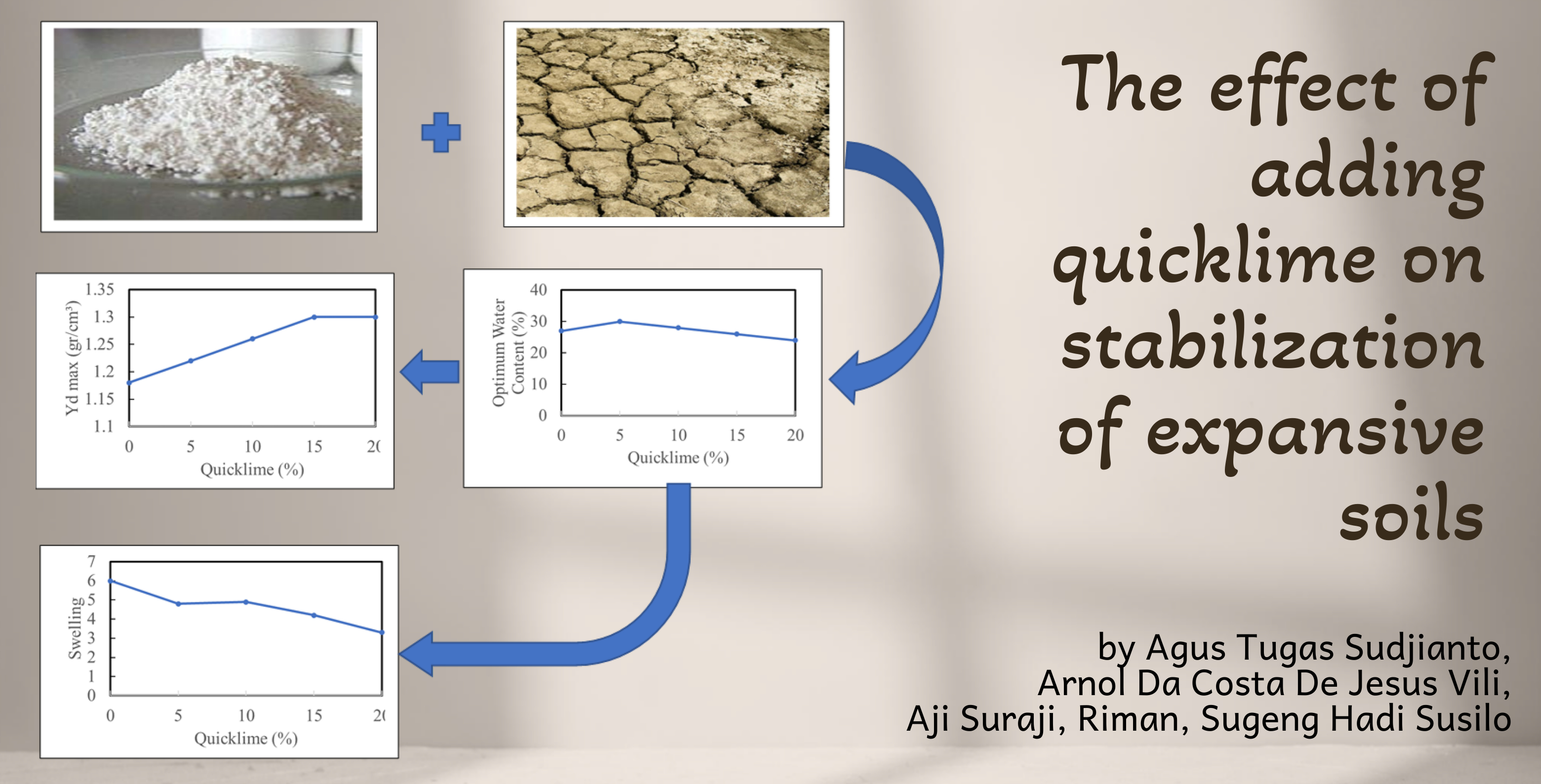
The object of this research is Ampelgading clay (Malang, East Java), known for its high plasticity and low strength, which impact building stability. This study focuses on how varying proportions of quicklime affect soil properties. One of the main issues is clay instability, caused by volume changes due to water fluctuations, which poses a major challenge for infrastructure, particularly in high-rainfall and humid areas. In the study, expansive clay from Ampelgading with quicklime percentages of 0 %, 5 %, 10 %, 15 %, and 20 % was tested. Geotechnical and mechanical tests, including water content, specific gravity, Atterberg limits, compressive strength, and swelling, were conducted. The results show that adding quicklime significantly alters the physical and mechanical properties of the clay, reducing water content from 58.20 % to 35.64 % and specific gravity from 3.362 to 2.118. Volumetric weight initially increases at low quicklime levels but decreases at higher levels. Quicklime alters soil microstructure through a pozzolanic reaction with calcium hydroxide (Ca(OH)₂) and silica/alumina, forming calcium hydrates that enhance cohesion and strength. However, excessive quicklime creates non-uniform aggregates, reducing density and stability. Optimal compressive strength occurs at 15 % quicklime, but at 20 %, stability decreases, plasticity reduces, and swelling accelerates. Furthermore, lower moisture content improves compaction and enhances soil stability. Compared to cement or fly ash, quicklime reacts faster, provides immediate stability, and minimizes long-term swelling and shrinkage. The pozzolanic reaction further strengthens the soil by forming stable calcium hydrate and calcium aluminate compounds.
Supporting Agency
- This research was funded by Widyagama University Malang (Indonesia).
References
- Liu, M., Saberian, M., Li, J., Zhu, J., Perera, S. T., Anupiya, M. et al. (2024). Evaluation of brown coal fly ash for stabilising expansive clay subgrade: A sustainable solution for pavement construction. Resources, Conservation and Recycling, 204, 107533. https://doi.org/10.1016/j.resconrec.2024.107533
- Zhu, J., Saberian, M., Li, J., Maqsood, T., Yang, W. (2023). Performance of clay soil reinforced with PET plastic waste subjected to freeze-thaw cycles for pavement subgrade application. Cold Regions Science and Technology, 214, 103957. https://doi.org/10.1016/j.coldregions.2023.103957
- Suhudi, S., Frida, S. K., Damayanti, F. (2024). Analysis of the Stability Plan for Kambaniru Weir, East Sumba District. Journal of Evrímata: Engineering and Physics, 2 (2), 138–143. https://doi.org/10.70822/journalofevrmata.v2i02.65
- Putra, M. H. R., Utomo, E. B., Maulana, F. R., Huda, M. S. (2024). Improving the Quality of Frozen Chicken Sempol Products Using the Six Sigma Method at UMKM Suropati Pasuruan. Journal of Evrímata: Engineering and Physics, 2 (1), 104–111. https://doi.org/10.70822/journalofevrmata.vi.41
- Rezaee, L., Davatgar, N., Moosavi, A. A., Sepaskhah, A. R. (2024). Assessing the impact of soil shrinkage and pore size dynamics on rice crop yield in expansive clay soils. Soil and Tillage Research, 244, 106261. https://doi.org/10.1016/j.still.2024.106261
- Listiyono, L., Subagijo, S., Hadi susilo, S. (2023). Analysis Of Hardening Products And Micro Structure Of Steel With Carbon Equivalent Variations And Cooling Oil Viscosity. Journal of Evrímata: Engineering and Physics, 1 (1), 24–30. https://doi.org/10.70822/journalofevrmata.vi.8
- Liu, C., Wu, Z., Garg, A., Qin, Y., Mei, G., Lv, C., Zhang, H. (2023). Experimental investigation for dynamic characteristics of paraffin-graphite based CPCM (composite phase change material) amended expansive soil under dry-wet cycles. Construction and Building Materials, 404, 133170. https://doi.org/10.1016/j.conbuildmat.2023.133170
- Lazuardi, L., Akhlis Rizza, M., Maryono, M. (2024). application Planning of Microhydro Electricity Generating Technology With 55 Kw Power in the Mountains Using the River Flow of Coban Rondo Waterfall, Krajaan, Pandesari, Kec. Pujon, Malang, East Jawa. Journal of Evrímata: Engineering and Physics, 1 (2), 61–69. https://doi.org/10.70822/journalofevrmata.vi.25
- Crichlow, A., Roopnarine, R., Eudoxie, G., Pinongcos, F. (2024). Nature-based solutions for regulating moisture content in an expansive clay soil. Nature-Based Solutions, 5, 100125. https://doi.org/10.1016/j.nbsj.2024.100125
- Suhudi, S., Damayanti, F. (2024). Stability Analysis of Retaining Soil Walls Protecting Banu Canal, Ngantru Village, Ngantang District, Malang-Indonesia. Journal of Evrímata: Engineering and Physics, 2 (1), 95–103. https://doi.org/10.70822/journalofevrmata.vi.37
- Abden, A., Al-Shamrani, M., Dafalla, M. (2024). Evaluating the feasibility of inverted T foundation on expansive soils. Journal of Building Engineering, 97, 110788. https://doi.org/10.1016/j.jobe.2024.110788
- Du, J., Zhang, L., Hu, Q., Luo, Q., Connolly, D. P., Liu, K. et al. (2024). Characterization of controlled low-strength materials from waste expansive soils. Construction and Building Materials, 411, 134690. https://doi.org/10.1016/j.conbuildmat.2023.134690
- Irfin, Z., Moentamaria, D., Nur Arifa, A. (2023). Optimization of Making Edible Film from Glucomannan Flour with the Addition of CaCO3, Gelatin, Glycerol, Coconut Oil, and Tea Tree Oil. Journal of Evrímata: Engineering and Physics, 1 (1), 9–17. https://doi.org/10.70822/journalofevrmata.vi.3
- Zainal, M. Z. A., Susilo, S. H. (2023). Simulation of Heat Transfer Rate in Motorcycle Engine Cylinder with Variation of Distance Between Fins and Material. Evrimata: Journal of Mechanical Engineering, 1 (1), 1–8. https://doi.org/10.70822/evrmata.vi.12
- Ma, S., Ma, M., Huang, Z., Hu, Y., Shao, Y. (2023). Research on the improvement of rainfall infiltration behavior of expansive soil slope by the protection of polymer waterproof coating. Soils and Foundations, 63 (3), 101299. https://doi.org/10.1016/j.sandf.2023.101299
- Pratama, A. Y., Widyasari, A., Fakhruddin, M., Muzaki, M., Firmansyah, H. I. (2024). Simulation of the Effect of Blank Geometry Toward the Mecanical Properties of Strains and Stress on Deep Drawing Process Using Material Aluminum 7075. Journal of Evrímata: Engineering and Physics, 1 (2), 70–77. https://doi.org/10.70822/journalofevrmata.vi.27
- Almuaythir, S., Zaini, M. S. I., Hasan, M., Hoque, Md. I. (2024). Sustainable soil stabilization using industrial waste ash: Enhancing expansive clay properties. Heliyon, 10 (20), e39124. https://doi.org/10.1016/j.heliyon.2024.e39124
- Asrori, A., Alfarisyi, M. F. S., Zainuri, Ach. M., Naryono, E. (2024). Characterization of the Bioenergy Potential of Corncob and Rice Husk mixtures in Biochar Briquettes. Evrimata: Journal of Mechanical Engineering, 1 (1), 14–20. https://doi.org/10.70822/evrmata.vi.22
- Danxi, S., Xian-Feng, L., Sheng-Yang, Y., Gaofeng, P., Guanlu, J., Hailong, W. et al. (2023). Three-dimensional characterization of cracks in undisturbed Mile expansive soil using X-ray computed tomography. Soils and Foundations, 63 (3), 101282. https://doi.org/10.1016/j.sandf.2023.101282
- Maryono, M., Ali, M., Lazuardi, L. (2024). Effect of Using Epoxy as a Substitute for Hydroxyl-Terminated Polybutadiene (HTPB) on Manufacturing Solid Propellants. Evrimata: Journal of Mechanical Engineering, 1 (3), 69–76. https://doi.org/10.70822/evrmata.v1i03.39
- Fadugba, O. G., Ajokotola, F. J., Oluyemi-Ayibiowu, B. D., Omomomi, O. J., Bodunrin, M., Adetukasi, A. O. (2024). Evaluation of citric acid-treated natural fibres as sustainable additives for improving expansive soil performance in highway construction. Journal of Engineering Research. https://doi.org/10.1016/j.jer.2024.02.012
- Rasidi, N., Dora, M. P. I., Ningrum, D. (2022). Experimental Testing Comparison between Wiremesh Reinforcement and Plain Reinforcement on Concrete Slabs. Asian Journal Science and Engineering, 1 (1), 48. https://doi.org/10.51278/ajse.v1i1.405
- A. Soltani, A., Taheri, A., Deng, A., O’Kelly, B. C. (2022). Stabilization of a highly expansive soil using waste-tire-derived aggregates and lime treatment. Case Studies in Construction Materials, 16, e01133. https://doi.org/10.1016/j.cscm.2022.e01133
- Hidayat, T. R., Whidiyanto, P., Maryono, M., Mangililo, R. C., Zai, A. S. (2025). Analysis of Material Variations (Ammonium Perchlorate/Aluminum/Epoxy) And Pressure on Propellant Combustion Speed. Evrimata: Journal of Mechanical Engineering, 1 (2), 57–62. https://doi.org/10.70822/evrmata.vi.40
- Yaghoubi, E., Yaghoubi, M., Guerrieri, M., Sudarsanan, N. (2021). Improving expansive clay subgrades using recycled glass: Resilient modulus characteristics and pavement performance. Construction and Building Materials, 302, 124384. https://doi.org/10.1016/j.conbuildmat.2021.124384
- Ningrum, D., Nahak, A., Rasidi, N. (2023). Comparison Analysis of Equivalent Static Earthquake and Spectrum Response Dynamics on Steel Structure. Asian Journal Science and Engineering, 1 (2), 103. https://doi.org/10.51278/ajse.v1i2.548
- Perera, M., Anupiya, S. T., Saberian, M., Zhu, J., Roychand, R., Li, J. (2022). Effect of crushed glass on the mechanical and microstructural behavior of highly expansive clay subgrade. Case Studies in Construction Materials, 17, e01244. https://doi.org/10.1016/j.cscm.2022.e01244
- Ibim, A. A. (2024). Adaptation to Climate Change, Conservation and Financial Feasibility in Heritage Buildings: A Nexus of Ideological Divergence in Post-Flood Disaster Reconstruction. Journal of Evrímata: Engineering and Physics, 2 (2), 150–157. https://doi.org/10.70822/journalofevrmata.v2i02.60
- Chabrat, N., Russo, G., Vitale, E., Masrouri, F., Cuisinier, O. (2024). Long-term characteristics of a stabilized expansive clay exposed to environmental-driven processes. Transportation Geotechnics, 46, 101257. https://doi.org/10.1016/j.trgeo.2024.101257
- Ningrum, D., Wijaya, H. S., Van, E. (2023). Effect of Treatment Age on Mechanical Properties of Geopolymer Concrete. Asian Journal Science and Engineering, 1 (2), 121. https://doi.org/10.51278/ajse.v1i2.544
Downloads
Published
How to Cite
Issue
Section
License
Copyright (c) 2025 Agus Tugas Sudjianto, Arnol Da Costa De Jesus Vili, Aji Suraji, Riman Riman, Sugeng Hadi Susilo

This work is licensed under a Creative Commons Attribution 4.0 International License.
The consolidation and conditions for the transfer of copyright (identification of authorship) is carried out in the License Agreement. In particular, the authors reserve the right to the authorship of their manuscript and transfer the first publication of this work to the journal under the terms of the Creative Commons CC BY license. At the same time, they have the right to conclude on their own additional agreements concerning the non-exclusive distribution of the work in the form in which it was published by this journal, but provided that the link to the first publication of the article in this journal is preserved.