Вплив додавання негашеного вапна на стабілізацію експансивних ґрунтів
DOI:
https://doi.org/10.15587/2706-5448.2025.326784Ключові слова:
негашене вапно, вміст води в ґрунті, питома вага ґрунту, напруження ґрунту, об'ємне набухання, стабілізація ґрунту, експансивний ґрунтАнотація
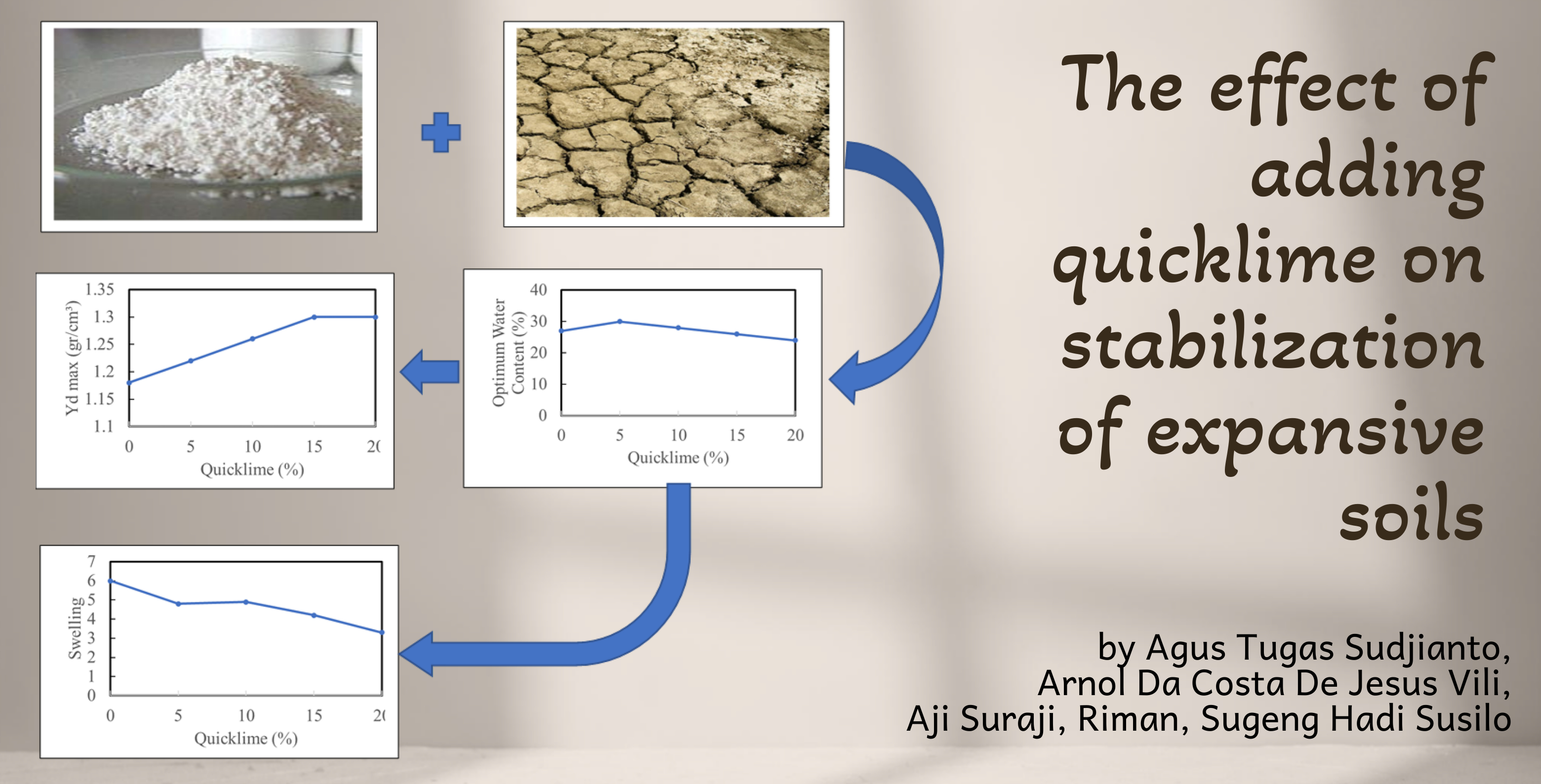
Об'єктом дослідження є ампельна глина (Маланг, Східна Ява), відома своєю високою пластичністю та низькою міцністю, що впливає на стійкість будівель. Дослідження фокусується на тому, як різні пропорції негашеного вапна впливають на властивості ґрунту. Однією з найбільш проблемних областей є нестабільність глини, спричинена зміною об'єму через коливання води, що становить серйозну проблему для інфраструктури, особливо в районах з великою кількістю опадів і районах з високою вологістю. У цьому дослідженні було випробувано експансивний глинистий ґрунт з ампельного родовища (Маланг) з різним вмістом негашеного вапна (0 %, 5 %, 10 %, 15 % і 20 %). Були проведені геотехнічні та механічні випробування, включаючи вміст води, питому вагу, межу міцності за Аттербергом, міцність на стиск та набухання. Результати показують, що додавання негашеного вапна впливає на фізико-механічні властивості глини зі зменшенням вмісту води з 58,20 % до 35,64 % і питомої ваги з 3,362 до 2,118. Об'ємна вага спочатку збільшується при низьких рівнях, але зменшується при високих рівнях. Негашене вапно змінює мікроструктуру та склад ґрунту через пуццоланову реакцію між гідроксидом кальцію (Ca(OH)₂) і кремнеземом/глиноземом, утворюючи гідрати кальцію, які підвищують зв'язність і міцність. Однак надлишок негашеного вапна створює неоднорідні агрегати, знижуючи щільність і стабільність. Оптимальна міцність на стиск досягається при 15 % негашеного вапна, але при 20 % стабільність знижується, пластичність зменшується, розширення прискорюється, а нижчий вміст вологи покращує ущільнення, підвищуючи стабільність ґрунту. Негашене вапно підвищує стабільність ґрунту, зменшуючи вміст води, питому вагу та індекс пластичності, одночасно збільшуючи щільність сухого ґрунту та міцність на стиск. Порівняно з цементом або золою, воно реагує швидше, забезпечує негайну стабільність і мінімізує довготривале набухання та усадку. Пуццоланова реакція додатково зміцнює ґрунт, утворюючи стабільні сполуки гідрату кальцію та алюмінату кальцію.
Спонсор дослідження
- This research was funded by Widyagama University Malang (Indonesia).
Посилання
- Liu, M., Saberian, M., Li, J., Zhu, J., Perera, S. T., Anupiya, M. et al. (2024). Evaluation of brown coal fly ash for stabilising expansive clay subgrade: A sustainable solution for pavement construction. Resources, Conservation and Recycling, 204, 107533. https://doi.org/10.1016/j.resconrec.2024.107533
- Zhu, J., Saberian, M., Li, J., Maqsood, T., Yang, W. (2023). Performance of clay soil reinforced with PET plastic waste subjected to freeze-thaw cycles for pavement subgrade application. Cold Regions Science and Technology, 214, 103957. https://doi.org/10.1016/j.coldregions.2023.103957
- Suhudi, S., Frida, S. K., Damayanti, F. (2024). Analysis of the Stability Plan for Kambaniru Weir, East Sumba District. Journal of Evrímata: Engineering and Physics, 2 (2), 138–143. https://doi.org/10.70822/journalofevrmata.v2i02.65
- Putra, M. H. R., Utomo, E. B., Maulana, F. R., Huda, M. S. (2024). Improving the Quality of Frozen Chicken Sempol Products Using the Six Sigma Method at UMKM Suropati Pasuruan. Journal of Evrímata: Engineering and Physics, 2 (1), 104–111. https://doi.org/10.70822/journalofevrmata.vi.41
- Rezaee, L., Davatgar, N., Moosavi, A. A., Sepaskhah, A. R. (2024). Assessing the impact of soil shrinkage and pore size dynamics on rice crop yield in expansive clay soils. Soil and Tillage Research, 244, 106261. https://doi.org/10.1016/j.still.2024.106261
- Listiyono, L., Subagijo, S., Hadi susilo, S. (2023). Analysis Of Hardening Products And Micro Structure Of Steel With Carbon Equivalent Variations And Cooling Oil Viscosity. Journal of Evrímata: Engineering and Physics, 1 (1), 24–30. https://doi.org/10.70822/journalofevrmata.vi.8
- Liu, C., Wu, Z., Garg, A., Qin, Y., Mei, G., Lv, C., Zhang, H. (2023). Experimental investigation for dynamic characteristics of paraffin-graphite based CPCM (composite phase change material) amended expansive soil under dry-wet cycles. Construction and Building Materials, 404, 133170. https://doi.org/10.1016/j.conbuildmat.2023.133170
- Lazuardi, L., Akhlis Rizza, M., Maryono, M. (2024). application Planning of Microhydro Electricity Generating Technology With 55 Kw Power in the Mountains Using the River Flow of Coban Rondo Waterfall, Krajaan, Pandesari, Kec. Pujon, Malang, East Jawa. Journal of Evrímata: Engineering and Physics, 1 (2), 61–69. https://doi.org/10.70822/journalofevrmata.vi.25
- Crichlow, A., Roopnarine, R., Eudoxie, G., Pinongcos, F. (2024). Nature-based solutions for regulating moisture content in an expansive clay soil. Nature-Based Solutions, 5, 100125. https://doi.org/10.1016/j.nbsj.2024.100125
- Suhudi, S., Damayanti, F. (2024). Stability Analysis of Retaining Soil Walls Protecting Banu Canal, Ngantru Village, Ngantang District, Malang-Indonesia. Journal of Evrímata: Engineering and Physics, 2 (1), 95–103. https://doi.org/10.70822/journalofevrmata.vi.37
- Abden, A., Al-Shamrani, M., Dafalla, M. (2024). Evaluating the feasibility of inverted T foundation on expansive soils. Journal of Building Engineering, 97, 110788. https://doi.org/10.1016/j.jobe.2024.110788
- Du, J., Zhang, L., Hu, Q., Luo, Q., Connolly, D. P., Liu, K. et al. (2024). Characterization of controlled low-strength materials from waste expansive soils. Construction and Building Materials, 411, 134690. https://doi.org/10.1016/j.conbuildmat.2023.134690
- Irfin, Z., Moentamaria, D., Nur Arifa, A. (2023). Optimization of Making Edible Film from Glucomannan Flour with the Addition of CaCO3, Gelatin, Glycerol, Coconut Oil, and Tea Tree Oil. Journal of Evrímata: Engineering and Physics, 1 (1), 9–17. https://doi.org/10.70822/journalofevrmata.vi.3
- Zainal, M. Z. A., Susilo, S. H. (2023). Simulation of Heat Transfer Rate in Motorcycle Engine Cylinder with Variation of Distance Between Fins and Material. Evrimata: Journal of Mechanical Engineering, 1 (1), 1–8. https://doi.org/10.70822/evrmata.vi.12
- Ma, S., Ma, M., Huang, Z., Hu, Y., Shao, Y. (2023). Research on the improvement of rainfall infiltration behavior of expansive soil slope by the protection of polymer waterproof coating. Soils and Foundations, 63 (3), 101299. https://doi.org/10.1016/j.sandf.2023.101299
- Pratama, A. Y., Widyasari, A., Fakhruddin, M., Muzaki, M., Firmansyah, H. I. (2024). Simulation of the Effect of Blank Geometry Toward the Mecanical Properties of Strains and Stress on Deep Drawing Process Using Material Aluminum 7075. Journal of Evrímata: Engineering and Physics, 1 (2), 70–77. https://doi.org/10.70822/journalofevrmata.vi.27
- Almuaythir, S., Zaini, M. S. I., Hasan, M., Hoque, Md. I. (2024). Sustainable soil stabilization using industrial waste ash: Enhancing expansive clay properties. Heliyon, 10 (20), e39124. https://doi.org/10.1016/j.heliyon.2024.e39124
- Asrori, A., Alfarisyi, M. F. S., Zainuri, Ach. M., Naryono, E. (2024). Characterization of the Bioenergy Potential of Corncob and Rice Husk mixtures in Biochar Briquettes. Evrimata: Journal of Mechanical Engineering, 1 (1), 14–20. https://doi.org/10.70822/evrmata.vi.22
- Danxi, S., Xian-Feng, L., Sheng-Yang, Y., Gaofeng, P., Guanlu, J., Hailong, W. et al. (2023). Three-dimensional characterization of cracks in undisturbed Mile expansive soil using X-ray computed tomography. Soils and Foundations, 63 (3), 101282. https://doi.org/10.1016/j.sandf.2023.101282
- Maryono, M., Ali, M., Lazuardi, L. (2024). Effect of Using Epoxy as a Substitute for Hydroxyl-Terminated Polybutadiene (HTPB) on Manufacturing Solid Propellants. Evrimata: Journal of Mechanical Engineering, 1 (3), 69–76. https://doi.org/10.70822/evrmata.v1i03.39
- Fadugba, O. G., Ajokotola, F. J., Oluyemi-Ayibiowu, B. D., Omomomi, O. J., Bodunrin, M., Adetukasi, A. O. (2024). Evaluation of citric acid-treated natural fibres as sustainable additives for improving expansive soil performance in highway construction. Journal of Engineering Research. https://doi.org/10.1016/j.jer.2024.02.012
- Rasidi, N., Dora, M. P. I., Ningrum, D. (2022). Experimental Testing Comparison between Wiremesh Reinforcement and Plain Reinforcement on Concrete Slabs. Asian Journal Science and Engineering, 1 (1), 48. https://doi.org/10.51278/ajse.v1i1.405
- A. Soltani, A., Taheri, A., Deng, A., O’Kelly, B. C. (2022). Stabilization of a highly expansive soil using waste-tire-derived aggregates and lime treatment. Case Studies in Construction Materials, 16, e01133. https://doi.org/10.1016/j.cscm.2022.e01133
- Hidayat, T. R., Whidiyanto, P., Maryono, M., Mangililo, R. C., Zai, A. S. (2025). Analysis of Material Variations (Ammonium Perchlorate/Aluminum/Epoxy) And Pressure on Propellant Combustion Speed. Evrimata: Journal of Mechanical Engineering, 1 (2), 57–62. https://doi.org/10.70822/evrmata.vi.40
- Yaghoubi, E., Yaghoubi, M., Guerrieri, M., Sudarsanan, N. (2021). Improving expansive clay subgrades using recycled glass: Resilient modulus characteristics and pavement performance. Construction and Building Materials, 302, 124384. https://doi.org/10.1016/j.conbuildmat.2021.124384
- Ningrum, D., Nahak, A., Rasidi, N. (2023). Comparison Analysis of Equivalent Static Earthquake and Spectrum Response Dynamics on Steel Structure. Asian Journal Science and Engineering, 1 (2), 103. https://doi.org/10.51278/ajse.v1i2.548
- Perera, M., Anupiya, S. T., Saberian, M., Zhu, J., Roychand, R., Li, J. (2022). Effect of crushed glass on the mechanical and microstructural behavior of highly expansive clay subgrade. Case Studies in Construction Materials, 17, e01244. https://doi.org/10.1016/j.cscm.2022.e01244
- Ibim, A. A. (2024). Adaptation to Climate Change, Conservation and Financial Feasibility in Heritage Buildings: A Nexus of Ideological Divergence in Post-Flood Disaster Reconstruction. Journal of Evrímata: Engineering and Physics, 2 (2), 150–157. https://doi.org/10.70822/journalofevrmata.v2i02.60
- Chabrat, N., Russo, G., Vitale, E., Masrouri, F., Cuisinier, O. (2024). Long-term characteristics of a stabilized expansive clay exposed to environmental-driven processes. Transportation Geotechnics, 46, 101257. https://doi.org/10.1016/j.trgeo.2024.101257
- Ningrum, D., Wijaya, H. S., Van, E. (2023). Effect of Treatment Age on Mechanical Properties of Geopolymer Concrete. Asian Journal Science and Engineering, 1 (2), 121. https://doi.org/10.51278/ajse.v1i2.544
##submission.downloads##
Опубліковано
Як цитувати
Номер
Розділ
Ліцензія
Авторське право (c) 2025 Agus Tugas Sudjianto, Arnol Da Costa De Jesus Vili, Aji Suraji, Riman Riman, Sugeng Hadi Susilo

Ця робота ліцензується відповідно до Creative Commons Attribution 4.0 International License.
Закріплення та умови передачі авторських прав (ідентифікація авторства) здійснюється у Ліцензійному договорі. Зокрема, автори залишають за собою право на авторство свого рукопису та передають журналу право першої публікації цієї роботи на умовах ліцензії Creative Commons CC BY. При цьому вони мають право укладати самостійно додаткові угоди, що стосуються неексклюзивного поширення роботи у тому вигляді, в якому вона була опублікована цим журналом, але за умови збереження посилання на першу публікацію статті в цьому журналі.