Determining the influence of some factors on improving the quality of Sherry wine material
DOI:
https://doi.org/10.15587/2706-5448.2025.346265Keywords:
juice, Sherry wine material, phenolic compounds, nitrogenous substances, ethyl alcohol, yeast solutionAbstract
The object of research is the production of Sherry must and wine materials, as well as the processes that occur during this production.
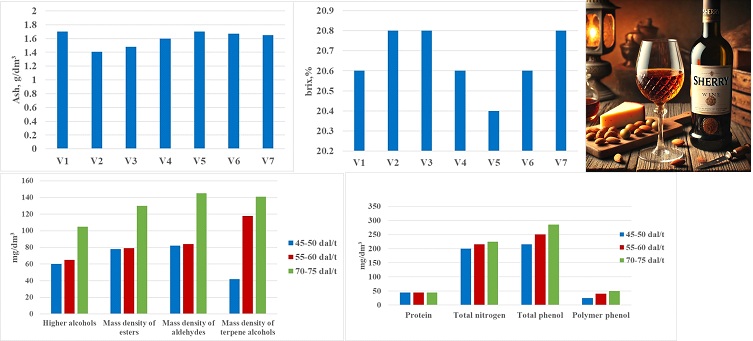
Factors affecting the quality of Sherry wine material – particularly the amount of juice yield, different combinations of fining agents, the duration and course of fermentation, and the role of the grape variety – have not been sufficiently studied. It was found that increasing the juice yield per ton of grapes from 50 to 75 decaliters led to an increase in aldehydes from 61.2 mg/dm³ to 86.1 mg/dm³, esters from 67.3 mg/dm³ to 86.7 mg/dm³, higher alcohols by 40 mg/dm³, and terpenes by up to 100 mg/dm³ in the resulting wine material. An increase in phenolic compounds and oxidation-reduction potential (ORP) caused oxidation uncharacteristic of Sherry wine material, leading to a decrease in quality. Sensory analysis showed a decline in quality scores by 0.02–0.10 points. The effect of fining agents reduced the content of phenolic compounds and titratable acids, while color values shifted positively. Juice samples were fermented both with (experimental) and without (control) the addition of nutrient supplements. Compared with the control, fermentation in the experimental samples was completed 2 days earlier. Increasing the dose of sulfur dioxide added to the juice from 50 mg/dm³ to 120 mg/dm³ resulted in a decrease in alcohol content and an increase in titratable acidity in the fermented samples. Wine materials prepared from Bayan, Fetyaska, and Rkatsiteli grape varieties are suitable for Sherry production; however, in terms of optimal composition, Fetyaska wine material was considered superior.
The obtained results can be applied in family-owned vineyards and winemaking enterprises.
References
- Avdanina, D., Zghun, A. (2022). Sherry Wines: Worldwide Production, Chemical Composition and Screening Conception for Flor Yeasts. Fermentation, 8 (8), 381. https://doi.org/10.3390/fermentation8080381
- Durán-Guerrero, E., Castro, R., García-Moreno, M. de V., Rodríguez-Dodero, M. del C., Schwarz, M., Guillén-Sánchez, D. (2021). Aroma of Sherry Products: A Review. Foods, 10 (4), 753. https://doi.org/10.3390/foods10040753
- Guerrero-Chanivet, M., Valcárcel-Muñoz, M. J., García-Moreno, M. V., Rodríguez-Dodero, M. C., Guillén-Sánchez, D. A. (2024). Influence of the type of Sherry wine and the seasoning length of time on the organic acids, volatile compounds, and sensory profile of Brandy de Jerez. Journal of Food Composition and Analysis, 125, 105780. https://doi.org/10.1016/j.jfca.2023.105780
- Butrón-Benítez, D., Valcárcel-Muñoz, M. J., García-Moreno, M. V., Rodríguez-Dodero, M. C., Guillén-Sánchez, D. A. (2025). Influence of pH and Sulfur Dioxide in Unaged Wine Distillates on the Physicochemical and Sensory Profile of the Brandies de Jerez. Food and Bioprocess Technology, 18 (5), 4707–4722. https://doi.org/10.1007/s11947-024-03704-6
- Valcárcel-Muñoz, M. J., Guerrero-Chanivet, M., del Carmen Rodríguez-Dodero, M., Butrón-Benítez, D., de Valme García-Moreno, M., Guillén-Sánchez, D. A. (2023). Analytical and Chemometric Characterization of Sweet Pedro Ximénez Sherry Wine during Its Aging in a Criaderas y Solera System. Foods, 12 (9), 1911. https://doi.org/10.3390/foods12091911
- Sánchez-Ponce, L., Granado-Castro, M. D., Casanueva-Marenco, M. J., Galindo-Riaño, M. D., Díaz-de-Alba, M. (2021). Sherry wine industry by-product as potential biosorbent for the removal of Cr(VI) from aqueous medium. Biomass Conversion and Biorefinery, 13 (14), 12489–12507. https://doi.org/10.1007/s13399-021-02053-0
- Ruiz-Muñoz, M., Cordero-Bueso, G., Izquierdo-Cañas, P. M., Mena-Morales, A., Cantoral, J. M. (2022). Improving an Industrial Sherry Base Wine by Yeast Enhancement Strategies. Foods, 11 (8), 1104. https://doi.org/10.3390/foods11081104
- Pastor-Vega, N., Carbonero-Pacheco, J., Mauricio, J. C., Moreno, J., García-Martínez, T., Nitin, N. et al. (2023). Flor yeast immobilization in microbial biocapsules for Sherry wine production: microvinification approach. World Journal of Microbiology and Biotechnology, 39 (10). https://doi.org/10.1007/s11274-023-03713-1
- Butrón-Benítez, D., Valcárcel-Muñoz, M. J., García-Moreno, M. V., Rodríguez-Dodero, M. C., Guillén-Sánchez, D. A. (2024). Chemical and Sensory Profile of Grape Distillates Aged in Quercus alba Casks Previously Used for Sherry Wine or Brandy. Molecules, 29 (22), 5303. https://doi.org/10.3390/molecules29225303
- Guerrero-Chanivet, M., García-Moreno, M. V., Valcárcel-Muñoz, M. J., Guillén-Sánchez, D. A. (2023). Determining the impact of seasoning on the volatile chemical composition of the oak wood of different Sherry Casks® by DTD–GC–MS. Wood Science and Technology, 57 (4), 861–878. https://doi.org/10.1007/s00226-023-01478-2
- Cruces-Montes, S. J., Merchán-Clavellino, A., Romero-Moreno, A., Paramio, A. (2020). Perception of the Attributes of Sherry Wine and Its Consumption in Young People in the South of Spain. Foods, 9 (4), 417. https://doi.org/10.3390/foods9040417
- Kishkovskaya, S. A., Tanashchuk, T. N., Shalamitskiy, M. Yu., Zagoryiko, V. I., Shiryaev, M. I., Avdanina, D. A. et al. (2020). Natural Yeast Strains of Saccharomyces cerevisiae that are Promising for Sherry Production. Applied Biochemistry and Microbiology, 56 (3), 329–335. https://doi.org/10.1134/s0003683820030060
- Cordero-Bueso, G., Ruiz-Muñoz, M., Florido-Barba, A., Manuel Cantoral Fernández, J. (2023). Update on the role of Saccharomyces cerevisiae in Sherry wines. New Advances in Saccharomyces. IntechOpen. https://doi.org/10.5772/intechopen.1003733
- Sancho-Galán, P., Amores-Arrocha, A., Palacios, V., Jiménez-Cantizano, A. (2020). Identification and Characterization of White Grape Varieties Autochthonous of a Warm Climate Region (Andalusia, Spain). Agronomy, 10 (2), 205. https://doi.org/10.3390/agronomy10020205
- Cordero-Bueso, G., Ruiz-Muñoz, M., González-Moreno, M., Chirino, S., Bernal-Grande, M., Cantoral, J. (2018). The Microbial Diversity of Sherry Wines. Fermentation, 4 (1), 19. https://doi.org/10.3390/fermentation4010019
- Andreu-García, P., Jiménez-Cantizano, A., Sancho-Galán, P., Palacios, V., Castro-Mejías, R., Amores-Arrocha, A. (2023). The Use of Overripe Grapes and Their Skins for Naturally Sweet Wines Production in a Warm Climate Zone. Agronomy, 13 (11), 2686. https://doi.org/10.3390/agronomy13112686
- Fataliyev, H., Malikov, A., Lezgiyev, Y., Gadimova, N., Musayev, T., Aliyeva, G. (2024). Identifying of the wine-making potential of the autochthon madrasa grape variety of different colors and quality. Eastern-European Journal of Enterprise Technologies, 2 (11 (128)), 56–63. https://doi.org/10.15587/1729-4061.2024.302971
- Fataliyev, H., Malikov, A., Lazgiyev, Y., Haydarov, E., Agayeva, S., Baloghlanova, K. et al. (2023). Effect of maceration regime on phenolic compound quantity and color quality of madrasa wine samples. Food Science and Technology, 17 (4). https://doi.org/10.15673/fst.v17i4.2784
- Fataliyev, H., Lezgiyev, Y., Aghazade, Y., Gadimova, N., Heydarov, E., Ismailov, M. (2024). Identifying the influence of various technological techniques on the indicators of the composition of bunches and wine samples of the madras grape variety. Eastern-European Journal of Enterprise Technologies, 6 (11 (132)), 50–62. https://doi.org/10.15587/1729-4061.2024.318532
- Fataliyev, H., Aghazade, Y., Heydarov, E., Gadimova, N., Ismayilov, M., Imanova, K. (2025). Identifying the factors affecting the production of juice and wine from the autochthonous Bayanshira grape variety. Eastern-European Journal of Enterprise Technologies, 1 (11 (133)), 38–50. https://doi.org/10.15587/1729-4061.2025.323382
- Fataliyev, H., Gadimova, N., Huseynova, S., Isgandarova, S., Heydarov, E., Mammadova, S. (2024). Enrichment of functional drinks using grape pomace extracts, analysis of physicochemical indicators. Eastern-European Journal of Enterprise Technologies, 3 (11 (129)), 37–45. https://doi.org/10.15587/1729-4061.2024.307039
- Fataliyev, H., Isgandarova, S., Gadimova, N., Mammadova, A., Ismailov, M., Mammadzade, M. (2024). Identification of the effect of ripening conditions on the yield of rose hips and their processed products. Eastern-European Journal of Enterprise Technologies, 4 (11 (130)), 26–35. https://doi.org/10.15587/1729-4061.2024.309597
- Fataliyev, H., Mammadzade, M., Ismayılov, M., Gadimova, N., Mammadova, N., Musayev, T. (2025). Identifying the factors affecting the preparation of wine material from cherry fruits. Eastern-European Journal of Enterprise Technologies, 2 (11 (134)), 77–88. https://doi.org/10.15587/1729-4061.2025.326471
- Salimov, V., Huseynova, A., Guliyeva, A., Alizade, S., Mammadova, R. (2025). Assessment of Biomorphological and Economically Important Traits of some Local Grape Varieties and Clones of Azerbaijan. Advances in Biology & Earth Sciences, 10 (2). https://doi.org/10.62476/abes.102303
- Gadimova, N., Fataliyev, H., Allahverdiyeva, Z., Musayev, T., Akhundova, N., Babashli, A. (2022). Obtaining and investigation of the chemical composition of powdered malt and polymalt extracts for application in the production of non-alcoholic functional beverages. Eastern-European Journal of Enterprise Technologies, 5 (11 (119)), 66–74. https://doi.org/10.15587/1729-4061.2022.265762
- Sheskin, D. J. (2020). Handbook of Parametric and Nonparametric Statistical Procedures. Chapman and Hall/CRC, 1928. https://doi.org/10.1201/9780429186196
Downloads
Published
How to Cite
Issue
Section
License
Copyright (c) 2025 Hasil Fataliyev, Natavan Gadimova, Azer Taghiyev, Konul Baloghlanova, Alakbar Alakbarov

This work is licensed under a Creative Commons Attribution 4.0 International License.
The consolidation and conditions for the transfer of copyright (identification of authorship) is carried out in the License Agreement. In particular, the authors reserve the right to the authorship of their manuscript and transfer the first publication of this work to the journal under the terms of the Creative Commons CC BY license. At the same time, they have the right to conclude on their own additional agreements concerning the non-exclusive distribution of the work in the form in which it was published by this journal, but provided that the link to the first publication of the article in this journal is preserved.