Визначення впливу деяких факторів на поліпшення якості хересного виноматеріалу
DOI:
https://doi.org/10.15587/2706-5448.2025.346265Ключові слова:
сік, хересний виноматеріал, фенольні сполуки, азотисті речовини, етиловий спирт, дріжджовий розчинАнотація
Об'єктом дослідження є виробництво сусла та винних матеріалів для хересу, а також процеси, що відбуваються під час цього виробництва.
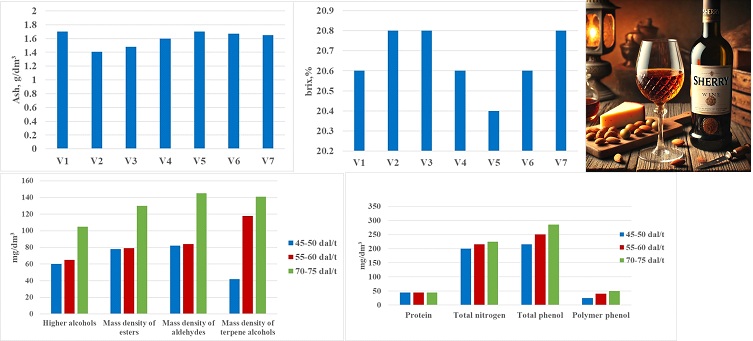
Фактори, що впливають на якість сировини для виробництва хересу, зокрема кількість соку, різні комбінації освітлювальних речовин, тривалість і перебіг бродіння, а також роль сорту винограду, не були достатньо вивчені. Було встановлено, що збільшення виходу соку з тонни винограду з 50 до 75 декалітрів призвело до збільшення вмісту альдегідів з 61,2 мг/дм³ до 86,1 мг/дм³, ефірів з 67,3 мг/дм³ до 86,7 мг/дм³, вищих спиртів на 40 мг/дм³, а терпенів – до 100 мг/дм³ в отриманому винному матеріалі. Збільшення вмісту фенольних сполук і окисно-відновного потенціалу (ОВП) спричинило окислення, нехарактерне для хересного винного матеріалу, що призвело до зниження якості. Сенсорний аналіз показав зниження показників якості на 0,02–0,10 бала. Вплив освітлювальних засобів зменшив вміст фенольних сполук і титруваних кислот, а показники кольору змінились у позитивний бік. Зразки соку ферментували як з додаванням (експериментальні), так і без додавання (контрольні) поживних добавок. Порівняно з контролем, ферментація в експериментальних зразках завершилася на 2 дні раніше. Збільшення дози діоксиду сірки, доданого до соку, з 50 мг/дм³ до 120 мг/дм³, призвело до зниження вмісту алкоголю та підвищення титруємої кислотності у ферментованих зразках. Виноматеріали, виготовлені з сортів винограду Баян, Фетяска та Ркацителі, придатні для виробництва хересу, проте з точки зору оптимального складу виноматеріал Фетяска був визнаний кращим.
Отримані результати можуть бути застосовані у сімейних виноградниках і на виноробних підприємствах.
Посилання
- Avdanina, D., Zghun, A. (2022). Sherry Wines: Worldwide Production, Chemical Composition and Screening Conception for Flor Yeasts. Fermentation, 8 (8), 381. https://doi.org/10.3390/fermentation8080381
- Durán-Guerrero, E., Castro, R., García-Moreno, M. de V., Rodríguez-Dodero, M. del C., Schwarz, M., Guillén-Sánchez, D. (2021). Aroma of Sherry Products: A Review. Foods, 10 (4), 753. https://doi.org/10.3390/foods10040753
- Guerrero-Chanivet, M., Valcárcel-Muñoz, M. J., García-Moreno, M. V., Rodríguez-Dodero, M. C., Guillén-Sánchez, D. A. (2024). Influence of the type of Sherry wine and the seasoning length of time on the organic acids, volatile compounds, and sensory profile of Brandy de Jerez. Journal of Food Composition and Analysis, 125, 105780. https://doi.org/10.1016/j.jfca.2023.105780
- Butrón-Benítez, D., Valcárcel-Muñoz, M. J., García-Moreno, M. V., Rodríguez-Dodero, M. C., Guillén-Sánchez, D. A. (2025). Influence of pH and Sulfur Dioxide in Unaged Wine Distillates on the Physicochemical and Sensory Profile of the Brandies de Jerez. Food and Bioprocess Technology, 18 (5), 4707–4722. https://doi.org/10.1007/s11947-024-03704-6
- Valcárcel-Muñoz, M. J., Guerrero-Chanivet, M., del Carmen Rodríguez-Dodero, M., Butrón-Benítez, D., de Valme García-Moreno, M., Guillén-Sánchez, D. A. (2023). Analytical and Chemometric Characterization of Sweet Pedro Ximénez Sherry Wine during Its Aging in a Criaderas y Solera System. Foods, 12 (9), 1911. https://doi.org/10.3390/foods12091911
- Sánchez-Ponce, L., Granado-Castro, M. D., Casanueva-Marenco, M. J., Galindo-Riaño, M. D., Díaz-de-Alba, M. (2021). Sherry wine industry by-product as potential biosorbent for the removal of Cr(VI) from aqueous medium. Biomass Conversion and Biorefinery, 13 (14), 12489–12507. https://doi.org/10.1007/s13399-021-02053-0
- Ruiz-Muñoz, M., Cordero-Bueso, G., Izquierdo-Cañas, P. M., Mena-Morales, A., Cantoral, J. M. (2022). Improving an Industrial Sherry Base Wine by Yeast Enhancement Strategies. Foods, 11 (8), 1104. https://doi.org/10.3390/foods11081104
- Pastor-Vega, N., Carbonero-Pacheco, J., Mauricio, J. C., Moreno, J., García-Martínez, T., Nitin, N. et al. (2023). Flor yeast immobilization in microbial biocapsules for Sherry wine production: microvinification approach. World Journal of Microbiology and Biotechnology, 39 (10). https://doi.org/10.1007/s11274-023-03713-1
- Butrón-Benítez, D., Valcárcel-Muñoz, M. J., García-Moreno, M. V., Rodríguez-Dodero, M. C., Guillén-Sánchez, D. A. (2024). Chemical and Sensory Profile of Grape Distillates Aged in Quercus alba Casks Previously Used for Sherry Wine or Brandy. Molecules, 29 (22), 5303. https://doi.org/10.3390/molecules29225303
- Guerrero-Chanivet, M., García-Moreno, M. V., Valcárcel-Muñoz, M. J., Guillén-Sánchez, D. A. (2023). Determining the impact of seasoning on the volatile chemical composition of the oak wood of different Sherry Casks® by DTD–GC–MS. Wood Science and Technology, 57 (4), 861–878. https://doi.org/10.1007/s00226-023-01478-2
- Cruces-Montes, S. J., Merchán-Clavellino, A., Romero-Moreno, A., Paramio, A. (2020). Perception of the Attributes of Sherry Wine and Its Consumption in Young People in the South of Spain. Foods, 9 (4), 417. https://doi.org/10.3390/foods9040417
- Kishkovskaya, S. A., Tanashchuk, T. N., Shalamitskiy, M. Yu., Zagoryiko, V. I., Shiryaev, M. I., Avdanina, D. A. et al. (2020). Natural Yeast Strains of Saccharomyces cerevisiae that are Promising for Sherry Production. Applied Biochemistry and Microbiology, 56 (3), 329–335. https://doi.org/10.1134/s0003683820030060
- Cordero-Bueso, G., Ruiz-Muñoz, M., Florido-Barba, A., Manuel Cantoral Fernández, J. (2023). Update on the role of Saccharomyces cerevisiae in Sherry wines. New Advances in Saccharomyces. IntechOpen. https://doi.org/10.5772/intechopen.1003733
- Sancho-Galán, P., Amores-Arrocha, A., Palacios, V., Jiménez-Cantizano, A. (2020). Identification and Characterization of White Grape Varieties Autochthonous of a Warm Climate Region (Andalusia, Spain). Agronomy, 10 (2), 205. https://doi.org/10.3390/agronomy10020205
- Cordero-Bueso, G., Ruiz-Muñoz, M., González-Moreno, M., Chirino, S., Bernal-Grande, M., Cantoral, J. (2018). The Microbial Diversity of Sherry Wines. Fermentation, 4 (1), 19. https://doi.org/10.3390/fermentation4010019
- Andreu-García, P., Jiménez-Cantizano, A., Sancho-Galán, P., Palacios, V., Castro-Mejías, R., Amores-Arrocha, A. (2023). The Use of Overripe Grapes and Their Skins for Naturally Sweet Wines Production in a Warm Climate Zone. Agronomy, 13 (11), 2686. https://doi.org/10.3390/agronomy13112686
- Fataliyev, H., Malikov, A., Lezgiyev, Y., Gadimova, N., Musayev, T., Aliyeva, G. (2024). Identifying of the wine-making potential of the autochthon madrasa grape variety of different colors and quality. Eastern-European Journal of Enterprise Technologies, 2 (11 (128)), 56–63. https://doi.org/10.15587/1729-4061.2024.302971
- Fataliyev, H., Malikov, A., Lazgiyev, Y., Haydarov, E., Agayeva, S., Baloghlanova, K. et al. (2023). Effect of maceration regime on phenolic compound quantity and color quality of madrasa wine samples. Food Science and Technology, 17 (4). https://doi.org/10.15673/fst.v17i4.2784
- Fataliyev, H., Lezgiyev, Y., Aghazade, Y., Gadimova, N., Heydarov, E., Ismailov, M. (2024). Identifying the influence of various technological techniques on the indicators of the composition of bunches and wine samples of the madras grape variety. Eastern-European Journal of Enterprise Technologies, 6 (11 (132)), 50–62. https://doi.org/10.15587/1729-4061.2024.318532
- Fataliyev, H., Aghazade, Y., Heydarov, E., Gadimova, N., Ismayilov, M., Imanova, K. (2025). Identifying the factors affecting the production of juice and wine from the autochthonous Bayanshira grape variety. Eastern-European Journal of Enterprise Technologies, 1 (11 (133)), 38–50. https://doi.org/10.15587/1729-4061.2025.323382
- Fataliyev, H., Gadimova, N., Huseynova, S., Isgandarova, S., Heydarov, E., Mammadova, S. (2024). Enrichment of functional drinks using grape pomace extracts, analysis of physicochemical indicators. Eastern-European Journal of Enterprise Technologies, 3 (11 (129)), 37–45. https://doi.org/10.15587/1729-4061.2024.307039
- Fataliyev, H., Isgandarova, S., Gadimova, N., Mammadova, A., Ismailov, M., Mammadzade, M. (2024). Identification of the effect of ripening conditions on the yield of rose hips and their processed products. Eastern-European Journal of Enterprise Technologies, 4 (11 (130)), 26–35. https://doi.org/10.15587/1729-4061.2024.309597
- Fataliyev, H., Mammadzade, M., Ismayılov, M., Gadimova, N., Mammadova, N., Musayev, T. (2025). Identifying the factors affecting the preparation of wine material from cherry fruits. Eastern-European Journal of Enterprise Technologies, 2 (11 (134)), 77–88. https://doi.org/10.15587/1729-4061.2025.326471
- Salimov, V., Huseynova, A., Guliyeva, A., Alizade, S., Mammadova, R. (2025). Assessment of Biomorphological and Economically Important Traits of some Local Grape Varieties and Clones of Azerbaijan. Advances in Biology & Earth Sciences, 10 (2). https://doi.org/10.62476/abes.102303
- Gadimova, N., Fataliyev, H., Allahverdiyeva, Z., Musayev, T., Akhundova, N., Babashli, A. (2022). Obtaining and investigation of the chemical composition of powdered malt and polymalt extracts for application in the production of non-alcoholic functional beverages. Eastern-European Journal of Enterprise Technologies, 5 (11 (119)), 66–74. https://doi.org/10.15587/1729-4061.2022.265762
- Sheskin, D. J. (2020). Handbook of Parametric and Nonparametric Statistical Procedures. Chapman and Hall/CRC, 1928. https://doi.org/10.1201/9780429186196
##submission.downloads##
Опубліковано
Як цитувати
Номер
Розділ
Ліцензія
Авторське право (c) 2025 Hasil Fataliyev, Natavan Gadimova, Azer Taghiyev, Konul Baloghlanova, Alakbar Alakbarov

Ця робота ліцензується відповідно до Creative Commons Attribution 4.0 International License.
Закріплення та умови передачі авторських прав (ідентифікація авторства) здійснюється у Ліцензійному договорі. Зокрема, автори залишають за собою право на авторство свого рукопису та передають журналу право першої публікації цієї роботи на умовах ліцензії Creative Commons CC BY. При цьому вони мають право укладати самостійно додаткові угоди, що стосуються неексклюзивного поширення роботи у тому вигляді, в якому вона була опублікована цим журналом, але за умови збереження посилання на першу публікацію статті в цьому журналі.