Determination of the influence of rosehip powder on the quality of wheat dough and bread
DOI:
https://doi.org/10.15587/2706-5448.2026.353167Keywords:
wheat bread, rosehip powder, gluten, dough ripening, quality indicatorsAbstract
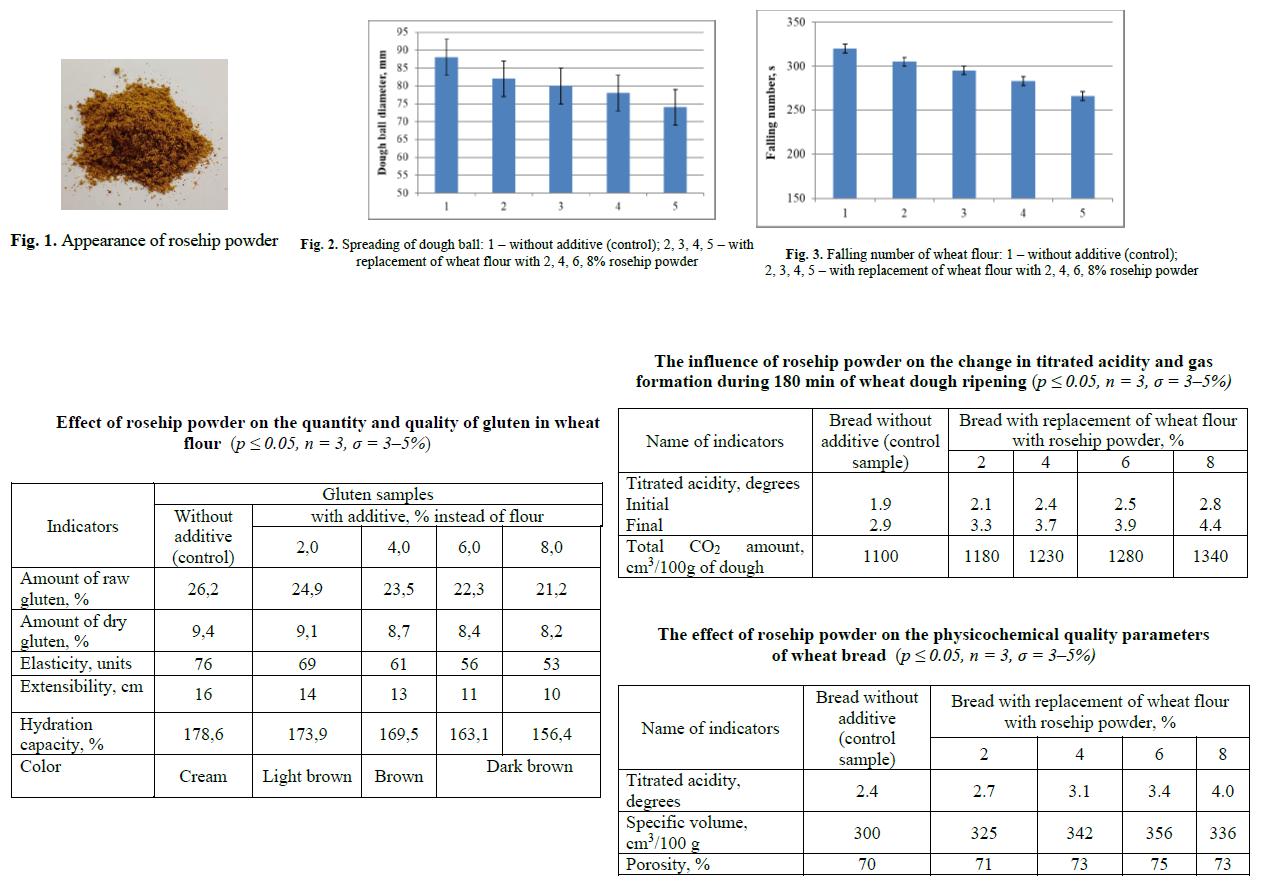
The object of the research is the technology of wheat bread. The problem of creating high-quality bakery products using natural non-traditional raw materials with a high content of physiologically functional nutrients is solved. For this purpose, it is proposed to use rosehip powder. The introduction of non-traditional raw materials into the dough affects not only the nutritional value, but also the formation of bread quality. In this regard, the work investigated the effect of rosehip powder on the properties of wheat flour, as well as the processes of dough ripening, organoleptic and physicochemical properties of products. It was found that the introduction of rosehip powder in an amount of 2.0–8.0% to replace wheat flour contributes to the strengthening of gluten, namely, increasing elasticity and reducing gluten extensibility, reducing dough spreading, and improving the gas-holding capacity of the dough. This is explained by the oxidative action of ascorbic acid, the formation of complexes of gluten protein with polyphenols and dietary fibers of rosehip powder.
It was found that in the presence of rosehip fruit powder, lactic acid and alcoholic fermentation are activated, which contributes to more intense changes in acid accumulation and gas formation in the dough due to the activation of lactic acid bacteria and baker's yeast in the presence of biologically active substances of the additive.
The use of rosehip powder in an amount of 2.0–6.0% contributes to an increase in the specific volume, porosity and elasticity of the crumb, the formation of harmonious taste and aromatic properties of products with characteristic rosehip notes. The introduction of 8.0% of the additive is not recommended, as it leads to the formation of coarser porosity, too sharp sour taste of the additive and crunch.
The results obtained can be used in the practice of baking production to develop a technology for bread of increased nutritional value using rosehip powder.
References
- Sagbas, H. I. (2023). Investigation of Fruit Quality and Biochemical Traits of Rosehip (R. canina) Ecotypes in the Aegean Region of Türkiye. Horticulturae, 9 (12), 1292. https://doi.org/10.3390/horticulturae9121292
- Peña, F., Valencia, S., Tereucán, G., Nahuelcura, J., Jiménez-Aspee, F., Cornejo, P., Ruiz, A. (2023). Bioactive Compounds and Antioxidant Activity in the Fruit of Rosehip (Rosa canina L. and Rosa rubiginosa L.). Molecules, 28 (8), 3544. https://doi.org/10.3390/molecules28083544
- Ionescu, A.-D., Voicu, G., Stefan, E.-M., Constantin, G.-A., Tudor, P., Militaru, G. (2025). Physico-Chemical and Resistance Characteristics of Rosehip Seeds. Agriculture, 15 (14), 1539. https://doi.org/10.3390/agriculture15141539
- Chrubasik, C., Roufogalis, B. D., Müller‐Ladner, U., Chrubasik, S. (2008). A systematic review on the Rosa canina effect and efficacy profiles. Phytotherapy Research, 22 (6), 725–733. https://doi.org/10.1002/ptr.2400
- Drobot, V. I. (2024) Tekhnolohiia khlibopekarskoho vyrobnytstva. Kyiv: Vydavnytstvo ProfKnyha, 516.
- Vartolomei, N., Turtoi, M. (2023). Effect of Rosehip Powder Addition on Dough Extensographic, Amylographic and Rheofermentographic Properties and Sensory Attributes of Bread. Processes, 11 (4), 1088. https://doi.org/10.3390/pr11041088
- Vartolomei, N., Turtoi, M. (2021) The influence of the addition of rosehip powder to wheat flour on the dough farinographic properties and bread physico-chemical characteristics. Applied Sciences, 11 (24), 12035. https://doi.org/10.3390/app112412035
- Boz, H., Murat Karaoğlu, M., Gürbüz Kotancilar, H., Emre Gerçekaslan, K. (2010). The effects of different materials as dough improvers for organic whole wheat bread. International Journal of Food Science & Technology, 45 (7), 1472–1477. https://doi.org/10.1111/j.1365-2621.2010.02289.x
- Ivanova, P., Chochkov, R., Zlateva, D., Stefanova, D. (2023) Total phenolic and flavonoid content, and antioxidant activity of wheat bread enriched with pumpkin, chestnut and rosehip flour. Carpathian Journal of Food Science and Technology. 15 (2), 33–41. https://doi.org/10.34302/crpjfst/2023.15.2.4
- Chochkov, R., Zlateva, D., Ivanova, P., Stefanova, D. (2022). Effect of rosehip flour on the properties of wheat dough and bread. Ukrainian Food Journal, 11 (4), 558–572. https://doi.org/10.24263/2304-974x-2022-11-4-6
- Oliinyk, S., Samokhvalova, O., Lapitskaya, N. (2019). The influence of meal of rose hips on the ripening and quality of rye-wheat bread. Scientific Works of National University of Food Technologies, 25 (6), 249–258. https://doi.org/10.24263/2225-2924-2019-25-6-31
- Oliinyk, S., Samokhvalova, O., Lapitska, N., Kucheruk, Z. (2020). Studying the influence of meats from wheat and oat germs, and rose hips, on the formation of quality of ryew heat dough and bread. Eastern-European Journal of Enterprise Technologies, 1 (11 (103)), 59–65. https://doi.org/10.15587/1729-4061.2020.187944
- Lapytska, Н., Syza, О., Gorodyska, О., Savchenko, О., Rebenok, E. (2022). The impact of rosehip oil on quality of rye-wheat bread. Biota. Human. Technology, 2, 106–117. https://doi.org/10.58407/bht.2.22.8
- Gül, H., Șen, H. (2017). The influence of rosehip seed flour on bread quality. Scientific Bulletin. Biotechnologies. F, 21, 336–342. Available at: http://biotechnologyjournal.usamv.ro/pdf/2017/vol2017.pdf
- Lebedenko, T., Korkach, H., Kozhevnikova, V., Novichkova, T. (2019). Methods of regulating physical properties of dough using phytoextracts. Food Science and Technology, 12 (4), 52–62. https://doi.org/10.15673/fst.v12i4.1182
- Pop, I.-A., Dossa, S., Stoin, D., Neagu, C., Moigradean, D., Alexa, E., Poiana, M.-A. (2025). Nutritional, Rheological, and Functional Assessment in the Development of Bread Using Chestnut and Rosehip-Fortified Wheat Flour. Foods, 14 (19), 3343. https://doi.org/10.3390/foods14193343
- Alashbayeva, L., Kenzhekhojayev, M., Borankulova, A., Muldabekova, B., Yakiyayeva, M., Tursunbayeva, S., Dyusembaeva, Z. (2024). Enhancing the quality of wholemeal bread with chia, sesame, and rosehip: mathematical modelling and organoleptic analysis. Potravinarstvo Slovak Journal of Food Sciences, 18, 993–1005. https://doi.org/10.5219/2006
- Drobot, V. I. (2015). Tekhnokhimichnyi kontrol syrovyny ta khlibobulochnykh i makaronnykh vyrobiv. Kyiv: Kondor-Vydavnytstvo, 972.
- Drobot, V. I. (2006). Laboratornyi praktykum z tekhnolohii khlibopekarskoho i makaronnoho vyrobnytstva. Kyiv: Tsentr navchalnoi literatury, 341.
- Drobot, V. I. (2019). Dovidnyk z tekhnolohii khlibopekarskoho vyrobnytstva. Dovidnyk. Kyiv: ProfKnyha, 580.
- Oliinyk, S., Samokhvalova, O.; Gubsky, S., Stabnikova, O., Stabnikov, V., Paredes-López, O. (Eds.) (2025). Wild Edible Plants Used in Bakery Production. Wild Edible Plants. CRC Press, 268–293. https://doi.org/10.1201/9781003486794-10
- Elkassabany, M., Hoseney, R. C. (1980). Ascorbic acid as an oxidant in wheat flour dough. II. Rheological effects. Cereal Chemistry, 57 (2), 88–91. Available at: https://www.cerealsgrains.org/publications/cc/backissues/1980/Documents/chem57_88.pdf
- Samokhvalova, O. V., Chernikova, Yu. O., Oliinyk, S. H., Kasabova, K. R. (2015). The effect of microbial polysaccharides on the properties of wheat flour. Eastern-European Journal of Enterprise Technologies, 6 (10 (77)), 11–15. https://doi.org/10.15587/1729-4061.2015.56177
- Welc-Stanowska, R., Kłosok, K., Nawrocka, A. (2023). Effects of gluten-phenolic acids interaction on the gluten structure and functional properties of gluten and phenolic acids. Journal of Cereal Science, 111, 103682. https://doi.org/10.1016/j.jcs.2023.103682
- Krekora, M., Miś, A., Nawrocka, A. (2021). Molecular interactions between gluten network and phenolic acids studied during overmixing process with application of FT-IR spectroscopy. Journal of Cereal Science, 99, 103203. https://doi.org/10.1016/j.jcs.2021.103203
- Du, J., Dang, M., Khalifa, I., Du, X., Xu, Y., Li, C. (2020). Persimmon tannin changes the properties and the morphology of wheat gluten by altering the cross-linking, and the secondary structure in a dose-dependent manner. Food Research International, 137, 109536. https://doi.org/10.1016/j.foodres.2020.109536
- Wu, Y., Liu, Y., Jia, Y., Zhang, H., Ren, F. (2024). Formation and Application of Starch–Polyphenol Complexes: Influencing Factors and Rapid Screening Based on Chemometrics. Foods, 13 (10), 1557. https://doi.org/10.3390/foods13101557
Downloads
Published
How to Cite
Issue
Section
License
Copyright (c) 2026 Bohdan Bilash, Svitlana Oliinyk, Olga Samokhvalova, Olena Bolkhovitina

This work is licensed under a Creative Commons Attribution 4.0 International License.
The consolidation and conditions for the transfer of copyright (identification of authorship) is carried out in the License Agreement. In particular, the authors reserve the right to the authorship of their manuscript and transfer the first publication of this work to the journal under the terms of the Creative Commons CC BY license. At the same time, they have the right to conclude on their own additional agreements concerning the non-exclusive distribution of the work in the form in which it was published by this journal, but provided that the link to the first publication of the article in this journal is preserved.