Justification of the use of a technological food additive with transglutaminase for stabilization of mince systems of cooked sausage products
DOI:
https://doi.org/10.15587/2706-5448.2026.357682Keywords:
meat products, minced meat systems, transglutaminase, structure stabilization, hydrocolloids, emulsion sausagesAbstract
The object of the research is the technology for producing minced meat products using a functional additive. The need to form stable technological and structural indicators of emulsion sausages requires a comprehensive solution consisting in combining structure-forming raw materials of different origins.
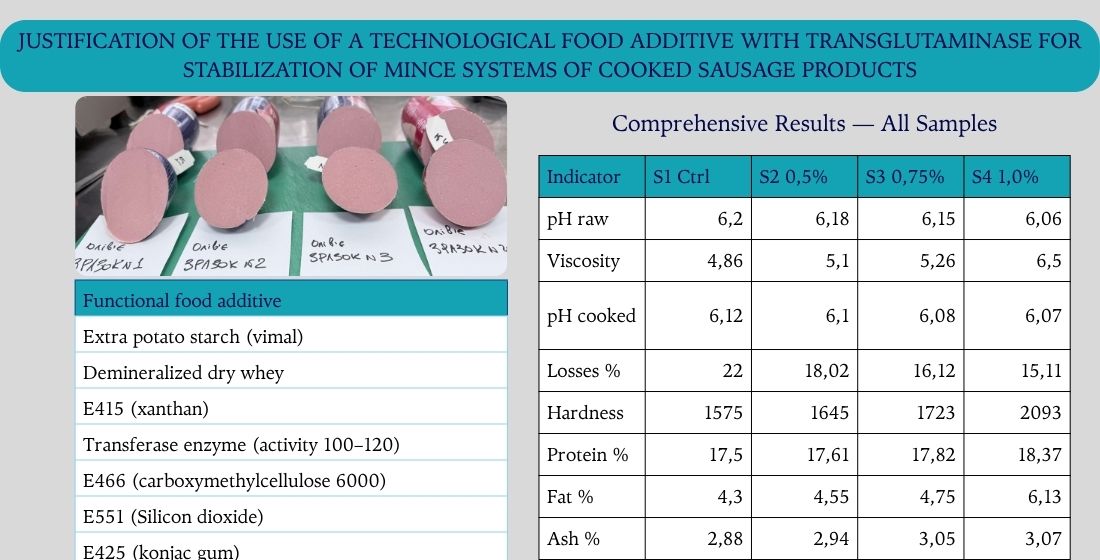
Cooked sausage “Olivier” minced systems were developed using a functional system consisting of transferase, hydrocolloids and a protein-containing additive. As a research result of minced meat systems, it was determined that the viscosity of the resulting minced meat increases with an increase in the content of the functional additive. This indicates an increase in intermolecular interaction and compaction of the protein matrix. A comprehensive assessment of active acidity before and after heat treatment indicates the possibility of stabilizing this indicator with enzymatic action on the raw materials. The textural characteristics of the finished product show a similar pattern, so the hardness of the sample without the use of the additive was 1575 g/cm2, and when using 1% of the additive it increased by 32.9% and amounted to 2093 g/cm2. Also heat treatment losses decreased from 22.00% to 15.11%.
The use of hydrocolloids and transglutaminase makes it possible to increase the protein and fat content in the products due to the formation of a strong matrix, which significantly reduces losses during heat treatment and prevents phase separation.
The obtained results made it possible to establish the relationship between the contraction of the technological additive with transglutaminase on the structural- mechanical indicators and chemical composition of minced systems. The practical value of the work lies in the possibility of using an ingredient complex to increase stability of minced systems, optimize the technological process and reduce losses.
References
- Marynin, A., Shpak, V., Pasichnyi, V., Svyatnenko, R., Shubina, Y. (2023). Physico-chemical and rheological properties of meat pates with corn starch suspensions prepared on electrochemically activated water. Ukrainian Food Journal, 12 (2). https://doi.org/10.24263/2304-974x-2023-12-2-5
- Fadeyibi, A. (2022). Modeling Rheological Behavior of Beef based on Time-Dependent Deformation and Packaging. Gazi University Journal of Science, 35 (3), 997–1008. https://doi.org/10.35378/gujs.742087
- Schreuders, F. K. G., Schlangen, M., Kyriakopoulou, K., Boom, R. M., van der Goot, A. J. (2021). Texture methods for evaluating meat and meat analogue structures: A review. Food Control, 127, 108103. https://doi.org/10.1016/j.foodcont.2021.108103
- Wang, H., Lin, X., Zhu, J., Yang, Y., Qiao, S., Jiao, B. et al. (2023). Encapsulation of lutein in gelatin type A/B-chitosan systems via tunable chains and bonds from tweens: Thermal stability, rheologic property and food 2D/3D printability. Food Research International, 173, 113392. https://doi.org/10.1016/j.foodres.2023.113392
- Rudiuk, V., Pasichnyi, V. (2023). Assessment of function-technological and rheological parameters of consistency stabilisers for dairy protein-fat systems for the production of semi-smoked sausages. Technology Audit and Production Reserves, 3 (3 (71)), 41–45. https://doi.org/10.15587/2706-5448.2023.283465
- Ciobanu, M.-M., Manoliu, D.-R., Ciobotaru, M. C., Flocea, E.-I., Boișteanu, P.-C. (2025). Dietary Fibres in Processed Meat: A Review on Nutritional Enhancement, Technological Effects, Sensory Implications and Consumer Perception. Foods, 14 (9), 1459. https://doi.org/10.3390/foods14091459
- Zhang, C., He, Y., Zheng, Y., Ai, C., Cao, H., Xiao, J. et al. (2023). Effect of carboxymethyl cellulose (CMC) on some physico-chemical and mechanical properties of unrinsed surimi gels. LWT, 180, 114653. https://doi.org/10.1016/j.lwt.2023.114653
- Shao, J., Zhang, C., Ai, Y., Wang, H., Han, Y., Hou, W. (2025). Effects of pre-gelatinized whole Pueraria powder on the properties of duck meat sausages: Insights into gelatinization and molecular interactions. Food Chemistry, 493, 146020. https://doi.org/10.1016/j.foodchem.2025.146020
- Montes, L., Rosell, C. M., Moreira, R. (2022). Rheological Properties of Corn Starch Gels With the Addition of Hydroxypropyl Methylcellulose of Different Viscosities. Frontiers in Nutrition, 9. https://doi.org/10.3389/fnut.2022.866789
- Kalsi, G., Hazarika, U., Baruah, L. D., Bordoloi, P. L., Gogoi, M. (2025). Comprehensive review of carrageenan’s multifaceted role in health and food systems. Discover Food, 5 (1). https://doi.org/10.1007/s44187-025-00405-7
- Stabnikova, O., Marinin, A., Stabnikov, V. (2021). Main trends in application of novel natural additives for food production. Ukrainian Food Journal, 10 (3), 524–551. https://doi.org/10.24263/2304-974x-2021-10-3-8
- Svishchova, Y., Sachko, A., Gubsky, S., Stabnikova, O., Paredes-López, O. (2025). Structural and rheological behaviour of mayonnaise-type emulsions containing aquafaba and functional oil blends. Ukrainian Food Journal, 14 (4), 683–697. https://doi.org/10.24263/2304-974x-2025-14-4-7
- Woo, M., Jo, K., Kim, S., Han, S., Choi, Y.-S., Kang, T. et al. (2025). Agar-based composite emulsion gel as a pork fat substitute in sausages: Understanding meat batter stabilization mechanisms based on fat sources. International Journal of Biological Macromolecules, 318, 144851. https://doi.org/10.1016/j.ijbiomac.2025.144851
- Strashynskiy, I., Fursik, O., Pasichniy, V., Marynin, A., Goncharov, G. (2016). Influence of functional food composition on the properties of meat mince systems. Eastern-European Journal of Enterprise Technologies, 6 (11 (84)), 53–58. https://doi.org/10.15587/1729-4061.2016.86957
- Lin, W., Barbut, S. (2025). Effects of 0–12% soy proteins (four texturized and one isolate) on a lean hybrid meat system: cooking loss, texture, dynamic rheology, microstructure, and T2 NMR. Applied Food Research, 5 (1), 100747. https://doi.org/10.1016/j.afres.2025.100747
- Bozhko, N., Pasichnyi, V., Tischenko, V., Marynin, A., Shubina, Y., Strashynskyi, I. (2021). Determining the nutritional value and quality indicators of meat-containing bread made with hemp seeds flour (Cannabis sativa L.). Eastern-European Journal of Enterprise Technologies, 4 (11 (112)), 58–65. https://doi.org/10.15587/1729-4061.2021.237806
- Pasichniy, V., Marynin, A., Moroz, E., Geredchuk, A. (2015). Development of combined protein-fat emulsions for sausage and semifinished products with poultry meat. Eastern-European Journal of Enterprise Technologies, 1 (6 (73)), 32–38. https://doi.org/10.15587/1729-4061.2015.36232
- Baechle, M., Via, M. A., Clausen, M. P., Vilgis, T. A. (2025). Function of Different Emulsifiers in Spreadable Meat Emulsions: A Systematic Study of Physical Properties. Food Biophysics, 20 (2). https://doi.org/10.1007/s11483-025-09941-2
- Youssef, M. K., Barbut, S. (2011). Effects of two types of soy protein isolates, native and preheated whey protein isolates on emulsified meat batters prepared at different protein levels. Meat Science, 87 (1), 54–60. https://doi.org/10.1016/j.meatsci.2010.09.002
- Topchii, O., Pasichnyi, V., Marynin, A., Stabnikova, O. (2023). Biotransformation of Collagen-Containing Meat Materials into Valuable Product. Bioconversion of Wastes to Value-Added Products, 37–68. https://doi.org/10.1201/9781003329671-2
- Anaduaka, E. G., Chibuogwu, C. C., Ezugwu, A. L., Ezeorba, T. P. C. (2023). Nature-derived ingredients as sustainable alternatives for tenderizing meat and meat products: an updated review. Food Biotechnology, 37 (2), 136–165. https://doi.org/10.1080/08905436.2023.2201354
- Ivanov, V., Shevchenko, O., Marynin, A., Stabnikov, V., Gubenia, O., Stabnikova, O. et al. (2021). Trends and expected benefits of the breaking edge food technologies in 2021–2030. Ukrainian Food Journal, 10 (1), 7–36. https://doi.org/10.24263/2304-974x-2021-10-1-3
- Akbari, M., Razavi, S. H., Kieliszek, M. (2021). Recent advances in microbial transglutaminase biosynthesis and its application in the food industry. Trends in Food Science & Technology, 110, 458–469. https://doi.org/10.1016/j.tifs.2021.02.036
- Lv, Y., Tang, T., Xu, L., Wang, J., Su, Y., Li, J. et al. (2022). Influence of soybean dietary fiber with varying particle sizes and transglutaminase on soy protein isolate gel. Food Research International, 161, 111876. https://doi.org/10.1016/j.foodres.2022.111876
- Wang, Q., Sun, Y., Shao, J., Lv, B., Yu, Z., Zhao, S., Li, C. (2021). Tetrasodium pyrophosphate promotes light meromyosin crosslinking by microbial transglutaminase. Food Chemistry, 346, 128910. https://doi.org/10.1016/j.foodchem.2020.128910
- Feng, Y., Li, X., Zhao, Z., Kong, B., Cao, C., Sun, F. et al. (2025). Underlying the interactions in myofibrillar proteins and κ-carrageenan mixed sols as mediated by microbial transglutaminase based on conformational alterations, rheological behavior and molecular docking. Food Hydrocolloids, 165, 111253. https://doi.org/10.1016/j.foodhyd.2025.111253
- Shevchenko, I., Haschuk, O., Moskaliuk, O., Kharchenko, Y. (2025). Effect of transglutaminase on quality characteristics of two-structure cooked-smoked sausages. Ukrainian Food Journal, 14 (4), 698–712. https://doi.org/10.24263/2304-974x-2025-14-4-8
- Yang, L., Yang, L., Feng, X., Xiao, Y., Tian, X., Huang, W., Liu, Y. (2025). Effects of ultrasound-assisted extraction and transglutaminase treatment on the physicochemical properties of protein from Stropharia rugosoannulata. Ultrasonics Sonochemistry, 122, 107637. https://doi.org/10.1016/j.ultsonch.2025.107637
- Ersöz, F., Aykin Dinçer, E., Özçelik, A. T., İnan, M. (2021). Rekombinant Transglutaminazın Pişmiş Sığır Köftelerinin Kalite Özelliklerine Etkisi. Kafkas Universitesi Veteriner Fakultesi Dergisi. https://doi.org/10.9775/kvfd.2020.25080
- Fudali, A., Chełmecka, I., Salejda, A. M., Krasnowska, G. (2021). Microbiological Safety and Organoleptic Quality of Homogenized Sausages Manufactured with Commercial Functional Additives. Applied Sciences, 11 (24), 11662. https://doi.org/10.3390/app112411662
- Han, M., Bertram, H. C. (2017). Designing healthier comminuted meat products: Effect of dietary fibers on water distribution and texture of a fat-reduced meat model system. Meat Science, 133, 159–165. https://doi.org/10.1016/j.meatsci.2017.07.001
Downloads
Published
How to Cite
Issue
Section
License
Copyright (c) 2026 Vasyl Pasichnyi, Andrii Marynin, Sergii Iepishkin, Yevheniia Shubina, Olena Moroz

This work is licensed under a Creative Commons Attribution 4.0 International License.
The consolidation and conditions for the transfer of copyright (identification of authorship) is carried out in the License Agreement. In particular, the authors reserve the right to the authorship of their manuscript and transfer the first publication of this work to the journal under the terms of the Creative Commons CC BY license. At the same time, they have the right to conclude on their own additional agreements concerning the non-exclusive distribution of the work in the form in which it was published by this journal, but provided that the link to the first publication of the article in this journal is preserved.