Assessment of the effect of rosehip powder on the structural and mechanical properties of wheat dough and bread
DOI:
https://doi.org/10.15587/2706-5448.2026.358699Keywords:
bread, dough, rosehip powder, structural and mechanical properties, specific volumeAbstract
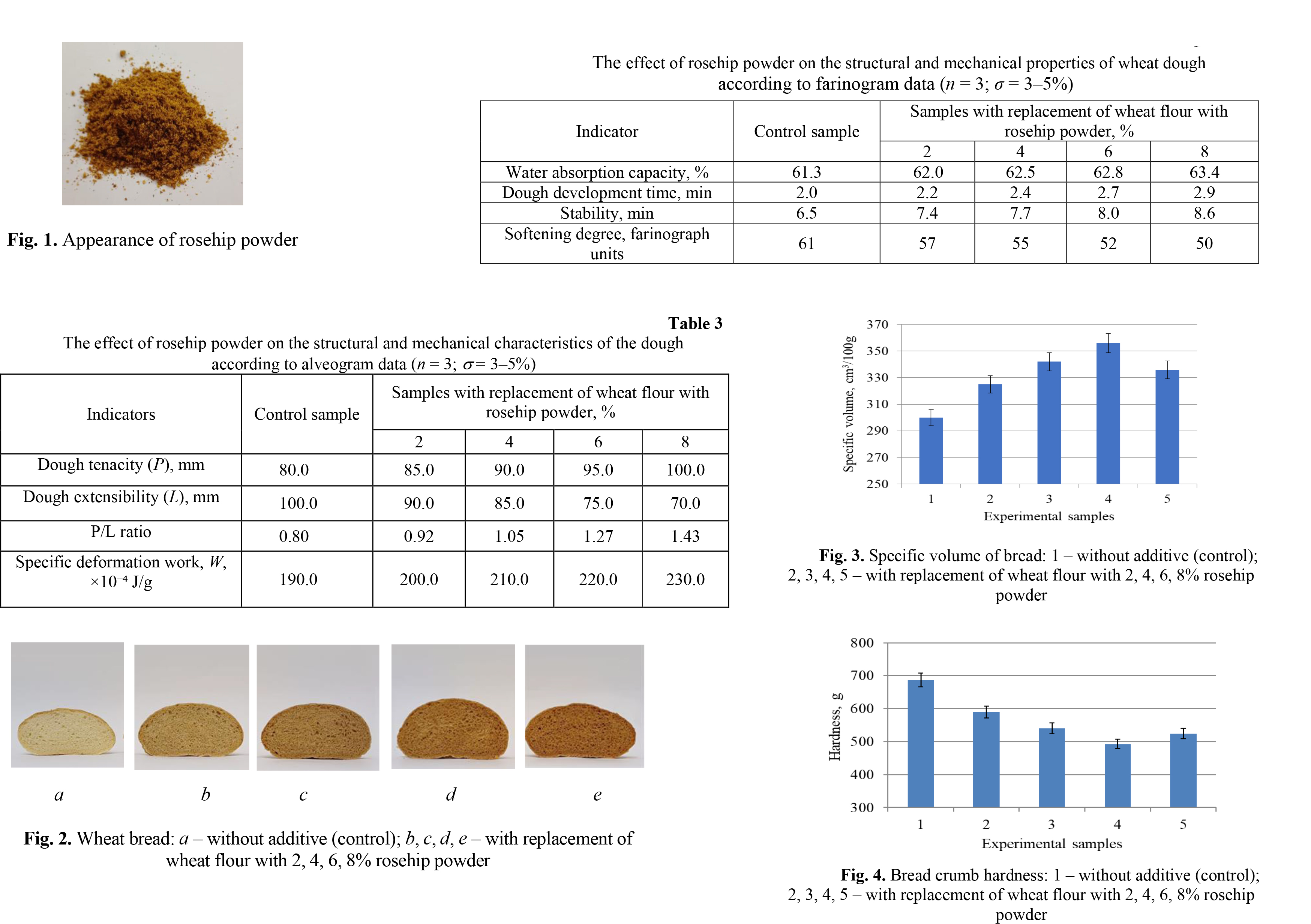
The object of research is dough and bread made from wheat flour with the addition of rosehip powder. Its use in bread technology is considered as a promising direction for improving the quality of dough and finished products due to the natural content of biologically active substances in rosehip. The problem of insufficient knowledge of the effect of whole rosehip powder on the structural and mechanical properties of dough and bread is solved by conducting comprehensive studies using modern methods. According to the results of farinographic studies, it was found that the introduction of 2–8% rosehip powder contributes to an increase in the water absorption capacity of the dough and an extension of its formation time. At the same time, an increase in dough stability by 13.8–32.3% and a decrease in the degree of dilution by 6.6–18.0% compared to the control sample are observed, which indicates the strengthening of the structural and mechanical properties of the dough and its increased resistance to mechanical stress during kneading. Alveographic analysis also confirmed the strengthening of the dough structure: its tenacity increases, extensibility decreases, and the specific work of deformation increases by 5.3–21.1%. This is due to the strengthening of the gluten complex of wheat flour under the action of ascorbic acid, non-starch polysaccharides and polyphenolic compounds contained in rosehip powder.
It was established that the introduction of rosehip powder in an amount of 2–6% of the flour mass contributed to the improvement of the structure of the products, which is manifested in an increase in the specific volume of bread by 12.0–22.8% and a decrease in the hardness of its crumb by 14.1–28.2%. Increasing the additive content to 8% leads to a decrease in the improving effect, but the experimental indicators remain higher than the control ones.
The results obtained can be used in the practice of baking production during the development of bread technology with increased nutritional value and quality.
References
- Peña, F., Valencia, S., Tereucán, G., Nahuelcura, J., Jiménez-Aspee, F., Cornejo, P. et al. (2023). Bioactive Compounds and Antioxidant Activity in the Fruit of Rosehip (Rosa canina L. and Rosa rubiginosa L.). Molecules, 28 (8), 3544. https://doi.org/10.3390/molecules28083544
- Ahmad, N., Anwar, F., Gilani, A.-U.-H. (2016). Rose Hip (Rosa canina L.) Oils. Essential Oils in Food Preservation, Flavor and Safety, 667–675. https://doi.org/10.1016/b978-0-12-416641-7.00076-6
- Paunović, D., Kalušević, A., Petrović, T., Urošević, T., Djinović, D., Nedović, V. et al. (2018). Assessment of Chemical and Antioxidant Properties of Fresh and Dried Rosehip (Rosa canina L.). Notulae Botanicae Horti Agrobotanici Cluj-Napoca, 47 (1), 108–113. https://doi.org/10.15835/nbha47111221
- Chrubasik, C., Roufogalis, B. D., Müller‐Ladner, U., Chrubasik, S. (2008). A systematic review on the Rosa canina effect and efficacy profiles. Phytotherapy Research, 22 (6), 725–733. https://doi.org/10.1002/ptr.2400
- Patel, S. (2012). Rose hips as complementary and alternative medicine: overview of the present status and prospects. Mediterranean Journal of Nutrition and Metabolism, 6 (2), 89–97. https://doi.org/10.1007/s12349-012-0118-7
- Zhou, M., Sun, Y., Luo, L., Pan, H., Zhang, Q., Yu, C. (2023). Road to a bite of rosehip: A comprehensive review of bioactive compounds, biological activities, and industrial applications of fruits. Trends in Food Science & Technology, 136, 76–91. https://doi.org/10.1016/j.tifs.2023.04.006
- Mahsa, S., Mania, S., Saeed, B. (2022). Optimization of oxidative improver’s formulation for the wheat flours with different extraction rates. International Journal of Agricultural Science and Food Technology, 8 (1), 1–10. https://doi.org/10.17352/2455-815x.000137
- Drobot, V. I. (2024). Tekhnolohiia khlibopekarskoho vyrobnytstva. Kyiv: Vydavnytstvo ProfKnyha, 516. Available at: https://surl.li/dwijil
- Vartolomei, N., Turtoi, M. (2023). Effect of Rosehip Powder Addition on Dough Extensographic, Amylographic and Rheofermentographic Properties and Sensory Attributes of Bread. Processes, 11 (4), 1088. https://doi.org/10.3390/pr11041088
- Vartolomei, N., Turtoi, M. (2021). The Influence of the Addition of Rosehip Powder to Wheat Flour on the Dough Farinographic Properties and Bread Physico-Chemical Characteristics. Applied Sciences, 11 (24), 12035. https://doi.org/10.3390/app112412035
- Boz, H., Murat Karaoğlu, M., Gürbüz Kotancilar, H., Emre Gerçekaslan, K. (2010). The effects of different materials as dough improvers for organic whole wheat bread. International Journal of Food Science & Technology, 45 (7), 1472–1477. https://doi.org/10.1111/j.1365-2621.2010.02289.x
- Ivanova, P., Chochkov, R., Zlateva, D., Stefanova, D. (2023). Total phenolic and flavonoid content and antioxidant activity of wheat bread enriched with pumpkin, chestnut and rosehip flour. Carpathian Journal of Food Science and Technology, 15 (2), 33–41. https://doi.org/10.34302/crpjfst/2023.15.2.4
- Chochkov, R., Zlateva, D., Ivanova, P., Stefanova, D. (2022). Effect of rosehip flour on the properties of wheat dough and bread. Ukrainian Food Journal, 11 (4), 558–572. https://doi.org/10.24263/2304-974x-2022-11-4-6
- Lapytska, N., Syza, O., Gorodyska, O., Savchenko, O., Rebenok, E. (2022). The impact of rosehip oil on quality of rye-wheat bread. Biota. Human. Technology, 2, 106–117. https://doi.org/10.58407/bht.2.22.8
- Oliinyk, S., Samokhvalova, O., Lapitskaya, N. (2019). The influence of meal of rose hips on the ripening and quality of rye-wheat bread. Scientific Works of National University of Food Technologies, 25 (6), 249–258. https://doi.org/10.24263/2225-2924-2019-25-6-31
- Oliinyk, S., Samokhvalova, O., Lapitska, N., Kucheruk, Z. (2020). Studying the influence of meats from wheat and oat germs, and rose hips, on the formation of quality of ryew heat dough and bread. Eastern-European Journal of Enterprise Technologies, 1 (11 (103)), 59–65. https://doi.org/10.15587/1729-4061.2020.187944
- Gül, H., Șen, H. (2017). The influence of rosehip seed flour on bread quality. Scientific Bulletin. Biotechnologies, 21, 336–342. Available at: https://biotechnologyjournal.usamv.ro/pdf/2017/Art54.pdf
- Cingöz, A., Şahin, N. (2023). Determination of Rheological and Chemical Properties of Hemp, Rosehip Seed and Safflower Flours. Tarım Bilimleri Dergisi, 29 (4), 914–923. https://doi.org/10.15832/ankutbd.1178258
- Sanfilippo, R., Canale, M., Fascella, G., Scarangella, M., Strano, M. C., Mangione, G. et al. (2025). Nutritional and technological characterization of rosehip seed flours as a functional ingredient in common wheat bread. European Food Research and Technology, 251 (6), 1033–1045. https://doi.org/10.1007/s00217-025-04686-1
- Alashbayeva, L., Kenzhekhojayev, M., Borankulova, A., Muldabekova, B., Yakiyayeva, M., Tursunbayeva, S. et al. (2024). Enhancing the quality of wholemeal bread with chia, sesame, and rosehip: mathematical modelling and organoleptic analysis. Potravinarstvo Slovak Journal of Food Sciences, 18, 993–1005. https://doi.org/10.5219/2006
- Pop, I.-A., Dossa, S., Stoin, D., Neagu, C., Moigradean, D., Alexa, E. et al. (2025). Nutritional, Rheological, and Functional Assessment in the Development of Bread Using Chestnut and Rosehip-Fortified Wheat Flour. Foods, 14 (19), 3343. https://doi.org/10.3390/foods14193343
- Drobot, V. I. (2015). Tekhnokhimichnyi kontrol syrovyny ta khlibobulochnykh i makaronnykh vyrobiv. Kyiv: Kondor, 958. Available at: https://surl.li/rzgiga
- Bourne, M. C. (2002). Food texture and viscosity: Concept and measurement. Academic Press. Available at: https://library.agnescameron.info/industrial%20food%20production/Food%20Texture%20and%20Viscosity,%20Malcolm%20Bourne.pdf
- Samokhvalova, O. V., Chernikova, Yu. O., Oliinyk, S. H., Kasabova, K. R. (2015). The effect of microbial polysaccharides on the properties of wheat flour. Eastern-European Journal of Enterprise Technologies, 6 (10 (78)), 11–15. https://doi.org/10.15587/1729-4061.2015.56177
- Nađpal, J. D., Lesjak, M. M., Šibul, F. S., Anačkov, G. T., Četojević-Simin, D. D., Mimica-Dukić, N. M. et al. (2016). Comparative study of biological activities and phytochemical composition of two rose hips and their preserves: Rosa canina L. and Rosa arvensis Huds. Food Chemistry, 192, 907–914. https://doi.org/10.1016/j.foodchem.2015.07.089
- Welc-Stanowska, R., Kłosok, K., Nawrocka, A. (2023). Effects of gluten-phenolic acids interaction on the gluten structure and functional properties of gluten and phenolic acids. Journal of Cereal Science, 111, 103682. https://doi.org/10.1016/j.jcs.2023.103682
- Krekora, M., Miś, A., Nawrocka, A. (2021). Molecular interactions between gluten network and phenolic acids studied during overmixing process with application of FT-IR spectroscopy. Journal of Cereal Science, 99, 103203. https://doi.org/10.1016/j.jcs.2021.103203
Downloads
Published
How to Cite
Issue
Section
License
Copyright (c) 2026 Bohdan Bilash, Olga Samokhvalova, Svitlana Oliinyk, Olena Bolkhovitina, Nataliia Cherevychna

This work is licensed under a Creative Commons Attribution 4.0 International License.
The consolidation and conditions for the transfer of copyright (identification of authorship) is carried out in the License Agreement. In particular, the authors reserve the right to the authorship of their manuscript and transfer the first publication of this work to the journal under the terms of the Creative Commons CC BY license. At the same time, they have the right to conclude on their own additional agreements concerning the non-exclusive distribution of the work in the form in which it was published by this journal, but provided that the link to the first publication of the article in this journal is preserved.